
Introduction
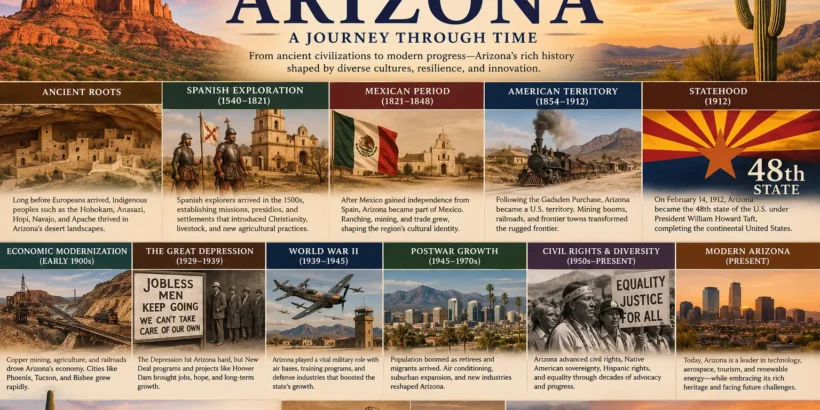
Arizona is one of the most fascinating states in the United States. Known for its breathtaking deserts, towering saguaro cacti, spectacular canyons, and vibrant sunsets, Arizona attracts millions of visitors every year. Yet behind its natural beauty lies a rich and complex history that stretches back thousands of years.
The history of Arizona is a story of ancient civilizations, Indigenous cultures, Spanish exploration, Mexican governance, American expansion, frontier conflicts, economic development, and eventual statehood. It is a history shaped by resilience, survival, cultural exchange, and sometimes conflict.
Long before Arizona became the 48th state of the United States in 1912, the region was home to sophisticated Native American societies that developed remarkable agricultural systems and thriving communities in one of North America’s most challenging environments.
This article explores the complete history of Arizona, tracing its journey from prehistoric civilizations to modern statehood.
The Geography of Arizona and Its Historical Importance
Arizona is located in the southwestern United States and shares borders with California, Nevada, Utah, New Mexico, Colorado, and Mexico.
The state’s diverse geography includes:
- The Sonoran Desert
- The Colorado Plateau
- The Grand Canyon
- Mountain ranges
- Fertile river valleys
This unique geography played a major role in shaping Arizona’s history. While deserts presented significant challenges, rivers and fertile valleys enabled early civilizations to flourish.
The region also became a strategic crossroads connecting North America and Mesoamerica, facilitating trade, migration, and cultural exchange for centuries.
The First Inhabitants of Arizona
Early Human Settlement
Archaeological evidence suggests that humans have lived in Arizona for more than 12,000 years.
The earliest inhabitants were hunter-gatherers who followed large Ice Age animals across North America. These early peoples adapted to changing climates and eventually developed permanent settlements.
Over thousands of years, Arizona became home to numerous Indigenous cultures, each contributing to the region’s unique heritage.
The Hohokam Civilization
Origins of the Hohokam
One of Arizona’s most remarkable ancient civilizations was the Hohokam culture.
The Hohokam emerged around 300 CE and thrived in central and southern Arizona for over a thousand years.
The name “Hohokam” comes from the O’odham language and roughly means “those who have gone before.”
Engineering Marvels
The Hohokam are best known for constructing one of the most sophisticated irrigation systems in ancient North America.
Using simple tools and remarkable engineering skills, they built hundreds of miles of canals that diverted water from rivers to agricultural fields.
These irrigation systems allowed them to cultivate:
- Corn
- Beans
- Squash
- Cotton
- Tobacco
The canal networks transformed Arizona’s arid landscape into productive farmland.
Some modern canals in the Phoenix area follow routes originally established by the Hohokam.
Trade and Culture
The Hohokam maintained extensive trade networks reaching:
- Mexico
- California
- New Mexico
Artifacts discovered by archaeologists include:
- Copper bells
- Seashell jewelry
- Pottery
- Stone tools
These discoveries demonstrate the civilization’s economic and cultural sophistication.
The Ancestral Puebloans
Northern Arizona Settlements
Another influential culture in Arizona was the Ancestral Puebloan civilization.
Previously known as the Anasazi, these people inhabited northern Arizona and surrounding regions.
They became famous for constructing impressive:
- Cliff dwellings
- Stone villages
- Multi-story structures
Many of these architectural wonders can still be visited today.
Agricultural Innovation
The Ancestral Puebloans developed farming methods adapted to Arizona’s challenging environment.
They cultivated crops using:
- Rainwater collection
- Terraced fields
- Advanced storage techniques
These innovations allowed them to support growing populations despite limited water resources.
The Mogollon Culture
The Mogollon culture occupied eastern Arizona and neighboring regions.
They developed distinct traditions involving:
- Pottery production
- Agriculture
- Trade
The Mogollon contributed significantly to the cultural foundations of the American Southwest.
Their influence can still be observed in archaeological sites across Arizona.
The Mystery of Ancient Civilizations
Why Did They Disappear?
One of Arizona’s greatest historical mysteries concerns the decline of its ancient civilizations.
By approximately the 1400s, many large settlements had been abandoned.
Researchers propose several explanations:
Climate Change
Extended droughts may have reduced agricultural productivity.
Resource Depletion
Growing populations could have strained available resources.
Social Conflict
Competition for water and farmland may have led to conflicts.
Migration
Some communities may have relocated to more favorable regions.
Although the exact reasons remain debated, descendants of these cultures continue to live throughout the Southwest today.
Indigenous Nations Before European Contact
Before Europeans arrived, Arizona was home to many Indigenous nations.
These included:
- Apache
- Navajo
- Hopi
- O’odham
- Yavapai
- Havasupai
- Zuni
Each nation possessed unique traditions, languages, governance systems, and spiritual beliefs.
These communities maintained complex relationships involving trade, diplomacy, and occasional conflict.
The Arrival of Europeans
Spanish Exploration Begins
European involvement in Arizona began during the 16th century.
Spanish explorers sought:
- Wealth
- New trade routes
- Religious converts
- Territorial expansion
Their arrival would fundamentally transform the region.
Marcos de Niza’s Expedition
In 1539, Franciscan friar Marcos de Niza journeyed into what would later become Arizona.
He reported seeing the legendary Seven Cities of Gold, known as Cibola.
His claims generated enormous excitement within the Spanish Empire.
Although these cities did not actually exist, the reports inspired further exploration.
Coronado’s Expedition
In 1540, Spanish explorer Francisco Vázquez de Coronado led a large expedition into the Southwest.
Coronado hoped to discover:
- Vast wealth
- Golden cities
- New territories
Instead, he encountered Indigenous communities and challenging desert environments.
While the expedition failed to find gold, it expanded Spanish knowledge of the region.
Spanish Colonization of Arizona
Missions and Presidios
Spain gradually established a presence in Arizona through the following:
- Missions
- Presidios (military forts)
- Settlements
Missionaries attempted to convert Indigenous populations to Christianity.
These institutions became centers of Spanish influence.
Father Eusebio Kino
One of Arizona’s most important historical figures was Jesuit missionary Father Eusebio Kino.
Arriving in the late 1600s, Kino founded numerous missions across the region.
His contributions included:
- Agricultural development
- Livestock introduction
- Mapping exploration
- Cultural exchange
Today, Kino remains an influential figure in Arizona history.
Indigenous Resistance
Despite Spanish efforts, Indigenous nations resisted colonization.
Many communities opposed the plan:
- Forced conversions
- Cultural assimilation
- Labor demands
- Territorial encroachment
Conflicts frequently erupted between Spanish settlers and Indigenous groups.
These struggles would continue for centuries.
Arizona Under Spanish Rule
Throughout the 17th and 18th centuries, Arizona remained a remote frontier of the Spanish Empire.
Life was difficult due to:
- Harsh environmental conditions
- Limited resources
- Frequent raids
- Geographic isolation
Nevertheless, Spanish influence continued to expand gradually.
The region became part of a broader colonial network connecting Mexico and the American Southwest.
The Apache and Their Role in Arizona History
Among Arizona’s Indigenous peoples, the Apache became especially significant.
The Apache were highly adaptable and skilled warriors.
Their deep understanding of Arizona’s terrain allowed them to resist outside control effectively.
They developed reputations as formidable defenders of their homeland.
Spanish authorities struggled to establish lasting peace with Apache groups.
This conflict would continue through multiple generations.
Economic Life During the Spanish Era
Arizona’s colonial economy relied on:
- Agriculture
- Ranching
- Trade
- Mining
Spanish settlers introduced:
- Horses
- Cattle
- Sheep
- European farming methods
These introductions permanently transformed Arizona’s economy and environment.
Legacy of the Spanish Period
The Spanish colonial era left a lasting impact on Arizona.
Its influence can still be seen today in:
- Place names
- Architecture
- Religious traditions
- Ranching culture
- Language
Spanish heritage remains an integral component of Arizona’s identity.
Conclusion of Part 1
The earliest chapters of Arizona’s history reveal a land rich in innovation, cultural diversity, and resilience. Long before European explorers arrived, sophisticated civilizations transformed the desert into thriving centers of agriculture and trade. The arrival of Spanish explorers introduced new opportunities, challenges, and conflicts that would shape the region for centuries.
In Part 2, we will explore:
- Arizona under Mexican rule
- The Mexican-American War
- The Gadsden Purchase
- Apache resistance
- Cochise and Geronimo
- Expansion of American control
These events dramatically altered Arizona’s future and set the stage for its transformation into a U.S. territory.
History of Arizona: From Ancient Civilizations to Modern Statehood
Part 2: Mexican Rule, American Expansion, and the Apache Wars
In Part 1, we explored Arizona’s ancient civilizations, Indigenous cultures, and the Spanish colonial era. The story now moves into one of the most transformative periods in Arizona’s history—a time marked by political upheaval, territorial disputes, military conflicts, and dramatic changes that reshaped the region forever.
This period witnessed the decline of Spanish rule, the rise of Mexico, the expansion of the United States, and the legendary resistance of Apache leaders who fought to protect their homeland.
Arizona Becomes Part of Mexico
Mexican Independence from Spain
In 1821, Mexico gained independence from Spain after a lengthy struggle.
With this victory, Arizona became part of the newly independent Mexican nation.
For many residents, the transition represented hope for a more stable future. However, governing Arizona proved difficult because of its:
- Vast deserts
- Sparse population
- Geographic isolation
- Ongoing conflicts with Indigenous nations
The Mexican government inherited many of the same challenges Spain had faced.
Challenges of Mexican Governance
Although Arizona was officially Mexican territory, effective control over the region remained limited.
The government struggled to:
- Maintain military outposts
- Protect settlements
- Develop infrastructure
- Encourage migration
Many frontier communities were vulnerable to raids and attacks.
The region remained one of the most remote and difficult parts of northern Mexico.
The Apache Resistance Intensifies
Continuing Frontier Conflicts
The Apache nations remained among the strongest Indigenous forces in the Southwest.
They viewed outside governments—whether Spanish, Mexican, or American—as threats to their independence.
Apache groups conducted raids against settlements and supply routes, while military forces launched retaliatory campaigns.
This cycle of violence became a defining feature of Arizona during the early nineteenth century.
Life on the Frontier
Frontier life was dangerous and unpredictable.
Settlers often faced:
- Food shortages
- Drought
- Isolation
- Security concerns
Small communities depended heavily on cooperation and self-defense.
Arizona’s harsh environment added another layer of difficulty to daily survival.
The Growing Interest of the United States
Manifest Destiny
By the mid-nineteenth century, the United States was expanding rapidly westward.
Many Americans believed in the concept of “Manifest Destiny”—the idea that the nation was destined to expand across North America.
This belief fueled interest in territories controlled by Mexico, including Arizona.
Politicians, settlers, and business leaders saw enormous opportunities in the Southwest.
Strategic Importance of Arizona
Arizona held significant value because of:
- Trade routes
- Mineral resources
- Agricultural potential
- Transportation possibilities
Its location made it important for future railroad development and westward expansion.
As American interest increased, tensions between Mexico and the United States escalated.
The Mexican-American War
Causes of the War
The Mexican-American War began in 1846.
Several factors contributed to the conflict:
- Territorial disputes
- Texas annexation
- Expansionist ambitions
- Political disagreements
The war would have profound consequences for Arizona and the entire Southwest.
The Treaty of Guadalupe Hidalgo
The war ended in 1848 with the Treaty of Guadalupe Hidalgo.
Under the treaty, Mexico ceded a vast amount of territory to the United States.
This included portions of present-day Arizona.
The treaty dramatically altered the political map of North America.
Millions of acres changed hands, and Arizona entered a new chapter under American influence.
The Gadsden Purchase
Completing Arizona’s Modern Borders
Although the Treaty of Guadalupe Hidalgo transferred large areas to the United States, parts of southern Arizona remained Mexican territory.
In 1853, American diplomat James Gadsden negotiated a land purchase from Mexico.
This agreement became known as the Gadsden Purchase.
The United States acquired approximately 29,670 square miles of land.
Why the Purchase Was Important
The purchase was motivated largely by transportation concerns.
American leaders wanted:
- A southern railroad route
- Improved trade opportunities
- Clearer territorial boundaries
The Gadsden Purchase completed much of Arizona’s modern geographic shape.
It remains one of the most significant land acquisitions in U.S. history.
Arizona Under American Control
A New Political Era
Following the Gadsden Purchase, Arizona increasingly came under American administration.
However, American control did not immediately bring peace.
The region continued to experience:
- Indigenous resistance
- Political disputes
- Economic challenges
- Security concerns
Many communities remained isolated and vulnerable.
Territorial Development
As American settlers arrived, new settlements emerged.
Economic activity expanded through:
- Ranching
- Mining
- Agriculture
- Commerce
Transportation routes gradually improved.
Nevertheless, Arizona still retained much of its frontier character.
The Apache Wars
One of America’s Longest Conflicts
The Apache Wars became one of the longest-running military conflicts in United States history.
These wars involved numerous Apache groups resisting American expansion into their traditional lands.
The conflict lasted for decades and profoundly influenced Arizona’s development.
Causes of the Apache Wars
Several factors fueled hostilities:
Loss of Traditional Lands
Apache communities increasingly lost access to territories they had occupied for generations.
Competition for Resources
Settlers and Indigenous groups competed for:
- Water
- Grazing areas
- Hunting grounds
Cultural Differences
Misunderstandings and conflicting worldviews often intensified tensions.
Broken Agreements
Numerous treaties and promises failed to resolve disputes.
Cochise: The Legendary Apache Leader
Early Life
Cochise was born around 1805 and became one of the most respected leaders of the Chiricahua Apache.
Known for his intelligence and leadership abilities, he played a central role in resisting American expansion.
His reputation extended far beyond Arizona.
The Bascom Affair
A major turning point occurred in 1861.
An American officer accused Cochise of kidnapping a rancher’s child.
Cochise denied involvement.
When military officials attempted to detain him during negotiations, violence erupted.
This event became known as the Bascom Affair.
Many historians regard it as one of the key triggers of intensified warfare between the Apache and the United States.
Years of Resistance
Following the Bascom Affair, Cochise led numerous campaigns against military forces and settlements.
His knowledge of Arizona’s rugged terrain allowed him to evade capture repeatedly.
For years, he successfully defended Apache interests despite overwhelming odds.
Peace and Legacy
Eventually, negotiations produced a fragile peace agreement.
Cochise died in 1874.
Today, he is remembered as one of the most influential Indigenous leaders in American history.
His legacy symbolizes courage, leadership, and resistance.
Geronimo: The Last Great Apache Warrior
Early Life
Geronimo was born in 1829.
His life changed dramatically after Mexican soldiers attacked his community and killed members of his family.
The tragedy deeply affected him and helped shape his future role as a warrior.
Rise as a Leader
Geronimo became renowned for his determination and military skill.
He led numerous raids and resistance efforts against both Mexican and American forces.
His ability to survive in difficult environments earned him legendary status.
Military Campaigns
The United States devoted enormous resources to capturing Geronimo.
Thousands of soldiers participated in operations designed to locate and apprehend him.
Despite these efforts, he repeatedly escaped pursuit.
His resistance became a symbol of Indigenous determination.
Final Surrender
In 1886, Geronimo finally surrendered.
His surrender effectively marked the end of the Apache Wars.
Afterward, he lived under government supervision far from his homeland.
Although his military resistance ended, his legacy endured.
Today, Geronimo remains one of the most recognized figures in Native American history.
Reservation Policies and Their Impact
Forced Relocation
As military conflicts declined, federal policies increasingly focused on relocating Indigenous peoples to reservations.
Many communities were moved away from ancestral territories.
The process often caused significant hardship.
Cultural Challenges
Reservation life brought numerous difficulties:
- Economic hardship
- Limited resources
- Social disruption
- Loss of traditional lifestyles
Government policies frequently sought to assimilate Indigenous peoples into mainstream American society.
Boarding Schools
Many Native American children were sent to boarding schools.
These institutions often discouraged or prohibited:
- Native languages
- Traditional customs
- Cultural practices
The long-term consequences of these policies continue to be felt today.
Arizona During the Civil War
Strategic Importance
Although major Civil War battles occurred elsewhere, Arizona played a role in the conflict.
Both Union and Confederate forces recognized the region’s strategic significance.
Several military engagements occurred within Arizona Territory.
Confederate Arizona
For a brief period, Confederate supporters established a Confederate Territory of Arizona.
However, Union forces eventually regained control.
The Civil War contributed to political changes that accelerated Arizona’s territorial development.
Creation of Arizona Territory
Separation from New Mexico
Before becoming a separate territory, Arizona was administered as part of New Mexico Territory.
Many residents believed Arizona needed independent governance.
In 1863, the United States officially created Arizona Territory.
Benefits of Territorial Status
The establishment of Arizona Territory led to:
- Improved administration
- Greater military presence
- Increased investment
- Expanded settlement
Territorial status represented an important step toward eventual statehood.
Mining and Economic Growth
Discovery of Valuable Minerals
The late nineteenth century witnessed major mining booms.
Arizona possessed rich deposits of:
- Copper
- Silver
- Gold
- Lead
Mining quickly became one of the territory’s most important industries.
Growth of Mining Towns
Mining activity attracted thousands of newcomers.
Communities emerged around major mining operations.
Some prospered and evolved into permanent cities.
Others disappeared after mineral deposits were exhausted.
These abandoned settlements later became famous ghost towns.
The Rise of the American Frontier
Arizona increasingly became associated with the mythology of the American Wild West.
Images of:
- Cowboys
- Ranchers
- Prospectors
- Lawmen
captured public imagination.
Yet behind these romanticized stories lay a more complicated reality involving hardship, conflict, and economic struggle.
Conclusion of Part 2
By the late nineteenth century, Arizona had undergone dramatic transformation. Spanish rule had ended, Mexico had lost control, and the United States had established political authority over the region. The Apache Wars, led by figures such as Cochise and Geronimo, became defining chapters in Arizona’s history. Meanwhile, mining booms, territorial government, and increasing settlement laid the foundations for modern Arizona.
In Part 3:
- Tombstone and the Wild West
- The Gunfight at the O.K. Corral
- Railroad expansion
- Economic development
- Social and cultural changes
- The movement toward Arizona statehood
- Political struggles of the early twentieth century
History of Arizona: From Ancient Civilizations to Modern Statehood
Part 3: The Wild West Era, Railroad Expansion, and the Road to Statehood
By the late nineteenth century, Arizona had emerged from decades of conflict and uncertainty. The Apache Wars were winding down, mining operations were expanding, and settlers continued arriving in search of wealth and opportunity.
Yet Arizona remained a rugged frontier where law and order were often fragile. During this period, the territory became one of the most famous symbols of the American Wild West.
The legends, gunfights, mining booms, and frontier towns that developed during this era would become deeply embedded in American culture and continue to shape Arizona’s identity today.
The Rise of the Wild West
Arizona as a Frontier Territory
During the late 1800s, Arizona represented the frontier spirit of the American West.
The territory attracted:
- Miners
- Ranchers
- Merchants
- Railroad workers
- Adventurers
- Outlaws
Many newcomers were drawn by the possibility of wealth and land ownership.
However, life on the frontier was often dangerous and unpredictable.
Daily Life in Frontier Arizona
Most residents faced significant hardships.
Challenges included:
- Limited transportation
- Extreme temperatures
- Water shortages
- Disease outbreaks
- Economic instability
Communities often depended on cooperation and self-reliance for survival.
Despite these difficulties, Arizona’s population continued to grow steadily.
The Mining Boom
Copper: Arizona’s Most Valuable Resource
Mining became the foundation of Arizona’s economy.
Among all minerals, copper proved especially important.
Large deposits were discovered throughout the territory.
Mining companies invested heavily in extraction operations, transforming Arizona into one of the world’s leading copper-producing regions.
Eventually, Arizona became known as the “Copper State.”
Gold and Silver Discoveries
Prospectors also searched for:
- Gold
- Silver
- Lead
- Zinc
New discoveries triggered waves of migration.
Thousands of people traveled west hoping to strike it rich.
Some achieved great success, while many others left disappointed.
Boomtowns and Ghost Towns
Mining created numerous boomtowns across Arizona.
These communities often appeared almost overnight.
Successful towns featured:
- Hotels
- Stores
- Schools
- Churches
- Saloons
However, when mineral deposits became exhausted, many settlements declined rapidly.
Abandoned communities eventually became ghost towns, several of which remain popular tourist attractions today.
Tombstone: The Town Too Tough to Die
Founding of Tombstone
One of Arizona’s most famous towns was Tombstone.
Founded in 1879 after the discovery of silver, Tombstone quickly became one of the richest mining communities in the Southwest.
Its population expanded rapidly as miners, businessmen, and entrepreneurs arrived seeking fortune.
Economic Prosperity
At its peak, Tombstone featured:
- Multiple newspapers
- Luxury hotels
- Theaters
- Restaurants
- Banks
The town generated enormous wealth through silver production.
It became one of the most prosperous communities in the Arizona Territory.
A Reputation for Lawlessness
Alongside prosperity came crime and violence.
Conflicts often emerged between:
- Ranchers
- Miners
- Business owners
- Outlaws
- Law enforcement officials
Tombstone gained a reputation as one of the most dangerous towns in the West.
The Gunfight at the O.K. Corral
One of America’s Most Famous Shootouts
Perhaps no event symbolizes the Wild West more than the Gunfight at the O.K. Corral.
The confrontation occurred on October 26, 1881, in Tombstone.
Although the shootout lasted only about thirty seconds, it became one of the most famous events in American history.
Key Participants
The confrontation involved:
Lawmen
- Wyatt Earp
- Virgil Earp
- Morgan Earp
- Doc Holliday
Cowboys
- Ike Clanton
- Billy Clanton
- Tom McLaury
- Frank McLaury
The dispute stemmed from long-standing tensions involving law enforcement, cattle rustling, and political rivalries.
Historical Significance
The gunfight became legendary through the following:
- Newspapers
- Books
- Films
- Television programs
Although often romanticized, the event reflected the instability and violence that characterized frontier Arizona.
Today, Tombstone remains one of Arizona’s most visited historic destinations.
Ranching and the Cattle Industry
Growth of Cattle Operations
While mining dominated Arizona’s economy, ranching also became a major industry.
The territory’s open grasslands supported large cattle herds.
Ranchers established extensive operations throughout the region.
The Cowboy Culture
Cowboys became iconic figures of the American West.
Their responsibilities included:
- Herding cattle
- Repairing fences
- Branding livestock
- Protecting ranch property
The cowboy lifestyle inspired countless stories and legends.
Although often romanticized, ranch work was physically demanding and dangerous.
Railroad Expansion
Transforming Arizona’s Economy
One of the most important developments in Arizona history was the arrival of railroads.
Rail transportation revolutionized the territory by connecting isolated communities to national markets.
Southern Pacific Railroad
The Southern Pacific Railroad reached Arizona in the 1880s.
The railroad brought significant benefits:
- Faster transportation
- Economic growth
- Increased migration
- Expanded trade
Mining companies particularly benefited from improved transportation networks.
New Opportunities
Railroads encouraged:
- Urban development
- Agricultural expansion
- Tourism
- Industrial growth
Arizona became increasingly integrated into the broader American economy.
The era of geographic isolation gradually came to an end.
Immigration and Population Growth
A Diverse Population
Arizona attracted people from many backgrounds.
Immigrants arrived from:
- Mexico
- China
- Europe
- Other parts of the United States
These groups contributed significantly to Arizona’s cultural and economic development.
Mexican Communities
Mexican residents played a vital role in:
- Agriculture
- Ranching
- Mining
- Construction
Their contributions helped shape Arizona’s social and cultural identity.
Spanish language and traditions remained influential throughout the territory.
Chinese Immigrants
Chinese laborers were instrumental in railroad construction.
Despite their contributions, many faced discrimination and exclusion.
Nevertheless, Chinese communities became an important part of Arizona’s multicultural history.
Native Americans During the Late Nineteenth Century
Life on Reservations
As settlement expanded, Indigenous communities faced increasing challenges.
Many Native Americans lived on reservations where opportunities were limited.
Problems included:
- Poverty
- Limited healthcare
- Inadequate education
- Economic restrictions
Cultural Preservation
Despite government assimilation efforts, Indigenous peoples preserved many aspects of their heritage.
Communities continued to maintain:
- Languages
- Ceremonies
- Traditional knowledge
- Artistic traditions
These cultural practices remain central to Arizona’s identity today.
Urban Development in Arizona
Growth of Phoenix
Phoenix emerged as one of Arizona’s most important cities.
Its growth was supported by:
- Irrigation systems
- Agriculture
- Commerce
- Transportation improvements
The city’s location near ancient Hohokam canal systems proved particularly advantageous.
Tucson’s Importance
Tucson also developed into a major urban center.
As one of Arizona’s oldest settlements, Tucson served as:
- A trade center
- Military hub
- Transportation crossroads
Its strong Mexican and Indigenous influences remain visible today.
Education and Social Development
Establishment of Schools
As Arizona’s population increased, educational institutions expanded.
Schools were established to serve growing communities.
Education became increasingly important for economic development and civic participation.
The University of Arizona
Founded in 1885 in Tucson, the University of Arizona became one of the territory’s most important institutions.
The university contributed to:
- Scientific research
- Workforce development
- Cultural advancement
Today it remains one of the leading public universities in the United States.
Political Development
Territorial Government
Arizona’s territorial government evolved throughout the late nineteenth century.
Officials worked to improve:
- Infrastructure
- Public services
- Legal systems
- Economic development
Political leaders increasingly advocated for statehood.
Desire for Greater Representation
Many residents believed territorial status limited their political influence.
Statehood promised:
- Congressional representation
- Greater self-government
- Increased federal support
- Enhanced prestige
The movement for statehood gained momentum.
Obstacles to Statehood
Concerns in Washington
Despite local support, some national leaders hesitated to admit Arizona as a state.
Critics argued that Arizona:
- Had a relatively small population
- Remained economically dependent on mining
- Retained a reputation for frontier violence
These concerns delayed statehood efforts for many years.
Proposal for Joint Statehood
At one point, Congress proposed combining Arizona and New Mexico into a single state.
Many Arizona residents opposed the idea.
They believed Arizona possessed a distinct identity and deserved separate statehood.
Voters overwhelmingly rejected the proposal.
The Progressive Era in Arizona
Political Reform
During the early twentieth century, Arizona embraced many Progressive Era reforms.
Citizens advocated for:
- Government accountability
- Direct democracy
- Labor protections
- Political transparency
These reforms influenced Arizona’s future constitution.
Constitutional Convention
Delegates met to draft a state constitution.
The document included provisions designed to increase public participation in government.
Arizona’s constitution became one of the most progressive in the nation.
Arizona Approaches Statehood
By the beginning of the twentieth century, Arizona had undergone remarkable transformation.
The territory now possessed:
- Expanding cities
- Thriving industries
- Growing educational institutions
- Improved transportation networks
The frontier image that once defined Arizona was gradually giving way to a more modern society.
Statehood appeared increasingly inevitable.
Conclusion of Part 3
The late nineteenth and early twentieth centuries transformed Arizona from a rugged frontier into a developing modern territory. Mining booms, ranching, railroad expansion, and urban growth created new opportunities and attracted diverse populations. Legendary events such as the Gunfight at the O.K. Corral helped shape Arizona’s image, while political reforms and economic development brought the territory closer to achieving statehood.
History of Arizona – Part 4 (Final Part)
Arizona’s Admission as the 48th State (1912)
On February 14, 1912, Arizona officially became the 48th state of the United States, marking the final step in the continental expansion of the nation. It was the last of the contiguous states to join the Union.
Statehood came after a long and politically complex process. Arizona had originally been part of the larger New Mexico Territory, and later the separate Arizona Territory was established in 1863 during the Civil War era. However, full statehood was delayed for decades due to concerns in Washington about:
- The territory’s relatively small population
- Economic underdevelopment compared to eastern states
- Political debates over judicial recall provisions in the proposed state constitution
President William Howard Taft played a decisive role in the final approval process. He initially opposed Arizona’s constitution because it included provisions allowing the recall of judges, which he believed threatened judicial independence. Taft demanded revisions, and Arizona complied by temporarily removing judicial recall provisions, allowing statehood to proceed. Interestingly, Arizona voters later reinstated those provisions after admission.
When President Taft signed the proclamation on February 14, 1912, Arizona became the 48th state—often symbolically described as the “last jewel” of the continental United States.
Economic Modernization in Early Statehood
Following statehood, Arizona began transitioning from a frontier territory into a more structured modern economy.
The early economy was heavily dependent on:
- Copper mining (Arizona became one of the world’s leading copper producers)
- Agriculture, especially cotton, citrus fruits, and cattle ranching
- Railroads, which connected mining towns to national markets
Cities like Phoenix, Tucson, and Bisbee expanded rapidly. Water management became a major concern due to the desert climate, leading to early irrigation projects along the Salt and Gila Rivers.
By the 1920s, Arizona had begun attracting investment from mining companies, railroad corporations, and agricultural developers, laying the foundation for long-term growth.
The Great Depression (1929–1939)
The Great Depression had a severe impact on Arizona, as it did across the United States.
Key effects included:
- Collapse of copper prices, devastating mining towns
- Sharp decline in agricultural income
- Widespread unemployment and poverty
- Bank failures and financial instability
Many rural communities struggled to survive, and migration patterns shifted as people left struggling mining towns for larger cities like Phoenix.
However, federal intervention through President Franklin D. Roosevelt’s New Deal programs brought significant relief. Projects such as:
- Hoover Dam (completed in 1936)
- Road construction programs
- Agricultural subsidies
- Civilian Conservation Corps (CCC) work camps
helped stabilize the state economy and provided thousands of jobs. The Hoover Dam, in particular, transformed the Southwest by providing electricity and water resources that supported future urban expansion.
World War II and Arizona’s Strategic Role
During World War II (1939–1945), Arizona became strategically important for the United States military.
Its desert landscape and climate made it ideal for:
- Air force training bases
- Testing aircraft equipment
- Military logistics operations
Major developments included:
- Establishment of large military airfields in Phoenix, Tucson, and Yuma
- Training of thousands of pilots and soldiers
- Increased federal investment in infrastructure
Arizona’s economy benefited significantly from wartime spending. The war also marked the beginning of long-term population growth, as many military personnel later returned to settle in the state.
Postwar Growth and Suburban Expansion
After World War II, Arizona experienced one of the fastest growth rates in the United States.
Key drivers of expansion included:
1. Population Boom
Returning veterans, retirees, and migrants from colder states were attracted to Arizona’s warm climate.
2. Air Conditioning Revolution
Widespread adoption of air conditioning made desert living far more comfortable, especially in cities like Phoenix and Tucson.
3. Industrial Diversification
While mining and agriculture remained important, Arizona began expanding into:
- Manufacturing
- Aerospace and defense industries
- Electronics and technology sectors
4. Urban Development
Phoenix evolved into a major metropolitan hub, with suburban communities spreading rapidly across Maricopa County.
This period transformed Arizona from a rural mining and farming state into a modern urban economy.
Civil Rights Developments in Arizona
Like many U.S. states, Arizona underwent significant social and legal changes during the 20th century civil rights era.
Key developments included:
Native American Rights
Arizona is home to a large Native American population, including the Navajo Nation, Hopi, and Apache tribes. Throughout the mid-20th century:
- Tribal sovereignty rights were gradually strengthened
- Education and healthcare services expanded
- Legal recognition of tribal lands improved
Hispanic and Mexican-American Rights
Due to Arizona’s proximity to Mexico, Hispanic communities have long played a central role in the state’s culture and economy. Civil rights movements addressed:
- Labor rights for farmworkers
- Educational access
- Voting rights protections
Desegregation
Schools and public institutions underwent desegregation following national civil rights rulings, although progress varied by region and community.
Arizona’s civil rights journey reflected broader national struggles for equality while also highlighting its unique multicultural identity.
Modern Arizona (Late 20th Century to Present)
Modern Arizona has become one of the fastest-growing and economically diverse states in the U.S.
Economic Transformation
Today, Arizona’s economy includes:
- Technology and semiconductor industries (especially in Phoenix)
- Aerospace and defense manufacturing
- Tourism and hospitality
- Real estate development
- Renewable energy projects (solar power expansion)
Population Growth
Arizona has experienced continuous population increases, particularly in metropolitan areas like:
- Phoenix (one of the largest cities in the U.S.)
- Tucson
- Mesa
- Scottsdale
Infrastructure and Urbanization
The state has heavily invested in:
- Highways and transportation systems
- International airports
- Water conservation projects (Colorado River management)
Environmental Challenges
Arizona also faces modern challenges such as:
- Water shortages and drought linked to climate change
- Rapid urban sprawl
- Wildfire risks in forested regions
- Sustainable resource management
Despite these challenges, Arizona continues to balance growth with environmental preservation efforts.
Historical Legacy of Arizona
Arizona’s history reflects a unique blend of ancient Indigenous civilizations, Spanish colonial influence, Mexican heritage, and American frontier expansion.
Its legacy can be summarized through several key themes:
1. Indigenous Heritage
Thousands of years of Native American history remain deeply embedded in Arizona’s culture, art, and land stewardship traditions.
2. Frontier Expansion
The 19th-century mining booms and railroad development defined Arizona’s early American identity.
3. Statehood and Governance
The transition to statehood in 1912 marked Arizona’s entry into modern political and economic systems.
4. Economic Transformation
From copper mines to high-tech industries, Arizona’s economy has continuously evolved.
5. Cultural Diversity
Arizona remains a culturally rich state shaped by Native American, Hispanic, and Anglo-American influences.
Conclusion
The history of Arizona is a story of transformation—from ancient civilizations and desert survival to modern urban growth and technological innovation. Its journey to statehood in 1912 under President Taft marked the beginning of a new era, while its development through wars, economic crises, and modernization shaped it into one of the most dynamic states in the United States.
Today, Arizona stands as a symbol of resilience, adaptation, and cultural diversity—rooted in its desert landscape but firmly connected to global progress.
Complete Reference List
- U.S. National Archives – Arizona Statehood Records
- Library of Congress – Territorial History of Arizona
- U.S. Census Bureau – Historical Population Data
- Bureau of Reclamation – Hoover Dam Historical Reports
- Arizona State Library, Archives and Public Records
- National Park Service – Southwestern Historical Studies
- Smithsonian Institution – Native American History Collections
- Encyclopaedia Britannica – “Arizona (state)”
- U.S. Department of Defense – WWII Military Installations in Arizona
- Arizona Historical Society Publications
- Congressional Records (Statehood Proclamation of 1912)
- World Bank & U.S. Economic History Archives (Copper and Mining Data)