
The Complete History of Kentucky: From Ancient Native American Civilizations to the Bluegrass State of Today
The Complete History of Kentucky
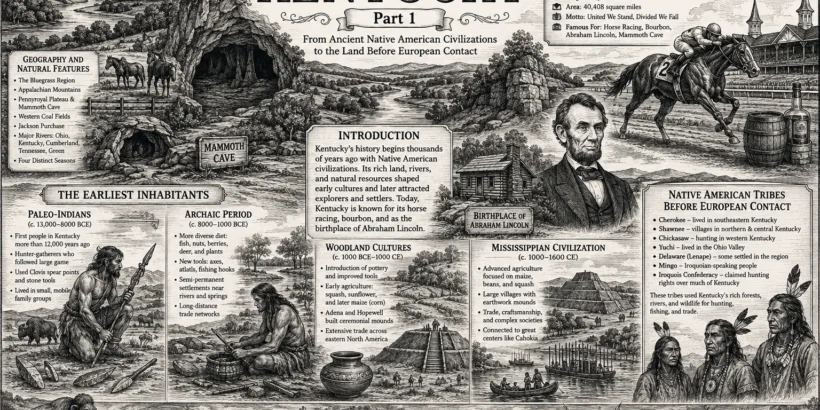
Kentucky occupies a unique place in American history. Known today as the Bluegrass State, Kentucky is celebrated worldwide for its rolling horse farms, the Kentucky Derby, world-famous bourbon whiskey, Mammoth Cave, and breathtaking Appalachian landscapes. Yet its story stretches back thousands of years before European settlers arrived, when Native American cultures flourished along its rivers, forests, and fertile valleys.
Archaeological evidence shows that humans have lived in present-day Kentucky for more than 12,000 years. Over millennia, Paleo-Indian hunters evolved into sophisticated agricultural societies that built ceremonial earthworks, established thriving villages, and developed extensive trade networks across eastern North America.
European exploration during the seventeenth and eighteenth centuries transformed the region. The arrival of long hunters, explorers, and pioneers—including the legendary Daniel Boone—opened Kentucky to settlement through the Wilderness Road. After years as part of Virginia, Kentucky became the 15th state admitted to the United States on June 1, 1792, marking a major milestone in America’s westward expansion.
Kentucky later played an important role during the Civil War as a border state that remained in the Union while many of its citizens supported the Confederacy. It is also the birthplace of President Abraham Lincoln, whose leadership preserved the United States during its greatest national crisis.
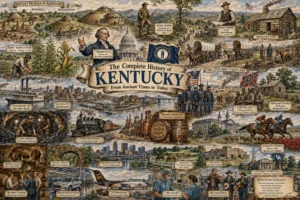
Today, Kentucky blends historic traditions with modern industries. Horse breeding, bourbon production, agriculture, manufacturing, healthcare, logistics, and tourism continue to shape its economy while preserving the state’s remarkable heritage.
This comprehensive guide explores Kentucky’s complete history—from prehistoric Native American cultures to the vibrant Commonwealth of the twenty-first century.
Quick Facts About Kentucky
| Category | Details |
|---|---|
| Official Name | Commonwealth of Kentucky |
| Nickname | The Bluegrass State |
| Statehood | June 1, 1792 (15th State) |
| Capital | Frankfort |
| Largest City | Louisville |
| Population | Approximately 4.6 million (2025 estimate) |
| Area | 40,408 square miles (104,656 km²) |
| State Motto | United We Stand, Divided We Fall |
| State Bird | Northern Cardinal |
| State Tree | Tulip Poplar |
| State Flower | Goldenrod |
| Highest Point | Black Mountain (4,145 feet) |
| Major Rivers | Ohio, Kentucky, Cumberland, Tennessee, Green River |
| Famous Industries | Bourbon, horse breeding, agriculture, manufacturing, healthcare, logistics |
| Famous Event | Kentucky Derby |
| National Park | Mammoth Cave National Park |
Geography and Natural Features
Kentucky lies in the east-central United States, bordered by Illinois, Indiana, Ohio, West Virginia, Virginia, Tennessee, and Missouri. The Ohio River forms much of its northern boundary, while the Mississippi River touches its western edge.
The state’s geography has profoundly influenced its history, economy, and settlement patterns.
The Bluegrass Region
Perhaps Kentucky’s best-known landscape is the Bluegrass Region, centered around Lexington.
Its limestone-rich soils naturally produce nutrient-rich grasses, making the area ideal for raising thoroughbred horses. The limestone also filters groundwater, contributing to the distinctive mineral content prized by bourbon distillers.
Today, this region remains one of the world’s premier horse-breeding centers.
Appalachian Mountains
Eastern Kentucky is dominated by the Appalachian Plateau and Cumberland Mountains.
This rugged landscape features:
- steep forested ridges
- narrow valleys
- coal deposits
- abundant wildlife
- scenic waterfalls
For centuries, these mountains isolated communities while preserving distinctive Appalachian traditions, music, and crafts.
Pennyroyal Plateau
South-central Kentucky contains the Pennyroyal Plateau, characterized by rolling farmland and karst topography.
This limestone region contains:
- underground rivers
- sinkholes
- caves
- springs
Its most famous feature is Mammoth Cave, the world’s longest known cave system, with more than 426 miles (685 km) explored and additional passages still being discovered.
Western Coal Fields
Western Kentucky contains valuable coal reserves that fueled industrial development throughout the nineteenth and twentieth centuries.
Mining communities emerged here, contributing significantly to Kentucky’s economy.
Jackson Purchase
The far western corner of Kentucky, known as the Jackson Purchase, became part of the state in 1818 after negotiations with the Chickasaw Nation.
This fertile lowland supports:
- corn
- soybeans
- cotton
- wheat
- livestock farming
Major Rivers
Kentucky’s rivers have always been essential transportation routes.
Important waterways include:
- Ohio River
- Kentucky River
- Green River
- Tennessee River
- Cumberland River
- Big Sandy River
These rivers connected early settlements with markets in Pittsburgh, Cincinnati, St. Louis, and New Orleans.
Climate
Kentucky experiences a humid subtropical climate with four distinct seasons.
Typical conditions include:
- warm summers
- mild to cool winters
- abundant rainfall
- colorful autumn foliage
- productive growing seasons
These favorable conditions encouraged agriculture from prehistoric times to the present day.
The Earliest Inhabitants
Human occupation of Kentucky began near the end of the last Ice Age.
Archaeologists estimate that people first entered the region approximately 12,000 to 13,000 years ago, following herds of large Ice Age mammals into newly habitable landscapes.
At that time, Kentucky looked very different from today.
Large portions of North America remained influenced by retreating glaciers, while Kentucky featured:
- spruce forests
- open grasslands
- large rivers
- abundant wildlife
Among the animals roaming the region were:
- mammoths
- mastodons
- giant bison
- elk
- giant ground sloths
- caribou
These early inhabitants adapted remarkably well to changing climates and ecosystems, laying the foundations for thousands of years of continuous human history.
Paleo-Indians (c. 13,000–8000 BCE)
The earliest known people in Kentucky belonged to what archaeologists call the Paleo-Indian Period.
These highly mobile hunter-gatherers traveled in small family groups.
Hunting Big Game
Paleo-Indians relied on sophisticated stone tools, especially the famous Clovis spear points, used to hunt large animals.
Their prey included:
- mammoths
- mastodons
- ancient bison
- deer
- elk
As the Ice Age ended and many large mammals became extinct, these hunters adapted by expanding their diets.
Stone Tool Technology
Kentucky provided excellent raw materials for toolmaking.
Chert deposits found throughout the state became valuable resources for producing:
- spear points
- knives
- scrapers
- drills
- cutting tools
Archaeological excavations have uncovered numerous Paleo-Indian artifacts near rivers and ancient campsites.
Seasonal Movement
Rather than establishing permanent villages, Paleo-Indians moved according to seasonal resources.
Families likely followed:
- migrating animals
- fish spawning cycles
- edible plant harvests
- fresh water sources
Their mobility allowed them to survive changing environmental conditions during the warming climate.
Archaeological Evidence
Excavations throughout Kentucky have revealed:
- fluted spear points
- hunting camps
- butchered animal bones
- stone flakes from tool production
These discoveries provide valuable insight into the earliest chapters of Kentucky’s human history.
Archaic Period (c. 8000–1000 BCE)
As forests expanded and Ice Age mammals disappeared, Kentucky entered the Archaic Period.
People developed more diverse ways of life, taking advantage of the state’s rich natural resources.
Changing Diets
Instead of relying mainly on large game, Archaic peoples harvested a wide variety of foods.
Their diet included:
- deer
- turkey
- fish
- shellfish
- berries
- nuts
- acorns
- roots
- wild fruits
This broader food base supported larger populations.
Improved Technology
New tools reflected changing lifestyles.
Common artifacts include:
- grinding stones
- axes
- fishing hooks
- bone tools
- woven baskets
- atlatls (spear throwers)
These innovations increased hunting efficiency and food processing.
Semi-Permanent Settlements
Unlike earlier Paleo-Indians, Archaic communities often returned to favored camps year after year.
Villages were frequently located near:
- rivers
- springs
- wetlands
- fertile valleys
These locations provided dependable access to food and fresh water.
Trade Networks
Archaeological evidence shows that Kentucky participated in long-distance exchange networks.
Materials traded across eastern North America included:
- marine shells from the Gulf Coast
- copper from the Great Lakes
- exotic stones
- pigments
- decorative items
These exchanges demonstrate that prehistoric societies maintained extensive social connections.
Woodland Cultures (c. 1000 BCE–1000 CE)
The Woodland Period marked one of the most significant cultural transformations in Kentucky’s ancient history.
Communities became increasingly organized, agriculture expanded, and elaborate ceremonial traditions emerged.
Introduction of Pottery
Woodland peoples introduced pottery, revolutionizing food preparation and storage.
Clay vessels allowed for:
- boiling foods
- storing grains
- preserving seeds
- cooking stews
Pottery styles varied among communities and help archaeologists identify different cultural traditions.
Early Agriculture
People gradually shifted from gathering wild plants to cultivating crops.
Common cultivated plants included:
- squash
- sunflower
- goosefoot
- maygrass
- knotweed
Later in the Woodland Period, maize (corn), originally domesticated in Mesoamerica, spread into the region and increasingly supplemented local agriculture.
Adena Culture
One of Kentucky’s most influential Woodland societies was the Adena culture.
Known for constructing impressive earthen burial mounds, the Adena flourished between roughly 1000 BCE and 200 BCE.
These ceremonial sites often contained:
- elaborate burials
- finely crafted stone pipes
- copper ornaments
- decorative artifacts
Their engineering skills demonstrate advanced planning and organized labor.
Hopewell Interaction Sphere
The later Hopewell tradition expanded long-distance trade and ceremonial activity.
Hopewell communities exchanged goods across vast distances, including:
- obsidian from the Rocky Mountains
- copper from the Great Lakes
- marine shells from the Gulf Coast
- mica from the Appalachian Mountains
Kentucky became an important participant in this extensive interaction network.
Ceremonial Earthworks
Woodland peoples constructed impressive earthworks for religious and ceremonial purposes.
These included:
- burial mounds
- geometric embankments
- ritual gathering places
Many remain protected archaeological sites that provide insight into prehistoric beliefs and social organization.
Mississippian Civilization (c. 1000–1600 CE)
Around AD 1000, Kentucky entered the Mississippian Period, during which some of the most socially and politically complex Indigenous societies in eastern North America emerged.
These communities practiced intensive agriculture centered on maize, allowing populations to grow and settlements to expand. Large villages featured planned layouts, central plazas, public buildings, and earthen platform mounds that supported temples, council houses, or the residences of elite leaders.
Mississippian peoples cultivated crops such as:
- maize (corn)
- beans
- squash
- pumpkins
- sunflowers
This agricultural system provided a stable food supply and supported specialized craftspeople, traders, and religious leaders.
Archaeological sites in western Kentucky reveal thriving communities connected through regional trade networks. Pottery, stone tools, shell ornaments, and ceremonial objects illustrate a sophisticated material culture.
Kentucky’s Mississippian societies maintained cultural ties with the great urban center of Cahokia, near present-day Collinsville, Illinois. At its peak between the 11th and 13th centuries, Cahokia was the largest city north of Mexico, influencing surrounding communities through trade, religious ideas, and political connections.
By the fifteenth and sixteenth centuries, many Mississippian centers in Kentucky had declined or been abandoned. Scholars continue to study the causes, which likely included a combination of environmental change, shifting trade patterns, disease, conflict, and population movements.
Native American Tribes Before European Contact
When Europeans began exploring the interior of North America during the sixteenth and seventeenth centuries, Kentucky was not densely populated by permanent villages. Instead, much of the region served as a shared hunting ground used by multiple Indigenous nations.
Several tribes maintained strong historical connections to Kentucky, including:
- Cherokee, whose territory extended into southeastern Kentucky and who hunted throughout the Cumberland region.
- Shawnee, who established villages in parts of northern and central Kentucky and later became one of the region’s most influential nations.
- Chickasaw, whose traditional lands lay mainly to the south and west but who hunted in western Kentucky.
- Yuchi, who occupied portions of the Ohio Valley before later migrating south.
- Delaware (Lenape), some of whom relocated into the Ohio Valley during the eighteenth century.
- Mingo, composed largely of Iroquoian-speaking peoples who settled in parts of the Ohio Country.
- Iroquois (Haudenosaunee Confederacy), who asserted hunting rights over much of Kentucky through the seventeenth-century Beaver Wars, though they maintained few permanent settlements there.
For many Indigenous nations, Kentucky’s rich forests, abundant wildlife, and river systems made it a prized seasonal hunting territory. Deer, elk, bison, black bears, and wild turkeys attracted hunters from surrounding regions, while rivers provided fish and convenient travel routes.
These nations possessed rich oral traditions, complex political systems, and deep spiritual relationships with the land. Their histories form the foundation of Kentucky’s human story and continue today through federally recognized tribal nations that preserve and celebrate their cultural heritage.
Next: Part 2 will cover:
- First European Explorers
- French and British Claims
- Daniel Boone and the Wilderness Road
- Harrodsburg and Boonesborough
- Frontier Life
- Conflicts with Native Americans
- Kentucky During the American Revolution
The Complete History of Kentucky (Part 2)
European Exploration, Frontier Settlement, and the American Revolution
After thousands of years of Native American history, Kentucky entered a new era during the sixteenth, seventeenth, and eighteenth centuries. European explorers, traders, and settlers gradually became aware of the region’s rich forests, fertile soils, abundant wildlife, and strategic river systems. Although few Europeans initially established permanent settlements, Kentucky became an increasingly important frontier that would eventually play a vital role in America’s westward expansion.
This chapter explores the arrival of European explorers, competing French and British territorial claims, the legendary exploits of Daniel Boone, the founding of Kentucky’s earliest settlements, frontier life, conflicts with Native American nations, and Kentucky’s significant role during the American Revolution.
First European Explorers
Long before Kentucky became a state, European explorers ventured into the interior of North America in search of wealth, trade routes, and new territories. While no definitive records confirm the first European to enter present-day Kentucky, several expeditions likely passed near or through the region during the sixteenth and seventeenth centuries.
Spanish Exploration
The earliest Europeans connected to Kentucky were likely members of Spanish expeditions exploring the southeastern United States.
One of the most notable was Hernando de Soto, who led an expedition across the Southeast between 1539 and 1543. Although historians generally agree that de Soto did not travel directly through present-day Kentucky, his exploration brought Europeans closer to the Ohio Valley than ever before and increased Spanish awareness of the region.
Another possible explorer was Juan Pardo, whose expeditions into the Appalachian Mountains during the 1560s expanded Spanish knowledge of the interior. However, no firm archaeological evidence confirms Spanish settlements within Kentucky itself.
French Explorers
By the late seventeenth century, French explorers were far more active in the Ohio and Mississippi River valleys.
Among the most influential were:
- René-Robert Cavelier, Sieur de La Salle
- Louis Jolliet
- Jacques Marquette
These explorers mapped major waterways and claimed vast portions of the Mississippi River basin for France.
Although they concentrated on rivers north and west of Kentucky, their expeditions revealed the importance of the Ohio River and its tributaries, placing Kentucky within France’s growing colonial ambitions.
Long Hunters
Before permanent settlements appeared, adventurous frontiersmen known as long hunters entered Kentucky.
These hunters:
- spent months or even years in the wilderness
- hunted deer, buffalo, elk, and bear
- collected valuable furs
- explored rivers and mountain passes
- mapped future settlement routes
Among the best known were:
- James Harrod
- Daniel Boone
- John Findley
- Simon Kenton
Their detailed knowledge of Kentucky’s landscape later proved invaluable for incoming settlers.
French and British Claims
Throughout the eighteenth century, Kentucky became part of the larger struggle between France and Great Britain for control of North America.
Although relatively few Europeans lived in Kentucky, both empires claimed ownership of the region.
French Louisiana
France based its claim on exploration and control of the Mississippi River watershed.
French traders established trading posts throughout the Ohio Valley and maintained alliances with many Native American nations.
Their interests centered on:
- fur trading
- river transportation
- diplomatic alliances
- military defense
However, the French generally established fewer farming settlements than the British.
British Colonial Claims
Britain claimed Kentucky through the colony of Virginia, whose colonial charter extended westward.
British settlers increasingly crossed the Appalachian Mountains searching for fertile farmland.
Land companies—including the Transylvania Company—sought enormous land grants in Kentucky despite Native American objections.
The French and Indian War (1754–1763)
Competition between Britain and France eventually erupted into the French and Indian War, the North American theater of the global Seven Years’ War.
Although few major battles occurred within Kentucky itself, the war transformed the region’s future.
The British victory in 1763 resulted in:
- France surrendering its claims east of the Mississippi River.
- Britain gaining control of Kentucky.
- Increased British settlement pressure west of the Appalachians.
Yet Native American nations did not recognize these territorial transfers, setting the stage for future conflict.
The Royal Proclamation of 1763
Following the war, King George III issued the Royal Proclamation of 1763, prohibiting colonial settlement west of the Appalachian Mountains.
The proclamation aimed to reduce conflicts with Native Americans by reserving western lands for Indigenous peoples.
Many colonists ignored the restriction, viewing Kentucky’s fertile lands as an irresistible opportunity.
The resulting tensions contributed to growing dissatisfaction with British rule in the years leading to the American Revolution.
Daniel Boone and the Wilderness Road
No individual is more closely associated with Kentucky’s frontier history than Daniel Boone.
Although often surrounded by legend, Boone played a genuine role in opening Kentucky to large-scale settlement.
Early Life
Daniel Boone was born in Pennsylvania in 1734 before moving with his family to North Carolina.
An experienced hunter, woodsman, and surveyor, Boone became fascinated by reports of Kentucky’s fertile valleys and abundant wildlife.
John Findley’s Influence
In 1767, frontiersman John Findley shared stories of Kentucky’s rich hunting grounds with Boone.
Inspired by these accounts, Boone organized exploratory expeditions into the region.
Exploring Kentucky
Beginning in 1769, Boone and several companions crossed the Cumberland Gap into Kentucky.
During these expeditions they:
- mapped rivers
- identified fertile valleys
- located buffalo traces
- hunted extensively
- encountered Native American hunting parties
Boone later described Kentucky as a “second paradise.”
The Wilderness Road
Boone’s greatest contribution came through construction of the Wilderness Road.
In 1775, working for Richard Henderson’s Transylvania Company, Boone helped blaze a trail through:
- Cumberland Gap
- Appalachian Mountains
- central Kentucky
This route became America’s first major western migration corridor.
Between 1775 and 1810, an estimated 200,000 to 300,000 settlers traveled the Wilderness Road into Kentucky and beyond.
Importance of the Wilderness Road
The trail transformed American expansion by:
- opening Kentucky to settlement
- encouraging migration westward
- stimulating trade
- strengthening frontier defense
- laying foundations for future states
Today, portions of the Wilderness Road are preserved within the Cumberland Gap National Historical Park.
Harrodsburg and Boonesborough
The opening of the Wilderness Road quickly led to Kentucky’s earliest permanent settlements.
Harrodsburg
In 1774, James Harrod founded Harrodstown, later renamed Harrodsburg.
It became the first permanent English-American settlement west of the Appalachian Mountains.
Early settlers built:
- log cabins
- defensive stockades
- blacksmith shops
- cornfields
- livestock pens
Harrodsburg served as an important supply center for later settlements.
Boonesborough
In 1775, Daniel Boone established Boonesborough along the Kentucky River.
Unlike Harrodsburg, Boonesborough was built specifically as a fortified frontier station.
Features included:
- wooden palisade walls
- blockhouses
- watchtowers
- cabins
- central gathering areas
Families lived within the fort for protection against attacks.
Logan’s Station
Benjamin Logan established Logan’s Station in 1775.
Located near present-day Stanford, it became another critical frontier settlement and defensive outpost.
Lexington
Originally surveyed in 1775, Lexington was named in honor of the American victory at the Battle of Lexington in Massachusetts.
It soon developed into one of Kentucky’s leading communities.
Growth of Frontier Settlements
Despite constant danger, settlements spread rapidly.
Pioneers established:
- farms
- mills
- churches
- schools
- trading posts
Kentucky’s population expanded dramatically during the late eighteenth century.
Frontier Life
Life on Kentucky’s frontier demanded extraordinary resilience.
Settlers faced isolation, unpredictable weather, disease, food shortages, and frequent violence.
Yet many believed the promise of fertile land outweighed these hardships.
Building Homes
Most families lived in simple log cabins constructed from nearby timber.
Cabins generally featured:
- one or two rooms
- stone fireplaces
- wooden floors
- handmade furniture
- animal-skin bedding
Construction required cooperation among neighbors.
Farming
Frontier families cultivated crops including:
- corn
- wheat
- tobacco
- beans
- squash
- pumpkins
They also raised:
- hogs
- chickens
- cattle
- horses
Hunting remained an important supplement to farming.
Hunting and Fishing
Kentucky’s forests supported abundant wildlife, including:
- white-tailed deer
- elk
- black bears
- wild turkeys
- rabbits
- squirrels
- bison (especially in earlier decades)
Rivers supplied:
- catfish
- bass
- trout
- freshwater mussels
Community Life
Despite scattered settlements, frontier communities developed strong social bonds.
Residents gathered for:
- church services
- cabin raisings
- weddings
- harvest festivals
- militia drills
- trading fairs
These events reinforced cooperation essential for survival.
Education
Formal schools were rare during Kentucky’s earliest years.
Children often learned:
- reading
- writing
- arithmetic
- farming skills
- hunting
- household crafts
Education usually occurred at home until communities became more established.
Conflicts with Native Americans
The rapid influx of settlers brought increasing conflict with Native American nations who had long hunted and traveled through Kentucky.
For Indigenous peoples, the arrival of permanent settlements threatened traditional lands, hunting grounds, and established ways of life.
A Shared Hunting Ground
Before widespread European settlement, Kentucky was used by several Native nations, including the Shawnee, Cherokee, Chickasaw, and others, primarily as a seasonal hunting territory rather than a densely settled homeland.
As settlers claimed land for farms and towns, these long-standing patterns were disrupted.
Rising Violence
During the 1770s and 1780s, frontier warfare intensified.
Raiding parties attacked:
- isolated cabins
- frontier stations
- hunting camps
- livestock herds
Settlers responded with militia expeditions and fortified communities.
These conflicts resulted in heavy losses on both sides and deepened cycles of retaliation.
Siege of Boonesborough
One of the most famous frontier confrontations occurred in 1778.
After Daniel Boone was captured and later escaped from Shawnee forces, Boonesborough prepared for attack.
A combined force of Shawnee warriors and British-supported allies laid siege to the settlement.
Although greatly outnumbered, the defenders successfully held the fort after approximately ten days of fighting.
The siege became one of Kentucky’s defining frontier episodes.
Lasting Consequences
The struggle for Kentucky reshaped the region.
Native American nations increasingly lost access to traditional hunting lands as settlement expanded, while frontier communities became more firmly established through continued migration and military support.
These events profoundly influenced Kentucky’s development and the broader history of the early United States.
Kentucky During the American Revolution
When the American Revolution began in 1775, Kentucky was still the western frontier of Virginia.
Although far from the major battlefields along the Atlantic coast, the region became strategically important.
Supporting the Patriot Cause
Most Kentucky settlers supported the Patriot movement.
Frontier militias protected settlements while also assisting Virginia’s defense of its western territory.
George Rogers Clark
The most significant military leader connected with Kentucky was George Rogers Clark.
Operating from Kentucky, Clark organized expeditions that captured key British posts in the Illinois Country, including Kaskaskia and Vincennes.
His victories weakened British influence in the Northwest and helped secure American claims to lands north of the Ohio River.
Many historians regard Clark’s campaigns as crucial to the eventual expansion of the United States after the Revolution.
Frontier Defense
Throughout the war, Kentucky settlements remained vulnerable to attacks by Native American warriors allied with the British.
Militias guarded frontier stations, escorted supply convoys, and defended farming communities, making Kentucky an active western theater of the Revolutionary War.
Treaty of Paris (1783)
The American Revolution officially ended with the Treaty of Paris in 1783.
Great Britain recognized the independence of the United States and ceded territory east of the Mississippi River to the new nation.
Kentucky remained part of Virginia but was now firmly within the United States.
The end of the war encouraged a surge of migration, as thousands of families crossed the Appalachians seeking new opportunities in Kentucky’s fertile lands.
This rapid population growth laid the groundwork for Kentucky’s admission to the Union as the 15th state in 1792.
The Complete History of Kentucky (Part 3)
Statehood, Early Government, and the Growth of the Bluegrass Frontier (1792–1820)
By the end of the American Revolution, Kentucky had transformed from a dangerous frontier into one of the fastest-growing regions of the new United States. Thousands of settlers crossed the Appalachian Mountains each year, establishing farms, towns, churches, and businesses throughout the fertile Bluegrass Region and along Kentucky’s rivers.
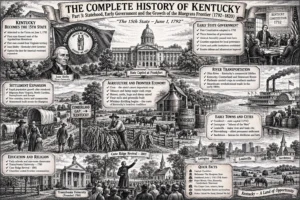
Rapid population growth, geographic isolation from Virginia, and the desire for local governance convinced Kentuckians that it was time to form their own state. On June 1, 1792, Kentucky officially became the 15th state admitted to the Union—the first state created west of the Appalachian Mountains.
This period laid the political, economic, and cultural foundations that continue to shape Kentucky today.
Kentucky Becomes the 15th State (1792)
The admission of Kentucky into the United States marked one of the earliest milestones in America’s westward expansion. Becoming a state gave Kentucky greater control over its government, laws, economy, and future development.
Separation from Virginia
Before statehood, Kentucky was known as Kentucky County, Virginia, established in 1776. Although settlers shared political ties with Virginia, practical challenges soon became apparent.
The distance between Kentucky and Virginia’s capital in Richmond made government administration difficult. Frontier residents often waited months for legal decisions, military assistance, or legislative action.
Other concerns included:
- Limited representation in Virginia’s legislature
- Difficulty defending frontier settlements
- Local control over taxation
- Management of western lands
- Regulation of river commerce
These issues led many residents to advocate for an independent state.
Constitutional Conventions
Between 1784 and 1792, delegates met in ten constitutional conventions at Danville to debate Kentucky’s future.
Delegates discussed:
- State boundaries
- Judicial systems
- Property rights
- Taxation
- Relations with Virginia
- Admission into the Union
These conventions demonstrated Kentucky’s commitment to orderly democratic government.
Admission to the Union
After negotiations with Virginia and approval by the United States Congress, Kentucky officially entered the Union on June 1, 1792.
Kentucky became:
- The 15th U.S. state
- The first state formed west of the Appalachian Mountains
- The first state created from Virginia’s territory
Statehood accelerated migration into Kentucky and symbolized America’s continued expansion toward the Mississippi River.
Isaac Shelby: Kentucky’s First Governor
Kentucky’s first governor was Isaac Shelby, a respected Revolutionary War veteran known for his leadership at the Battle of Kings Mountain.
Shelby focused on:
- Organizing state government
- Improving frontier defense
- Encouraging settlement
- Promoting agriculture
- Strengthening transportation
His leadership established many traditions of Kentucky’s early government.
Kentucky’s First Constitution
Kentucky adopted its first constitution in 1792.
The document established:
- Three branches of government
- A governor as chief executive
- A bicameral legislature
- An independent judiciary
- Procedures for elections
However, voting rights remained largely restricted to white male property owners, reflecting the political realities of the era.
Early State Government
Kentucky’s early government faced enormous challenges as it transitioned from frontier settlements to an organized state.
Lawmakers sought to create institutions that could support a rapidly growing population while maintaining public order and encouraging economic development.
The General Assembly
Kentucky’s legislature, known as the General Assembly, became responsible for passing state laws.
Its primary duties included:
- Establishing counties
- Funding roads
- Creating courts
- Organizing militias
- Supporting public education
- Regulating commerce
As new settlements appeared, legislators frequently created additional counties to improve local governance.
Judicial System
Kentucky developed an expanding court system to resolve:
- Land disputes
- Criminal cases
- Property claims
- Commercial disagreements
- Family matters
Land ownership was especially contentious because overlapping claims often resulted from inconsistent frontier surveys.
County Governments
Local governments became the foundation of daily life.
County officials oversaw:
- Tax collection
- Road construction
- Elections
- Public safety
- Courts
- Record keeping
By 1800, Kentucky already contained dozens of counties, reflecting rapid population growth.
Frontier Security
Although large-scale frontier warfare declined after the Revolution, state leaders continued organizing militias.
These forces protected settlements from occasional conflicts and later supported national military efforts during the War of 1812.
Building State Institutions
Kentucky gradually established:
- State archives
- Public offices
- Legislative buildings
- Correctional facilities
- Financial institutions
Frankfort developed into the administrative center where lawmakers met to govern the growing Commonwealth.
Settlement Expansion
Following statehood, Kentucky experienced one of the fastest population increases in the United States.
The promise of inexpensive, fertile land attracted settlers from:
- Virginia
- North Carolina
- Pennsylvania
- Maryland
- Tennessee
- South Carolina
Many families also arrived from Europe, particularly immigrants of English, Scots-Irish, German, and Irish ancestry.
Moving West
Thousands of pioneers entered Kentucky through the Wilderness Road and Cumberland Gap, while others traveled by flatboat along the Ohio River.
These migration routes brought farmers, merchants, artisans, teachers, and ministers into the expanding frontier.
New Counties
As settlement spread, Kentucky created numerous new counties.
Each county typically developed:
- A courthouse
- A public square
- Churches
- Taverns
- Blacksmith shops
- General stores
County seats became centers of commerce and local government.
Clearing the Land
Transforming forests into farmland required immense labor.
Settlers:
- Cut timber
- Burn tree stumps
- Built split-rail fences
- Constructed cabins
- Dug wells
- Established orchards
Entire families contributed to creating productive farms.
Population Growth
Kentucky’s population grew remarkably:
- 1790: approximately 74,000 residents
- 1800: about 220,000
- 1810: more than 400,000
- 1820: over 560,000
This growth made Kentucky one of the most populous western states of the early republic.
Relations with Native Americans
As settlement expanded, Indigenous communities were increasingly displaced from lands they had long used for hunting and travel. Although large-scale frontier warfare diminished after the 1790s, continued migration fundamentally altered the region’s demographic and cultural landscape.
Agriculture and Frontier Economy
Agriculture quickly became the backbone of Kentucky’s economy.
The state’s fertile soils, moderate climate, and abundant water allowed farmers to produce large harvests and support growing communities.
Corn Production
Corn became Kentucky’s most important crop.
Farmers used it for:
- Human consumption
- Livestock feed
- Whiskey production
- Trade
Corn remained the state’s agricultural foundation for decades.
Tobacco
Tobacco emerged as one of Kentucky’s most profitable cash crops.
Farmers exported tobacco to markets along the Ohio and Mississippi Rivers, where demand remained strong.
The crop contributed significantly to Kentucky’s economic prosperity while also increasing reliance on enslaved labor in many parts of the state.
Hemp
Kentucky became one of America’s leading producers of hemp.
Hemp fibers were manufactured into:
- Rope
- Sailcloth
- Bags
- Farm equipment
- Military supplies
The industry supported river commerce and national shipping.
Livestock
Kentucky farmers raised:
- Horses
- Cattle
- Hogs
- Sheep
- Chickens
Open pastures and rich Bluegrass grazing lands proved especially suitable for horse breeding, a tradition that would eventually make Kentucky internationally famous.
Flour Mills and Gristmills
Streams powered numerous mills that processed:
- Wheat
- Corn
- Lumber
These mills became economic centers where farmers gathered to trade goods and exchange news.
Distilling Begins
Many farmers converted surplus corn into whiskey because it was easier to transport and sell than raw grain.
Small frontier distilleries gradually evolved into Kentucky’s renowned bourbon industry.
Although bourbon’s exact origins remain debated, Kentucky’s limestone-filtered water, corn harvests, and skilled distillers helped establish a tradition that became synonymous with the state.
Slavery and the Early Economy
Enslaved African Americans played a significant role in portions of Kentucky’s agricultural economy, particularly on larger farms producing tobacco and hemp.
Unlike the Deep South’s plantation system, many Kentucky farms were smaller, but slavery remained an integral part of the state’s economic and social structure until its abolition after the Civil War.
River Transportation
Before railroads and modern highways, rivers served as Kentucky’s primary transportation network.
They connected farms and towns to national and international markets.
The Ohio River
The Ohio River became Kentucky’s commercial lifeline.
Flatboats and keelboats transported:
- Grain
- Tobacco
- Livestock
- Whiskey
- Timber
- Manufactured goods
Major river towns flourished along its banks.
Kentucky River
The Kentucky River linked the Bluegrass Region to the Ohio River.
It enabled farmers to ship crops while bringing manufactured products into the state’s interior.
Cumberland and Tennessee Rivers
Western Kentucky benefited from the Cumberland and Tennessee Rivers.
These waterways supported trade with Tennessee, the Mississippi River, and the Gulf of Mexico.
Flatboats
Most early farmers relied on flatboats.
These simple wooden vessels floated downstream carrying cargo to markets such as:
- Cincinnati
- Louisville
- St. Louis
- New Orleans
Many boats were dismantled and sold for lumber after completing their journey.
Steamboats
Beginning in the early nineteenth century, steamboats revolutionized transportation.
Unlike flatboats, steamboats could travel upstream, dramatically improving trade and communication.
Kentucky’s river towns experienced rapid economic growth as a result.
Early Towns and Cities
Kentucky’s earliest communities grew from frontier forts into thriving commercial centers.
Many remain important cities today.
Frankfort
Located along the Kentucky River, Frankfort became the state capital in 1792.
Its central location and river access made it an ideal administrative center.
Government buildings, courts, and businesses soon followed.
Lexington
Known as the “Athens of the West,” Lexington developed into Kentucky’s cultural and educational center.
The city’s prosperity came from:
- Horse breeding
- Agriculture
- Commerce
- Education
Elegant homes and public buildings reflected its growing wealth.
Louisville
Situated at the Falls of the Ohio River, Louisville became Kentucky’s largest commercial city.
Merchants benefited from river traffic moving between Pittsburgh and New Orleans.
Louisville later evolved into one of the nation’s leading transportation hubs.
Harrodsburg
Kentucky’s oldest permanent settlement remained an important agricultural and trading community.
Its historical significance attracted continued migration throughout the early nineteenth century.
Bardstown
Bardstown became famous for:
- Early Catholic institutions
- Distilleries
- Historic architecture
- Commerce
Today it is widely recognized as one of Kentucky’s most historic towns.
Education and Religion
As Kentucky matured, settlers increasingly invested in education and religious institutions.
These organizations shaped the state’s social and cultural development.
Early Schools
Most frontier children initially received education at home or in one-room schools.
Subjects commonly included:
- Reading
- Writing
- Arithmetic
- Geography
- Bible study
Teachers were often paid directly by local families.
Transylvania University
Founded in 1780 (as Transylvania Seminary) and later located in Lexington, Transylvania University became one of the earliest institutions of higher education west of the Appalachian Mountains.
It educated many future:
- Governors
- Judges
- Lawyers
- Physicians
- Business leaders
The university earned national recognition during the early nineteenth century.
Religious Revival
Kentucky became a major center of the Second Great Awakening, a widespread Protestant religious revival that swept the United States in the early 1800s.
Large outdoor camp meetings attracted thousands of worshippers from across the frontier.
These gatherings emphasized:
- Personal faith
- Community worship
- Evangelism
- Moral reform
Cane Ridge Revival
One of the most influential religious events in American history occurred at Cane Ridge near Paris, Kentucky, in 1801.
An estimated 10,000 to 20,000 people attended this extraordinary revival, making it one of the largest religious gatherings in early American history.
The Cane Ridge Revival inspired new denominations, strengthened existing churches, and significantly influenced the religious character of the expanding frontier.
Churches as Community Centers
Beyond worship, churches served as centers for:
- Education
- Charity
- Public meetings
- Social gatherings
- Moral guidance
They helped unite scattered frontier communities and fostered a shared sense of identity.
The Complete History of Kentucky (Part 4)
Kentucky in the Early 1800s: Politics, Agriculture, Industry, and Transportation (1800–1860)
The first half of the nineteenth century was a transformative period in Kentucky’s history. No longer a rugged frontier, Kentucky evolved into one of the nation’s leading agricultural and commercial states. Fertile farmland, navigable rivers, and a growing transportation network helped connect the Commonwealth to expanding national and international markets.
Kentucky also emerged as an influential political center through the leadership of Henry Clay, one of America’s most respected statesmen. At the same time, difficult issues—including slavery, states’ rights, and economic modernization—began to divide the state’s citizens. Improvements in roads, canals, and railroads accelerated economic growth, while Louisville developed into one of the busiest cities on the Ohio River.
This era laid the foundation for Kentucky’s role in national politics and set the stage for the conflicts that would culminate in the Civil War.
Kentucky in the Early 1800s
By 1800, Kentucky had become one of the fastest-growing states in the young United States. Its fertile Bluegrass Region attracted thousands of settlers, and new towns appeared throughout the Commonwealth.
Agriculture remained the primary occupation, but commerce, manufacturing, and transportation expanded rapidly.
During this period, Kentucky became known for:
- Rich farmland
- Horse breeding
- Tobacco cultivation
- Hemp production
- Flour milling
- River trade
Its central location along the Ohio River made Kentucky an important gateway between the eastern states and the expanding American West.
Population Growth
Kentucky’s population increased dramatically during the early nineteenth century.
Approximate population figures include:
- 1800: 220,955
- 1810: 406,511
- 1820: 564,317
- 1830: 687,917
- 1840: 779,828
- 1850: 982,405
- 1860: 1,155,684
This rapid growth encouraged the development of new counties, schools, churches, businesses, and transportation networks.
A Growing Commonwealth
As frontier dangers diminished, communities invested in:
- Courthouses
- Banks
- Inns and taverns
- Newspapers
- Libraries
- Public markets
- Medical practices
Kentucky gradually shifted from frontier settlements to organized towns with thriving civic life.
Henry Clay and National Politics
Few Kentuckians have influenced American history as profoundly as Henry Clay.
Born in Virginia in 1777, Clay moved to Lexington in 1797, where he quickly established himself as a successful lawyer before entering politics.
He became one of the most influential statesmen of the nineteenth century and earned the nickname “The Great Compromiser.”
Rise to Political Leadership
Henry Clay served in several important offices:
- United States Senator
- Speaker of the U.S. House of Representatives
- Secretary of State
He also ran for President multiple times, though he was never elected.
His remarkable legislative leadership helped shape the nation’s political development.
The American System
Clay proposed an ambitious economic plan known as the American System, which sought to strengthen the United States through:
- Protective tariffs to encourage domestic manufacturing
- A national bank to stabilize the economy
- Federal funding for roads, canals, and other internal improvements
Many Kentuckians supported these ideas because improved transportation and industry benefited the state’s farmers and merchants.
The Missouri Compromise (1820)
One of Clay’s greatest achievements was helping negotiate the Missouri Compromise.
The agreement admitted:
- Missouri as a slave state
- Maine as a free state
It also established a geographic boundary limiting the future expansion of slavery within much of the Louisiana Purchase.
Although temporary, the compromise postponed sectional conflict for several decades.
The Compromise Tariff of 1833
When South Carolina threatened to nullify federal tariffs, Clay negotiated another compromise that gradually reduced tariff rates.
His efforts helped prevent a constitutional crisis and reinforced his reputation as a skilled mediator.
The Compromise of 1850
Clay played a leading role in crafting the Compromise of 1850, a series of measures intended to ease tensions between free and slave states after the Mexican-American War.
Although he did not live to see all its provisions enacted, his proposals influenced the final legislation.
The compromise temporarily preserved the Union but failed to resolve the growing conflict over slavery.
Ashland Estate
Henry Clay’s home, Ashland, near Lexington, became one of Kentucky’s most famous estates.
Today it operates as a museum preserving the life and legacy of one of America’s greatest political leaders.
The War of 1812
When the United States declared war on Great Britain in 1812, Kentucky played an important military role.
Although no major battles occurred within Kentucky itself, thousands of Kentuckians volunteered for service.
Why Kentuckians Supported the War
Many residents believed Britain had:
- Interfered with American trade
- Impressed American sailors into the Royal Navy
- Supported Native American resistance in the Northwest Territory
These grievances encouraged strong patriotic support for the war.
Kentucky Volunteers
Kentucky earned a reputation for supplying large numbers of soldiers.
Volunteer regiments fought in campaigns throughout:
- The Northwest Territory
- The Great Lakes region
- Canada
- The Mississippi Valley
Their service earned Kentucky the nickname “The Dark and Bloody Ground’s Defenders.”
Battle of the Thames (1813)
One of Kentucky’s most significant contributions came during the Battle of the Thames in Ontario.
General William Henry Harrison’s forces, including many Kentucky volunteers under Governor Isaac Shelby, defeated British and Native American forces.
The battle resulted in the death of the Shawnee leader Tecumseh, marking a turning point in Native American resistance in the Old Northwest.
Battle of New Orleans (1815)
Kentucky soldiers also participated in the famous Battle of New Orleans, where General Andrew Jackson achieved a decisive victory against the British.
Although the Treaty of Ghent had already been signed, news had not yet reached the battlefield.
The victory boosted American national pride and elevated Jackson to national prominence.
Aftermath
The War of 1812 strengthened Kentucky’s sense of national identity.
Returning veterans became community leaders, while improved security encouraged further settlement and economic expansion.
Expansion of Farming
Agriculture remained Kentucky’s economic foundation throughout the first half of the nineteenth century.
Improved farming methods increased productivity and supported growing domestic and international markets.
Corn
Corn remained Kentucky’s most widely grown crop.
Farmers used it for:
- Food
- Animal feed
- Whiskey production
- Trade
Its versatility made it indispensable to rural life.
Tobacco
Tobacco became Kentucky’s most valuable commercial crop.
Major export markets included:
- New Orleans
- Cincinnati
- Philadelphia
- Europe
Tobacco cultivation generated significant wealth but also relied heavily on enslaved labor in many regions.
Hemp
Kentucky became America’s leading hemp-producing state.
Hemp fibers supplied raw materials for:
- Rope
- Sailcloth
- Canvas
- Bags
- Naval equipment
The federal government purchased large quantities for military use.
Livestock
Bluegrass pastures proved ideal for raising livestock.
Farmers bred:
- Horses
- Cattle
- Sheep
- Hogs
Kentucky horses gained an increasingly strong reputation for speed, endurance, and quality.
Horse Breeding
By the mid-1800s, Kentucky had become one of the nation’s premier horse-breeding regions.
Thoroughbred breeding expanded rapidly due to:
- Limestone-rich soils
- Nutritious bluegrass
- Mild climate
- Experienced breeders
These advantages laid the groundwork for Kentucky’s future leadership in horse racing.
Slavery in Kentucky
Slavery played an important role in Kentucky’s economy and society before the Civil War, though its character differed from the plantation systems of the Deep South.
Enslaved Population
By 1860, approximately 225,000 enslaved African Americans lived in Kentucky, representing about one-fifth of the state’s population.
Many worked on:
- Tobacco farms
- Hemp plantations
- Livestock operations
- Domestic households
- Skilled trades
Smaller Farms
Unlike states such as Mississippi or South Carolina, Kentucky generally had fewer large plantations.
Many slaveholders owned:
- Fewer than ten enslaved people
- Mixed agricultural operations
- Family farms
Nevertheless, slavery remained a legally protected institution that shaped the state’s economy and social hierarchy.
Free Black Communities
Kentucky was also home to a growing population of free African Americans.
Despite severe legal restrictions and discrimination, many established:
- Churches
- Schools
- Businesses
- Mutual aid organizations
Communities in Louisville, Lexington, and other towns became important centers of Black life.
Divided Opinions
Public opinion on slavery varied widely.
Some Kentuckians defended the institution, while others supported gradual emancipation or colonization efforts.
These differing views contributed to the state’s complex political position in the decades before the Civil War.
Louisville’s Growth
During the early nineteenth century, Louisville became Kentucky’s largest and most economically important city.
Its location at the Falls of the Ohio River made it a natural transportation hub.
River Commerce
Merchants shipped goods including:
- Tobacco
- Flour
- Whiskey
- Hemp
- Livestock
- Manufactured products
Boats traveling between Pittsburgh and New Orleans often stopped in Louisville.
Portland Canal
Completed in 1830, the Louisville and Portland Canal allowed boats to bypass the dangerous Falls of the Ohio.
The canal dramatically increased trade and strengthened Louisville’s position as one of America’s busiest inland ports.
Immigration
Louisville attracted immigrants from:
- Germany
- Ireland
- England
- Scotland
These newcomers contributed to commerce, construction, manufacturing, and cultural life.
Banking and Commerce
Banks, insurance companies, warehouses, and wholesale businesses flourished.
By the 1850s, Louisville had become one of the leading commercial cities in the western United States.
Industrial Development
Although agriculture remained dominant, Kentucky gradually diversified its economy through industrial growth.
Flour Mills
Water-powered and steam-powered mills processed enormous quantities of wheat and corn.
Flour became one of Kentucky’s most valuable exports.
Bourbon Distilling
Kentucky’s bourbon industry expanded significantly during the early nineteenth century.
Distilleries benefited from:
- High-quality limestone-filtered water
- Abundant corn harvests
- White oak barrels
- Skilled craftsmanship
Bourbon gradually became Kentucky’s signature product.
Iron Production
Eastern Kentucky contained valuable iron deposits.
Iron furnaces manufactured:
- Tools
- Farm equipment
- Railroad components
- Household goods
These industries supported regional development.
Coal Mining
Commercial coal mining began expanding in eastern and western Kentucky.
Although production remained modest before the Civil War, coal would become one of Kentucky’s most important industries later in the nineteenth century.
Manufacturing
Growing towns supported factories producing:
- Furniture
- Leather goods
- Textiles
- Bricks
- Agricultural equipment
Industrial employment steadily increased as urban populations grew.
Transportation Improvements
Transportation improvements transformed Kentucky’s economy during the first half of the nineteenth century.
Improved mobility reduced travel times, expanded markets, and encouraged settlement.
Turnpikes
Private companies and local governments constructed improved toll roads connecting major communities.
These turnpikes linked:
- Lexington
- Frankfort
- Louisville
- Maysville
- Bardstown
Wagons could transport goods more efficiently than on earlier frontier trails.
Canals
The construction of canals, particularly the Louisville and Portland Canal, revolutionized river commerce by eliminating major navigation obstacles.
Steamboats
Steamboats became increasingly common after 1811.
Their advantages included:
- Upstream travel
- Faster transportation
- Larger cargo capacity
- Reliable schedules
River trade expanded dramatically as a result.
Railroads
By the 1830s and 1840s, Kentucky began building railroads.
Early rail lines connected farms, towns, and river ports, reducing dependence on waterways alone.
Railroads also stimulated:
- Manufacturing
- Coal production
- Urban growth
- Regional trade
Telegraph
The arrival of the telegraph in the 1840s revolutionized communication.
News that once required weeks to travel could now be transmitted in minutes, strengthening commerce and government administration.
Preparing for a New Era
By 1860, Kentucky had become a prosperous and strategically important state. Its fertile farms, expanding industries, bustling river ports, and improving transportation network placed it at the crossroads of the North and South. Yet growing national disagreements over slavery, states’ rights, and the future of the Union increasingly divided Kentuckians.
These tensions would soon thrust the Commonwealth into one of the most challenging chapters in its history—the American Civil War.
The Complete History of Kentucky (Part 5)
Kentucky and the Civil War: A Divided Commonwealth (1861–1877)
The American Civil War was one of the most defining periods in Kentucky’s history. Although Kentucky officially remained in the Union, the state was deeply divided. Families, neighbors, and political leaders often found themselves supporting opposite sides of the conflict.
Because of its strategic location, extensive river systems, agricultural wealth, and transportation network, Kentucky became one of the most important border states in the war. Its divided loyalties made it a battleground not only for military campaigns but also for political influence.
The Civil War forever transformed Kentucky’s economy, society, and government. It also brought emancipation, the enlistment of African American soldiers, and a challenging period of Reconstruction that reshaped the Commonwealth for generations.
Kentucky and the Civil War
When the Civil War began in April 1861, Kentucky occupied a unique and difficult position. Geographically and culturally, it stood between the industrial North and the agricultural South.
The state shared many economic and family ties with the South, including the institution of slavery. At the same time, many Kentuckians believed preserving the Union was essential to the nation’s future.
Kentucky’s strategic importance included:
- Control of the Ohio River
- Access to the Mississippi River Valley
- Important railroad connections
- Agricultural production
- Manufacturing centers
- Military supply routes
President Abraham Lincoln reportedly recognized Kentucky’s significance, saying that losing the state would make preserving the Union far more difficult.
Divided Loyalties
Kentuckians were deeply divided over the war.
Some citizens favored:
- Remaining loyal to the United States
- Preserving the Union
- Protecting federal authority
Others supported:
- States’ rights
- The Confederate cause
- Southern political traditions
Many families experienced painful divisions, with brothers and cousins serving in opposing armies.
Military Contributions
Kentucky supplied soldiers to both sides.
Approximately:
- 90,000–100,000 Kentuckians served in the Union Army.
- 25,000–40,000 served in the Confederate Army.
This made Kentucky one of the few states to provide substantial military forces to both governments.
Why Kentucky Stayed in the Union
Kentucky’s decision to remain in the Union resulted from a combination of political leadership, military strategy, and economic considerations.
Neutrality in 1861
At the beginning of the war, Kentucky declared itself neutral.
State leaders hoped neutrality would:
- Prevent invasion
- Protect farms and businesses
- Avoid internal conflict
- Preserve peace
Both the Union and Confederacy initially respected this position.
Confederate Invasion
Kentucky’s neutrality ended in September 1861, when Confederate General Leonidas Polk occupied Columbus, Kentucky.
The action alarmed many Kentuckians.
Soon afterward, Union forces entered the state.
The legislature voted overwhelmingly to support the Union, effectively ending Kentucky’s neutrality.
Strategic Importance
The Union considered Kentucky indispensable because it offered:
- River transportation
- Agricultural resources
- Industrial production
- Access to Tennessee
- Defensive positions along the Ohio River
Maintaining control of Kentucky helped protect the Midwest while supporting campaigns deeper into the South.
Political Leadership
Many influential Kentucky leaders opposed secession.
Although they held differing views on slavery, they believed preserving the United States outweighed calls for disunion.
Their leadership helped keep Kentucky officially within the Union.
Border State Politics
Kentucky’s status as a border state made politics extraordinarily complex during the Civil War.
Unlike the Confederate states, Kentucky never officially left the Union. However, Confederate sympathizers established a rival government that claimed to represent the state.
Union Government
The recognized state government remained loyal to the United States.
Frankfort continued serving as the official capital under Union authority.
State officials cooperated with President Lincoln’s administration while attempting to maintain order.
Confederate Shadow Government
In late 1861, Confederate supporters met in Russellville and established a provisional Confederate government for Kentucky.
This government:
- Claimed Kentucky had seceded
- Elected Confederate officials
- Sent representatives to the Confederate Congress
Although the Confederacy admitted Kentucky as its 13th state, the provisional government never gained lasting control over most of the Commonwealth.
Civil Liberties
The war created tensions over civil liberties.
Both Union and Confederate authorities sometimes:
- Arrested suspected opponents
- Restricted newspapers
- Imposed martial law in certain areas
- Confiscated property
These measures reflected the extraordinary pressures of wartime.
Confederate Sympathizers
Although Kentucky remained in the Union, Confederate support remained strong in many regions.
Southern sympathizers often believed:
- States possessed the constitutional right to secede.
- Federal power had become excessive.
- Slavery should continue.
- Southern society deserved protection.
Support varied considerably across the state, with western and southern Kentucky generally exhibiting stronger Confederate sentiment than some northern regions.
Confederate Recruitment
Thousands of Kentuckians crossed into Tennessee and other Confederate-controlled areas to enlist.
Kentucky produced several prominent Confederate military leaders, including:
- John C. Breckinridge, former Vice President of the United States and later Confederate Secretary of War.
- John Hunt Morgan, famed cavalry commander known for his daring raids.
- Simon Bolivar Buckner, Confederate general and former governor of Kentucky.
Guerrilla Warfare
Beyond conventional battles, Kentucky experienced guerrilla warfare.
Small bands conducted:
- Ambushes
- Railroad sabotage
- Supply raids
- Attacks on isolated communities
These irregular conflicts prolonged violence even in areas far from major battlefields.
Major Battles
Although many of the Civil War’s largest battles occurred elsewhere, Kentucky witnessed numerous important military engagements.
Battle of Mill Springs (January 1862)
One of the first major Union victories in the Western Theater occurred at Mill Springs.
Union forces defeated Confederate troops under General George B. Crittenden.
The victory strengthened Union control of eastern Kentucky and boosted Northern morale.
Battle of Richmond (August 1862)
The Battle of Richmond, Kentucky, became one of the Confederacy’s most decisive victories in the state.
Confederate General Edmund Kirby Smith defeated Union forces, opening the way for an invasion into central Kentucky.
Despite the victory, Confederate control proved temporary.
Battle of Perryville (October 8, 1862)
The Battle of Perryville was Kentucky’s largest Civil War battle.
Approximately 72,000 soldiers participated.
Although tactically inconclusive, Confederate General Braxton Bragg withdrew shortly afterward, ending the Confederacy’s major invasion of Kentucky.
The battle effectively secured Kentucky for the Union for the remainder of the war.
Today, Perryville Battlefield State Historic Site preserves one of America’s best-preserved Civil War battlefields.
Morgan’s Raid (1863)
Confederate General John Hunt Morgan launched a daring cavalry raid through Kentucky, Indiana, and Ohio.
Although initially successful, the raid ultimately ended with Morgan’s capture.
The operation demonstrated both the mobility of cavalry forces and the vulnerability of Northern territory.
Abraham Lincoln’s Kentucky Birthplace
One of Kentucky’s greatest historical distinctions is being the birthplace of Abraham Lincoln, the 16th President of the United States.
Lincoln was born on February 12, 1809, at Sinking Spring Farm near Hodgenville, Kentucky.
Although his family moved to Indiana when he was seven years old, Lincoln’s Kentucky birthplace remains an important symbol of his early life.
Early Childhood
Thomas and Nancy Lincoln raised young Abraham on frontier farms where he learned:
- Hard work
- Farming
- Woodworking
- Reading
- Self-reliance
These experiences helped shape his character and leadership.
Lincoln During the Civil War
As president, Lincoln faced the enormous challenge of preserving the Union.
His administration:
- Directed Union military strategy
- Issued the Emancipation Proclamation (1863), which declared freedom for enslaved people in Confederate-held territory.
- Supported passage of the Thirteenth Amendment, which abolished slavery throughout the United States in 1865.
Lincoln’s connection to Kentucky illustrates the state’s complex identity during the Civil War.
Abraham Lincoln Birthplace National Historical Park
Today, Lincoln’s birthplace is preserved as Abraham Lincoln Birthplace National Historical Park.
Visitors can explore:
- Memorial Building
- Symbolic log cabin
- Historic farm
- Museum exhibits
- Walking trails
The site attracts visitors from around the world.
Camp Nelson
One of Kentucky’s most significant Civil War sites was Camp Nelson, located near Nicholasville.
Established in 1863, Camp Nelson became:
- A major Union supply depot
- A military training center
- A recruitment center for African American soldiers
- A refugee center for formerly enslaved people seeking freedom
Recruitment of Black Soldiers
Following federal authorization for Black military service, Camp Nelson became one of the nation’s largest recruiting centers for the United States Colored Troops (USCT).
More than 10,000 African American men enlisted there, joining the Union Army and contributing significantly to the war effort.
Refuge for Freedom Seekers
Camp Nelson also served as a sanctuary for thousands of enslaved people escaping to Union lines.
Schools, hospitals, housing, and churches were eventually established to support these communities.
National Monument
Recognizing its national significance, Camp Nelson was designated Camp Nelson National Monument in 2018.
The site preserves the stories of soldiers, civilians, and formerly enslaved families whose lives were transformed during the war.
African American Soldiers
The Civil War created new opportunities for African Americans to fight for freedom and citizenship.
Before 1863, Black men were generally barred from military service in the Union Army.
The creation of the United States Colored Troops (USCT) changed this policy.
Service in the Union Army
Thousands of Black Kentuckians enlisted despite enormous risks.
They served as:
- Infantry
- Cavalry
- Artillery
- Engineers
- Labor units
Many fought bravely in campaigns throughout the South.
Challenges
African American soldiers faced:
- Unequal pay during much of the war
- Discrimination
- Dangerous assignments
- Harsh treatment if captured by Confederate forces
Despite these hardships, their service strengthened the Union Army and advanced the cause of emancipation.
Legacy
The contributions of Black soldiers demonstrated courage, patriotism, and determination.
Their military service helped lay the groundwork for future struggles for civil rights and equal citizenship.
Reconstruction
The Civil War ended in 1865, but Kentucky’s recovery proved complex.
Unlike the former Confederate states, Kentucky was not placed under formal military Reconstruction because it had never officially seceded. Nevertheless, the Commonwealth faced profound political, economic, and social changes.
End of Slavery
The Thirteenth Amendment, ratified in 1865, abolished slavery throughout the United States, including Kentucky.
This transformed the lives of more than 225,000 formerly enslaved people in the state.
Economic Change
Former slaveholders adjusted to a free labor system.
Agriculture continued, but labor arrangements increasingly included:
- Wage labor
- Tenant farming
- Sharecropping
Economic recovery varied across different regions of Kentucky.
Political Challenges
Kentucky experienced intense debates over:
- Voting rights
- Civil rights
- Federal authority
- Veterans’ benefits
- Economic modernization
Although slavery had ended, African Americans continued to face widespread discrimination and legal barriers to full equality.
Education and Community Building
Freed African Americans established:
- Churches
- Schools
- Businesses
- Mutual aid societies
- Civic organizations
These institutions became pillars of Black communities across Kentucky.
Looking Toward the Future
By the late 1870s, Kentucky had entered a new era. Reconstruction had reshaped its labor system, political landscape, and society. The Commonwealth now turned toward industrial growth, expanding railroads, bourbon production, coal mining, horse breeding, and urban development—developments that would define Kentucky during the late nineteenth and early twentieth centuries.
The Complete History of Kentucky (Part 6)
Kentucky During the Gilded Age: Bourbon, Horses, Coal, and Modern Growth (1877–1914)
Following Reconstruction, Kentucky entered a period of rapid economic expansion and modernization known nationally as the Gilded Age. Between the late nineteenth century and the beginning of World War I, the Commonwealth experienced remarkable growth in manufacturing, transportation, mining, agriculture, education, and commerce.
The expansion of railroads connected rural communities with national markets, while Kentucky’s bourbon distilleries gained international recognition. The Kentucky Derby became one of America’s premier sporting events, and the state’s coalfields fueled the nation’s industrial revolution.
At the same time, Kentucky welcomed immigrants from Europe and other regions of the United States, whose labor and entrepreneurial spirit helped transform its cities and industries. Educational institutions expanded, literacy improved, and many influential Kentuckians left a lasting mark on American history.
The Gilded Age
The Gilded Age, roughly spanning from 1877 to 1900, was characterized by rapid industrialization, technological innovation, and economic growth across the United States.
Kentucky shared in this transformation while maintaining its strong agricultural traditions.
Major developments during this period included:
- Industrial expansion
- Railroad construction
- Urban growth
- Increased manufacturing
- Commercial agriculture
- Rising national political influence
Although prosperity increased for many, the era also brought economic inequality, labor disputes, and political corruption, challenges experienced throughout much of the country.
Economic Diversification
Kentucky gradually became less dependent solely on agriculture.
Growing industries included:
- Bourbon distilling
- Tobacco processing
- Flour milling
- Lumber
- Iron production
- Coal mining
- Textile manufacturing
Cities such as Louisville, Lexington, Covington, and Paducah became increasingly important commercial centers.
Urban Growth
Kentucky’s cities expanded rapidly during the late nineteenth century.
Urban populations grew as people moved from rural communities seeking employment.
Cities added:
- Electric streetcars
- Public water systems
- Sewer systems
- Hospitals
- Libraries
- Public parks
These improvements significantly enhanced the quality of urban life.
Technological Change
New inventions transformed everyday life.
Residents gradually adopted:
- Electric lighting
- Telephones
- Improved farm machinery
- Modern factories
- Refrigeration
- Mechanical transportation
Technological progress increased productivity throughout Kentucky.
Bourbon Industry
No product is more closely associated with Kentucky than bourbon whiskey.
Although whiskey had been distilled in Kentucky since the late eighteenth century, the bourbon industry expanded dramatically after the Civil War.
By the late nineteenth century, Kentucky had become the undisputed center of bourbon production in the United States.
Why Kentucky Became Famous for Bourbon
Several natural advantages contributed to Kentucky’s success.
These included:
- Limestone-filtered water low in iron
- Abundant corn harvests
- High-quality white oak forests for barrels
- Favorable climate for barrel aging
- Generations of skilled distillers
Together, these factors created ideal conditions for producing premium bourbon.
Growth of Distilleries
By the late 1800s, hundreds of distilleries operated across Kentucky.
Many famous brands trace their origins to this era, including:
- Old Forester
- Early Times
- Jim Beam (through earlier family distilling traditions)
- Wild Turkey (later developed from historic distilling roots)
- Buffalo Trace (originating from one of America’s oldest distilling sites)
Large distilleries modernized production while maintaining traditional aging techniques.
The Bottled-in-Bond Act (1897)
A milestone for the industry came with the Bottled-in-Bond Act of 1897, the first major federal consumer protection law for distilled spirits.
The law required bonded bourbon to:
- Be produced by one distiller.
- Be distilled in a single season.
- Age for at least four years in a federally supervised warehouse.
- Be bottled at 100 proof (50% alcohol by volume).
The act helped protect consumers from adulterated whiskey and strengthened Kentucky’s reputation for quality.
Bourbon as a Cultural Symbol
By the beginning of the twentieth century, bourbon had become an important symbol of Kentucky’s identity and economy.
Today, the Kentucky Bourbon Trail attracts millions of visitors from around the world, preserving the state’s long distilling heritage.
Horse Racing and the Kentucky Derby
Kentucky’s international reputation as the Horse Capital of the World developed during the nineteenth century.
The Bluegrass Region’s nutrient-rich limestone soils produced excellent grazing conditions that strengthened horses’ bones and overall health.
Thoroughbred Breeding
Wealthy farmers invested heavily in breeding superior racehorses.
Kentucky quickly became America’s leading center for:
- Thoroughbred breeding
- Horse training
- Equine veterinary medicine
- Bloodstock sales
Many of the world’s finest racehorses continue to originate from Kentucky farms.
Founding of Churchill Downs
In 1875, Louisville businessman Meriwether Lewis Clark Jr., grandson of explorer William Clark, founded Churchill Downs.
Inspired by European horse racing traditions, he established a world-class racetrack that soon became Kentucky’s premier sporting venue.
The First Kentucky Derby
The inaugural Kentucky Derby took place on May 17, 1875.
Approximately 10,000 spectators attended the first race.
The winning horse was Aristides, ridden by African American jockey Oliver Lewis.
The event quickly became one of America’s most celebrated annual sporting traditions.
“The Run for the Roses”
Over time, the Kentucky Derby became known as:
- “The Most Exciting Two Minutes in Sports”
- “The Run for the Roses”
Winning horses receive a blanket of red roses, a tradition established in the late nineteenth century and now recognized worldwide.
Economic Impact
Horse racing became one of Kentucky’s most valuable industries.
The equine sector supports:
- Horse farms
- Veterinarians
- Feed suppliers
- Tourism
- Breeding operations
- Racing events
- International auctions
Today, the industry contributes billions of dollars annually to Kentucky’s economy.
Coal Mining
Coal became one of Kentucky’s most important natural resources during the late nineteenth century.
Rich coal deposits in eastern and western Kentucky fueled America’s rapidly expanding industries.
Eastern Kentucky Coalfields
The Appalachian Mountains contain extensive reserves of high-quality bituminous coal.
Mining towns developed throughout counties including:
- Pike
- Harlan
- Letcher
- Bell
- Perry
- Floyd
These communities depended heavily on coal production.
Company Towns
Many mining companies constructed entire communities for their workers.
Company towns often included:
- Housing
- Schools
- Company stores
- Churches
- Rail connections
While they provided employment, workers frequently depended on mining companies for nearly every aspect of daily life.
Working Conditions
Coal mining was dangerous.
Miners faced hazards such as:
- Cave-ins
- Explosions
- Dust-related lung diseases
- Flooding
- Equipment accidents
Despite these risks, mining offered one of the few steady sources of income in many Appalachian communities.
Labor Organizing
As the industry expanded, miners increasingly sought:
- Higher wages
- Safer working conditions
- Shorter working hours
- Union representation
Labor activism would become even more significant during the twentieth century.
Railroads
The rapid expansion of railroads revolutionized Kentucky’s economy.
By connecting rural communities with national markets, railroads accelerated industrial growth and transformed transportation.
Expansion of Rail Lines
Major railroads linked Kentucky with:
- Chicago
- Cincinnati
- St. Louis
- Nashville
- Atlanta
- New Orleans
Freight and passenger travel became faster and more reliable than ever before.
Economic Benefits
Railroads enabled farmers and manufacturers to transport goods more efficiently.
Major products shipped by rail included:
- Tobacco
- Bourbon
- Coal
- Livestock
- Lumber
- Flour
- Manufactured goods
Rail transportation significantly lowered shipping costs and expanded market opportunities.
Railroad Towns
Many Kentucky communities grew around railroad depots.
New businesses included:
- Hotels
- Restaurants
- Warehouses
- Banks
- General stores
Railroads also encouraged tourism by making travel easier for visitors.
Bridges and Engineering
Railroad companies constructed impressive bridges spanning the Ohio and Kentucky Rivers.
These engineering achievements strengthened regional trade and connected Kentucky more closely with neighboring states.
Immigration
Although Kentucky did not receive immigrant populations on the scale of New York or Chicago, immigration played an important role in shaping the Commonwealth.
New arrivals contributed to business, manufacturing, education, and cultural life.
German Immigrants
German immigrants settled primarily in:
- Louisville
- Covington
- Newport
They established:
- Breweries
- Bakeries
- Churches
- Schools
- Music societies
German traditions enriched Kentucky’s cultural heritage.
Irish Immigrants
Irish immigrants frequently worked on:
- Railroads
- Canals
- Construction projects
- Factories
Many later became successful merchants, public servants, and community leaders.
Other European Communities
Smaller numbers of immigrants arrived from:
- England
- Scotland
- Italy
- Poland
- Eastern Europe
These communities added to Kentucky’s cultural diversity through their traditions, cuisine, architecture, and religious institutions.
African American Migration
Following emancipation, many African Americans relocated within Kentucky or moved from rural communities into cities such as Louisville and Lexington.
They established thriving neighborhoods, businesses, churches, schools, and civic organizations despite persistent segregation and discrimination.
Education Reform
Education expanded considerably during the late nineteenth century.
State leaders increasingly recognized that economic progress depended upon a better-educated population.
Public Schools
Kentucky invested in improving its public education system.
Reforms included:
- More school districts
- Longer school terms
- Teacher certification
- Standardized curricula
- New school buildings
Although funding remained uneven, educational opportunities steadily improved.
Berea College
Founded in 1855, Berea College became nationally recognized for its commitment to educating students regardless of race or gender during much of its early history.
After the 1904 Kentucky Day Law prohibited integrated education, the college was forced to segregate its student body until the law was overturned decades later.
Today, Berea College remains known for academic excellence, tuition-free education supported by its endowment, and a strong labor-study program.
University of Kentucky
Established in 1865 as the Agricultural and Mechanical College of Kentucky University, the institution later became the University of Kentucky.
It grew into the Commonwealth’s flagship public university, advancing research in:
- Agriculture
- Engineering
- Medicine
- Business
- Science
Libraries and Literacy
Public libraries expanded throughout Kentucky.
Literacy rates improved steadily as increasing numbers of children attended school.
Books, newspapers, and magazines became more widely available, encouraging civic participation and lifelong learning.
Famous Kentuckians
Kentucky has produced many individuals who have shaped American history, politics, sports, science, literature, and culture.
Abraham Lincoln (1809–1865)
Born near Hodgenville, Abraham Lincoln became the 16th President of the United States.
His leadership during the Civil War preserved the Union and contributed to the abolition of slavery.
Henry Clay (1777–1852)
Known as “The Great Compromiser,” Henry Clay represented Kentucky in Congress and played a central role in shaping nineteenth-century American politics through landmark legislative compromises.
Jefferson Davis (1808–1889)
Jefferson Davis, born in present-day Kentucky, became the President of the Confederate States of America during the Civil War.
His birthplace reflects Kentucky’s complex historical connections to both the Union and the Confederacy.
Mary Todd Lincoln (1818–1882)
A native of Lexington, Mary Todd Lincoln married Abraham Lincoln and served as First Lady of the United States during the Civil War.
Cassius Marcellus Clay (1810–1903)
A prominent Kentucky politician and outspoken abolitionist, Cassius Marcellus Clay advocated for the gradual end of slavery and supported the Union during the Civil War.
Muhammad Ali (1942–2016)
Born Cassius Marcellus Clay Jr. in Louisville, Muhammad Ali became one of the greatest heavyweight boxers in history.
Beyond his athletic achievements, he was widely recognized for his humanitarian work and influence on civil rights and global culture.
Colonel Harland Sanders (1890–1980)
The founder of Kentucky Fried Chicken (KFC) transformed a roadside restaurant into one of the world’s most recognizable fast-food brands.
His image remains one of Kentucky’s most famous global symbols.
Loretta Lynn (1932–2022)
Although best known for her career in neighboring Tennessee, country music legend Loretta Lynn was born in Butcher Hollow, Kentucky and often celebrated her Appalachian roots through her music.
Legacy of the Gilded Age
By the early twentieth century, Kentucky had become a more diversified and prosperous state. Railroads connected nearly every region, bourbon and horse breeding earned worldwide recognition, coal fueled industrial growth, and expanding educational opportunities prepared new generations for a changing economy.
Yet challenges remained. Labor disputes, segregation, public health concerns, and the demands of modernization would shape Kentucky’s next chapter as the Commonwealth entered the twentieth century and faced two world wars, the Great Depression, and the Civil Rights Movement.
The Complete History of Kentucky -Part 7
Kentucky in the Twentieth Century: War, Recovery, Civil Rights, and Modernization (1914–2000)
The twentieth century brought profound changes to Kentucky. Two world wars, the Great Depression, the Civil Rights Movement, rapid industrialization, and advances in healthcare and education transformed the Commonwealth from a largely agricultural state into a diverse modern economy.
Although Kentucky maintained its traditions in horse breeding, bourbon production, and farming, it also emerged as a leader in automobile manufacturing, logistics, healthcare, higher education, and scientific research. Louisville and Lexington expanded into vibrant metropolitan centers, while rural communities experienced significant economic and social change.
This era demonstrated Kentucky’s resilience and ability to adapt during some of the most challenging periods in American history.
Kentucky During World War I
When the United States entered World War I in 1917, thousands of Kentuckians answered the nation’s call to service.
Kentucky became an important center for military training, agricultural production, and industrial support during the war.
Military Service
Approximately 65,000 Kentuckians served in the U.S. Armed Forces during World War I.
They fought in major campaigns across Europe, including:
- Meuse-Argonne Offensive
- Saint-Mihiel Offensive
- Champagne Region
- Western Front
Many soldiers earned commendations for bravery under difficult battlefield conditions.
Camp Zachary Taylor
One of the state’s most important military installations was Camp Zachary Taylor, established near Louisville in 1917.
The camp trained tens of thousands of soldiers before deployment overseas.
It included:
- Barracks
- Hospitals
- Training grounds
- Supply depots
- Administrative headquarters
The camp significantly boosted Louisville’s wartime economy.
Agricultural Production
Kentucky farmers supported the war effort by increasing production of:
- Corn
- Wheat
- Tobacco
- Livestock
- Dairy products
Food shipments supplied both American troops and Allied nations.
Home Front Contributions
Kentucky citizens participated in:
- Liberty Bond campaigns
- Red Cross fundraising
- Volunteer nursing
- Food conservation
- War relief organizations
Communities throughout the Commonwealth united in support of the national war effort.
The Great Depression
The prosperity of the 1920s ended abruptly with the Stock Market Crash of 1929, ushering in the Great Depression.
Kentucky’s farmers, coal miners, factory workers, and small businesses all suffered severe economic hardship.
Economic Decline
Major challenges included:
- Falling crop prices
- High unemployment
- Bank failures
- Business closures
- Reduced industrial production
Coal mining communities in eastern Kentucky experienced especially severe economic distress.
Rural Hardship
Many farm families struggled to survive.
Problems included:
- Crop failures
- Declining tobacco prices
- Heavy debt
- Foreclosures
- Limited access to credit
Families often relied on subsistence farming to meet basic needs.
Urban Challenges
Cities such as Louisville, Lexington, and Covington also experienced rising unemployment.
Factories reduced production, construction slowed dramatically, and charitable organizations worked to assist struggling families.
Community Resilience
Despite economic difficulties, Kentuckians supported one another through:
- Church assistance
- Community kitchens
- Cooperative farming
- Local relief organizations
- Volunteer programs
Strong community ties helped many families endure the Depression.
New Deal Programs
President Franklin D. Roosevelt’s New Deal brought significant federal investment to Kentucky during the 1930s.
These programs provided employment while modernizing infrastructure throughout the Commonwealth.
Civilian Conservation Corps (CCC)
The CCC employed thousands of young men.
Workers completed projects including:
- Forest restoration
- Flood control
- State park development
- Trail construction
- Soil conservation
Many Kentucky parks still feature CCC-built facilities.
Works Progress Administration (WPA)
The WPA funded public works projects such as:
- Schools
- Roads
- Bridges
- Libraries
- Airports
- Courthouses
Artists, writers, musicians, and historians also received employment through cultural programs.
Tennessee Valley Authority (TVA)
The TVA transformed western Kentucky by constructing dams and hydroelectric facilities.
Benefits included:
- Flood control
- Electricity
- Navigation improvements
- Economic development
- Agricultural modernization
Communities that previously lacked reliable electricity gained access to modern power.
Rural Electrification
The Rural Electrification Administration (REA) extended electric service into remote farming communities.
Electricity transformed daily life by improving:
- Home lighting
- Refrigeration
- Farm equipment
- Communication
- Education
World War II
The outbreak of World War II again placed Kentucky at the center of America’s military mobilization.
The Commonwealth contributed soldiers, industrial production, agricultural resources, and military training facilities.
Military Service
More than 300,000 Kentuckians served in the Armed Forces during World War II.
They participated in campaigns across:
- Europe
- North Africa
- The Pacific
- Asia
Thousands earned military honors for courage and sacrifice.
Fort Knox
Located south of Louisville, Fort Knox became one of America’s most important military bases.
It served as:
- Armored training center
- Tank instruction facility
- Military headquarters
Fort Knox also gained worldwide fame as the location of the United States Bullion Depository, which stores a substantial portion of the nation’s gold reserves.
Industrial Production
Kentucky factories manufactured:
- Vehicles
- Ammunition
- Aircraft parts
- Machinery
- Military uniforms
Industrial employment expanded rapidly during the war.
Women in the Workforce
As men entered military service, women assumed increasingly important roles.
Many worked in:
- Factories
- Hospitals
- Government offices
- Transportation
- Education
Their contributions permanently changed workplace opportunities for women.
Agricultural Support
Kentucky farms continued supplying:
- Tobacco
- Corn
- Meat
- Dairy products
- Horses
Agricultural production remained essential to the national war effort.
Civil Rights Movement
Following World War II, Kentucky became part of the national struggle for racial equality.
Although segregation existed throughout much of the Commonwealth, many citizens worked to expand civil rights and educational opportunities.
School Integration
A major milestone occurred in 1954 when the U.S. Supreme Court decided Brown v. Board of Education, declaring segregated public schools unconstitutional.
Kentucky generally implemented school desegregation more peacefully than many Southern states, though the process varied by community and was not without resistance.
Civil Rights Leadership
Kentucky produced numerous educators, ministers, lawyers, and community leaders who advocated for:
- Equal voting rights
- Fair housing
- Integrated education
- Employment opportunities
- Equal public accommodations
Organizations such as the NAACP played important roles throughout the state.
Louisville and Lexington
The state’s largest cities became centers of peaceful demonstrations, voter registration efforts, and community activism.
Local governments gradually removed many discriminatory laws and practices.
Muhammad Ali
One of Kentucky’s most influential figures during the Civil Rights era was Muhammad Ali, born in Louisville in 1942.
Beyond becoming one of the greatest heavyweight boxing champions in history, Ali became internationally recognized for his advocacy of civil rights, religious freedom, humanitarian causes, and social justice.
His legacy continues to inspire people worldwide.
Modern Louisville and Lexington
During the second half of the twentieth century, Louisville and Lexington developed into modern metropolitan centers.
Both cities diversified their economies while preserving their unique historical identities.
Louisville
Louisville became Kentucky’s largest city and principal economic center.
Major industries included:
- Healthcare
- Logistics
- Manufacturing
- Food processing
- Financial services
- Bourbon tourism
The city is also home to UPS Worldport, one of the world’s largest package-sorting and air cargo hubs, reinforcing Louisville’s role in global logistics.
Cultural Attractions
Louisville is internationally known for:
- Churchill Downs
- Kentucky Derby Museum
- Louisville Slugger Museum & Factory
- Muhammad Ali Center
- Historic Main Street
- Waterfront Park
The city hosts numerous festivals celebrating music, food, bourbon, and the arts.
Lexington
Lexington strengthened its reputation as the Horse Capital of the World.
The city became internationally recognized for:
- Thoroughbred breeding
- Equine research
- Horse auctions
- Veterinary medicine
- Agricultural science
The University of Kentucky also helped establish Lexington as a center for higher education, healthcare, and scientific research.
Urban Development
Modern Lexington expanded through:
- Business parks
- Medical centers
- Technology companies
- Cultural institutions
- Residential neighborhoods
The city successfully balanced urban growth with preservation of its iconic horse farms.
Manufacturing Growth
During the twentieth century, manufacturing became one of Kentucky’s largest economic sectors.
National and international companies invested heavily in the Commonwealth.
Automobile Manufacturing
Kentucky emerged as one of America’s leading automobile-producing states.
Major manufacturers established facilities producing:
- Cars
- Pickup trucks
- Sport utility vehicles
- Automotive components
These factories created tens of thousands of jobs and supported extensive supplier networks.
Food Processing
Kentucky’s agricultural heritage supported growth in:
- Meat processing
- Grain milling
- Beverage production
- Bourbon distilling
- Packaged foods
Food manufacturing became a major contributor to the state’s economy.
Aerospace
Kentucky also expanded into aerospace manufacturing.
Companies produced:
- Aircraft components
- Precision machinery
- Electronic systems
- Defense equipment
These industries benefited from the state’s skilled workforce and transportation infrastructure.
Logistics
Because of its central location, Kentucky became a national logistics hub.
Interstate highways, railroads, airports, and river ports allowed businesses to distribute goods efficiently across North America.
Healthcare and Education
The twentieth century witnessed remarkable improvements in healthcare and education throughout Kentucky.
University of Kentucky
The University of Kentucky expanded into one of America’s leading public research universities.
Major areas of excellence include:
- Medicine
- Pharmacy
- Agriculture
- Engineering
- Business
- Nursing
- Scientific research
The university also operates one of the nation’s premier academic medical centers.
University of Louisville
The University of Louisville gained international recognition for medical innovation.
One of its most significant achievements occurred in 1999, when surgeons at the university performed the world’s first successful self-contained permanent implantation of a totally artificial heart.
The institution continues to lead research in medicine, engineering, dentistry, and public health.
Expanding Healthcare
Kentucky invested heavily in:
- Regional hospitals
- Medical schools
- Public health programs
- Emergency services
- Rural healthcare initiatives
Advances in medicine significantly increased life expectancy and improved quality of life.
Educational Progress
Public education expanded through:
- New high schools
- Community colleges
- Technical training centers
- University research
- Adult education programs
Educational opportunities became available to far more Kentuckians than ever before.
Entering the Twenty-First Century
By the close of the twentieth century, Kentucky had successfully transformed itself into a diverse and dynamic state. Agriculture, bourbon production, horse breeding, manufacturing, healthcare, logistics, tourism, and higher education all played major roles in the Commonwealth’s economy.
While challenges such as economic disparities, environmental concerns, and public health issues remained, Kentucky entered the new millennium with a strong foundation built upon centuries of resilience, innovation, and cultural heritage.
The Complete History of Kentucky (Part 8)
Kentucky in the 21st Century: Economy, Tourism, Culture, and the Modern Bluegrass State (2000–Present)
The twenty-first century has brought remarkable opportunities and challenges to Kentucky. While preserving its rich traditions in horse breeding, bourbon production, agriculture, and Appalachian heritage, the Commonwealth has also embraced advanced manufacturing, logistics, healthcare, renewable energy, higher education, and tourism.
Today, Kentucky is recognized as one of America’s leading producers of bourbon whiskey, home to world-famous horse farms, the longest cave system on Earth, thriving universities, major manufacturing facilities, and vibrant cultural traditions that continue to attract millions of visitors each year.
Modern Kentucky successfully combines centuries of history with innovation, making it one of the most distinctive states in the United States.
Kentucky in the 21st Century
Since 2000, Kentucky has experienced significant economic diversification. Although agriculture remains an important part of the state’s identity, manufacturing, healthcare, logistics, tourism, aerospace, and technology now play major roles in the Commonwealth’s economy.
State leaders have invested in:
- Transportation infrastructure
- Workforce development
- Advanced manufacturing
- Tourism promotion
- Education
- Healthcare
- Renewable energy initiatives
Kentucky’s central location allows businesses to reach much of the U.S. population within a day’s drive, making it an attractive destination for investment.
Population and Urban Growth
Kentucky’s population has continued to grow steadily.
Major metropolitan areas include:
- Louisville
- Lexington
- Bowling Green
- Owensboro
- Covington
- Georgetown
- Florence
- Elizabethtown
Urban development has expanded alongside efforts to preserve Kentucky’s rural landscapes, horse farms, forests, and historic communities.
Innovation and Technology
Modern Kentucky supports innovation through investments in:
- Biotechnology
- Medical research
- Information technology
- Aerospace engineering
- Robotics
- Automotive technology
Universities, research centers, and private companies collaborate to strengthen Kentucky’s growing technology sector.
Modern Economy
Kentucky now has one of the most diverse economies in its history.
While agriculture remains important, manufacturing and service industries account for a large share of employment and economic output.
Manufacturing
Kentucky ranks among America’s leading manufacturing states.
Major products include:
- Automobiles
- Pickup trucks
- Aircraft components
- Industrial machinery
- Food products
- Chemicals
- Aluminum products
Global manufacturers operate large production facilities throughout the Commonwealth.
Logistics and Distribution
Kentucky’s location makes it one of North America’s most important logistics centers.
Key advantages include:
- Interstate highway network
- Ohio River transportation
- Rail connections
- International airports
- Air cargo facilities
Louisville’s UPS Worldport is one of the world’s largest package-sorting hubs, processing millions of shipments each day.
Agriculture
Kentucky continues to be a leading agricultural producer.
Major products include:
- Corn
- Soybeans
- Tobacco
- Hay
- Wheat
- Beef cattle
- Poultry
- Dairy products
Family-owned farms remain an essential part of Kentucky’s rural economy.
Energy
Kentucky’s energy sector includes:
- Coal
- Natural gas
- Hydroelectric power
- Solar energy
- Wind energy
Although coal production has declined compared to its twentieth-century peak, energy remains an important economic sector.
Bourbon Tourism
Kentucky is internationally recognized as the birthplace of bourbon whiskey.
Federal law requires bourbon to be produced in the United States, but approximately 95% of the world’s bourbon is distilled in Kentucky.
The Kentucky Bourbon Trail
Established in 1999, the Kentucky Bourbon Trail has become one of America’s most successful tourism initiatives.
Visitors tour historic distilleries, observe traditional production methods, and learn about bourbon’s history.
Popular destinations include:
- Buffalo Trace Distillery
- Maker’s Mark
- Woodford Reserve
- Jim Beam
- Wild Turkey
- Four Roses
- Heaven Hill
- Bardstown Bourbon Company
Economic Impact
Bourbon tourism generates billions of dollars annually through:
- Hotel stays
- Restaurants
- Transportation
- Retail shopping
- Guided tours
- Cultural events
The industry also supports thousands of jobs across Kentucky.
International Recognition
Kentucky bourbon is exported worldwide.
Its reputation for craftsmanship, quality, and heritage has made it one of America’s most recognizable cultural products.
Horse Industry
Kentucky remains the Horse Capital of the World.
The state’s horse industry contributes billions of dollars annually and supports tens of thousands of jobs.
Thoroughbred Breeding
Kentucky’s Bluegrass Region continues producing many of the world’s finest Thoroughbred racehorses.
Its success is attributed to:
- Limestone-rich soil
- Nutrient-rich bluegrass
- Experienced breeders
- World-class veterinary care
- Excellent training facilities
Many Triple Crown winners have originated from Kentucky farms.
Churchill Downs
Churchill Downs remains one of the world’s most famous racetracks.
Each May, it hosts the Kentucky Derby, attracting visitors from around the globe.
The event combines:
- Elite horse racing
- Southern traditions
- Fashion
- Music
- International tourism
Keeneland
Located in Lexington, Keeneland Race Course is renowned for:
- Thoroughbred auctions
- Horse racing
- Historic architecture
- Equine research
It is widely regarded as one of the premier horse auction venues in the world.
Equine Healthcare
Kentucky leads the world in equine veterinary medicine.
Research institutions continue developing advances in:
- Horse nutrition
- Reproductive science
- Surgery
- Sports medicine
- Disease prevention
Mammoth Cave National Park
One of Kentucky’s greatest natural treasures is Mammoth Cave National Park.
Designated a national park in 1941 and later recognized as a UNESCO World Heritage Site and an International Biosphere Reserve, Mammoth Cave contains the longest known cave system on Earth, with more than 430 miles (690+ kilometers) of mapped passages and new sections still being discovered.
Geological Formation
The cave developed over millions of years as underground rivers dissolved thick layers of limestone.
Visitors can explore:
- Massive chambers
- Underground rivers
- Limestone formations
- Historic saltpeter mining areas
- Rare ecosystems
Wildlife
The park protects numerous species, including:
- Bats
- Cave fish
- Salamanders
- Wild turkeys
- White-tailed deer
- Songbirds
Many cave species are found nowhere else in the world.
Recreation
Popular activities include:
- Guided cave tours
- Hiking
- Camping
- Canoeing
- Wildlife viewing
- Photography
Mammoth Cave attracts hundreds of thousands of visitors each year.
Red River Gorge
Located within the Daniel Boone National Forest, the Red River Gorge Geological Area is one of Kentucky’s premier outdoor recreation destinations.
Known for its rugged sandstone cliffs and spectacular scenery, the area is famous for:
- Natural stone arches
- Towering cliffs
- Deep canyons
- Dense forests
- Scenic overlooks
Rock Climbing
The Red River Gorge is internationally recognized as one of the world’s top rock-climbing destinations.
Climbers from around the globe visit to experience:
- Sport climbing
- Traditional climbing
- Bouldering
- Hiking trails
Natural Bridge State Resort Park
Nearby Natural Bridge State Resort Park features one of Kentucky’s most iconic natural landmarks—a massive sandstone arch formed through millions of years of erosion.
The park offers:
- Scenic hiking trails
- Sky Lift
- Campgrounds
- Educational programs
- Wildlife observation
Conservation
State and federal agencies continue protecting the Gorge’s unique geology, biodiversity, and recreational opportunities while balancing conservation with public access.
Universities
Kentucky’s universities play a vital role in education, research, healthcare, and economic development.
University of Kentucky
Located in Lexington, the University of Kentucky (UK) is the state’s flagship public research university.
It is nationally recognized for:
- Medicine
- Agriculture
- Engineering
- Pharmacy
- Nursing
- Business
- Scientific research
UK also operates one of the nation’s leading academic medical centers.
University of Louisville
The University of Louisville is internationally respected for:
- Medical research
- Engineering
- Dentistry
- Business
- Public health
Its medical innovations have earned worldwide recognition.
Western Kentucky University
Located in Bowling Green, Western Kentucky University is known for excellence in:
- Teacher education
- Journalism
- Business
- Engineering
- Public administration
Eastern Kentucky University
Located in Richmond, Eastern Kentucky University specializes in:
- Criminal justice
- Education
- Healthcare
- Public safety
- Aviation
Morehead State University
Located in northeastern Kentucky, Morehead State University is recognized for:
- Space science
- Engineering
- Environmental studies
- Teacher preparation
Berea College
Founded in 1855, Berea College remains one of America’s most distinctive liberal arts institutions.
Its tuition-free model, supported by its endowment and student labor program, provides educational opportunities for students with financial need.
Music and Culture
Kentucky’s cultural heritage reflects Native American traditions, Appalachian influences, African American contributions, and European immigrant communities.
Bluegrass Music
Kentucky is the birthplace of Bluegrass music, a genre pioneered by Bill Monroe of Rosine, Kentucky.
Bluegrass blends:
- Folk music
- Country
- Gospel
- Celtic traditions
Today, festivals across Kentucky celebrate this internationally influential musical style.
Appalachian Heritage
Eastern Kentucky preserves rich Appalachian traditions, including:
- Storytelling
- Quilting
- Woodworking
- Basket weaving
- Traditional crafts
- Folk music
These customs continue to shape regional identity.
Festivals
Kentucky hosts numerous annual festivals, including:
- Kentucky Derby Festival
- World Chicken Festival
- International Bar-B-Q Festival
- Bourbon Festival
- Bluegrass Music Festivals
- Appalachian Heritage Festivals
These events celebrate the state’s diverse cultural traditions.
Sports
Sports play an important role in Kentucky’s identity.
Horse Racing
Horse racing remains Kentucky’s signature sport.
Major events include:
- Kentucky Derby
- Kentucky Oaks
- Blue Grass Stakes
- Keeneland Racing Seasons
College Basketball
Kentucky is one of America’s premier college basketball states.
The University of Kentucky Wildcats have won multiple NCAA national championships and are among the most successful programs in college basketball history.
The University of Louisville Cardinals have also earned national championships and maintain one of the nation’s most recognized basketball traditions.
Other Sports
Kentucky also supports:
- Baseball
- Football
- Soccer
- Auto racing
- Fishing
- Hiking
- Rock climbing
- Cycling
Outdoor recreation continues growing throughout the Commonwealth.
Interesting Facts About Kentucky
- Kentucky became the 15th U.S. state on June 1, 1792.
- It is officially a Commonwealth, not simply a state.
- Kentucky is known as the Bluegrass State.
- Abraham Lincoln, the 16th President of the United States, was born in Kentucky.
- Jefferson Davis, President of the Confederate States, was also born in Kentucky.
- The Kentucky Derby, first held in 1875, is the longest continuously held major sporting event in the United States.
- Approximately 95% of the world’s bourbon is produced in Kentucky.
- Mammoth Cave is the world’s longest known cave system.
- Kentucky borders seven states, more than most U.S. states.
- The Ohio River forms much of Kentucky’s northern boundary.
- Fort Knox houses one of the world’s most famous gold bullion depositories.
- Kentucky is home to thousands of Thoroughbred horse farms.
- The state played a crucial role as a border state during the Civil War.
- Bill Monroe, the “Father of Bluegrass Music,” was born in Kentucky.
- Kentucky has more navigable miles of water than any state except Alaska.
Historical Timeline (Prehistory–Present)
| Year/Period | Event |
|---|---|
| c. 13,000 BCE | Paleo-Indians arrive in present-day Kentucky |
| 8000–1000 BCE | Archaic cultures flourish |
| 1000 BCE–1000 CE | Woodland cultures build burial mounds and expand agriculture |
| 1000–1600 CE | Mississippian civilizations establish large agricultural communities |
| 1500s–1600s | European explorers begin exploring the interior of North America |
| 1769 | Daniel Boone explores Kentucky |
| 1774 | James Harrod establishes Harrodsburg |
| 1775 | Boonesborough founded; Wilderness Road expanded |
| 1775–1783 | Kentucky participates in the American Revolution |
| June 1, 1792 | Kentucky admitted as the 15th state |
| 1801 | Cane Ridge Revival influences American religious history |
| 1812–1815 | Kentucky contributes thousands of soldiers to the War of 1812 |
| 1820 | Henry Clay helps negotiate the Missouri Compromise |
| 1830 | Louisville and Portland Canal opens |
| 1861–1865 | Kentucky remains in the Union during the Civil War |
| 1863 | Camp Nelson becomes a major Union recruiting center |
| 1865 | Thirteenth Amendment abolishes slavery |
| 1875 | First Kentucky Derby held at Churchill Downs |
| Late 1800s | Bourbon, coal, and railroads drive industrial growth |
| 1917–1918 | Kentucky participates in World War I |
| 1929–1939 | Great Depression affects farms, mining, and industry |
| 1941–1945 | Kentucky contributes to World War II; Fort Knox expands |
| 1941 | Mammoth Cave designated a National Park |
| 1954 | School desegregation begins following Brown v. Board of Education |
| 1960s | Civil Rights Movement advances equality in Kentucky |
| 1999 | University of Louisville performs the first successful implantation of a self-contained permanent artificial heart |
| 1999 | Kentucky Bourbon Trail is established |
| 21st Century | Kentucky grows as a leader in bourbon, horse breeding, manufacturing, logistics, healthcare, tourism, and higher education |
The Complete History of Kentucky -Part 9 – Final Part
Frequently Asked Questions (FAQs)
1. When did Kentucky become a state?
Kentucky became the 15th state of the United States on June 1, 1792, after separating from Virginia.
2. Why is Kentucky called the Bluegrass State?
Kentucky is known as the Bluegrass State because of the blue-purple seed heads produced by its fertile bluegrass pastures, especially in the Bluegrass Region around Lexington. These pastures have made Kentucky famous for raising world-class Thoroughbred horses.
3. Who lived in Kentucky before European settlers?
For thousands of years, Kentucky was inhabited by Native American peoples, including the Adena, Hopewell, Mississippian cultures, and later the Shawnee, Cherokee, Chickasaw, and other tribes who hunted, traded, and lived throughout the region.
4. Who founded Kentucky?
Kentucky was not founded by a single individual. However, pioneers such as Daniel Boone and James Harrod played major roles in opening the region to European-American settlement during the late eighteenth century.
5. What role did Kentucky play in the American Civil War?
Kentucky was a border state that officially remained in the Union but had many citizens who supported the Confederacy. Soldiers from Kentucky fought on both sides of the war, making the state one of the Civil War’s most politically divided regions.
6. Was Abraham Lincoln born in Kentucky?
Yes. Abraham Lincoln, the 16th President of the United States, was born on February 12, 1809, at Sinking Spring Farm near Hodgenville, Kentucky.
7. Why is Kentucky famous for bourbon?
Kentucky produces approximately 95% of the world’s bourbon. Its limestone-filtered water, favorable climate, abundant corn, and long tradition of distilling have made the Commonwealth the global center of bourbon production.
8. What is Mammoth Cave National Park?
Mammoth Cave National Park contains the world’s longest known cave system, with more than 430 miles (690+ km) of mapped passages. It is both a UNESCO World Heritage Site and an International Biosphere Reserve.
9. Why is Kentucky famous for horses?
Kentucky’s fertile Bluegrass Region provides ideal conditions for raising Thoroughbred horses. The state hosts the Kentucky Derby, one of the world’s most famous horse races, and is widely recognized as the Horse Capital of the World.
10. What are Kentucky’s major industries today?
Kentucky’s economy is driven by:
- Manufacturing
- Bourbon production
- Agriculture
- Horse breeding
- Logistics
- Healthcare
- Tourism
- Automotive manufacturing
- Aerospace
- Higher education
Conclusion
Kentucky’s history reflects the broader story of the United States—a journey marked by Indigenous civilizations, frontier settlement, westward expansion, political leadership, conflict, innovation, and cultural achievement.
Long before European exploration, Native American peoples built thriving communities across Kentucky’s forests, rivers, and fertile valleys. During the eighteenth century, pioneers such as Daniel Boone helped open the region to settlement, eventually leading to Kentucky’s admission as the fifteenth state in 1792.
Throughout the nineteenth century, Kentucky emerged as an agricultural powerhouse, producing tobacco, hemp, livestock, and later becoming synonymous with bourbon whiskey and Thoroughbred horses. Influential leaders such as Henry Clay shaped national politics, while the Commonwealth’s strategic location made it one of the most important border states during the Civil War.
The twentieth century brought industrialization, coal mining, manufacturing, educational expansion, military service during two world wars, and participation in the Civil Rights Movement. In the twenty-first century, Kentucky has evolved into a dynamic state where historic traditions coexist with advanced manufacturing, logistics, healthcare, scientific research, and global tourism.
Today, visitors come from around the world to experience the Kentucky Derby, the Kentucky Bourbon Trail, Mammoth Cave National Park, the Red River Gorge, and the scenic horse farms of the Bluegrass Region. Together, these landmarks symbolize a Commonwealth that honors its past while embracing the future.
Kentucky’s legacy is one of resilience, innovation, and enduring cultural influence. Its remarkable journey—from ancient Native American civilizations to a modern economic and cultural leader—continues to make the Bluegrass State one of America’s most distinctive and historically significant places.
Complete Bibliography and References
Government Sources
- Kentucky Historical Society. Kentucky History Resources. https://history.ky.gov
- Commonwealth of Kentucky. https://kentucky.gov
- National Park Service. Mammoth Cave National Park. https://www.nps.gov/maca
- National Park Service. Abraham Lincoln Birthplace National Historical Park. https://www.nps.gov/abli
- National Park Service. Camp Nelson National Monument. https://www.nps.gov/cane
- Library of Congress. https://www.loc.gov
- National Archives and Records Administration. https://www.archives.gov
- U.S. Census Bureau. https://www.census.gov
- Smithsonian Institution. https://www.si.edu
- United States Geological Survey (USGS). https://www.usgs.gov
Books
- Clark, Thomas D. A History of Kentucky. University Press of Kentucky.
- Harrison, Lowell H. Kentucky’s Road to Statehood. University Press of Kentucky.
- Harrison, Lowell H. The Civil War in Kentucky. University Press of Kentucky.
- Kleber, John E. (Ed.). The Kentucky Encyclopedia. University Press of Kentucky.
- Remini, Robert V. Henry Clay: Statesman for the Union. W. W. Norton.
- Brands, H. W. The Age of Gold. Anchor Books.
- McPherson, James M. Battle Cry of Freedom. Oxford University Press.
- Ambrose, Stephen E. Undaunted Courage. Simon & Schuster.
- Goodwin, Doris Kearns. Team of Rivals. Simon & Schuster.
Academic Institutions
- University of Kentucky
- University of Louisville
- Berea College
- Western Kentucky University
- Eastern Kentucky University