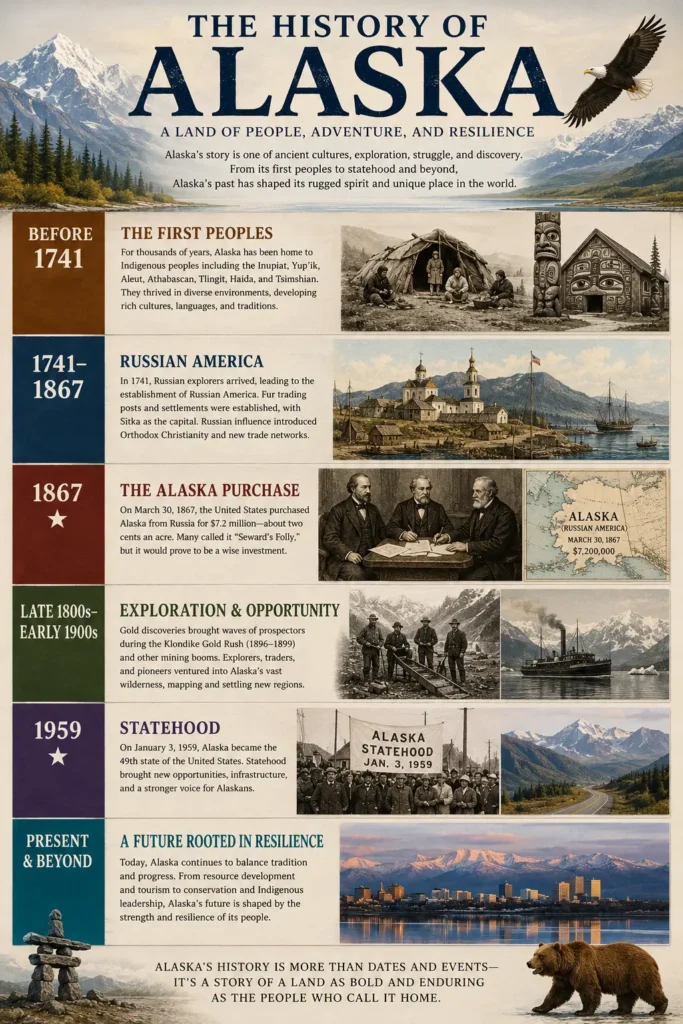
The History of Alaska: From Ancient Beringia to America’s Last Frontier
Introduction
Alaska is often called “The Last Frontier,” a land of immense wilderness, towering mountains, glaciers, rich natural resources, and vibrant Indigenous cultures. However, Alaska’s history stretches back thousands of years before it became the 49th state of the United States. Its story is one of survival, exploration, cultural resilience, economic transformation, and environmental significance.
From the first humans who crossed the ancient land bridge connecting Asia and North America to the modern challenges of climate change and Arctic geopolitics, Alaska has continuously shaped and been shaped by powerful forces of nature and humanity.
This article explores the complete history of Alaska, tracing its journey from prehistoric times to the modern era. The narrative is based on the themes and historical developments described in the attached document, including Indigenous civilizations, Russian colonization, the American acquisition, the Gold Rush, World War II, statehood, oil development, and Alaska’s role in the 21st century.
Chapter 1: Alaska Before Human History
Long before Alaska became known by its modern name, powerful geological forces shaped the land.
Millions of years ago, tectonic plates collided beneath the Earth’s surface. The Pacific Plate pushed beneath the North American Plate, creating massive mountain ranges, volcanoes, and seismic activity that continue to define Alaska today. These geological processes formed some of the highest peaks in North America, including the famous Denali.
During the Ice Age, enormous glaciers covered much of the region. These glaciers carved deep valleys, fjords, and river systems that remain visible today. Volcanoes and glaciers worked together to create one of the world’s most dramatic landscapes.
Even now, Alaska remains geologically active, experiencing frequent earthquakes and volcanic eruptions that remind residents that the forces which created the land are still at work.
Chapter 2: Beringia and the First Peoples
One of the most significant chapters in human history occurred in Alaska.
During the last Ice Age, sea levels dropped dramatically. This exposed a vast land bridge known as Beringia, connecting Siberia and Alaska. Rather than a narrow pathway, Beringia was a massive grassland ecosystem supporting mammoths, bison, horses, and other Ice Age animals.
Following these animal migrations, the first humans crossed into North America. They carried tools, knowledge, and traditions that would eventually spread across the continent.
These early inhabitants were not explorers seeking new territory. They were families searching for food and opportunities for survival. Over generations, they adapted to Alaska’s challenging environment and established sophisticated societies.
Chapter 3: Indigenous Civilizations of Alaska
Long before Europeans arrived, Alaska was home to diverse Indigenous cultures.
These communities developed unique ways of life adapted to their specific environments.
The Inupiat
The Inupiat lived in northern Alaska near the Arctic Ocean.
Their survival depended heavily on marine mammals, particularly whales. Hunting bowhead whales required extraordinary skill, cooperation, and courage. Every part of the whale was used, including:
- Meat for food
- Blubber for fuel
- Bones for tools
- Skin for shelter
Their culture emphasized cooperation because successful whale hunting required entire communities working together.
The Yupik
The Yupik inhabited western Alaska and coastal regions.
Their lives revolved around:
- Salmon fishing
- Seal hunting
- Bird harvesting
The Yupik believed in maintaining respectful relationships with animals and nature. Ceremonies and festivals celebrated the interconnectedness of all living things.
The Aleut (Unangan)
The Aleut people lived throughout the Aleutian Islands.
They became master navigators and hunters of the North Pacific. Using specialized skin boats, they hunted:
- Sea otters
- Seals
- Sea lions
Their craftsmanship was remarkable. Waterproof clothing made from seal intestines provided protection superior to many modern materials.
The Tlingit and Haida
In southeastern Alaska, the Tlingit and Haida built complex societies based on fishing, trade, and clan relationships.
These communities became known for:
- Totem poles
- Large wooden houses
- Trade networks
- Artistic achievements
Their social structures were highly organized and wealth was often displayed through generosity and ceremonial gift-giving.
The Athabascans
The interior regions of Alaska were home to Athabascan peoples.
Living in forests and river valleys, they relied on:
- Moose hunting
- Caribou hunting
- Fishing
- Seasonal migration
Their knowledge of the land was extensive and essential for survival in Alaska’s harsh climate.
Chapter 4: Spirituality and Cultural Traditions
Indigenous Alaskan societies developed rich spiritual traditions.
Nature was viewed as a living force populated by spirits. Animals, mountains, rivers, and weather all possessed spiritual significance.
Stories served multiple purposes:
- Preserving history
- Teaching morality
- Passing survival knowledge
- Strengthening cultural identity
The Raven, a prominent figure in many traditions, appeared as both creator and trickster. Oral storytelling became one of the most important methods of preserving cultural knowledge.
These traditions created a worldview emphasizing balance between humans and nature.
Chapter 5: Trade Networks Before European Contact
Contrary to popular misconceptions, Indigenous Alaskan societies were not isolated.
Extensive trade networks connected communities across vast distances.
Goods traded included:
- Copper
- Obsidian
- Shells
- Furs
- Food products
Trade routes linked coastal and interior regions, facilitating cultural exchange and economic cooperation. Stories, songs, and technologies traveled alongside physical goods.
These networks demonstrate the sophistication of Alaska’s Indigenous civilizations long before European arrival.
Chapter 6: Russian Exploration and Colonization
European involvement in Alaska began through Russian exploration.
In the early eighteenth century, Russian ruler Peter the Great sought to expand knowledge of the empire’s eastern frontier.
He commissioned expeditions led by Vitus Bering.
In 1741, Bering’s expedition reached Alaska, opening the region to Russian commercial interests.
Chapter 7: The Sea Otter Fur Trade
Russia’s primary interest in Alaska was not land but fur.
Sea otter pelts were among the most valuable commodities in global markets, especially in China.
Russian traders quickly established hunting operations throughout coastal Alaska. The demand for sea otter fur transformed Alaska into a major economic frontier.
However, this trade had devastating consequences:
- Overhunting reduced sea otter populations.
- Indigenous communities faced exploitation.
- Traditional lifestyles were disrupted.
- Disease spread among Native populations.
Chapter 8: Russian America
By the late eighteenth century, Russia established formal colonial control.
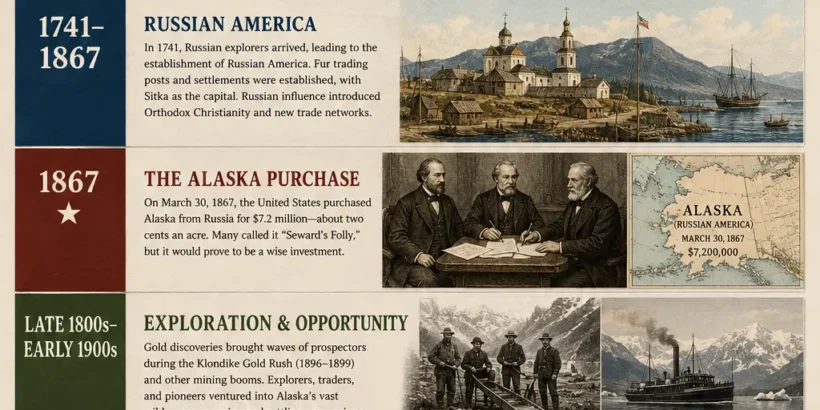
The Russian-American Company became the primary governing authority in Alaska. Its headquarters were located at Sitka, then known as Novo-Arkhangelsk.
Russian settlements expanded throughout coastal regions.
Relations between Russians and Indigenous peoples varied from cooperation to violent conflict. The Tlingit resistance at Sitka became one of the most significant confrontations of the colonial era.
Russian missionaries introduced Orthodox Christianity, leaving a lasting religious legacy that remains visible in many Alaskan communities today.
Chapter 9: Why Russia Sold Alaska
By the mid-nineteenth century, maintaining Alaska had become increasingly difficult for Russia.
Several factors influenced the decision to sell:
- Declining fur revenues
- High administrative costs
- Geographic isolation
- Fear of British expansion from Canada
- Financial pressures following the Crimean War
Russian leaders concluded that selling Alaska would be more beneficial than risking its loss during future conflicts.
Chapter 10: The Alaska Purchase
In 1867, the United States purchased Alaska from Russia for $7.2 million.
The agreement was negotiated by:
- William H. Seward
- Eduard de Stoeckl
The purchase equated to approximately two cents per acre.
At the time, many Americans criticized the acquisition.
Critics called it:
- “Seward’s Folly”
- “Seward’s Icebox”
Many believed Alaska was a frozen wasteland with little economic value. However, Seward believed Alaska’s strategic location and natural resources would eventually prove invaluable.
Part 2: Gold Rushes, Territorial Growth, World War II, and Statehood
Chapter 11: Early American Alaska (1867–1890)
Following the Alaska Purchase in 1867, the United States faced the challenge of governing a vast and remote territory.
Initially, Alaska received little attention from Washington. The federal government had limited administrative structures in place, and much of the territory remained largely unchanged from the Russian colonial era.
The U.S. Army, Treasury Department, and later the Navy each assumed partial responsibility for governing Alaska. However, there was no comprehensive territorial government for many years.
Despite the lack of governmental investment, several industries began to grow:
- Fishing
- Whaling
- Fur trading
- Timber harvesting
- Mining
American entrepreneurs soon recognized that Alaska possessed extraordinary economic potential.
The fishing industry became one of the first major sectors to expand. Alaska’s rivers and coastal waters contained some of the richest salmon populations in the world. Canneries began appearing along the coast, creating jobs and stimulating local economies.
At the same time, Indigenous communities faced significant changes. Federal policies encouraged assimilation, while missionary schools attempted to replace Native languages and traditions with Western cultural practices.
These developments marked the beginning of Alaska’s transition from a neglected frontier into a territory of growing national importance.
Chapter 12: The Discovery of Gold
The event that transformed Alaska’s destiny was the discovery of gold.
Throughout history, gold discoveries have triggered migrations, economic booms, and social transformations. Alaska proved no exception.
In the late nineteenth century, prospectors searching for mineral wealth began exploring the region’s rivers and mountains. Reports of gold deposits spread rapidly throughout North America.
The possibility of instant wealth attracted thousands of fortune seekers.
Many sold their possessions, left their jobs, and embarked on dangerous journeys into Alaska’s wilderness.
Most never became wealthy.
Yet the gold rush permanently changed Alaska’s population, economy, and relationship with the rest of the United States.
Chapter 13: The Klondike Gold Rush (1896–1899)
The most famous gold rush associated with Alaska began in 1896.
Gold was discovered near the Klondike River in neighboring Yukon Territory, Canada. Although the discovery occurred outside Alaska, most prospectors traveled through Alaskan ports to reach the goldfields.
The news exploded across North America in 1897.
Newspapers published dramatic headlines describing fortunes waiting to be claimed.
Thousands of prospectors rushed toward Alaska.
Key gateway communities included:
- Skagway
- Dyea
These settlements grew almost overnight.
What had been small frontier towns became bustling centers filled with:
- Merchants
- Saloon owners
- Transportation companies
- Hotel operators
- Outfitters
The journey to the goldfields was extremely difficult.
Prospectors crossed dangerous mountain passes such as:
- Chilkoot Pass
- White Pass
Many faced:
- Extreme cold
- Avalanches
- Starvation
- Disease
Despite the hardships, the Klondike Gold Rush became one of the most famous migration events in North American history.
Chapter 14: The Rise of Nome
Shortly after the Klondike excitement began to fade, another major gold discovery occurred.
In 1898, gold was found near Nome on Alaska’s western coast.
Unlike the Klondike deposits, Nome’s gold could often be collected directly from beach sands.
This accessibility attracted thousands of prospectors.
Nome’s population surged dramatically.
Tent cities appeared almost overnight.
Businesses, banks, newspapers, and transportation networks quickly emerged.
The Nome Gold Rush contributed significantly to Alaska’s economic development and reinforced the perception that the territory possessed immense mineral wealth.
By the early twentieth century, mining had become one of Alaska’s most important industries.
Chapter 15: Infrastructure Development
The gold rushes created demand for transportation and communication systems.
Prior to these developments, travel across Alaska was extremely difficult.
Economic growth encouraged investment in:
- Roads
- Telegraph lines
- Ports
- Railroads
One of the most significant projects was the construction of the Alaska Railroad.
Completed in the early twentieth century, the railroad connected key regions of south-central Alaska.
The railway improved:
- Trade
- Passenger travel
- Resource transportation
- Economic integration
Infrastructure projects helped transform Alaska from an isolated frontier into a more connected territory.
Chapter 16: Alaska’s Indigenous Peoples During American Rule
The expansion of American influence brought major changes for Alaska Native communities.
Government policies often sought to assimilate Indigenous populations into mainstream American culture.
Native children were frequently sent to boarding schools where:
- Native languages were discouraged.
- Traditional customs were restricted.
- Western educational systems were imposed.
These policies had long-lasting cultural consequences.
However, Indigenous communities demonstrated remarkable resilience.
Many continued preserving:
- Languages
- Oral traditions
- Artistic practices
- Spiritual beliefs
- Traditional ecological knowledge
Throughout the twentieth century, Alaska Native leaders increasingly organized to protect their rights, lands, and cultural heritage.
Their efforts would later influence major legal and political reforms.
Chapter 17: Alaska and World War II
World War II transformed Alaska’s strategic importance.
Because of its geographic position between North America and Asia, Alaska became a critical military frontier.
The territory suddenly gained national security significance.
Military bases expanded rapidly.
Roads, airfields, and ports were constructed throughout the region.
Thousands of military personnel arrived in Alaska.
The war accelerated economic development and population growth.
For many Americans, World War II was the first time Alaska appeared prominently in national news.
Chapter 18: The Aleutian Campaign
One of the least-known chapters of World War II occurred in Alaska.
In 1942, Japanese forces occupied two islands in the Aleutian chain:
- Attu
- Kiska
This marked the only occupation of American soil by enemy forces during the war.
The Aleutian Campaign became a major military operation.
American and Canadian forces launched efforts to retake the islands.
Harsh weather created extraordinary challenges:
- Dense fog
- Freezing temperatures
- Powerful winds
- Rugged terrain
Combat conditions were among the most difficult experienced during World War II.
The campaign ultimately succeeded in removing Japanese forces, but the conflict highlighted Alaska’s strategic importance in global military planning.
Chapter 19: Construction of the Alaska Highway
One of the most significant wartime infrastructure projects was the Alaska Highway.
Constructed in 1942, the highway connected Alaska to the continental United States through Canada.
The project was completed at remarkable speed.
Thousands of workers faced:
- Swamps
- Mountains
- Forests
- Permafrost
The Alaska Highway transformed transportation in northern North America.
Its benefits continued long after the war ended.
The road improved:
- Commerce
- Tourism
- National defense
- Regional connectivity
Today, it remains one of the most famous highways in the world.
Chapter 20: The Road to Statehood
Following World War II, many Alaskans believed territorial status no longer reflected the region’s importance.
Several arguments supported statehood:
Economic Growth
Alaska possessed valuable natural resources and growing industries.
Strategic Importance
The Cold War increased Alaska’s military significance.
Democratic Representation
Residents wanted greater political representation and self-governance.
Population Expansion
Population growth strengthened arguments that Alaska deserved statehood.
Statehood advocates worked tirelessly to convince Congress that Alaska was prepared to become a full member of the Union.
Chapter 21: The Statehood Movement
The statehood movement gained momentum during the 1950s.
Local leaders organized campaigns promoting Alaska’s future as a state.
Citizens argued that territorial status limited their ability to influence national policy.
Supporters emphasized:
- Economic potential
- Military significance
- Democratic principles
Opponents raised concerns regarding:
- Small population
- Administrative costs
- Geographic remoteness
Despite these challenges, public support for statehood continued growing.
The movement became one of the most important political campaigns in Alaska’s history.
Chapter 22: Alaska Becomes the 49th State
A historic milestone occurred on January 3, 1959.
Alaska officially became the 49th state of the United States.
The achievement represented decades of effort by residents and political leaders.
Statehood brought:
- Congressional representation
- Greater control over resources
- Increased federal investment
- Expanded political influence
Celebrations occurred across the territory.
For many residents, statehood symbolized recognition of Alaska’s unique contributions to the nation.
The event marked the beginning of a new chapter in Alaska’s development.
Chapter 23: The Cold War Frontier
Following statehood, Alaska became a critical location during the Cold War.
Its proximity to the Soviet Union made it strategically important.
Military installations expanded significantly.
Radar systems monitored potential threats across the Arctic.
Air bases became essential components of North American defense networks.
The Cold War strengthened Alaska’s role in national security and brought substantial federal investment into the state.
Chapter 24: Social and Economic Changes
Statehood encouraged rapid modernization.
New investments supported:
- Education
- Healthcare
- Transportation
- Communications
Urban centers expanded.
Communities such as:
- Anchorage
- Fairbanks
- Juneau
experienced significant growth.
Economic opportunities attracted workers from across the United States.
As Alaska entered the modern era, debates increasingly focused on balancing economic development with environmental protection and Indigenous rights.
The History of Alaska: From Ancient Beringia to America’s Last Frontier
Part 3: Oil, Indigenous Rights, Conservation, and Modern Alaska
Chapter 25: Alaska Enters the Oil Age
The decades following statehood brought one of the most transformative developments in Alaska’s history: the discovery of vast petroleum reserves.
Although geologists had long suspected that Alaska contained significant oil deposits, the true scale of its resources was not fully understood until the late 1960s.
The discovery of oil would permanently alter Alaska’s:
- Economy
- Politics
- Infrastructure
- Population growth
- Relationship with the federal government
Many historians consider the oil era the most significant economic transformation since the Gold Rush.
The impact extended far beyond energy production.
Oil revenues would fund public services, infrastructure projects, education, and economic development for decades to come.
Chapter 26: Discovery of Prudhoe Bay
A historic breakthrough occurred in 1968.
Large oil reserves were discovered at Prudhoe Bay on Alaska’s North Slope.
The discovery shocked energy experts.
Prudhoe Bay proved to be one of the largest oil fields ever discovered in North America.
The scale of the reserves immediately attracted national and international attention.
The discovery promised:
- Economic prosperity
- Energy security
- Employment opportunities
- Increased investment
However, major challenges remained.
The North Slope was extremely remote.
Transporting oil from Arctic Alaska to markets in the continental United States required innovative engineering solutions.
Chapter 27: The Trans-Alaska Pipeline System
To move oil from Prudhoe Bay to southern ports, one of the world’s most ambitious engineering projects was undertaken.
The Trans-Alaska Pipeline System (TAPS) was constructed during the 1970s.
The pipeline stretches approximately 800 miles across Alaska.
Key engineering challenges included:
- Permafrost
- Earthquakes
- Mountain ranges
- River crossings
- Extreme temperatures
Engineers designed specialized supports that allowed portions of the pipeline to remain elevated above the ground.
This prevented heat from the oil from melting frozen soil.
Construction employed thousands of workers and stimulated economic activity throughout the state.
When oil began flowing through the pipeline in 1977, Alaska entered a new era of prosperity.
The project became one of the most famous engineering achievements in modern American history.
Chapter 28: Economic Transformation Through Oil
Oil revenues dramatically increased state income.
Alaska suddenly possessed financial resources far beyond what many residents had imagined possible.
Revenue generated from oil production funded:
- Schools
- Roads
- Airports
- Healthcare facilities
- Public services
The energy sector became a dominant component of Alaska’s economy.
Employment opportunities expanded significantly.
Workers arrived from across the United States seeking jobs in:
- Construction
- Engineering
- Transportation
- Energy production
- Support services
Oil transformed Alaska from a relatively small economy into one of America’s most resource-rich states.
Chapter 29: The Alaska Permanent Fund
One of Alaska’s most innovative policies emerged from the oil boom.
In 1976, Alaska established the Alaska Permanent Fund.
The purpose was simple but visionary.
Rather than spending all oil revenues immediately, a portion would be invested for future generations.
The fund grew rapidly over time.
Investment earnings generated annual dividends distributed directly to eligible Alaska residents.
This system became internationally famous.
The Permanent Fund demonstrated how resource wealth could be managed for long-term public benefit rather than short-term consumption.
Today, it remains one of Alaska’s most important financial institutions.
Chapter 30: Alaska Native Land Claims
As development accelerated, unresolved questions regarding Indigenous land ownership became increasingly important.
For generations, Alaska Native communities had maintained strong cultural and historical ties to their ancestral lands.
However, legal ownership remained uncertain under American law.
Large-scale resource development intensified demands for a comprehensive settlement.
Indigenous leaders argued that economic expansion should not proceed without addressing Native rights.
The issue became one of the most significant political debates in Alaska’s history.
Chapter 31: The Alaska Native Claims Settlement Act (ANCSA)
A landmark solution emerged in 1971.
Congress passed the Alaska Native Claims Settlement Act.
ANCSA represented one of the largest Indigenous land settlements in American history.
The legislation provided:
- Millions of acres of land
- Financial compensation
- Creation of Native corporations
The act sought to balance:
- Indigenous rights
- Economic development
- State interests
- Federal priorities
While opinions regarding ANCSA remain diverse, the legislation fundamentally reshaped Alaska’s political and economic landscape.
Many Native corporations became important contributors to Alaska’s economy.
Chapter 32: Cultural Revival and Indigenous Leadership
The late twentieth century witnessed a resurgence of Indigenous cultural expression.
Many communities launched efforts to preserve:
- Native languages
- Traditional arts
- Oral histories
- Ceremonial practices
- Ecological knowledge
Educational programs encouraged younger generations to learn traditional skills and cultural heritage.
Museums, cultural centers, and tribal organizations expanded their activities.
Indigenous leaders increasingly participated in state and national politics.
Their advocacy influenced policies related to:
- Education
- Resource management
- Environmental protection
- Tribal sovereignty
The cultural revival strengthened Alaska’s diverse identity.
Chapter 33: Environmental Awareness
As industrial development expanded, environmental concerns also grew.
Alaska’s ecosystems are among the most unique on Earth.
The state contains:
- Arctic tundra
- Boreal forests
- Mountain ranges
- Wetlands
- Coastal ecosystems
These habitats support extraordinary biodiversity.
Scientists and conservationists emphasized the importance of protecting natural resources while allowing responsible economic growth.
Public debates increasingly focused on balancing development with conservation.
Chapter 34: National Parks and Protected Lands
Alaska contains some of the largest protected natural areas in the world.
Important conservation efforts led to the creation and expansion of parks and wildlife refuges.
Major protected areas include:
- Denali National Park and Preserve
- Glacier Bay National Park and Preserve
- Katmai National Park and Preserve
- Wrangell–St. Elias National Park and Preserve
- Kenai Fjords National Park
These protected areas preserve:
- Wildlife habitat
- Geological features
- Cultural resources
- Recreational opportunities
They also support Alaska’s tourism industry.
Chapter 35: The Exxon Valdez Oil Spill
One of Alaska’s most significant environmental disasters occurred in 1989.
The tanker Exxon Valdez oil spill ran aground in Prince William Sound.
Millions of gallons of crude oil entered the marine environment.
The spill affected:
- Wildlife populations
- Fisheries
- Coastal ecosystems
- Local communities
Images of oil-covered birds and marine mammals received global attention.
The disaster prompted major reforms in:
- Maritime safety
- Environmental regulation
- Oil transportation standards
The Exxon Valdez spill remains a defining event in environmental history.
Chapter 36: Alaska’s Fishing Industry
Fishing remains one of Alaska’s most important industries.
The state’s waters support valuable commercial fisheries.
Major products include:
- Salmon
- Halibut
- Pollock
- Crab
- Cod
Alaska is internationally recognized for sustainable fishery management.
Regulations seek to balance economic activity with long-term resource conservation.
Fishing supports thousands of jobs and contributes billions of dollars to the economy.
Many coastal communities continue relying heavily on marine resources.
Chapter 37: Tourism and the Last Frontier Experience
Tourism emerged as another major economic sector.
Visitors travel to Alaska seeking:
- Wilderness adventures
- Wildlife viewing
- Glacier tours
- Fishing opportunities
- Cultural experiences
Popular attractions include:
- Denali
- Glacier Bay
- Inside Passage
- Northern Lights
- Arctic landscapes
Cruise tourism became particularly important.
Thousands of visitors arrive annually through southeastern Alaska ports.
Tourism generates significant revenue while showcasing Alaska’s natural beauty to the world.
Chapter 38: Climate Change and the Arctic
In recent decades, climate change has become one of Alaska’s most important challenges.
The Arctic is warming faster than many other regions on Earth.
Observable impacts include:
- Melting glaciers
- Thawing permafrost
- Coastal erosion
- Changing wildlife patterns
- Reduced sea ice
Some communities face relocation due to environmental changes.
Scientists use Alaska as a critical location for climate research.
The state’s experiences provide valuable insights into global environmental trends.
Chapter 39: Alaska’s Strategic Importance in the Twenty-First Century
The Arctic’s growing importance has increased Alaska’s geopolitical significance.
Several factors contribute to this trend:
Arctic Shipping Routes
Reduced sea ice may create new maritime pathways.
Natural Resources
The Arctic contains significant energy and mineral resources.
National Security
Alaska remains strategically positioned between North America and Asia.
Scientific Research
The state serves as a major center for Arctic research.
As global attention increasingly focuses on the Arctic, Alaska’s importance continues to grow.
Chapter 40: Modern Alaska Society
Today’s Alaska reflects a blend of tradition and modernity.
The state’s population includes:
- Indigenous peoples
- Long-term residents
- Military personnel
- Energy workers
- Entrepreneurs
- Scientists
Modern Alaska combines:
- Advanced infrastructure
- Traditional cultural practices
- Economic innovation
- Environmental stewardship
Residents continue adapting to both opportunities and challenges.
This adaptability has characterized Alaska throughout its history.
Conclusion of Part 3
The discovery of oil transformed Alaska’s economy, while Indigenous land settlements reshaped political relationships and cultural preservation efforts strengthened Native communities. At the same time, environmental challenges and Arctic geopolitics positioned Alaska at the center of important global discussions.
Part 4 (Final Part): Timeline, Key Figures, Economy, Culture, Future, FAQ, and References
Chapter 41: Complete Historical Timeline of Alaska
Prehistoric Era
25,000–15,000 BCE
- Formation of Beringia, the land bridge connecting Asia and North America.
- Early humans migrate into Alaska.
12,000–8,000 BCE
- Indigenous cultures begin establishing permanent settlements.
Indigenous Alaska
Before 1700
- Development of major Indigenous cultures:
- Inupiat
- Yupik
- Aleut (Unangan)
- Athabascan
- Tlingit
- Haida
- Tsimshian
- Expansion of trade networks throughout Alaska.
Russian Era
1728
- Vitus Bering explores the region.
1741
- Russian expedition reaches Alaska.
1784
- First permanent Russian settlement established.
1799
- Russian-American Company receives authority to govern Russian America.
American Acquisition
1867
- Alaska purchased from Russia for $7.2 million.
- Purchase negotiated by William H. Seward.
Gold Rush Era
1880
- Gold discovered near Juneau.
1896
- Klondike Gold Rush begins.
1898
- Nome Gold Rush starts.
Twentieth Century
1912
- Alaska becomes an organized U.S. territory.
1942
- Japanese forces occupy Attu and Kiska Islands.
1942
- Alaska Highway construction begins.
1959
- Alaska becomes the 49th state.
Oil Era
1968
- Discovery of Prudhoe Bay oil field.
1971
- Alaska Native Claims Settlement Act passed.
1977
- Trans-Alaska Pipeline begins operation.
1976–Present
- Alaska Permanent Fund established and grows.
Modern Era
1989
- Exxon Valdez oil spill.
2000–Present
- Climate change becomes a major issue.
2020s
- Increasing global attention on Arctic resources and shipping routes.
Chapter 42: Key Historical Figures in Alaska History
Vitus Bering
The explorer whose voyages opened Alaska to Russian expansion.
His expeditions changed global understanding of the North Pacific and helped initiate European involvement in Alaska.
William H. Seward
Often ridiculed for supporting the Alaska Purchase, Seward ultimately became recognized as a visionary statesman.
His belief in Alaska’s future proved remarkably accurate.
Indigenous Leaders
Numerous Indigenous leaders helped preserve Alaska Native cultures despite centuries of colonial pressure.
Their efforts contributed to:
- Cultural survival
- Land rights
- Political representation
- Educational reform
Statehood Advocates
Political leaders, activists, and ordinary citizens worked tirelessly to achieve statehood.
Their campaign culminated in Alaska’s admission to the Union in 1959.
Chapter 43: Alaska’s Economy Today
Modern Alaska possesses one of the most resource-rich economies in North America.
Key sectors include:
Oil and Gas
The energy sector remains a major source of:
- Revenue
- Employment
- Government funding
Fishing
Commercial fisheries produce billions of dollars in economic activity.
Alaska seafood is exported worldwide.
Tourism
Visitors contribute significantly through:
- Cruise travel
- Adventure tourism
- Wildlife tours
- Cultural tourism
Mining
Important minerals include:
- Gold
- Zinc
- Lead
- Silver
- Copper
Government and Military
Federal agencies and military installations provide substantial employment.
Chapter 44: Alaska’s Cultural Heritage
One of Alaska’s greatest strengths is its cultural diversity.
The state combines influences from:
- Indigenous traditions
- Russian heritage
- American frontier culture
- Modern global influences
Traditional art forms remain vibrant.
Examples include:
- Totem carving
- Basket weaving
- Ivory carving
- Beadwork
- Storytelling
Cultural festivals celebrate both Indigenous heritage and Alaska’s multicultural identity.
Chapter 45: Alaska’s Wildlife
Alaska supports some of the world’s most iconic wildlife populations.
Notable species include:
- Brown bears
- Polar bears
- Moose
- Caribou
- Wolves
- Dall sheep
- Bald eagles
- Humpback whales
- Orcas
- Sea otters
Wildlife contributes significantly to:
- Tourism
- Scientific research
- Indigenous subsistence practices
- Conservation efforts
Chapter 46: Alaska and the Future Arctic Economy
The Arctic is becoming increasingly important.
Future opportunities may include:
Shipping
New Arctic sea routes could shorten international trade routes.
Energy Development
Significant untapped resources remain.
Scientific Research
Alaska serves as a critical laboratory for climate studies.
International Cooperation
Arctic nations increasingly collaborate on:
- Environmental protection
- Resource management
- Security concerns
Alaska is expected to play a major role in these developments.
Chapter 47: Fifty Important Facts About Alaska
- Alaska is the largest U.S. state.
- It became the 49th state in 1959.
- Russia sold Alaska in 1867.
- The purchase cost $7.2 million.
- Alaska has more coastline than all other U.S. states combined.
- Denali is North America’s highest peak.
- Alaska contains thousands of glaciers.
- It experiences frequent earthquakes.
- The state hosts active volcanoes.
- Indigenous peoples have lived there for thousands of years.
- Beringia once connected Asia and North America.
- Russian explorers arrived in the eighteenth century.
- Sea otter fur drove early Russian interest.
- Sitka was once the capital of Russian America.
- Gold discoveries transformed the territory.
- Nome became famous during the Gold Rush.
- Juneau is the state capital.
- Anchorage is the largest city.
- Fairbanks is a major interior city.
- Alaska played a strategic role in World War II.
- Japanese forces occupied Aleutian islands.
- The Alaska Highway was built during WWII.
- Prudhoe Bay contains major oil reserves.
- The Trans-Alaska Pipeline spans about 800 miles.
- The Alaska Permanent Fund distributes dividends.
- ANCSA settled Indigenous land claims.
- Alaska has extensive national parks.
- Glacier Bay is internationally famous.
- Katmai is known for bears.
- Denali attracts climbers worldwide.
- Fishing is a major industry.
- Salmon are economically important.
- Tourism generates billions of dollars.
- Cruise ships bring many visitors.
- Alaska experiences the midnight sun.
- Some areas experience polar night.
- Climate change affects Alaska significantly.
- Permafrost is thawing in many regions.
- Arctic sea ice is declining.
- Alaska is rich in biodiversity.
- Native languages are being revitalized.
- Totem poles remain important cultural symbols.
- Alaska has rich mineral resources.
- Military installations are strategically important.
- Arctic research is expanding.
- Renewable energy projects are increasing.
- Wildlife conservation remains a priority.
- Alaska has a strong outdoor culture.
- The Arctic’s global importance continues to grow.
- Alaska remains America’s Last Frontier.
Frequently Asked Questions (FAQ)
Why did Russia sell Alaska?
Russia sold Alaska because it was expensive to maintain, geographically isolated, and vulnerable to British expansion after the Crimean War.
How much did the United States pay for Alaska?
The United States paid $7.2 million in 1867.
What is Alaska famous for?
Alaska is famous for:
- Wilderness
- Mountains
- Glaciers
- Wildlife
- Oil
- Gold Rush history
- Indigenous cultures
What is Alaska’s largest city?
Anchorage is Alaska’s largest city.
What is Alaska’s highest mountain?
Denali is the highest mountain in North America.
Why is Alaska important today?
Alaska is important because of:
- Energy resources
- Strategic military location
- Arctic research
- Fisheries
- Tourism
- Environmental significance
Conclusion
The history of Alaska is one of extraordinary transformation. From the ancient migrations across Beringia to the rise of Indigenous civilizations, from Russian colonization to American acquisition, from Gold Rush excitement to oil wealth, Alaska has continuously evolved while preserving its unique character.
Its story reflects themes that resonate throughout human history:
- Exploration
- Adaptation
- Economic opportunity
- Cultural resilience
- Environmental stewardship
Today, Alaska stands at the intersection of tradition and modernity, local heritage and global significance. As climate change, Arctic development, and international cooperation shape the future, Alaska remains one of the most fascinating and strategically important regions in the world.
Far more than a remote frontier, Alaska is a vital part of the American story and a critical player in the future of the Arctic.
References
- Alaska historical materials and timelines from the uploaded source files.
- Indigenous cultures and early Alaska history from the uploaded educational content.
- Russian exploration and colonization records contained in the uploaded files.
- Russian America and Sitka historical sections from the uploaded files.
- Alaska Purchase documentation and historical summaries from the uploaded files.
- Alaska statehood and twentieth-century development materials from the uploaded files.
- Oil development, Prudhoe Bay, and Trans-Alaska Pipeline information from the uploaded historical resources.
- Alaska Native Claims Settlement Act historical sections from the uploaded files.
- Environmental conservation and modern Alaska chapters from the uploaded materials.
- Climate, economy, and contemporary Arctic significance sections from the uploaded files.
Alaska’s Geography and Natural Features
Alaska is the largest state in the United States, covering approximately 665,384 square miles (1.72 million square kilometers). Its immense size makes it larger than Texas, California, and Montana combined.
The state is divided into several major geographic regions:
Arctic Region
Northern Alaska consists primarily of Arctic tundra. This region experiences extremely cold winters and short summers.
Interior Alaska
The interior is characterized by vast forests, river systems, and mountain ranges. The Yukon River serves as one of the region’s most important waterways.
South-Central Alaska
This area includes Anchorage and some of the state’s largest population centers. It is surrounded by mountains, glaciers, and coastal ecosystems.
Southeast Alaska
Known as the “Inside Passage,” this region contains fjords, islands, temperate rainforests, and thriving fishing communities.
Aleutian Islands
Stretching toward Asia, the Aleutian chain contains numerous volcanic islands and plays an important role in both ecology and geopolitics.
Alaska’s Climate
One of Alaska’s defining characteristics is its diverse climate.
Arctic Climate
Northern Alaska experiences:
- Long, cold winters
- Short summers
- Limited precipitation
- Extensive snow cover
Subarctic Climate
Interior Alaska features:
- Extremely cold winters
- Warm summers
- Large seasonal temperature variations
Maritime Climate
Southern coastal areas experience:
- Milder winters
- Cooler summers
- Heavy rainfall
- Frequent storms
These climatic differences create diverse ecosystems and influence how communities live and work throughout the state.
Education in Alaska
Education has played a vital role in Alaska’s development.
Major educational institutions include:
University of Alaska Anchorage
One of the state’s largest higher education institutions.
University of Alaska Fairbanks
Known for Arctic research and scientific studies.
University of Alaska Southeast
Serves southeastern communities and specializes in regional programs.
These institutions contribute significantly to:
- Scientific research
- Workforce development
- Arctic studies
- Indigenous education
Transportation in Alaska
Transportation presents unique challenges because of Alaska’s vast size and rugged terrain.
Roads
Major highways include:
- Alaska Highway
- Parks Highway
- Richardson Highway
Aviation
Many communities rely heavily on aircraft.
Small planes provide:
- Passenger transportation
- Medical services
- Supply deliveries
Marine Transportation
Ferries play an important role in connecting coastal communities.
The Alaska Marine Highway System serves numerous towns inaccessible by road.
Alaska’s Role in Scientific Research
Alaska has become one of the world’s most important locations for scientific research.
Research areas include:
Climate Science
Scientists study:
- Glacial retreat
- Permafrost thaw
- Arctic warming
- Ocean changes
Wildlife Biology
Researchers monitor:
- Bear populations
- Marine mammals
- Bird migrations
- Fish stocks
Earth Sciences
Alaska provides opportunities to study:
- Volcanoes
- Earthquakes
- Tectonic activity
- Glaciers
Research conducted in Alaska contributes to global understanding of environmental change.
Indigenous Languages of Alaska
Alaska is home to numerous Indigenous languages.
Examples include:
- Inupiaq
- Yup’ik
- Aleut
- Tlingit
- Haida
- Athabascan languages
Language revitalization efforts include:
- Community programs
- Educational curricula
- Digital resources
- Cultural immersion initiatives
Many communities view language preservation as essential to maintaining cultural identity.
Alaska’s Major Festivals and Celebrations
Throughout the year, Alaska hosts numerous cultural events.
Iditarod Trail Sled Dog Race
The famous race commemorates historic transportation routes across Alaska.
Native Heritage Celebrations
These events showcase:
- Traditional dance
- Storytelling
- Music
- Art
Winter Festivals
Communities celebrate Alaska’s unique winter environment through festivals and competitions.
These events strengthen community identity and attract visitors from around the world.
Alaska’s Influence on Popular Culture
Alaska has inspired countless works of literature, film, and television.
Its dramatic landscapes and frontier image have appeared in:
- Adventure novels
- Documentary films
- Nature programs
- Travel writing
Writers and filmmakers are often drawn to Alaska because it represents:
- Wilderness
- Exploration
- Independence
- Human resilience
Challenges Facing Alaska in the Future
While Alaska possesses tremendous opportunities, several challenges remain.
Climate Change
Impacts include:
- Coastal erosion
- Thawing permafrost
- Infrastructure damage
- Ecosystem changes
Economic Diversification
Reducing dependence on oil remains a major policy goal.
Rural Development
Many remote communities face:
- High transportation costs
- Limited infrastructure
- Population decline
Arctic Competition
Growing international interest in Arctic resources and shipping routes presents both opportunities and challenges.
Why Alaska Matters Globally
Alaska’s importance extends far beyond the United States.
It plays a significant role in:
- Arctic governance
- Global climate research
- Energy production
- Fisheries management
- International security
As the Arctic becomes increasingly important during the twenty-first century, Alaska’s strategic value is likely to continue growing.