The Complete History of Indiana
Indiana is one of the most historically significant states in the American Midwest. Known today for its fertile farmland, thriving manufacturing industry, bustling transportation network, and the world-famous Indianapolis 500, Indiana has a rich story stretching back thousands of years before European settlers arrived.
Long before Indiana became the 19th state of the United States on December 11, 1816, the region was home to thriving Native American cultures that built villages, traded across North America, and developed complex societies. Later, French explorers navigated its rivers, British officials governed its frontier, American pioneers settled its forests, and industrial development transformed it into one of the nation’s economic powerhouses.
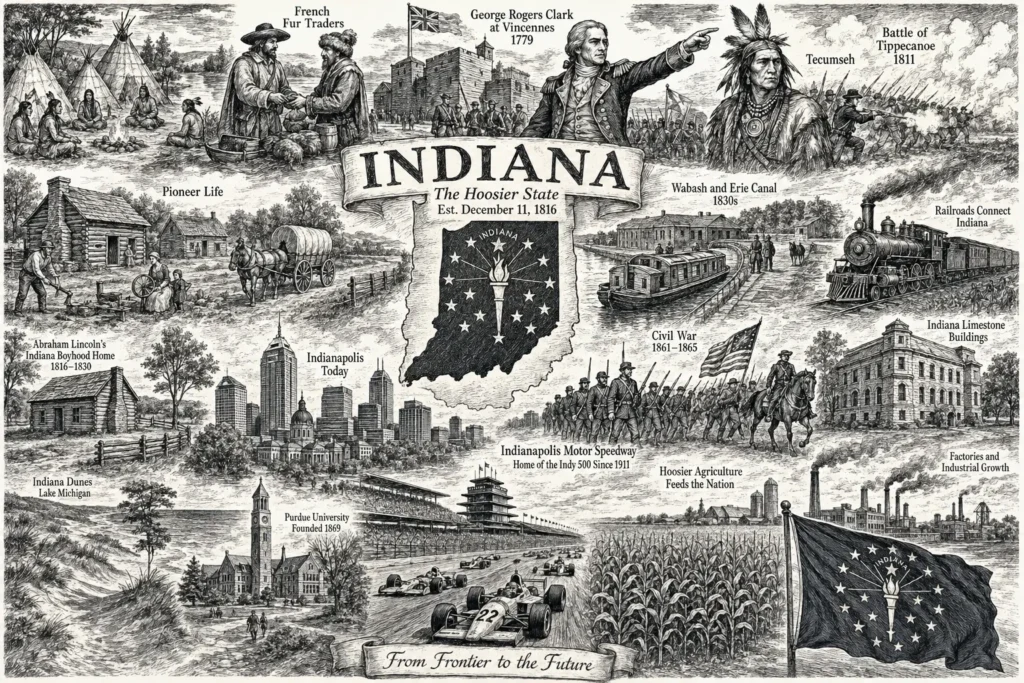
Indiana’s central location made it a gateway connecting the eastern United States with the expanding western frontier. Throughout its history, the state has played important roles during the Revolutionary War, westward expansion, the Civil War, both World Wars, and America’s modern industrial growth.
Today, Indiana combines a strong agricultural tradition with advanced manufacturing, healthcare, education, logistics, and motorsports. Millions visit annually to experience the Indianapolis Motor Speedway, Indiana Dunes National Park, historic towns, museums, and cultural festivals that celebrate the state’s unique heritage.
This comprehensive guide explores Indiana’s fascinating history—from prehistoric civilizations to its place in the twenty-first century.
Quick Facts About Indiana
| Feature | Information |
|---|---|
| Statehood | December 11, 1816 |
| State Number | 19th State |
| Capital | Indianapolis |
| Largest City | Indianapolis |
| Nickname | The Hoosier State |
| Motto | The Crossroads of America |
| Population | Approximately 6.9 million (2025 estimate) |
| Official Bird | Northern Cardinal |
| Official Flower | Peony |
| Official Tree | Tulip Tree |
| Major Industries | Manufacturing, Agriculture, Healthcare, Logistics |
| Famous Event | Indianapolis 500 |
Where Is Indiana?
Indiana lies in the heart of the American Midwest. It shares borders with:
- Michigan to the north
- Ohio to the east
- Kentucky to the south
- Illinois to the west
The state also has a small shoreline along Lake Michigan, providing access to one of North America’s largest freshwater systems.
Covering approximately 36,420 square miles (94,321 square kilometers), Indiana is neither among the largest nor the smallest U.S. states, but its strategic location has made it one of the country’s most important transportation hubs.
Because several major interstate highways, railroads, and shipping routes pass through Indiana, it is often called “The Crossroads of America.”
Indiana’s Natural Landscape
Indiana’s geography has significantly influenced its history and economy.
Northern Indiana
Northern Indiana features:
- Rich farmland
- Numerous lakes
- Sand dunes along Lake Michigan
- Flat glacial plains
The Indiana Dunes are among the state’s most famous natural attractions and support diverse ecosystems with hundreds of plant and animal species.
Central Indiana
Central Indiana is characterized by:
- Rolling plains
- Fertile agricultural land
- Major rivers
- Large urban centers
Indianapolis, the state’s capital and largest city, is located here, serving as Indiana’s political, economic, and cultural heart.
Southern Indiana
Southern Indiana differs markedly from the rest of the state, with:
- Forested hills
- Limestone caves
- Rugged terrain
- Scenic river valleys
The Ohio River forms Indiana’s southern border and has long served as an important transportation and trade route.
Climate and Natural Resources
Indiana experiences four distinct seasons:
- Warm summers
- Colorful autumns
- Cold winters
- Mild springs
Its fertile soil supports major agricultural production, including:
- Corn
- Soybeans
- Wheat
- Tomatoes
- Melons
- Livestock
Southern Indiana contains abundant limestone deposits that have been used in famous buildings across America, including parts of the Pentagon, the Empire State Building, and the National Cathedral.
Indiana Before Human Settlement
Thousands of years ago, glaciers covered much of Indiana.
During the last Ice Age:
- Massive sheets of ice reshaped the landscape.
- Rivers changed course.
- Lakes formed.
- Rich soils developed.
As the glaciers retreated approximately 12,000 years ago, forests gradually spread across Indiana, creating ideal environments for wildlife and eventually human settlement.
Mammoths, mastodons, giant ground sloths, and other Ice Age animals once roamed the region before becoming extinct.
The First People of Indiana
Archaeological evidence suggests humans arrived in present-day Indiana more than 12,000 years ago.
These early inhabitants belonged to the Paleo-Indian culture, known for:
- Hunting large Ice Age animals
- Crafting finely shaped stone spear points
- Following migrating game across North America
As the climate warmed, these early peoples adapted by hunting deer, fishing, gathering plants, and establishing seasonal camps.
The Archaic Period
Between approximately 8000 BCE and 1000 BCE, Indiana’s inhabitants entered the Archaic Period.
During this era they:
- Used improved stone tools
- Developed fishing technologies
- Collected nuts and berries
- Built semi-permanent villages
- Increased regional trade
Population slowly grew as communities became more stable.
The Woodland Period
Beginning around 1000 BCE, Indiana experienced the Woodland Period.
Significant developments included:
Pottery
Communities began producing ceramic pottery for cooking and storage.
Agriculture
People cultivated crops such as:
- Squash
- Sunflowers
- Goosefoot
- Later, maize (corn)
Burial Mounds
Many Woodland cultures built ceremonial earthworks and burial mounds that reflected increasingly organized societies and spiritual traditions.
The Mississippian Culture
Around 1000 CE, the Mississippian culture spread into parts of southern Indiana.
These societies built:
- Large towns
- Temple mounds
- Public plazas
- Agricultural communities
Their economy centered on maize agriculture, supported by extensive trade networks reaching across much of North America.
Although Indiana was not home to cities as large as Cahokia in present-day Illinois, Mississippian influence shaped many communities throughout the Ohio River Valley.
Native American Tribes of Indiana
When Europeans first arrived, Indiana was home to several Native American nations.
Among the most influential were:
Miami
The Miami people occupied much of northern and central Indiana.
They became skilled:
- Farmers
- Hunters
- Diplomats
- Traders
The Miami Confederacy became one of the most powerful Native alliances in the Great Lakes region.
Potawatomi
The Potawatomi lived mainly in northern Indiana.
Their economy combined:
- Farming
- Fishing
- Hunting
- Fur trading
Many later formed alliances with the French during the colonial era.
Shawnee
The Shawnee frequently moved throughout Indiana and neighboring regions.
Known as fierce defenders of Native lands, they later became central figures in resistance against American expansion under the leadership of Tecumseh.
Delaware (Lenape)
Originally from the eastern colonies, many Delaware people relocated to Indiana during the eighteenth century after pressure from European settlement.
Wea
The Wea lived primarily along the Wabash River and became important trading partners with French settlers.
Kickapoo
The Kickapoo occupied western Indiana and neighboring Illinois.
They maintained strong hunting traditions while participating in regional trade.
Daily Life of Indiana’s Native Peoples
Native communities adapted closely to Indiana’s environment.
Typical villages included:
- Wooden longhouses
- Bark-covered homes
- Storage pits
- Community gardens
Families cultivated crops known as the Three Sisters:
- Corn
- Beans
- Squash
Men often hunted:
- Deer
- Elk
- Buffalo (occasionally)
- Bear
- Turkey
Women played central roles in farming, food preparation, pottery production, and community leadership.
Trade routes connected Indiana with distant regions, bringing:
- Copper
- Seashells
- Flint
- Decorative stones
- Ceremonial objects
Spiritual Beliefs
Native American spirituality emphasized harmony with nature.
Animals, rivers, forests, and celestial bodies held deep spiritual significance.
Ceremonies often marked:
- Seasonal changes
- Successful hunts
- Harvests
- Births
- Deaths
Medicine people and spiritual leaders guided communities through rituals, healing practices, and oral traditions.
Early European Exploration
The first Europeans to reach the Indiana region were almost certainly French explorers during the seventeenth century.
France sought to expand its influence throughout North America by exploring rivers, establishing fur-trading networks, and building alliances with Native peoples.
Unlike later American settlers, the French initially focused more on trade than permanent settlement.
Samuel de Champlain’s Influence
Although Samuel de Champlain never entered present-day Indiana, his explorations of Canada and the Great Lakes inspired later French expeditions into the interior of North America.
His efforts established New France as a major colonial power.
French Explorers Reach Indiana
By the late 1600s, French explorers and missionaries traveled through the Great Lakes into the Indiana region.
Important figures included:
- René-Robert Cavelier, Sieur de La Salle
- Jacques Marquette
- Louis Jolliet
These explorers mapped rivers, documented Native communities, and established trade relationships.
The Wabash River soon became one of the most important transportation routes in the region.
The Fur Trade
The fur trade transformed Indiana during the seventeenth and eighteenth centuries.
European demand for beaver pelts encouraged French traders to establish trading posts throughout the region.
Native hunters exchanged:
- Beaver pelts
- Deer hides
- Animal furs
For European goods such as:
- Metal tools
- Firearms
- Blankets
- Glass beads
- Cooking utensils
These exchanges reshaped Native economies and strengthened French influence across the Midwest.
French Trading Posts
Several important trading centers developed in Indiana, including:
- Vincennes
- Ouiatenon (near present-day Lafayette)
These settlements became centers of commerce where Native Americans and French traders exchanged goods, shared knowledge, and built political alliances.
Missionaries also established churches and introduced Christianity to some Native communities, although many traditional beliefs remained strong.
The Complete History of Indiana: From Ancient Native Cultures to the Modern Hoosier State (Part 2)
British Rule After the French and Indian War
The balance of power in North America changed dramatically during the French and Indian War (1754–1763), the North American theater of the global Seven Years’ War. France and Great Britain fought for control of vast territories, including the Ohio Valley and the lands that now make up Indiana.
The conflict ended with the Treaty of Paris in 1763, under which France ceded nearly all of its territory east of the Mississippi River to Great Britain. As a result, Indiana became part of Britain’s expanding North American empire.
For the Native American nations living in the region, this transition brought uncertainty. Many tribes had developed cooperative relationships with French traders, who generally maintained smaller settlements and relied on alliances. British officials, however, often pursued different policies that strained these relationships.
Life Under British Rule
Although British control was officially established, the frontier remained largely shaped by Native American communities and the fur trade.
British authorities:
- Maintained former French forts.
- Continued the fur trade.
- Sent military garrisons to strategic locations.
- Attempted to regulate westward settlement.
However, tensions quickly arose because many Native nations feared British expansion would lead to the loss of their ancestral lands.
Pontiac’s Rebellion (1763–1766)
One of the earliest and most significant challenges to British authority was Pontiac’s Rebellion.
Pontiac, an Ottawa leader, united numerous Native American tribes in resistance against British occupation. Although Indiana itself was not the center of the uprising, several forts and trading posts in and around the region were affected.
The goals of the rebellion included:
- Driving British troops from the Great Lakes.
- Protecting Native lands.
- Preserving traditional ways of life.
- Restoring balanced trade relationships.
Native warriors attacked British forts across the frontier, demonstrating the strength of intertribal cooperation.
Although British forces eventually suppressed the rebellion, they recognized the need for a more cautious approach toward Native nations.
The Royal Proclamation of 1763
In response to Pontiac’s Rebellion, King George III issued the Royal Proclamation of 1763.
This proclamation established a boundary along the Appalachian Mountains and prohibited colonial settlement west of that line without government approval.
Its objectives were to:
- Reduce conflicts between settlers and Native Americans.
- Stabilize Britain’s frontier.
- Maintain profitable trade with Native nations.
While the policy temporarily slowed westward expansion, many colonists ignored the restrictions, creating resentment that later contributed to the American Revolution.
Indiana During the American Revolution
When the American Revolutionary War (1775–1783) began, Indiana remained a remote frontier.
Although there were relatively few European settlements, the region held strategic importance because of its rivers, trading posts, and alliances with Native tribes.
Different groups supported different sides:
- Most British officials remained loyal to the Crown.
- Many Native nations allied with Britain, believing British victory would better protect their lands.
- American settlers sought to expand westward.
The conflict transformed Indiana into an important frontier battleground.
George Rogers Clark’s Campaign
One of the Revolution’s most famous western leaders was George Rogers Clark.
In 1778, Clark organized an expedition from Kentucky to capture British-held settlements in the Illinois Country and the Wabash Valley.
His forces seized Vincennes, one of Indiana’s oldest European settlements.
Although the British briefly regained control, Clark launched a daring winter campaign in 1779.
After marching through flooded wilderness for weeks, his men surprised British forces at Vincennes and secured an American victory.
This campaign strengthened American claims to the Northwest Territory during later peace negotiations.
Vincennes: Indiana’s First Major Settlement
Founded around 1732 by French traders, Vincennes became the oldest continuously inhabited European settlement in Indiana.
Throughout the eighteenth century, it served as:
- A fur-trading center.
- A military outpost.
- A farming community.
- A meeting place between Native Americans and Europeans.
George Rogers Clark’s capture of Vincennes became one of the most celebrated events in Indiana’s colonial history.
Today, the George Rogers Clark National Historical Park commemorates this achievement.
Native American Alliances During the Revolution
Many Native American nations viewed the American Revolution differently from European colonists.
Their primary concern was preserving their homeland rather than choosing between Britain and the American colonies.
Several tribes, including members of the Miami and Shawnee nations, generally favored Britain because British officials had attempted—at least officially—to limit colonial settlement west of the Appalachians.
However, Native communities were not united. Some groups remained neutral, while others formed different alliances depending on local circumstances.
These divisions would shape the decades that followed.
The Treaty of Paris (1783)
The Revolutionary War ended with the Treaty of Paris in 1783.
Great Britain recognized the independence of the United States and ceded territory extending to the Mississippi River.
This agreement transferred control of present-day Indiana to the new United States.
However, Native American nations were not represented during the negotiations, even though they occupied much of the region.
As a result, many tribes rejected American claims to the land, leading to years of conflict on the frontier.
The Northwest Territory
After independence, Congress faced the challenge of governing the vast lands west of the Appalachian Mountains.
The solution came through the Northwest Ordinance of 1787, one of the most important laws in early American history.
The ordinance created the Northwest Territory, which included lands that would eventually become:
- Ohio
- Indiana
- Illinois
- Michigan
- Wisconsin
- Part of Minnesota
The law established a process for creating new states rather than permanent colonies.
Why the Northwest Ordinance Was Important
The Northwest Ordinance introduced several groundbreaking principles.
It guaranteed:
- Organized territorial government.
- Religious freedom.
- Trial by jury.
- Public education.
- Orderly admission of new states.
Most significantly, it prohibited slavery throughout most of the Northwest Territory, shaping the region’s future political and economic development.
The ordinance became a model for later U.S. territorial expansion.
Early Settlement of Indiana
Following the Revolutionary War, increasing numbers of American settlers crossed the Ohio River into Indiana.
They established:
- Farms.
- Villages.
- Trading posts.
- Churches.
- Schools.
Most early settlements developed near rivers, which served as the primary transportation routes before roads became widespread.
Settlement remained limited, however, because large portions of Indiana were still controlled by Native American nations.
Conflict on the Frontier
As settlers moved westward, disputes over land intensified.
Native nations argued that:
- Their treaties with Britain remained valid.
- The United States had no authority to claim their territory without negotiation.
- Continued settlement violated earlier agreements.
Frontier violence increased throughout the late eighteenth century.
American military expeditions met determined Native resistance, resulting in several costly defeats.
The Treaty of Greenville (1795)
Following General Anthony Wayne’s victory at the Battle of Fallen Timbers (1794), peace negotiations were held between the United States and several Native American nations.
The resulting Treaty of Greenville, signed in 1795, became a turning point in Indiana’s history.
Under the treaty:
- Native tribes ceded large areas of land in present-day Ohio.
- Small strategic tracts in Indiana were also transferred to the United States.
- Americans gained access to important transportation routes and trading locations.
- Peace temporarily returned to the frontier.
Although the treaty opened new areas to settlement, many Native leaders opposed further land cessions.
The Creation of the Indiana Territory (1800)
As population increased, Congress divided the Northwest Territory.
On July 4, 1800, the Indiana Territory was officially created.
It originally included land that would later become:
- Indiana
- Illinois
- Michigan
- Wisconsin
- Parts of Minnesota
Its first capital was Vincennes, which remained the territory’s political center for many years.
William Henry Harrison Becomes Governor
President John Adams appointed William Henry Harrison as the first governor of the Indiana Territory.
Only twenty-seven years old when appointed, Harrison quickly became one of the most influential figures in Indiana’s early history.
His responsibilities included:
- Negotiating treaties.
- Encouraging settlement.
- Maintaining frontier security.
- Establishing territorial government.
- Promoting economic development.
Harrison believed rapid expansion was essential to the territory’s future.
Land Treaties and Expansion
Governor Harrison negotiated numerous treaties with Native American leaders.
These agreements transferred millions of acres of land to the United States.
American officials argued that these purchases were legal because they were made through formal negotiations.
Many Native leaders, however, believed:
- Individual chiefs could not sell tribal lands without broader consent.
- The treaties were unfair.
- American pressure influenced negotiations.
- Continued land sales threatened the survival of Native communities.
These disagreements fueled growing resistance.
Tecumseh: A Visionary Leader
Among Harrison’s strongest opponents was Tecumseh, a Shawnee leader remembered as one of the greatest Native American statesmen.
Tecumseh believed Native nations had to unite to preserve their lands and independence.
He argued that:
- Land belonged collectively to all Native peoples.
- No single tribe had the right to sell territory.
- Unity offered the best chance to resist American expansion.
Traveling thousands of miles, Tecumseh visited tribes throughout the Midwest and South, urging cooperation against further settlement.
Tenskwatawa: The Prophet
Tecumseh’s younger brother, Tenskwatawa, became a respected spiritual leader known as The Prophet.
He called upon Native peoples to:
- Reject European customs.
- Revive traditional religious practices.
- Avoid alcohol.
- Strengthen Native identity.
- Resist American influence.
His teachings inspired many followers and helped unite different tribes around a shared purpose.
Prophetstown
In 1808, Tecumseh and Tenskwatawa established Prophetstown, located near the confluence of the Tippecanoe and Wabash Rivers.
The settlement became:
- A religious center.
- A political headquarters.
- A gathering place for multiple Native nations.
- A symbol of Native resistance.
Its population grew rapidly as families from various tribes joined the movement.
American officials increasingly viewed Prophetstown as a potential military threat.
Rising Tensions
Governor Harrison grew concerned about Tecumseh’s expanding alliance.
In 1810 and 1811, Harrison met personally with Tecumseh to discuss disputed treaties.
The meetings were tense.
Tecumseh insisted that previous land sales were invalid because they lacked the consent of all Native nations.
Harrison rejected this argument, maintaining that the treaties were lawful.
Neither side reached a compromise.
The Battle of Tippecanoe (1811)
While Tecumseh traveled south seeking additional allies, Governor Harrison led approximately 1,000 soldiers toward Prophetstown.
On November 7, 1811, Native warriors led primarily by Tenskwatawa attacked Harrison’s camp near the Tippecanoe River before dawn.
The fighting was fierce and lasted several hours.
Although both sides suffered significant casualties, Harrison’s forces held their position.
After the battle, American troops entered and burned Prophetstown.
Significance of the Battle
The Battle of Tippecanoe had lasting consequences.
It:
- Weakened Tecumseh’s confederacy.
- Increased American settlement.
- Elevated William Henry Harrison’s national reputation.
- Contributed to rising tensions between the United States and Britain.
The campaign later inspired Harrison’s famous presidential slogan:
“Tippecanoe and Tyler Too.”
Historians continue to debate the battle’s long-term significance, but it remains one of Indiana’s defining historical events.
Indiana During the War of 1812
When the War of 1812 erupted between the United States and Great Britain, many Native nations joined British forces, hoping to halt American expansion.
Tecumseh allied with the British and became one of their most capable military leaders.
Following Tecumseh’s death at the Battle of the Thames in 1813, the confederacy gradually dissolved, reducing organized Native resistance in the Old Northwest.
For Indiana settlers, the war increased demands for stronger defenses and accelerated migration into the territory after peace returned.
The Road to Indiana Statehood
By the mid-1810s, Indiana’s population had grown rapidly due to immigration from Kentucky, Virginia, Pennsylvania, and other eastern states.
Several factors supported statehood:
- Expanding agricultural settlements.
- Growing population that exceeded congressional requirements.
- Developing territorial government.
- Improved transportation along rivers and trails.
- Increased economic activity.
In 1815, territorial leaders petitioned Congress for permission to draft a state constitution.
Delegates gathered in Corydon, where they wrote Indiana’s first constitution, laying the foundation for state government.
On December 11, 1816, Indiana was officially admitted to the Union as the 19th state, marking the beginning of a new chapter in Hoosier history.
The Complete History of Indiana: From Ancient Native Cultures to the Modern Hoosier State (Part 3)
Indiana Becomes the 19th State (1816)
After years of territorial growth and increasing settlement, Indiana officially became the 19th state of the United States on December 11, 1816. Statehood marked the transition from a frontier territory to a fully represented member of the Union, giving Indiana the right to elect its own governor, legislature, and representatives in Congress.
By 1816, Indiana’s population had surpassed the minimum required for statehood under the Northwest Ordinance. Thousands of pioneers had established farms, villages, and businesses throughout the territory, creating a strong foundation for self-government.
Congress approved Indiana’s admission after delegates drafted a state constitution and demonstrated that the territory possessed the political and economic stability needed to function as a state.
For many settlers, statehood symbolized opportunity, security, and the promise of prosperity in the growing American Midwest.
The Indiana Constitutional Convention
In June 1816, delegates from across the territory gathered in Corydon to draft Indiana’s first constitution.
The convention lasted only a few weeks, but its work would shape Indiana’s government for generations.
The delegates represented a variety of communities, including farmers, lawyers, merchants, military veterans, and public officials. Together, they debated the structure of government, voting rights, education, and individual liberties.
Although the constitution reflected many ideas found in the United States Constitution, it also addressed the unique needs of a developing frontier state.
Indiana’s First Constitution
Indiana’s first constitution, adopted on June 29, 1816, established the framework for state government.
Among its most significant provisions were:
Three Branches of Government
The constitution created:
- An executive branch led by the governor.
- A legislative branch consisting of two houses.
- An independent judicial branch.
This separation of powers helped prevent any single branch from becoming too powerful.
Protection of Individual Rights
The constitution guaranteed many fundamental rights, including:
- Freedom of religion.
- Freedom of speech.
- Trial by jury.
- Protection of private property.
- Due process under the law.
These protections reflected the democratic ideals that had emerged during the American Revolution.
Education
Indiana’s founders believed education was essential for democracy.
The constitution encouraged the establishment of public schools and promoted educational opportunities throughout the state.
Although creating a statewide school system would take many years, this commitment to education became one of Indiana’s defining principles.
Slavery
Following the principles established by the Northwest Ordinance, Indiana’s constitution prohibited slavery.
This distinguished Indiana from neighboring Kentucky, where slavery remained legal.
Despite this prohibition, racial discrimination continued to affect many African Americans, and debates over civil rights would continue throughout the nineteenth century.
Jonathan Jennings: Indiana’s First Governor
Indiana voters elected Jonathan Jennings as the state’s first governor in 1816.
Born in New Jersey in 1784, Jennings moved west as a young man and quickly became involved in territorial politics.
He strongly supported:
- Statehood.
- Democratic government.
- Public education.
- Individual liberties.
- Opposition to slavery.
Jennings served as governor from 1816 to 1822 and helped guide Indiana through its formative years.
Jennings’ Leadership
Governor Jennings faced enormous responsibilities.
His administration worked to:
- Organize state government.
- Establish courts.
- Improve transportation.
- Encourage settlement.
- Strengthen local governments.
- Promote economic development.
He also negotiated with federal officials on issues involving land ownership, Native American relations, and financial support for public projects.
Jennings’ leadership provided stability during a period of rapid growth.
Corydon: Indiana’s First Capital
When Indiana became a state, Corydon served as its first capital.
Located in southern Indiana, Corydon had already functioned as the territorial capital before statehood.
The town was chosen because:
- It was one of the territory’s largest settlements.
- It had government buildings already in place.
- It was accessible to early settlers living along the Ohio River.
At the time, Corydon was a small frontier community with only a few hundred residents.
The First Statehouse
Indiana’s first statehouse in Corydon was built from local limestone.
The modest building housed:
- The governor’s office.
- Legislative chambers.
- Courtrooms.
- Government records.
Today, the original statehouse remains one of Indiana’s most important historic landmarks and serves as a museum preserving the state’s early political history.
Why the Capital Moved
As settlement expanded northward, Corydon became less centrally located.
Travel to the capital often required:
- Long horseback journeys.
- River travel.
- Travel through forests with few roads.
State leaders realized a more central location would better serve Indiana’s growing population.
Selecting Indianapolis
In 1820, the state legislature appointed commissioners to choose a new capital.
They selected a site near the center of Indiana along the White River.
The location was chosen because it offered:
- Greater geographic accessibility.
- Room for future expansion.
- Access to transportation routes.
- A strategic position for government administration.
The new city was named Indianapolis, combining “Indiana” with the Greek word polis, meaning “city.”
Moving the Capital to Indianapolis
Construction of government buildings began soon after the site was selected.
In 1825, the state government officially moved from Corydon to Indianapolis.
At first, Indianapolis was a small settlement surrounded by forests.
Roads were rough, buildings were few, and many government officials worked in simple wooden structures.
Despite these humble beginnings, Indianapolis grew rapidly and eventually became one of the Midwest’s largest cities.
Today, it remains Indiana’s capital and largest metropolitan area.
Establishing State Government
Creating an effective government required considerable effort.
Indiana officials established:
The General Assembly
Indiana’s legislature consisted of:
- The House of Representatives.
- The Senate.
Lawmakers met regularly to pass laws, approve budgets, and address public concerns.
The Judicial System
Courts were organized throughout the state to resolve disputes involving:
- Property ownership.
- Criminal offenses.
- Contracts.
- Family matters.
Circuit courts often served multiple counties because settlements remained widely scattered.
County Governments
As population increased, new counties were created.
Each county elected officials responsible for:
- Maintaining roads.
- Collecting taxes.
- Recording land ownership.
- Conducting elections.
- Administering local justice.
This local government structure remains an important feature of Indiana today.
Population Growth
Statehood encouraged rapid immigration.
Thousands of families moved to Indiana from:
- Kentucky.
- Virginia.
- Pennsylvania.
- North Carolina.
- Ohio.
- Tennessee.
Immigrants from Germany, Ireland, and other European countries would begin arriving in greater numbers later in the nineteenth century.
Indiana’s population grew from approximately 63,000 residents in 1810 to more than 147,000 by 1820, reflecting one of the fastest growth rates in the United States.
Pioneer Life in Early Indiana
Life for Indiana’s early settlers was demanding.
Most pioneer families built homes using logs cut from nearby forests.
A typical cabin featured:
- One or two rooms.
- A large fireplace.
- Handmade furniture.
- Dirt or wooden floors.
Families often lived in temporary shelters while constructing permanent homes.
Every member of the household contributed to daily survival.
Daily Life on the Frontier
Pioneer families spent much of their time performing essential tasks.
Daily responsibilities included:
- Clearing forests.
- Planting crops.
- Caring for livestock.
- Hunting game.
- Gathering firewood.
- Repairing fences.
- Making clothing.
- Preserving food for winter.
Neighbors frequently worked together during barn raisings, harvests, and community projects.
These cooperative efforts helped isolated settlements survive.
Frontier Communities
Small villages gradually developed throughout Indiana.
Most communities included:
- A general store.
- A blacksmith shop.
- A gristmill.
- A church.
- A schoolhouse.
- A tavern.
These centers became gathering places where residents exchanged news, traded goods, and celebrated holidays.
Farming Becomes Indiana’s Economic Foundation
Agriculture quickly became the backbone of Indiana’s economy.
The state’s fertile soil produced abundant harvests.
Common crops included:
- Corn.
- Wheat.
- Oats.
- Rye.
- Potatoes.
- Vegetables.
Farmers also raised:
- Cattle.
- Hogs.
- Chickens.
- Sheep.
- Horses.
Surplus crops were sold in nearby towns or transported along rivers to larger markets.
Hunting and Natural Resources
Although farming expanded rapidly, hunting remained important.
Indiana’s forests provided:
- Deer.
- Wild turkey.
- Rabbits.
- Squirrels.
- Waterfowl.
Timber became another valuable resource.
Settlers harvested trees to build:
- Homes.
- Barns.
- Bridges.
- Furniture.
- Boats.
Forests also supplied firewood, an essential source of heat and cooking fuel.
Trade and Transportation
Before railroads and canals, transportation remained difficult.
The principal routes included:
- The Ohio River.
- The Wabash River.
- White River.
- Buffalo Trace.
- Early wagon roads.
Farmers often transported products by flatboat or wagon to regional markets.
River transportation was generally faster and less expensive than overland travel.
Land Ownership
The federal government sold public land to encourage settlement.
Families purchased farms through government land offices, although some settlers occupied land before completing legal purchases.
Land ownership represented:
- Economic independence.
- Political influence.
- Long-term security.
As more land entered private ownership, forests gradually gave way to farms and growing towns.
Education in Early Indiana
Although schools were scarce during the state’s earliest years, education remained a high priority.
Most early schools were:
- One-room log buildings.
- Supported by local communities.
- Operated during the winter months.
- Led by a single teacher.
Students learned:
- Reading.
- Writing.
- Arithmetic.
- History.
- Geography.
Attendance varied because children were often needed to help with farm work.
Higher Education Begins
Indiana’s leaders recognized the importance of advanced education.
In 1820, the state established the State Seminary, which later evolved into Indiana University.
Located in Bloomington, the institution would grow into one of America’s leading public universities.
Its founding reflected Indiana’s long-term commitment to education, research, and public service.
Religion and Community Life
Churches played a central role in frontier society.
Religious denominations included:
- Methodist.
- Baptist.
- Presbyterian.
- Quaker.
- Lutheran.
Traveling ministers often visited isolated settlements, conducting services in cabins, barns, or open fields before permanent churches were constructed.
Churches also served as:
- Schools.
- Community meeting places.
- Centers for charitable activities.
Religious gatherings strengthened social bonds among pioneer families.
Relations with Native Americans
Even after statehood, Native American nations continued to live in parts of Indiana.
Some communities maintained peaceful trade with settlers, while others experienced tensions over land ownership and continued expansion.
Additional treaties signed during the 1810s and 1820s transferred more Native lands to the United States.
These agreements accelerated settlement but also displaced many Native communities, fundamentally reshaping Indiana’s population and landscape.
Economic Challenges
Indiana’s young government faced numerous financial difficulties.
Among the most pressing challenges were:
- Limited tax revenue.
- Poor roads.
- Sparse population in many areas.
- Expensive infrastructure projects.
- Limited banking services.
Despite these obstacles, state leaders invested in transportation and public improvements, believing they were essential for long-term growth.
Health and Frontier Hardships
Life expectancy on the frontier was lower than today.
Settlers faced:
- Malaria in swampy regions.
- Cholera outbreaks.
- Limited medical care.
- Harsh winters.
- Crop failures.
- Periodic flooding.
Doctors were few, and many families relied on traditional remedies and local healers.
Even so, communities continued to grow through determination, cooperation, and steady immigration.
Indiana at the End of Its First Decade
By the mid-1820s, Indiana had made remarkable progress.
The young state now possessed:
- A functioning constitutional government.
- A growing network of counties.
- Expanding agricultural production.
- Increasing population.
- New educational institutions.
- A centrally located capital in Indianapolis.
- Strong prospects for future economic development.
The foundations established during these early years would support the dramatic changes that accompanied canals, railroads, industrialization, and westward expansion in the decades ahead.
The Complete History of Indiana: From Ancient Native Cultures to the Modern Hoosier State (Part 4)
The Canal Era and Internal Improvements
By the 1820s and 1830s, Indiana’s leaders recognized that transportation was the key to economic success. Although the state’s fertile farmland produced abundant crops, moving goods to distant markets remained slow, expensive, and often unreliable.
Most roads were little more than dirt paths that became muddy during spring rains and nearly impassable in winter. Rivers were useful for transportation but did not connect every community. State officials believed that a network of canals, roads, and bridges would stimulate commerce, attract settlers, and strengthen Indiana’s economy.
This period became known as the Era of Internal Improvements, during which Indiana invested heavily in transportation infrastructure.
Why Canals Were Important
Before the widespread use of railroads, canals represented one of the most efficient ways to transport heavy goods.
Canals offered several advantages:
- Lower transportation costs
- Faster movement of agricultural products
- Improved trade between towns
- Better access to eastern markets
- Opportunities for new businesses along canal routes
Boats pulled by horses or mules could carry far larger loads than wagons traveling on rough roads, making canals an attractive investment.
The Mammoth Internal Improvement Act of 1836
In 1836, the Indiana General Assembly passed the ambitious Mammoth Internal Improvement Act.
The legislation authorized funding for an extensive system of:
- Canals
- Roads
- Railroads
- Bridges
Lawmakers hoped these projects would transform Indiana into the transportation center of the Midwest.
Major planned improvements included:
- The Wabash and Erie Canal
- The Whitewater Canal
- Expansion of the National Road
- Improvements to river navigation
- Early railroad construction
Although visionary, the program proved extremely expensive and placed a heavy financial burden on the young state.
The Wabash and Erie Canal
The most significant canal project in Indiana was the Wabash and Erie Canal.
Construction began in the 1830s with the goal of connecting Lake Erie to the Ohio River through Indiana’s interior.
When completed in stages, it became the longest canal ever built in North America, stretching more than 450 miles.
The canal passed through numerous Indiana communities, including:
- Fort Wayne
- Delphi
- Lafayette
- Terre Haute
It became a vital transportation corridor for several decades.
Life Along the Canal
The canal transformed everyday life in many Indiana towns.
Canal boats carried:
- Corn
- Wheat
- Flour
- Timber
- Limestone
- Livestock
- Manufactured goods
Communities along the canal experienced rapid growth.
New businesses included:
- Warehouses
- Hotels
- Blacksmith shops
- Boat repair facilities
- Grain elevators
- General stores
Many immigrants found employment digging canals, constructing locks, and maintaining waterways.
Challenges of Canal Construction
Building canals required enormous labor and financial resources.
Workers faced:
- Swamps
- Dense forests
- Harsh weather
- Disease
- Difficult terrain
Many laborers were Irish and German immigrants seeking employment in America.
Construction accidents, malaria, and cholera were common hazards.
Despite these hardships, thousands of workers completed impressive engineering projects that reshaped Indiana’s landscape.
Financial Difficulties
The ambitious improvement program soon encountered serious problems.
Construction costs exceeded expectations, while the Panic of 1837, a nationwide financial crisis, reduced government revenue and made borrowing more difficult.
Indiana accumulated significant debt.
By the early 1840s:
- Several projects remained unfinished.
- The state struggled to repay loans.
- Public confidence declined.
- Construction slowed dramatically.
Although many improvements were completed, Indiana learned valuable lessons about balancing infrastructure investment with fiscal responsibility.
The National Road
Another transformative transportation project was the National Road, America’s first federally funded highway.
Authorized by Congress in 1806, the road gradually extended westward from Maryland.
By the 1830s, it reached Indiana, crossing the state from east to west.
Important Indiana communities along the National Road included:
- Richmond
- Centerville
- Cambridge City
- Indianapolis
- Plainfield
- Terre Haute
The highway dramatically improved travel and commerce.
Impact of the National Road
The National Road encouraged settlement by making western migration easier.
Thousands of travelers used the road each year, including:
- Pioneer families
- Merchants
- Stagecoach passengers
- Livestock traders
- Government officials
Businesses flourished along the route.
Travelers found:
- Inns
- Taverns
- Blacksmith shops
- Wagon repair businesses
- General stores
The road also strengthened Indianapolis’ position as a transportation hub.
Rivers Continue to Support Commerce
Even as roads and canals expanded, rivers remained essential to Indiana’s economy.
Major waterways included:
- Ohio River
- Wabash River
- White River
- Whitewater River
Flatboats and steamboats transported agricultural products to larger markets, particularly New Orleans via the Mississippi River.
River towns became important commercial centers where farmers sold crops and purchased manufactured goods.
Building Indiana’s Transportation Network
By the mid-nineteenth century, Indiana possessed an increasingly diverse transportation system.
The state relied on:
- Rivers
- Canals
- Wagon roads
- Turnpikes
- Stagecoach routes
- The National Road
These improvements reduced travel times, lowered shipping costs, and connected isolated communities.
As transportation improved, Indiana became more closely integrated with the national economy.
Stagecoach Travel
Before railroads became common, stagecoaches provided regular passenger service across Indiana.
Travel remained uncomfortable by modern standards.
Passengers often encountered:
- Rough roads
- Long travel times
- Dust during summer
- Mud during rainy seasons
- Snow during winter
Nevertheless, stagecoaches greatly improved communication and allowed newspapers, mail, and government documents to circulate more efficiently.
Railroads Transform Indiana
While canals represented the transportation technology of the early nineteenth century, railroads soon revolutionized travel and commerce.
The first railroads reached Indiana during the late 1830s and expanded rapidly during the 1840s and 1850s.
Compared to canals, railroads offered several advantages:
- Faster transportation
- Year-round operation
- Greater flexibility
- Lower long-term maintenance
- Access to regions without navigable rivers
Railroads soon became the dominant form of transportation.
Expansion of the Railroad Network
By the 1850s, railroad companies connected many of Indiana’s growing communities.
Major rail lines linked:
- Indianapolis
- Fort Wayne
- Terre Haute
- Lafayette
- Richmond
- Evansville
- South Bend
These connections allowed manufacturers and farmers to reach markets across the United States.
Indiana’s central location made it a natural crossroads for east-west and north-south rail traffic.
Economic Impact of Railroads
Railroads transformed Indiana’s economy in numerous ways.
They:
- Reduced shipping costs.
- Increased agricultural profits.
- Encouraged factory construction.
- Expanded urban growth.
- Attracted investors.
- Stimulated land development.
Farmers could now sell products farther from home while receiving better prices.
Manufacturers gained reliable access to raw materials and customers throughout the country.
Decline of the Canal System
As railroads expanded, canals gradually lost their importance.
Rail transportation proved:
- Faster
- More dependable
- Less affected by weather
- Easier to expand
Many canals became unprofitable by the late 1850s.
Some were abandoned, while others were converted into drainage systems or filled in as communities developed.
Although short-lived, the canal era played a crucial role in Indiana’s early economic development.
Manufacturing and Early Industrial Growth
During the mid-nineteenth century, Indiana’s economy began shifting beyond agriculture.
Small industries developed throughout the state, including:
- Flour mills
- Sawmills
- Textile production
- Iron foundries
- Furniture manufacturing
- Brickmaking
Most early factories remained relatively small, but they laid the groundwork for later industrial expansion.
Indiana’s Rich Natural Resources
Several natural resources supported manufacturing growth.
These included:
Limestone
Southern Indiana produced high-quality limestone that became famous nationwide.
Indiana limestone was later used in many iconic American buildings because of its durability and attractive appearance.
Timber
Large forests supplied wood for:
- Construction
- Furniture
- Railroad ties
- Barrels
- Wagons
Logging became an important industry before conservation efforts and agricultural expansion reduced forested areas.
Clay
Clay deposits supported growing brick and pottery industries, supplying materials for homes, businesses, and public buildings.
Growth of Agriculture
Although manufacturing expanded, farming remained Indiana’s largest industry.
Advances in agricultural technology increased productivity.
Farmers adopted:
- Steel plows
- Mechanical reapers
- Improved seed varieties
- Better livestock breeding
Indiana became known for producing:
- Corn
- Wheat
- Oats
- Pork
- Beef
Agriculture generated much of the wealth that financed further development.
Immigration and Population Expansion
Indiana’s improving economy attracted thousands of immigrants.
Many newcomers came from:
- Germany
- Ireland
- England
- Scotland
Others migrated from eastern American states seeking inexpensive farmland.
Immigrants contributed valuable skills as:
- Farmers
- Craftsmen
- Merchants
- Engineers
- Laborers
Their cultural traditions enriched Indiana’s communities.
German Immigrants
German immigrants established thriving settlements throughout Indiana.
Many became successful:
- Farmers
- Brewers
- Teachers
- Business owners
German communities founded churches, schools, newspapers, and cultural organizations that preserved their language and traditions while contributing to Indiana’s growth.
Irish Immigrants
Large numbers of Irish immigrants arrived during and after the Great Famine of the 1840s.
Many initially worked on:
- Canal construction
- Railroads
- Roads
- Public works
Over time, Irish families established businesses and became active participants in civic and political life.
Rise of Indianapolis
After becoming the state capital in 1825, Indianapolis experienced remarkable growth.
Its central location attracted:
- Government offices
- Merchants
- Banks
- Transportation companies
- Manufacturers
As roads, canals, and railroads converged there, Indianapolis became Indiana’s commercial and political center.
Indianapolis Becomes a Railroad Hub
By the 1850s, several major railroads intersected in Indianapolis.
This strategic position encouraged:
- Warehousing
- Wholesale trade
- Manufacturing
- Banking
- Population growth
The city’s accessibility would later make it one of the Midwest’s leading transportation centers.
Banking and Commerce
Economic growth required reliable financial institutions.
Banks provided:
- Business loans
- Farm mortgages
- Commercial credit
- Currency exchange
Merchants expanded trade by importing manufactured goods and exporting agricultural products throughout the United States.
Improved transportation made commerce faster, more predictable, and more profitable.
Education Continues to Expand
Indiana continued investing in education during the mid-nineteenth century.
Communities established:
- Additional public schools
- Academies
- Teacher training institutions
- Libraries
Indiana University expanded its academic programs, while other colleges were founded to meet the needs of the growing population.
Greater educational opportunities helped prepare citizens for careers in farming, business, law, medicine, and public service.
Political Debates in the Mid-Nineteenth Century
As Indiana grew, political discussions became increasingly complex.
Important issues included:
- Internal improvements
- Government debt
- Banking regulation
- Public education
- Land policy
- Slavery’s expansion into western territories
Although Indiana entered the Union as a free state, opinions about slavery and sectional politics varied among its residents, reflecting the state’s geographic position between North and South.
Indiana Approaches the Civil War
By the late 1850s, national tensions over slavery and states’ rights intensified.
Indiana’s economy remained closely tied to both northern industry and southern trade along the Ohio River.
Many Hoosiers hoped compromise could preserve the Union, but political divisions deepened as events unfolded across the nation.
When Abraham Lincoln was elected president in 1860, several Southern states chose to secede from the Union.
Like many northern states, Indiana soon faced the difficult decision of mobilizing men, resources, and industry for a conflict that would reshape both the state and the nation.
Indiana on the Eve of the Civil War
By 1861, Indiana had evolved from a sparsely populated frontier into a prosperous and rapidly developing state.
Its accomplishments included:
- A growing railroad network.
- Productive farms supplying national markets.
- Expanding manufacturing industries.
- A flourishing capital city in Indianapolis.
- Increasing immigration and population growth.
- Strong educational institutions.
- Improved transportation connecting communities across the Midwest.
These achievements positioned Indiana to play a vital role during the Civil War and in the nation’s continued industrial expansion.
The Complete History of Indiana: From Ancient Native Cultures to the Modern Hoosier State (Part 5)
Indiana and the American Civil War
The American Civil War (1861–1865) was one of the most defining events in both United States and Indiana history. Although Indiana was never the site of a major Civil War battle, the state played a vital role in preserving the Union through its soldiers, industries, agricultural production, and political leadership.
When Confederate forces attacked Fort Sumter in April 1861, President Abraham Lincoln called for volunteers to defend the Union. Indiana responded immediately and enthusiastically. Thousands of Hoosiers enlisted within days, demonstrating strong support for the federal government.
During the war, Indiana became one of the Union’s leading contributors of troops and supplies, earning a reputation for patriotism and determination.
Indiana’s Commitment to the Union
As a free state admitted under the Northwest Ordinance, Indiana remained loyal to the Union throughout the conflict.
Several factors encouraged support for the Union:
- Strong economic ties with Northern states
- Opposition to secession among many political leaders
- Established manufacturing industries
- Growing railroad network
- Commitment to preserving the United States
Although opinions about slavery differed among Hoosiers, most believed that the Union should remain intact.
Governor Oliver P. Morton and Wartime Leadership
Perhaps no individual influenced Indiana’s Civil War experience more than Governor Oliver P. Morton.
Elected governor in 1860, Morton became one of President Abraham Lincoln’s strongest supporters.
His administration focused on:
- Recruiting soldiers
- Raising military funds
- Organizing supplies
- Supporting soldiers’ families
- Maintaining public order
- Strengthening Indiana’s economy during wartime
Historians often describe Morton as one of the most effective Union governors.
Mobilizing Indiana
Governor Morton acted quickly after the outbreak of war.
His administration:
- Established recruiting stations across the state.
- Organized military training camps.
- Purchased uniforms and equipment.
- Coordinated transportation for troops.
- Improved communication with Washington.
Camp Morton in Indianapolis became one of the state’s principal military training centers.
Later in the war, it also served as a prisoner-of-war camp for captured Confederate soldiers.
Indiana Volunteers Answer the Call
Indiana exceeded its troop quotas throughout the Civil War.
Approximately 210,000 Hoosiers served in the Union Army and Navy, representing nearly one-quarter of the state’s population at the time.
Indiana organized:
- Infantry regiments
- Cavalry units
- Artillery batteries
- Medical personnel
- Supply units
Thousands of additional civilians supported the war effort through fundraising, manufacturing, and agricultural production.
Hoosier Soldiers on the Battlefield
Indiana soldiers fought in nearly every major theater of the Civil War.
They participated in numerous important campaigns, including:
- Shiloh
- Antietam
- Stones River
- Chickamauga
- Chattanooga
- Vicksburg
- Atlanta Campaign
- Gettysburg
- Petersburg
Their courage earned widespread respect among Union commanders.
The Battle of Shiloh
In April 1862, Indiana regiments fought at the Battle of Shiloh in Tennessee.
The battle shocked the nation because of its enormous casualties.
Indiana soldiers endured:
- Heavy artillery fire
- Fierce infantry combat
- Difficult battlefield conditions
Despite severe losses, Union forces secured an important strategic victory.
Gettysburg and Indiana
Several Indiana regiments played important roles during the Battle of Gettysburg in July 1863.
Although Indiana units occupied different positions on the battlefield, they contributed to the Union victory that became one of the turning points of the Civil War.
Gettysburg halted General Robert E. Lee’s invasion of the North and strengthened Union morale.
Indiana’s Military Leaders
Indiana produced numerous distinguished military officers.
Among the most notable was Lew Wallace.
Wallace:
- Commanded Union forces during several campaigns.
- Participated in the defense of Washington.
- Later became governor of the New Mexico Territory.
- Authored the bestselling historical novel Ben-Hur: A Tale of the Christ after the war.
His military and literary achievements made him one of Indiana’s most famous historical figures.
Medical Care During the War
The Civil War transformed military medicine.
Indiana contributed:
- Army surgeons
- Volunteer nurses
- Hospital workers
- Medical supplies
Hospitals treated wounded soldiers returning from southern battlefields.
Medical knowledge improved during the war, although disease continued to claim more lives than combat.
The Home Front During the Civil War
Not every Hoosier served on the battlefield.
Families remaining at home played essential roles by supporting the war effort.
Communities organized:
- Food drives
- Clothing collections
- Medical supply donations
- Fundraising events
- Relief organizations
Women assumed many responsibilities traditionally performed by men who had joined the military.
Women During the Civil War
Indiana women became indispensable contributors.
They worked as:
- Nurses
- Teachers
- Farmers
- Factory workers
- Volunteers
- Community organizers
Women’s aid societies prepared:
- Bandages
- Blankets
- Clothing
- Food packages
Their efforts sustained soldiers and families throughout the conflict.
Agriculture Supports the Union
Indiana’s farms supplied enormous quantities of food to Union armies.
Farmers increased production of:
- Corn
- Wheat
- Pork
- Beef
- Oats
- Hay
Mechanization and improved farming methods helped compensate for labor shortages caused by military service.
Agriculture remained one of Indiana’s greatest contributions to the Union victory.
Indiana’s Factories Aid the War
Manufacturing expanded rapidly during the Civil War.
Indiana industries produced:
- Wagons
- Railroad equipment
- Clothing
- Boots
- Blankets
- Agricultural tools
- Food products
Railroads transported military supplies efficiently across the Midwest.
The war accelerated Indiana’s industrial development.
Political Divisions Within Indiana
Although most Hoosiers supported the Union, political disagreements remained.
Some Democrats opposed certain wartime policies, including:
- Military conscription
- Expansion of federal power
- Suspension of some civil liberties
Governor Morton often acted decisively to maintain Indiana’s support for the Union, even when political conflicts became intense.
Despite these disagreements, Indiana never seriously threatened to leave the Union.
Abraham Lincoln’s Connection to Indiana
Although Abraham Lincoln is closely associated with Illinois, Indiana played an important role in his early life.
Lincoln lived in southern Indiana from 1816 to 1830, spending much of his childhood there.
His family settled in what is now Spencer County, where:
- He helped clear farmland.
- Worked alongside his father.
- Attended frontier schools.
- Developed a lifelong love of reading.
These formative experiences influenced his character and later leadership.
Lincoln and Indiana During the War
As president, Lincoln maintained strong relationships with Indiana leaders.
Governor Morton became one of Lincoln’s closest political allies.
Indiana consistently responded to Lincoln’s requests for:
- Troops
- Supplies
- Financial support
Lincoln frequently praised Indiana’s commitment to preserving the Union.
Today, the Lincoln Boyhood National Memorial commemorates his years in southern Indiana.
Camp Morton
One of Indiana’s best-known Civil War sites was Camp Morton in Indianapolis.
Originally established as a military training camp, it later became one of the Union’s largest prisoner-of-war camps.
Thousands of Confederate prisoners were held there.
Conditions were often difficult because of:
- Overcrowding
- Disease
- Limited medical resources
- Harsh weather
The camp remains an important chapter in Indiana’s wartime history.
The End of the Civil War
The Civil War concluded in April 1865 with the surrender of Confederate General Robert E. Lee.
Indiana celebrated the Union victory, but the war’s human cost was immense.
More than 24,000 Indiana soldiers lost their lives through combat, disease, or other wartime causes.
Nearly every community in the state mourned family members, neighbors, and friends.
Monuments honoring these sacrifices continue to stand throughout Indiana.
Reconstruction and Postwar Recovery
Following the Civil War, Indiana shifted its attention toward rebuilding the nation’s economy and expanding its own industries.
Unlike Southern states, Indiana escaped widespread physical destruction.
This allowed the state to:
- Resume agricultural production quickly.
- Expand manufacturing.
- Invest in transportation.
- Encourage immigration.
- Strengthen public education.
The postwar decades became a period of remarkable economic growth.
Veterans Return Home
Returning soldiers brought valuable leadership experience to their communities.
Many veterans became:
- Farmers
- Business owners
- Lawyers
- Teachers
- Politicians
Veterans’ organizations, particularly the Grand Army of the Republic (GAR), promoted patriotism, supported former soldiers, and helped preserve Civil War history.
Expansion of Manufacturing
Industrial development accelerated rapidly after 1865.
New factories produced:
- Farm machinery
- Railroad equipment
- Steel products
- Furniture
- Glass
- Textiles
Manufacturing gradually became nearly as important to Indiana’s economy as agriculture.
Natural Resources Fuel Industry
Indiana’s natural resources supported industrial expansion.
Important materials included:
- Limestone from southern Indiana
- Coal from southwestern counties
- Clay for brick production
- Timber from remaining forests
These resources attracted investors and encouraged the growth of construction and heavy industry.
The Rise of Major Cities
Urban populations increased dramatically during the late nineteenth century.
Among the fastest-growing cities were:
Indianapolis
The capital became Indiana’s political, financial, and transportation center.
Its railroad connections attracted manufacturers, wholesalers, and government institutions.
Fort Wayne
Located in northeastern Indiana, Fort Wayne developed into a major manufacturing city.
Its industries included:
- Machinery
- Railroad equipment
- Metalworking
- Food processing
Evansville
Situated on the Ohio River, Evansville expanded through river commerce and manufacturing.
The city became an important center for:
- Lumber
- Furniture
- Tobacco processing
- River trade
South Bend
South Bend experienced rapid industrial growth after the arrival of railroads.
The city later became internationally known for the Studebaker automobile and wagon company.
Immigration Continues
Indiana’s growing industries attracted immigrants from across Europe.
Many newcomers arrived from:
- Germany
- Ireland
- Poland
- Italy
- Hungary
- Eastern Europe
Immigrant communities established:
- Churches
- Schools
- Newspapers
- Cultural societies
- Businesses
Their traditions enriched Indiana’s cultural landscape while supplying skilled labor for expanding industries.
Agriculture in the Late Nineteenth Century
Even as cities expanded, farming remained central to Indiana’s identity.
Technological improvements increased efficiency.
Farmers increasingly used:
- Mechanical harvesters
- Steam-powered equipment
- Improved plows
- Better crop rotation
- Scientific livestock breeding
Indiana became one of America’s leading producers of:
- Corn
- Wheat
- Soybeans (later in the century and beyond)
- Pork
- Beef
Agricultural fairs showcased new farming techniques and encouraged innovation.
County Fairs and Community Life
County fairs became important annual events.
They featured:
- Livestock competitions
- Crop exhibitions
- Agricultural machinery demonstrations
- Horse races
- Music
- Community gatherings
These fairs strengthened rural communities while promoting advances in agriculture.
Banking and Commerce Expand
Economic growth encouraged the development of stronger financial institutions.
Banks financed:
- Farms
- Factories
- Railroads
- Commercial buildings
Merchants benefited from expanding transportation networks that connected Indiana to national and international markets.
Wholesale trade flourished, particularly in Indianapolis and other growing cities.
Public Education Improves
Indiana continued investing in education after the Civil War.
New schools were built throughout the state.
Educational reforms included:
- Longer school terms
- Better teacher training
- Expanded curricula
- Improved textbooks
Higher education also expanded.
Institutions such as Indiana University, Purdue University (founded in 1869), and other colleges contributed to advances in science, engineering, agriculture, and teacher education.
The Growth of Purdue University
Founded through the Morrill Land-Grant Act, Purdue University emphasized:
- Agriculture
- Engineering
- Mechanical arts
- Scientific research
Its practical approach complemented Indiana University’s broader liberal arts tradition.
Together, these universities became pillars of Indiana’s educational system.
Labor and Industrial Challenges
Rapid industrialization also created new problems.
Factory workers often faced:
- Long working hours
- Dangerous machinery
- Low wages
- Limited workplace protections
- Child labor
These conditions contributed to the growth of labor unions and reform movements during the late nineteenth century.
Indiana’s Transformation into an Industrial State
By the end of the nineteenth century, Indiana had evolved far beyond its frontier origins.
The state now featured:
- Modern railroads crossing every region.
- Expanding manufacturing centers.
- Thriving agricultural communities.
- Growing cities.
- Strong educational institutions.
- Increasing national economic importance.
Its strategic location earned Indiana recognition as one of America’s most important transportation and manufacturing states.
This transformation laid the foundation for the twentieth century, when automobiles, scientific innovation, world wars, and the Indianapolis 500 would further shape the Hoosier State.
The Complete History of Indiana: From Ancient Native Cultures to the Modern Hoosier State (Part 6)
The Progressive Era in Indiana
The dawn of the twentieth century brought sweeping changes to Indiana. Between the 1890s and the 1920s, the Progressive Era reshaped politics, education, public health, labor, and government throughout the state.
Like many Americans, Hoosiers sought solutions to the challenges created by rapid industrialization and urban growth. Cities were expanding quickly, factories employed thousands of workers, and new technologies transformed everyday life. At the same time, concerns about unsafe working conditions, political corruption, poverty, and inadequate public services encouraged reform.
Progressive leaders believed government should play a greater role in improving society while promoting efficiency, fairness, and accountability.
Political Reform
Indiana adopted several reforms designed to make government more responsive to its citizens.
Reform efforts included:
- Improving election procedures
- Strengthening local government
- Expanding public services
- Increasing transparency in government spending
- Modernizing state agencies
Municipal governments invested in better streets, water systems, sewage treatment, and public sanitation.
These improvements significantly enhanced public health and the quality of life in Indiana’s growing cities.
Public Health Improvements
Rapid urbanization highlighted the importance of public health.
State and local governments expanded programs that addressed:
- Clean drinking water
- Waste disposal
- Food safety
- Disease prevention
- Vaccination campaigns
- Hospital construction
Medical advances reduced deaths from infectious diseases and increased life expectancy.
Health departments became permanent parts of state and local government.
Education Reform
Education remained one of Indiana’s highest priorities.
During the Progressive Era, lawmakers expanded support for public schools by:
- Building larger school facilities
- Standardizing teacher qualifications
- Extending school terms
- Improving rural education
- Introducing vocational training
Public libraries also expanded across Indiana through local funding and philanthropic support, giving more residents access to books and educational resources.
Women’s Growing Influence
Women played an increasingly visible role in Indiana’s reform movements.
Women’s organizations advocated for:
- Better schools
- Child welfare
- Public health
- Temperance
- Voting rights
Indiana women organized charitable societies, community improvement projects, and educational campaigns that strengthened civic life.
After decades of advocacy, women gained the constitutional right to vote with the ratification of the Nineteenth Amendment in 1920.
Labor Movements and Workers’ Rights
Industrial growth created jobs but also exposed workers to difficult conditions.
Many factory employees worked:
- Ten- to twelve-hour days
- Six days per week
- In hazardous environments
- For relatively low wages
Industrial accidents were common, and workplace safety regulations remained limited.
As a result, workers increasingly organized to demand fair treatment.
Rise of Labor Unions
Labor unions expanded throughout Indiana during the late nineteenth and early twentieth centuries.
Union members sought:
- Higher wages
- Shorter working hours
- Safer workplaces
- Fair hiring practices
- Better working conditions
Although some employers resisted unionization, organized labor gradually gained influence in many industries.
Workplace Safety Reforms
Public concern over industrial accidents encouraged new workplace protections.
Indiana introduced regulations addressing:
- Factory inspections
- Mine safety
- Child labor restrictions
- Fire prevention
- Employer responsibility for workplace injuries
These reforms reflected a growing recognition that economic growth should be accompanied by worker protections.
Child Labor Laws
During the early twentieth century, many children still worked in factories, mines, and farms.
Progressive reformers argued that children belonged in school rather than hazardous workplaces.
Indiana gradually strengthened laws that:
- Limited working hours for minors
- Established minimum working ages
- Encouraged school attendance
- Improved educational opportunities
These reforms helped reduce child labor throughout the state.
The Rise of the Automobile Industry
One of the most transformative developments of the early twentieth century was the rapid growth of the automobile industry.
Indiana became an important center for automobile manufacturing due to:
- Skilled workers
- Railroad connections
- Central location
- Expanding industrial infrastructure
Numerous automobile companies operated within the state during the industry’s early years.
Studebaker: Indiana’s Automotive Pioneer
Among Indiana’s most famous manufacturers was the Studebaker Company, headquartered in South Bend.
The company began in the 1850s as a producer of:
- Wagons
- Carriages
- Horse-drawn vehicles
Recognizing the future of transportation, Studebaker transitioned into automobile manufacturing during the early twentieth century.
Its vehicles became known for:
- Quality craftsmanship
- Innovative engineering
- Attractive design
- Mechanical reliability
Studebaker eventually became one of America’s best-known automobile manufacturers.
Other Automobile Manufacturers
Indiana’s automotive industry extended beyond Studebaker.
The state also produced:
- Automobile engines
- Truck components
- Tires
- Machine tools
- Automotive glass
- Metal parts
Numerous smaller automobile companies operated in Indiana during the early decades of the automobile industry, contributing to technological innovation and economic growth.
Roads Improve Across Indiana
As automobile ownership increased, better roads became essential.
Indiana invested heavily in:
- Paved highways
- Bridges
- Rural roads
- Urban streets
Improved highways strengthened connections between farms, towns, and cities while supporting tourism and commerce.
These investments reinforced Indiana’s reputation as a transportation crossroads.
Indiana and World War I
When the United States entered World War I in April 1917, Indiana quickly mobilized to support the national war effort.
Thousands of Hoosiers volunteered or were drafted into military service.
Indiana contributed:
- Soldiers
- Nurses
- Engineers
- Medical personnel
- Industrial workers
The state’s factories and farms became essential to America’s wartime economy.
Indiana Industries During the War
Factories shifted production toward military needs.
Indiana manufacturers produced:
- Weapons
- Ammunition
- Military uniforms
- Trucks
- Steel products
- Machinery
Agricultural production also increased to supply American troops and Allied nations overseas.
Liberty Bonds and Civilian Support
Indiana residents supported the war through numerous civilian efforts.
Communities participated in:
- Liberty Bond drives
- Red Cross fundraising
- Food conservation campaigns
- Victory gardens
- Volunteer organizations
Schools, churches, businesses, and civic groups encouraged patriotism and community involvement throughout the conflict.
Returning Veterans
Following the end of World War I in 1918, thousands of Indiana veterans returned home.
Many pursued:
- College education
- Skilled trades
- Business ownership
- Farming
- Public service
Veterans’ experiences broadened Indiana’s connections to national and international affairs while contributing to economic growth during the postwar years.
The Roaring Twenties
The 1920s brought prosperity and rapid social change.
Indiana experienced:
- Industrial expansion
- Rising incomes
- Increased automobile ownership
- Growing cities
- Expanded consumer markets
Electricity reached many rural communities, improving daily life through modern appliances and communication technologies.
Entertainment and Popular Culture
The 1920s transformed leisure activities across Indiana.
Residents enjoyed:
- Motion picture theaters
- Radio broadcasts
- Professional sports
- County fairs
- Music performances
- Automobile travel
The spread of radio connected Hoosiers with national news, entertainment, and sporting events for the first time.
The Indianapolis Motor Speedway
Although the Indianapolis Motor Speedway opened in 1909, it became internationally famous during the early twentieth century.
The inaugural Indianapolis 500 was held in 1911.
The race quickly grew into one of the world’s most prestigious automobile competitions.
Each Memorial Day weekend, thousands of spectators traveled to Indianapolis to witness advances in automotive engineering and racing skill.
The Indianapolis 500 helped establish Indiana as the global center of motorsports.
Challenges of the 1920s
Despite economic growth, the decade also presented social and political challenges.
Indiana, like much of the nation, experienced debates over:
- Immigration
- Prohibition
- Political reform
- Religious differences
- Rapid urbanization
These issues reflected broader national tensions during a period of significant cultural change.
The Great Depression
The prosperity of the 1920s ended abruptly with the stock market crash of 1929.
The resulting Great Depression became the most severe economic crisis in modern American history.
Indiana experienced widespread hardship.
Factories reduced production or closed entirely.
Banks failed.
Unemployment rose sharply.
Many families struggled to obtain food, clothing, and housing.
Impact on Indiana’s Farmers
Agricultural communities also suffered.
Farmers faced:
- Falling crop prices
- Heavy debt
- Reduced exports
- Bank foreclosures
- Financial uncertainty
Although Indiana’s fertile farmland remained productive, low prices made it difficult for many farmers to earn a living.
Urban Hardships
Indiana’s cities experienced severe unemployment.
Many industrial workers lost their jobs as factories reduced production.
Communities responded by organizing:
- Soup kitchens
- Food banks
- Charitable organizations
- Emergency relief programs
Neighbors often supported one another through shared resources and volunteer efforts.
President Franklin D. Roosevelt’s New Deal
Following his election in 1932, President Franklin D. Roosevelt introduced the New Deal, a series of federal programs designed to stimulate economic recovery.
Indiana benefited from numerous New Deal initiatives.
Public Works Projects
Federal funding supported construction of:
- Schools
- Courthouses
- Roads
- Bridges
- Parks
- Public buildings
These projects created jobs while improving Indiana’s infrastructure.
Many New Deal buildings remain in use today.
Civilian Conservation Corps (CCC)
The Civilian Conservation Corps (CCC) employed thousands of young Indiana men.
CCC workers completed projects such as:
- Planting millions of trees
- Building hiking trails
- Constructing park facilities
- Preventing soil erosion
- Improving forests
Their work significantly enhanced Indiana’s natural resources and state parks.
Works Progress Administration (WPA)
The Works Progress Administration (WPA) became another major employer.
Indiana workers built:
- Libraries
- Sidewalks
- Airports
- Schools
- Community centers
Artists, musicians, writers, and historians also received support through WPA cultural programs.
These initiatives preserved important aspects of Indiana’s history and culture.
Agricultural Assistance
Federal agricultural programs attempted to stabilize farm incomes by:
- Supporting crop prices
- Conserving soil
- Providing farm loans
- Encouraging sustainable farming practices
Although recovery was gradual, these programs helped many Indiana farmers survive the Depression.
Indiana’s Cultural Growth
Despite economic hardship, Indiana continued developing its cultural institutions.
Museums expanded collections highlighting:
- Native American history
- Pioneer life
- Civil War heritage
- Industrial development
Historical societies preserved documents, artifacts, and historic buildings that remain valuable resources today.
Literature and the Arts
Indiana produced numerous influential writers, artists, and musicians during the early twentieth century.
Authors wrote about:
- Rural life
- Small-town communities
- Industrialization
- American values
Libraries, universities, and civic organizations encouraged artistic expression throughout the state.
Higher Education Expands
Indiana’s universities experienced steady growth.
Institutions including:
- Indiana University
- Purdue University
- University of Notre Dame
- Ball State Teachers College (later Ball State University)
expanded academic programs in:
- Engineering
- Medicine
- Agriculture
- Business
- Education
- Scientific research
These institutions helped prepare Indiana for the technological advances of the twentieth century.
Scientific and Technological Progress
Research at Indiana’s colleges and industries contributed to improvements in:
- Agriculture
- Manufacturing
- Chemistry
- Engineering
- Medicine
Innovation became increasingly important as Indiana transitioned from a primarily agricultural state into a diversified industrial economy.
Indiana Enters the Modern Age
By the late 1930s, Indiana had experienced extraordinary transformation.
The state now possessed:
- Modern highways
- Expanding automobile industries
- Advanced manufacturing
- Strong educational institutions
- Improved labor protections
- Growing cities
- Rich cultural organizations
Although the Great Depression had created immense hardship, Indiana emerged with stronger public infrastructure, more effective government programs, and a diversified economy.
These developments prepared the Hoosier State for its critical role during World War II, when Indiana’s factories, farms, research institutions, and military personnel would once again contribute significantly to the nation’s success.
The Complete History of Indiana: From Ancient Native Cultures to the Modern Hoosier State (Part 7)
Indiana During World War II
The outbreak of World War II (1939–1945) marked another pivotal chapter in Indiana’s history. Although the United States did not officially enter the war until after the Japanese attack on Pearl Harbor on December 7, 1941, Indiana was already preparing for the possibility of conflict.
Once America entered the war, Indiana mobilized on an unprecedented scale. Thousands of Hoosiers enlisted in the Army, Navy, Marine Corps, Coast Guard, and Army Air Forces, while factories, farms, universities, and research institutions redirected their efforts toward supporting the Allied cause.
Indiana became an essential part of what President Franklin D. Roosevelt famously called the “Arsenal of Democracy,” supplying troops, equipment, food, and industrial production that helped secure victory.
Hoosiers Answer the Call
Military service became a defining experience for many Indiana families.
More than 300,000 Indiana men and women served in the U.S. Armed Forces during World War II.
They fought in major campaigns across:
- Europe
- North Africa
- The Pacific Ocean
- Southeast Asia
Indiana service members participated in battles including:
- Normandy (D-Day)
- The Battle of the Bulge
- Iwo Jima
- Okinawa
- The liberation of the Philippines
Thousands earned military decorations for bravery and sacrifice.
Military Training in Indiana
Indiana hosted numerous military training installations during the war.
These facilities prepared soldiers for combat through instruction in:
- Infantry tactics
- Artillery operations
- Engineering
- Medical services
- Aviation support
One of the state’s most important installations was Camp Atterbury, established in 1942 near Edinburgh, Indiana.
Camp Atterbury trained hundreds of thousands of soldiers before deployment overseas and continues to serve military purposes today through the Indiana National Guard.
Military Production and the Arsenal of Democracy
Indiana’s industrial base became one of its greatest wartime assets.
Factories that had once produced automobiles, farm machinery, and consumer goods shifted almost overnight to military production.
Indiana industries manufactured:
- Tanks
- Military trucks
- Aircraft engines
- Ammunition
- Steel components
- Uniforms
- Communications equipment
- Medical supplies
Industrial production reached record levels as workers labored around the clock.
Aircraft Manufacturing
Several Indiana companies produced components for military aircraft.
Factories supplied:
- Engine parts
- Precision instruments
- Aluminum components
- Hydraulic systems
These products supported American bombers, fighter aircraft, and transport planes operating around the world.
Indiana manufacturers became known for precision engineering and dependable production.
Steel and Heavy Industry
Steel production expanded dramatically during the war.
Indiana’s mills supplied steel used in:
- Warships
- Tanks
- Aircraft
- Bridges
- Military vehicles
- Weapons
The state’s central location and transportation network allowed raw materials and finished products to move efficiently across the nation.
Women Enter the Workforce
As millions of American men entered military service, women assumed increasingly important roles in Indiana’s economy.
Thousands worked in:
- Aircraft factories
- Machine shops
- Ship component manufacturing
- Offices
- Laboratories
- Transportation
Inspired by the national symbol “Rosie the Riveter,” Indiana women demonstrated that they could perform skilled industrial work previously dominated by men.
Their contributions permanently changed attitudes about women in the workplace.
Agriculture Supports the War
Indiana’s farms remained critical to the war effort.
Farmers increased production of:
- Corn
- Soybeans
- Wheat
- Pork
- Beef
- Dairy products
Food from Indiana supplied:
- American troops
- Allied nations
- Civilians at home
Despite labor shortages caused by military service, agricultural output remained remarkably strong through improved machinery and efficient farming practices.
Scientific Research and Technological Innovation
World War II accelerated scientific progress across the United States, and Indiana participated in this transformation.
Universities expanded research in:
- Engineering
- Chemistry
- Medicine
- Agriculture
- Physics
Faculty members and students worked on projects supporting national defense while advancing knowledge that benefited postwar society.
Advances in Medicine
Indiana physicians and researchers contributed to wartime medical improvements.
Hospitals gained experience treating:
- Burn injuries
- Infectious diseases
- Trauma
- Rehabilitation
Medical advances developed during the war improved healthcare for both military personnel and civilians.
Purdue University and Engineering
Purdue University strengthened its reputation as one of America’s leading engineering schools.
Its graduates contributed to:
- Aircraft design
- Industrial manufacturing
- Military logistics
- Scientific research
The university’s close relationship with industry helped Indiana remain at the forefront of technological innovation.
Indiana University and Medical Research
Indiana University expanded programs in medicine, biology, and public health.
Its researchers supported improvements in:
- Disease prevention
- Pharmaceuticals
- Medical education
- Hospital care
These developments laid the groundwork for Indiana’s future leadership in healthcare and life sciences.
The End of World War II
Following Germany’s surrender in May 1945 and Japan’s surrender in September 1945, Indiana celebrated victory while mourning thousands of fallen service members.
Returning veterans benefited from the GI Bill, which provided assistance for:
- College education
- Vocational training
- Home ownership
- Business development
The GI Bill helped create a well-educated workforce that fueled Indiana’s postwar prosperity.
Postwar Economic Expansion
The decades following World War II brought remarkable economic growth.
Indiana experienced:
- Rising household incomes
- Expanding industries
- Population growth
- Increased consumer spending
- Housing construction
Factories returned to producing consumer goods while incorporating technologies developed during wartime.
Manufacturing Flourishes
Manufacturing became the cornerstone of Indiana’s economy.
Major industries included:
- Automobile production
- Steel manufacturing
- Pharmaceuticals
- Agricultural machinery
- Electrical equipment
- Chemicals
- Rubber products
Indiana ranked among America’s leading manufacturing states throughout the second half of the twentieth century.
Growth of Healthcare and Pharmaceuticals
Healthcare emerged as an increasingly important sector.
Indianapolis became home to major pharmaceutical companies and medical research institutions.
These organizations developed:
- Medicines
- Medical technologies
- Diagnostic equipment
- Research laboratories
Healthcare remains one of Indiana’s largest industries today.
The Interstate Highway System
One of the most significant developments after World War II was construction of the Interstate Highway System, authorized by the Federal-Aid Highway Act of 1956.
Because of its central location, Indiana became one of the nation’s most important transportation hubs.
Major interstate highways include:
- Interstate 65
- Interstate 69
- Interstate 70
- Interstate 74
- Interstate 80
- Interstate 90
- Interstate 94
These highways connected Indiana with major cities throughout the Midwest and beyond.
Indiana Becomes “The Crossroads of America”
The expanding highway network strengthened Indiana’s nickname:
“The Crossroads of America.”
Improved transportation encouraged:
- Distribution centers
- Manufacturing plants
- Warehousing
- Tourism
- Interstate commerce
Indiana became a key link between eastern and western markets.
Growth of Airports
Air transportation also expanded rapidly.
Indianapolis International Airport developed into one of the Midwest’s busiest cargo airports.
Improved aviation supported:
- Business travel
- Tourism
- Freight transportation
- International commerce
Combined with highways and railroads, airports reinforced Indiana’s strategic transportation role.
Civil Rights and Social Change in Indiana
Like the rest of the nation, Indiana experienced significant social change during the Civil Rights Movement of the 1950s and 1960s.
Although Indiana had entered the Union as a free state, racial discrimination and unequal opportunities persisted in many communities.
Civil rights advocates worked to promote:
- Equal educational opportunities
- Fair employment
- Equal housing
- Voting rights
- Desegregation
Their efforts helped reshape Indiana society.
Education and Integration
Schools gradually became more integrated following federal court decisions and civil rights legislation.
Educational reforms sought to provide:
- Equal access
- Improved facilities
- Expanded opportunities
- Greater inclusion
Universities also welcomed increasingly diverse student populations.
Expanding Opportunities for Women
The second half of the twentieth century also brought greater opportunities for women.
Indiana women entered growing numbers of professions including:
- Medicine
- Law
- Engineering
- Education
- Government
- Business
Women’s leadership expanded throughout both public and private sectors.
Growth of the Suburbs
Following World War II, suburban communities grew rapidly around major cities.
Families moved from urban centers to newly developed neighborhoods that offered:
- Single-family homes
- Modern schools
- Parks
- Shopping centers
- Improved highways
Suburban growth transformed metropolitan areas such as:
- Indianapolis
- Fort Wayne
- South Bend
- Evansville
- Lafayette
Shopping Centers and Consumer Culture
Postwar prosperity changed daily life.
Large shopping centers became popular destinations offering:
- Department stores
- Restaurants
- Entertainment
- Specialty shops
Television, household appliances, and personal automobiles became common features of American life.
Indiana families embraced many of these technological advances.
Manufacturing in the Late Twentieth Century
Although manufacturing remained strong, Indiana’s economy evolved during the late twentieth century.
Factories increasingly adopted:
- Automation
- Robotics
- Computer-controlled machinery
- Advanced quality control
Some traditional industries declined due to international competition, while new high-tech manufacturing sectors expanded.
Diversifying the Economy
Indiana broadened its economic base by investing in:
- Biotechnology
- Logistics
- Information technology
- Finance
- Healthcare
- Higher education
This diversification reduced dependence on any single industry and improved long-term economic resilience.
Environmental Conservation
Growing environmental awareness encouraged conservation efforts.
Indiana expanded protection for:
- State parks
- Forests
- Rivers
- Wetlands
- Wildlife habitats
The Indiana Dunes along Lake Michigan gained increasing national recognition for their ecological importance. In 2019, the area was redesignated as Indiana Dunes National Park, further highlighting its significance as a protected landscape.
Sports Become Part of Indiana’s Identity
Sports have long been central to Indiana’s culture.
The state is especially famous for:
- Basketball
- Auto racing
- College athletics
Basketball became deeply rooted in schools and communities, inspiring generations of players and fans.
The annual Indiana High School Boys Basketball Tournament gained national attention for its enthusiastic community support.
The Indianapolis 500
No sporting event is more closely associated with Indiana than the Indianapolis 500.
Held annually at the Indianapolis Motor Speedway, the race has become one of the world’s premier motorsport events.
Traditions include:
- The winner drinking milk in Victory Lane
- International drivers competing for victory
- Hundreds of thousands of spectators attending race weekend
The Indianapolis 500 contributes significantly to Indiana’s economy through tourism, hospitality, and international media coverage.
Higher Education and Research
Indiana’s universities continued expanding throughout the late twentieth century.
Major institutions such as:
- Indiana University
- Purdue University
- University of Notre Dame
- Ball State University
- Indiana State University
became nationally recognized for excellence in:
- Engineering
- Medicine
- Business
- Agriculture
- Scientific research
- Computer science
University research partnerships supported innovation throughout the state’s economy.
Indiana at the End of the Twentieth Century
By the close of the 1900s, Indiana had become a modern and diversified state.
Its defining characteristics included:
- A globally connected manufacturing sector
- One of the nation’s busiest transportation networks
- Productive agriculture
- Strong universities
- Expanding healthcare and pharmaceutical industries
- World-renowned sporting traditions
- Growing technological innovation
From its beginnings as a frontier territory in 1816, Indiana had transformed into an economic and cultural leader of the American Midwest.
The foundations established during the twentieth century positioned the Hoosier State to meet the opportunities and challenges of the twenty-first century, including globalization, technological advancement, renewable energy, and an increasingly knowledge-based economy.
The Complete History of Indiana: From Ancient Native Cultures to the Modern Hoosier State (Part 8)
Indiana in the 21st Century
Entering the twenty-first century, Indiana continued to build upon its long tradition of manufacturing, agriculture, transportation, and education while embracing new technologies and industries. The state has diversified its economy, invested in innovation, and strengthened its position as one of the leading economic centers of the American Midwest.
Today, Indiana is recognized for its world-class universities, advanced manufacturing, logistics network, healthcare industry, agricultural productivity, and internationally known sporting events.
Although challenges such as globalization, economic recessions, changing manufacturing practices, and public health crises have shaped the modern era, Indiana has remained resilient and continues to adapt to new opportunities.
Economic Transformation
Indiana’s economy has evolved significantly since the twentieth century.
While manufacturing remains one of its largest industries, modern Indiana also emphasizes:
- Advanced technology
- Healthcare
- Pharmaceuticals
- Life sciences
- Logistics
- Financial services
- Renewable energy
- Information technology
This diversification has strengthened the state’s economy and created thousands of highly skilled jobs.
Indiana’s Major Industries
Modern Indiana ranks among America’s leading manufacturing states.
Major industries include:
Advanced Manufacturing
Indiana manufactures:
- Automobiles
- Aircraft components
- Medical devices
- Heavy machinery
- Industrial equipment
- Electronics
Manufacturing contributes billions of dollars annually to Indiana’s economy.
Automotive Industry
Indiana continues to be a national leader in automobile production.
The state manufactures:
- Passenger vehicles
- Pickup trucks
- Engines
- Automotive parts
- Commercial vehicles
Numerous international automobile companies operate production facilities across Indiana.
The automotive supply chain employs tens of thousands of Hoosiers.
Pharmaceutical Industry
Indianapolis has become one of America’s most important pharmaceutical centers.
Companies involved in:
- Drug development
- Medical research
- Biotechnology
- Healthcare innovation
play major roles in both the state and national economies.
Research institutions continue developing new treatments and medical technologies.
Logistics and Distribution
Because of its central location, Indiana serves as one of North America’s leading logistics hubs.
Goods move efficiently through:
- Interstate highways
- Railroads
- Airports
- Inland waterways
Major distribution centers serve businesses throughout the United States.
This strategic position reinforces Indiana’s nickname:
“The Crossroads of America.”
Agriculture in the Modern Era
Agriculture remains one of Indiana’s defining industries.
Although farms have become increasingly mechanized and technologically advanced, farming continues to shape the state’s economy and culture.
Modern Indiana farmers use:
- GPS-guided tractors
- Precision agriculture
- Drones
- Soil monitoring systems
- Satellite technology
- Automated harvesting equipment
These innovations improve productivity while reducing environmental impacts.
Major Agricultural Products
Indiana consistently ranks among the nation’s leading producers of:
- Corn
- Soybeans
- Pork
- Poultry
- Eggs
- Dairy products
- Tomatoes
- Melons
- Mint
Corn and soybeans remain the state’s most valuable crops.
Many agricultural products are exported to international markets.
Sustainable Farming
Indiana farmers increasingly adopt sustainable practices such as:
- Crop rotation
- Conservation tillage
- Cover crops
- Water management
- Precision fertilizer application
- Soil conservation
Universities and agricultural organizations continue researching methods that balance productivity with environmental stewardship.
Renewable Energy
Indiana has expanded investment in renewable energy.
Projects include:
- Wind farms
- Solar energy facilities
- Biofuels
- Biomass research
While traditional energy sources remain important, renewable energy continues growing as part of Indiana’s diversified economy.
Indianapolis: A Global City
Indianapolis has become one of the Midwest’s most dynamic metropolitan areas.
As Indiana’s capital and largest city, it serves as the state’s center for:
- Government
- Business
- Healthcare
- Education
- Sports
- Culture
- Tourism
With a metropolitan population exceeding two million people, Indianapolis attracts visitors, businesses, and conventions from around the world.
Business and Innovation
Indianapolis hosts headquarters and major operations for companies in:
- Pharmaceuticals
- Insurance
- Manufacturing
- Logistics
- Technology
- Finance
Business incubators and startup organizations encourage entrepreneurship and innovation throughout the city.
Convention and Tourism Industry
The city has become one of America’s leading convention destinations.
Visitors attend:
- Business conferences
- Sporting events
- Medical conventions
- Educational meetings
- Cultural festivals
The Indiana Convention Center and Lucas Oil Stadium contribute significantly to the city’s economy.
Education and World-Class Universities
Indiana possesses one of the strongest higher education systems in the Midwest.
Its universities attract students from every U.S. state and many countries worldwide.
Indiana University
Founded in 1820, Indiana University has grown into one of America’s premier public research universities.
Its strengths include:
- Medicine
- Business
- Music
- Public health
- Computer science
- Law
The Indiana University School of Medicine is among the largest medical schools in the United States.
Purdue University
Purdue University in West Lafayette enjoys an international reputation for excellence in:
- Engineering
- Aviation
- Agriculture
- Computer science
- Artificial intelligence
- Space research
Many Purdue graduates have become astronauts, engineers, entrepreneurs, and scientific leaders.
Perhaps its most famous alumnus is Neil Armstrong, the first person to walk on the Moon.
University of Notre Dame
Located in South Bend, the University of Notre Dame is one of America’s most prestigious private universities.
It is recognized globally for:
- Academic excellence
- Research
- Theology
- Law
- Business
- Athletics
Notre Dame’s football program remains one of the most successful and recognizable in college sports history.
Other Leading Universities
Additional respected institutions include:
- Ball State University
- Indiana State University
- Butler University
- Valparaiso University
- University of Southern Indiana
- Indiana University–Purdue University Indianapolis (IUPUI, reorganized into separate Indiana University and Purdue-affiliated entities in 2024)
Together, these institutions contribute billions of dollars annually through research, innovation, healthcare, and workforce development.
Tourism in Indiana
Indiana welcomes millions of visitors each year.
Tourists enjoy:
- Historic landmarks
- Museums
- Sports events
- State parks
- National parks
- Festivals
- Scenic drives
Tourism supports local businesses, restaurants, hotels, and cultural attractions across the state.
Indiana Dunes National Park
Located along Lake Michigan, Indiana Dunes National Park is one of the state’s most visited natural attractions.
Visitors enjoy:
- Sandy beaches
- Hiking trails
- Birdwatching
- Camping
- Swimming
- Nature photography
The park protects one of the most biologically diverse ecosystems in the Great Lakes region.
Brown County State Park
Often called the “Little Smokies,” Brown County State Park is famous for:
- Colorful autumn foliage
- Scenic overlooks
- Hiking
- Mountain biking
- Horseback riding
- Wildlife viewing
Artists have long been inspired by the park’s rolling hills and forests.
Lincoln Boyhood National Memorial
Located in southern Indiana, this historic site commemorates Abraham Lincoln’s childhood.
Visitors can explore:
- A reconstructed pioneer farm
- Historical exhibits
- Walking trails
- Memorial buildings
The site highlights the formative years that helped shape one of America’s greatest presidents.
Indianapolis Motor Speedway Museum
The Indianapolis Motor Speedway Museum celebrates the history of automobile racing.
Exhibits feature:
- Winning race cars
- Historic trophies
- Driver memorabilia
- Engineering innovations
It attracts motorsports fans from around the globe.
Arts, Music, and Cultural Heritage
Indiana’s cultural life reflects centuries of Native American, European, African American, and immigrant influences.
Communities celebrate this heritage through:
- Festivals
- Museums
- Historic districts
- Performing arts
- Public art
Cultural institutions preserve Indiana’s diverse traditions while encouraging contemporary artistic expression.
Music
Indiana has contributed to many musical genres.
These include:
- Jazz
- Classical music
- Rock
- Country
- Gospel
The Indianapolis Symphony Orchestra is among the nation’s oldest and most respected orchestras.
Numerous music festivals are held throughout the state each year.
Museums
Indiana offers many outstanding museums, including:
- Indiana State Museum
- Eiteljorg Museum of American Indians and Western Art
- Children’s Museum of Indianapolis
- Indianapolis Motor Speedway Museum
- Studebaker National Museum
These institutions preserve the state’s history while educating future generations.
Sports Culture
Sports remain an essential part of Indiana’s identity.
Popular sports include:
- Basketball
- American football
- Baseball
- Soccer
- Auto racing
Indiana’s passion for basketball has inspired books, documentaries, and films such as “Hoosiers,” which celebrates the state’s legendary high school basketball tradition.
Famous People from Indiana
Indiana has produced many influential Americans.
Abraham Lincoln
Although born in Kentucky, Lincoln spent much of his childhood in Indiana, where he developed the values and work ethic that shaped his future leadership.
James Dean
Born in Marion, Indiana, James Dean became one of Hollywood’s most iconic actors through films such as Rebel Without a Cause.
Michael Jackson
Gary, Indiana, was the hometown of Michael Jackson and the famous Jackson family, whose influence transformed popular music around the world.
David Letterman
Television host David Letterman was born in Indianapolis and became one of America’s most influential late-night television personalities.
Larry Bird
Basketball legend Larry Bird, from French Lick, Indiana, is regarded as one of the greatest players in NBA history.
John Wooden
Born in Indiana, John Wooden became one of the most successful basketball coaches in American history, winning multiple NCAA championships at UCLA.
Cole Porter
Composer Cole Porter, born in Peru, Indiana, wrote numerous Broadway classics, including songs that remain popular worldwide.
Neil Armstrong
Astronaut Neil Armstrong, a Purdue University graduate, became the first human to walk on the Moon during the Apollo 11 mission in 1969.
Interesting Facts About Indiana
- Indiana became the 19th U.S. state on December 11, 1816.
- Indiana’s nickname is “The Hoosier State.”
- Indianapolis hosts the world-famous Indianapolis 500, first run in 1911.
- The Indianapolis Motor Speedway is one of the world’s largest sporting venues.
- Indiana is consistently among America’s top producers of corn and soybeans.
- The Children’s Museum of Indianapolis is the largest children’s museum in the world.
- Indiana is known as “The Crossroads of America” because of its extensive transportation network.
- Indiana limestone has been used in many famous American buildings, including the Empire State Building and the Pentagon.
- The state has more than 90 state parks, reservoirs, recreation areas, and nature preserves managed by the Indiana Department of Natural Resources.
- Basketball is deeply embedded in Indiana’s culture and history.
Historical Timeline (1816–Present)
| Year | Event |
|---|---|
| 1816 | Indiana admitted as the 19th U.S. state. |
| 1816 | Jonathan Jennings becomes the first governor. |
| 1825 | State capital moves from Corydon to Indianapolis. |
| 1830s | Construction begins on the Wabash and Erie Canal. |
| 1840s–1850s | Railroads expand rapidly across Indiana. |
| 1861–1865 | Indiana plays a major role in the American Civil War. |
| 1869 | Purdue University is founded. |
| 1909 | Indianapolis Motor Speedway opens. |
| 1911 | First Indianapolis 500 race is held. |
| 1917–1918 | Indiana supports World War I. |
| 1929 | Great Depression begins. |
| 1930s | New Deal programs improve infrastructure throughout the state. |
| 1941–1945 | Indiana becomes a major contributor to the Allied war effort during World War II. |
| 1956 | Interstate Highway System accelerates transportation development. |
| 1960s | Civil Rights Movement brings significant social change. |
| Late 20th Century | Economy diversifies into healthcare, logistics, and advanced manufacturing. |
| 2019 | Indiana Dunes becomes Indiana Dunes National Park. |
| 21st Century | Indiana continues growing as a leader in manufacturing, agriculture, healthcare, higher education, logistics, and motorsports. |
The Complete History of Indiana: From Ancient Native Cultures to the Modern Hoosier State (Part 9 – Final Part)
Frequently Asked Questions (FAQs)
1. When did Indiana become a state?
Indiana officially became the 19th state of the United States on December 11, 1816. It was admitted to the Union after meeting the requirements established by the Northwest Ordinance and adopting its first state constitution.
2. Why is Indiana called the Hoosier State?
Although the exact origin of the term “Hoosier” remains uncertain, it has been used since the early 1800s to describe Indiana residents. Today, “Hoosier” is a proud nickname representing the state’s people and culture.
3. What Native American tribes originally lived in Indiana?
Before European settlement, Indiana was home to several Native American nations, including the:
- Miami
- Potawatomi
- Shawnee
- Delaware (Lenape)
- Wea
- Kickapoo
These communities lived in the region for centuries and played a vital role in Indiana’s early history.
4. Why was Indiana important during the Civil War?
Indiana remained loyal to the Union during the Civil War and contributed approximately 210,000 soldiers, along with large quantities of food, equipment, horses, and manufactured goods. Governor Oliver P. Morton became one of President Abraham Lincoln’s strongest supporters.
5. Why is Indianapolis famous?
Indianapolis is known for:
- Being Indiana’s capital city
- The Indianapolis 500 race
- Indianapolis Motor Speedway
- Professional sports
- Healthcare and pharmaceutical industries
- Major conventions
- Museums and cultural attractions
6. What is Indiana’s largest industry today?
Indiana’s economy is highly diversified.
Major industries include:
- Advanced manufacturing
- Automotive production
- Agriculture
- Healthcare
- Pharmaceuticals
- Logistics
- Technology
- Higher education
Manufacturing remains one of the state’s strongest economic sectors.
7. What crops are grown in Indiana?
Indiana farmers produce:
- Corn
- Soybeans
- Wheat
- Tomatoes
- Melons
- Mint
- Pork
- Poultry
- Dairy products
The state consistently ranks among America’s leading agricultural producers.
8. What is Indiana famous for besides racing?
Indiana is also famous for:
- Basketball
- Limestone
- Purdue University
- Indiana University
- Notre Dame
- Indiana Dunes National Park
- Abraham Lincoln’s boyhood home
- The Children’s Museum of Indianapolis
9. What is Indiana’s nickname?
Indiana is officially known as “The Hoosier State.”
It is also widely called “The Crossroads of America” because of its central location and extensive transportation network.
10. Why is Indiana historically important?
Indiana played important roles in:
- Westward Expansion
- The Northwest Territory
- The Battle of Tippecanoe
- The Civil War
- Industrialization
- Automobile manufacturing
- World War I
- World War II
- American agriculture
- Modern manufacturing and logistics
Its central location helped make it one of America’s most influential Midwestern states.
Conclusion
Indiana’s history is a remarkable story of perseverance, innovation, and progress. From the earliest Native American civilizations that flourished along the Wabash and Ohio Rivers to the French explorers, frontier settlers, and pioneers who established thriving communities, every generation has contributed to the state’s development.
Admission to the Union in 1816 marked the beginning of Indiana’s journey as the nineteenth state, but its influence soon reached far beyond its borders. During the nineteenth century, fertile farmland, expanding transportation networks, and growing industries transformed Indiana into an economic powerhouse. Canals, railroads, and highways connected the state to national markets, while its farms fed millions and its factories supplied products that helped build America.
Indiana’s contributions during the Civil War, both World Wars, and the nation’s industrial expansion demonstrated its importance to the United States. Institutions such as Indiana University, Purdue University, and the University of Notre Dame have advanced education, scientific research, medicine, and technological innovation, preparing generations of leaders.
Today, Indiana successfully blends its historic agricultural roots with advanced manufacturing, healthcare, logistics, motorsports, and cutting-edge research. Visitors from around the world come to experience the excitement of the Indianapolis 500, the natural beauty of Indiana Dunes National Park, historic landmarks, museums, and vibrant communities that celebrate the state’s rich heritage.
As Indiana continues to grow in the twenty-first century, it remains true to the values that shaped its past: hard work, resilience, innovation, and a strong sense of community. The Hoosier State’s story continues to evolve, ensuring that its history will inspire future generations.
Complete Bibliography and References
The following authoritative sources provide reliable historical information about Indiana:
Government Sources
- Indiana State Library — https://www.in.gov/library/
- Indiana Historical Bureau — https://www.in.gov/history/
- Indiana Department of Natural Resources — https://www.in.gov/dnr/
- Indiana State Museum and Historic Sites — https://www.indianamuseum.org/
- National Park Service — Indiana Dunes National Park — https://www.nps.gov/indu/
- National Park Service — George Rogers Clark National Historical Park — https://www.nps.gov/
- Library of Congress — https://www.loc.gov/
- National Archives and Records Administration — https://www.archives.gov/
Educational Institutions
- Indiana University
- Purdue University
- University of Notre Dame
- Ball State University
- Indiana State University
Historical Organizations
- Indiana Historical Society
- Smithsonian Institution
- Encyclopedia Britannica
- American Battlefield Trust
- National Geographic Society
Recommended Books
Barnhart, John D. Indiana to 1816: The Colonial Period.
Cayton, Andrew R. L. Frontier Indiana.
Madison, James H. Hoosiers: A New History of Indiana.
Esarey, Logan. A History of Indiana.
Cottman, George S. Indiana History and Government.
The National Cyclopaedia of American Biography.
Oxford History of the United States Series.
This completes the full SEO-friendly article on “The Complete History of Indiana”, covering its journey from prehistoric Native American cultures to its role as a modern leader in manufacturing, agriculture, education, healthcare, logistics, and motorsports.