The Complete History of Illinois
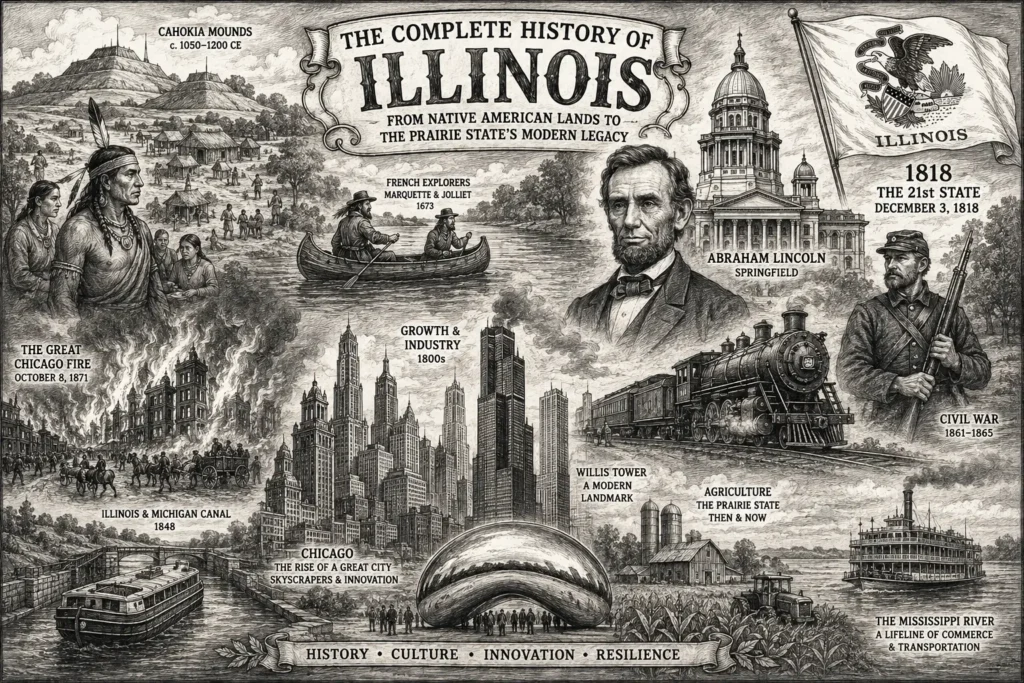
Illinois is one of America’s most historically significant states. Located in the heart of the Midwest, it has played a major role in shaping the United States politically, economically, culturally, and socially. Often called “The Prairie State,” Illinois has been home to Native American civilizations, French explorers, British soldiers, pioneering settlers, Abraham Lincoln, booming industries, and one of the world’s greatest cities—Chicago.
Officially becoming the 21st state on December 3, 1818, Illinois quickly transformed from a sparsely populated frontier into one of America’s leading centers of transportation, manufacturing, agriculture, and commerce.
Today Illinois remains an economic powerhouse thanks to its strategic location, fertile farmland, advanced industries, higher education institutions, and global transportation networks.
This complete guide explores thousands of years of Illinois history, beginning with its earliest inhabitants and continuing through modern times.
Geography of Illinois
Illinois occupies approximately 57,914 square miles in the American Midwest.
It borders:
- Wisconsin
- Iowa
- Missouri
- Kentucky
- Indiana
- Michigan (through Lake Michigan)
Several important rivers define the state’s geography:
- Mississippi River
- Illinois River
- Ohio River
- Wabash River
Northern Illinois contains fertile prairies and Lake Michigan shoreline.
Central Illinois features vast agricultural plains.
Southern Illinois includes forests, rolling hills, wetlands, and river valleys.
Because of its central location, Illinois naturally became one of America’s greatest transportation crossroads.
Climate and Natural Resources
Illinois enjoys four distinct seasons.
The state possesses abundant natural resources including:
- Rich prairie soil
- Coal deposits
- Limestone
- Clay
- Timber
- Waterways
These resources attracted settlers and fueled industrial development throughout the nineteenth century.
Agriculture continues to dominate much of Illinois’ landscape, especially corn and soybean production.
The First People of Illinois
Human history in Illinois stretches back over 12,000 years.
After the last Ice Age ended, glaciers slowly retreated northward, leaving behind fertile plains, rivers, forests, and wetlands.
Early Paleo-Indian hunters entered the region following large game animals such as:
- Mammoths
- Mastodons
- Giant bison
- Caribou
These first inhabitants lived as nomadic hunter-gatherers.
They built temporary camps near rivers where food and fresh water were plentiful.
Stone spear points discovered throughout Illinois provide evidence of these earliest communities.
Archaic Period (8000–1000 BCE)
As the climate warmed, giant Ice Age animals disappeared.
The people of Illinois adapted remarkably.
Instead of hunting massive mammals, they focused on:
- Deer
- Turkey
- Fish
- Waterfowl
- Nuts
- Berries
- Wild plants
Communities became more settled.
New technologies emerged:
- Fishing nets
- Dugout canoes
- Grinding stones
- Improved hunting weapons
Families often returned to the same seasonal camps year after year.
Trade between neighboring groups expanded considerably.
Woodland Period (1000 BCE–900 CE)
The Woodland Period marked significant cultural development.
People began:
- Growing crops
- Making pottery
- Building permanent villages
- Creating burial mounds
- Expanding long-distance trade
Agriculture slowly supplemented hunting and gathering.
Common crops included:
- Sunflowers
- Squash
- Goosefoot
- Maygrass
Later, maize (corn) became increasingly important.
Pottery allowed food to be stored safely throughout the winter.
Communities became larger and more organized.
Ancient Trade Networks
Illinois occupied an ideal location connecting eastern and western North America.
Archaeologists have discovered evidence of extensive trade.
Artifacts recovered from Illinois include:
- Copper from the Great Lakes
- Seashells from the Gulf Coast
- Obsidian from the Rocky Mountains
- Mica from Appalachia
- Decorative stones from distant regions
These discoveries show that Native American societies maintained sophisticated trade systems long before Europeans arrived.
The Mississippian Culture
Around 900 CE, one of North America’s greatest civilizations emerged near present-day Collinsville, Illinois.
Known as the Mississippian Culture, these people developed advanced urban centers supported by productive agriculture.
Their society featured:
- Large cities
- Monumental earthworks
- Religious ceremonies
- Organized government
- Skilled artisans
- Extensive trade
Corn agriculture dramatically increased food production.
Population growth followed.
Cahokia: North America’s Largest Ancient City
The greatest achievement of the Mississippian civilization was Cahokia.
Located just east of present-day St. Louis, Cahokia became the largest city north of Mexico.
Between 1050 and 1200 CE, its population likely reached 15,000–20,000 people, making it one of the largest urban centers in North America before European contact.
The city covered several square miles.
It included:
- Residential neighborhoods
- Public plazas
- Religious temples
- Markets
- Defensive structures
- Massive earthen mounds
Cahokia demonstrated an extraordinary level of political organization and engineering skill.
Monks Mound
The most famous structure at Cahokia is Monks Mound.
It remains the largest prehistoric earthen construction in North America.
Key facts include:
- About 100 feet (30 meters) tall
- Four large terraces
- Covers approximately 14 acres
- Built entirely by hand
- Required millions of baskets of earth
Leaders likely lived or conducted ceremonies atop the mound.
It symbolized political and religious authority.
Even today, Monks Mound impresses visitors with its immense scale.
Religion and Society
Religion shaped nearly every aspect of Mississippian life.
Priests organized ceremonies connected to:
- Agriculture
- Seasons
- Astronomy
- Ancestor worship
- Community leadership
Large public plazas hosted festivals, dances, and rituals.
The ruling elite directed labor for building projects while artisans crafted:
- Pottery
- Stone tools
- Shell ornaments
- Copper decorations
The society was highly organized yet deeply connected to nature.
Why Cahokia Declined
By around 1350 CE, Cahokia had largely been abandoned.
Historians continue to debate the reasons.
Possible causes include:
- Environmental degradation
- Deforestation
- Flooding
- Climate change
- Resource shortages
- Political instability
- Disease
- Social conflict
Rather than a single catastrophe, Cahokia’s decline likely resulted from several interacting factors over generations.
Although the city disappeared, its cultural influence spread throughout much of the Mississippi River Valley.
Native American Tribes Encountered by Europeans
By the seventeenth century, several tribes inhabited Illinois.
Among them were:
- Illiniwek Confederation
- Miami
- Sauk
- Fox (Meskwaki)
- Potawatomi
- Kickapoo
- Shawnee
- Peoria
- Kaskaskia
- Cahokia tribe
- Tamaroa
Many belonged to the Algonquian language family.
These tribes farmed, hunted, fished, and traded extensively.
Villages often stood near rivers where transportation and fertile soil supported daily life.
Daily Life
Native American communities raised crops such as:
- Corn
- Beans
- Squash
These “Three Sisters” formed the foundation of many diets.
Additional foods included:
- Deer
- Elk
- Buffalo (occasionally)
- Fish
- Wild turkey
- Berries
- Nuts
- Maple syrup
Homes varied by tribe but often consisted of bark-covered longhouses or dome-shaped wigwams.
Families worked cooperatively to cultivate fields, prepare food, and care for children.
The Illinois Country Before Europeans
Long before Europeans arrived, Illinois was already an important crossroads.
Major rivers connected distant communities.
Trade flourished.
Agriculture supported growing populations.
Religious traditions united villages.
Political alliances maintained stability.
This rich Indigenous heritage formed the foundation upon which later French explorers, British officials, and American settlers would build the future state of Illinois.
The Complete History of Illinois: From Native American Lands to the Prairie State’s Modern Legacy (Part 2)
French Exploration of Illinois
During the seventeenth century, European explorers turned their attention to the vast interior of North America. While the Atlantic coast was already home to English colonies, France sought to expand its influence by exploring the Great Lakes and the Mississippi River Valley.
Illinois soon became one of the most valuable regions of New France because of its fertile land, abundant wildlife, and strategic location along major waterways.
Unlike many English settlers who established permanent farming colonies, the French were initially more interested in the fur trade, missionary work, and exploration. This approach led to relatively cooperative relationships with many Native American nations, although conflicts and cultural changes inevitably followed.
The Search for the Mississippi River
French officials believed that a great river flowed through the center of North America.
Finding this river promised enormous benefits:
- New trade routes
- Access to the Gulf of Mexico
- Expansion of French influence
- Opportunities for missionary work
- Greater control of the fur trade
Several expeditions attempted to locate and map this mysterious waterway.
Jacques Marquette and Louis Jolliet
One of the most important journeys in Illinois history began in 1673.
Father Jacques Marquette, a Jesuit missionary, and Louis Jolliet, a French-Canadian explorer, were commissioned to explore the Mississippi River.
Traveling in birch-bark canoes with Native American guides, they departed from the Great Lakes and paddled through rivers that eventually carried them into present-day Illinois.
First European Descriptions of Illinois
Marquette carefully documented everything he observed.
He described:
- Rich prairie grasslands
- Vast forests
- Large rivers
- Fertile farmland
- Numerous Native American villages
- Abundant wildlife
He was particularly impressed by the beauty of the Illinois River Valley.
Marquette wrote that the region possessed some of the finest land he had ever seen.
These glowing reports encouraged further French exploration.
Meeting the Illiniwek Confederation
One of the expedition’s most important encounters occurred when they met members of the Illiniwek Confederation, a group of closely related Native American tribes.
The Illiniwek welcomed the French visitors with hospitality.
The explorers were offered:
- Food
- Shelter
- Safe passage
- Information about surrounding lands
These early peaceful relations helped establish lasting alliances between France and several Illinois tribes.
Missionaries soon followed the explorers to establish churches among Native communities.
The Importance of the Illinois River
Marquette and Jolliet recognized that the Illinois River served as a natural transportation corridor.
The river connected:
- The Great Lakes
- The Mississippi River
- Interior trading routes
- Native villages
Its location would later make Illinois one of North America’s greatest transportation centers.
Even today, many major cities and industries remain closely connected to these waterways.
René-Robert Cavelier, Sieur de La Salle
A few years after Marquette’s expedition, another famous French explorer arrived.
René-Robert Cavelier, Sieur de La Salle, expanded French exploration throughout the Mississippi Valley.
Beginning in 1679, La Salle sought to establish French control over the interior of North America.
He believed that whoever controlled the Mississippi River would dominate trade across much of the continent.
Building Fort Crevecoeur
In 1680, La Salle established Fort Crevecoeur near present-day Peoria.
The fort became one of the earliest European settlements in Illinois.
Its purposes included:
- Protecting traders
- Supporting exploration
- Expanding French influence
- Serving as a military outpost
- Developing trade with Native Americans
Although the fort survived only a short time, it marked an important step in France’s colonization efforts.
Claiming Louisiana
After successfully exploring the Mississippi River to the Gulf of Mexico in 1682, La Salle claimed the vast Mississippi Basin for France.
He named the enormous territory Louisiana in honor of King Louis XIV.
Illinois became one of the northernmost and most important regions within this immense French colony.
The Fur Trade
The fur trade quickly became the backbone of the French economy in Illinois.
European demand for beaver hats and other animal pelts created profitable opportunities.
French traders exchanged goods such as:
- Metal knives
- Axes
- Blankets
- Firearms
- Cooking utensils
- Glass beads
In return, Native Americans supplied:
- Beaver pelts
- Deer hides
- Otter furs
- Fox pelts
- Bear skins
The fur trade strengthened alliances but also increased competition among tribes.
French Missionaries
Jesuit missionaries established missions throughout Illinois.
Their goals included:
- Teaching Christianity
- Learning Native languages
- Providing education
- Building peaceful relationships
- Recording local cultures
Many missionaries became respected members of Native communities because they learned local customs and languages.
Father Marquette himself remained deeply committed to missionary work until his death in 1675.
Early French Settlements
As exploration continued, permanent settlements began appearing across Illinois.
Among the earliest were:
Kaskaskia
Founded around 1703, Kaskaskia became the most important French town in the Illinois Country.
The settlement featured:
- Churches
- Farms
- Trading posts
- Government buildings
- Schools
For many years it served as the colonial capital.
Cahokia
Not far from the ancient Mississippian city stood the French settlement of Cahokia, established in 1699.
It became one of the oldest continuously occupied European communities in the Midwest.
Residents engaged in:
- Farming
- Fur trading
- River commerce
- Missionary activities
Prairie du Rocher
Founded in 1722, Prairie du Rocher became another prosperous French agricultural community.
Its fertile floodplain produced:
- Wheat
- Corn
- Vegetables
- Livestock
Many descendants of these early French settlers still live in the region today.
Life in French Illinois
Life differed significantly from that in the English colonies.
French settlements were generally smaller.
Residents depended on:
- Farming
- Fishing
- Hunting
- River trade
- Fur trading
Families often lived in wooden homes built in traditional French colonial styles.
Catholic churches formed the center of community life.
Annual festivals celebrated both religious and agricultural events.
Agriculture Expands
Although the fur trade remained important, farming gradually became essential.
French settlers cultivated:
- Corn
- Wheat
- Tobacco
- Vegetables
- Fruit orchards
Livestock included:
- Horses
- Cattle
- Chickens
- Pigs
Illinois’ fertile soil quickly proved ideal for agriculture, laying the foundation for the state’s future reputation as one of America’s leading farming regions.
Relations with Native Americans
Compared with many English colonies, French officials generally pursued alliances rather than widespread settlement.
Marriage between French traders and Native American women was not uncommon, creating cultural ties and mixed-heritage communities.
However, relations were not always peaceful.
Competition over trade, disease introduced by Europeans, and shifting political alliances affected Indigenous societies throughout the region.
The French and Indian War
By the mid-eighteenth century, Britain and France competed fiercely for control of North America.
The conflict known in North America as the French and Indian War (1754–1763), part of the global Seven Years’ War, reached many frontier regions.
Although major battles did not occur throughout Illinois itself, the outcome dramatically changed its future.
British Victory
The Treaty of Paris (1763) ended the war.
France surrendered nearly all of its territory east of the Mississippi River to Great Britain.
As a result:
- Illinois came under British rule.
- French political authority ended.
- Many French residents remained in their villages.
- Trade patterns gradually changed.
- Native American alliances shifted.
British officials faced challenges governing a region where French culture remained strong.
Pontiac’s Rebellion
Shortly after Britain’s takeover, several Native American nations resisted British expansion.
One of the most significant conflicts was Pontiac’s Rebellion (1763–1766).
Although Pontiac was an Ottawa leader rather than an Illinois chief, the uprising spread across much of the Great Lakes region.
Several forts were attacked as Native groups attempted to halt British settlement west of the Appalachian Mountains.
The conflict demonstrated that Indigenous nations remained powerful political and military forces.
British Rule in Illinois
British control brought important changes:
- English legal practices slowly expanded.
- Military forts replaced some French administrative centers.
- Trade regulations changed.
- New settlers began arriving.
Yet French-speaking communities, Catholic churches, and long-established customs continued to shape everyday life in Illinois.
The region remained culturally diverse, blending Native American, French, and British influences.
Illinois on the Eve of Revolution
By the early 1770s, Illinois was a frontier society where multiple cultures coexisted.
French villages prospered along the Mississippi and Illinois Rivers.
Native American nations continued to occupy much of the surrounding land.
British soldiers maintained authority, but their presence was relatively limited.
As tensions grew between Britain and its American colonies, Illinois stood on the edge of another historic transformation.
The coming American Revolution would determine whether the Illinois Country remained part of the British Empire or became part of the newly independent United States.
The Complete History of Illinois: From Native American Lands to the Prairie State’s Modern Legacy (Part 3)
The American Revolution Reaches Illinois
When the American Revolution began in 1775, most of the fighting occurred along the Atlantic coast. However, the conflict soon spread westward into the Illinois Country, where British forts controlled key trade routes and maintained alliances with Native American nations.
Although Illinois was sparsely populated compared to the eastern colonies, control of the region was strategically important. Whoever held Illinois could influence the Mississippi River Valley and the expanding western frontier.
For the American patriots, capturing Illinois would weaken British power and strengthen future claims to western lands.
George Rogers Clark’s Illinois Campaign
One of the most remarkable military operations of the Revolutionary War was led by George Rogers Clark, a Virginia militia officer.
In 1778, Clark organized a force of about 175 frontiersmen to capture British-controlled settlements in the Illinois Country. Traveling hundreds of miles through forests, rivers, and difficult terrain, his expedition relied on speed, secrecy, and support from local residents.
Clark understood that a direct confrontation with a large British army was impossible. Instead, he planned to seize lightly defended forts before reinforcements could arrive.
Capture of Kaskaskia
On the night of July 4, 1778, Clark’s forces entered the French village of Kaskaskia without firing a shot.
The British commander was taken by surprise, and the settlement surrendered peacefully.
Clark assured the French residents that:
- Their property would be protected.
- Catholic worship would continue.
- Local customs would be respected.
- They would enjoy greater political freedom under American rule.
These promises persuaded many French inhabitants to support the American cause.
Winning Local Support
Clark realized that military success depended on cooperation from local communities.
He worked closely with:
- French settlers
- Catholic clergy
- Local merchants
- Friendly Native American leaders
His respectful treatment of civilians helped stabilize the region and reduced the likelihood of widespread resistance.
Capture of Cahokia
Soon after taking Kaskaskia, Clark secured Cahokia, another important French settlement.
Like Kaskaskia, Cahokia surrendered with little violence.
The peaceful transfer of power strengthened American influence throughout the Illinois Country.
The Capture of Fort Sackville
Clark’s greatest achievement came in 1779.
British Lieutenant Governor Henry Hamilton had recaptured Fort Sackville at Vincennes (in present-day Indiana), threatening American control of the western frontier.
Despite freezing temperatures, flooded rivers, and shortages of food, Clark led his men on a grueling winter march of more than 180 miles.
After surrounding the fort, Clark forced Hamilton to surrender.
This victory became one of the most celebrated campaigns of the Revolutionary War.
Why Clark’s Victory Mattered
George Rogers Clark’s victories had lasting consequences.
They:
- Reduced British influence in the Midwest.
- Strengthened American claims to western lands.
- Protected frontier settlements.
- Encouraged future migration westward.
- Influenced negotiations ending the Revolutionary War.
Many historians consider Clark’s Illinois Campaign essential to the future expansion of the United States.
Virginia’s Claim to the Illinois Country
Following Clark’s victories, Virginia claimed the Illinois Country as Illinois County, Virginia, in 1778.
Although Virginia exercised only limited control over the distant frontier, the claim demonstrated American intentions to govern the region after independence.
Managing such a vast territory proved difficult, and Virginia eventually transferred its western land claims to the national government.
The Treaty of Paris (1783)
The Treaty of Paris, signed in 1783, officially ended the American Revolutionary War.
Great Britain recognized the independence of the United States and ceded territory east of the Mississippi River (except for Spanish Florida) to the new nation.
Illinois now became part of the United States.
This agreement opened enormous opportunities for settlement and economic development across the western frontier.
The Northwest Ordinance of 1787
One of the most important laws in American history was the Northwest Ordinance of 1787.
Passed by the Continental Congress, it established a system for governing lands northwest of the Ohio River, including present-day Illinois.
The ordinance created an orderly process for:
- Establishing territorial governments.
- Protecting civil liberties.
- Surveying and selling public land.
- Creating new states.
- Admitting those states to the Union on equal footing with the original thirteen.
Key Provisions of the Northwest Ordinance
The ordinance included several groundbreaking principles:
- Freedom of religion was protected.
- Trial by jury was guaranteed.
- Public education was encouraged.
- Slavery was prohibited in the Northwest Territory (though enforcement was sometimes inconsistent).
- Territories could become states after reaching sufficient population.
These ideas greatly influenced the development of Illinois and the broader Midwest.
Illinois in the Northwest Territory
Beginning in 1787, Illinois formed part of the vast Northwest Territory.
The territory included land that would eventually become:
- Ohio
- Indiana
- Illinois
- Michigan
- Wisconsin
- Part of Minnesota
Governors appointed by the federal government oversaw administration while population remained relatively small.
During this period, American settlers steadily moved into the region.
Early American Settlers
After the Revolution, increasing numbers of pioneers arrived from:
- Virginia
- Kentucky
- Pennsylvania
- North Carolina
- Tennessee
Most settlers traveled by:
- Flatboats
- Wagons
- Horseback
- River routes
They established farms, cleared forests, built cabins, and founded small communities.
Life on the frontier demanded hard work, cooperation, and resilience.
Frontier Life
Daily life for early settlers was challenging.
Families built log cabins using local timber and relied on farming, hunting, and livestock for survival.
Common crops included:
- Corn
- Wheat
- Oats
- Vegetables
Settlers also raised:
- Cattle
- Hogs
- Chickens
- Horses
Communities gradually added:
- Schools
- Churches
- Mills
- Blacksmith shops
- General stores
Formation of the Indiana Territory
As the population of the Northwest Territory increased, Congress reorganized its administration.
In 1800, Illinois became part of the newly created Indiana Territory, governed from Vincennes.
Although still a frontier, settlement accelerated as more families moved westward in search of fertile farmland.
Creation of the Illinois Territory
Recognizing the region’s rapid growth, Congress established the Illinois Territory on February 3, 1809.
The new territory included:
- Present-day Illinois
- Parts of present-day Wisconsin
- Portions of Minnesota
The territorial capital was Kaskaskia, one of the oldest European settlements in the Midwest.
The first territorial governor was Ninian Edwards, who played a major role in organizing government and encouraging settlement.
Population Growth
Illinois grew quickly during the early nineteenth century.
Several factors encouraged migration:
- Fertile prairie soil
- Affordable land
- River transportation
- Expanding trade
- Peace following major frontier conflicts
By 1818, the territory’s population exceeded 40,000, meeting the minimum requirement for statehood under the Northwest Ordinance.
The Road to Statehood
Territorial leaders petitioned Congress to admit Illinois as a state.
Delegates met in Kaskaskia in the summer of 1818 to draft a state constitution.
The constitution established:
- Three branches of government.
- An elected legislature.
- A governor as chief executive.
- A judicial system.
- Voting rights for many white male citizens of the era.
Although the constitution reflected democratic ideals, voting rights and civil liberties were not extended equally to all residents, including women, enslaved people, and many Native Americans.
Illinois Becomes the 21st State
On December 3, 1818, President James Monroe signed the legislation admitting Illinois to the Union.
Illinois officially became the 21st state of the United States.
Statehood marked the beginning of a new era.
The young state now had the authority to:
- Elect representatives to Congress.
- Manage internal affairs.
- Expand infrastructure.
- Promote settlement.
- Develop its economy.
The First State Capital
Illinois’ first state capital remained Kaskaskia.
Located along the Mississippi River, Kaskaskia had long served as the political and cultural center of the region.
However, as settlement expanded northward and eastward, the capital would later move to better serve the growing population.
Illinois’ First Governor
Illinois elected Shadrach Bond as its first governor in 1818.
A respected frontier leader and farmer, Bond focused on building the foundations of the new state.
His administration worked to:
- Organize state government.
- Improve transportation.
- Encourage immigration and settlement.
- Strengthen agriculture.
- Promote economic growth.
Although resources were limited, Bond helped establish stable governance during Illinois’ formative years.
Challenges Facing the New State
Despite achieving statehood, Illinois faced significant obstacles:
- Limited roads and bridges.
- Financial constraints.
- Conflicts over Native American lands.
- Sparse population in many areas.
- Dependence on agriculture.
- Difficult transportation during wet seasons.
Overcoming these challenges required investment, migration, and cooperation among settlers and state leaders.
A State Poised for Growth
By the early 1820s, Illinois was no longer merely a remote frontier. Rich farmland, expanding settlements, and strategic river access positioned the young state for remarkable growth.
Within a few decades, Illinois would become one of the nation’s leading agricultural producers, attract immigrants from around the world, and produce one of America’s most influential political figures—Abraham Lincoln.
The Complete History of Illinois: From Native American Lands to the Prairie State’s Modern Legacy (Part 4)
Early State Politics and Economic Development
After achieving statehood in 1818, Illinois entered a period of rapid political and economic change. Although much of the state remained a sparsely settled frontier, thousands of migrants arrived each year seeking fertile farmland and new opportunities.
The first state leaders faced enormous responsibilities. They had to establish courts, build roads, create schools, organize local governments, and encourage economic growth while managing limited financial resources.
Most early Illinois residents lived on small farms. Agriculture formed the backbone of the state’s economy, while small towns developed as centers for trade and local government.
Building a State Government
Illinois adopted a government modeled after the United States Constitution.
The government consisted of three branches:
- Executive Branch, led by the governor.
- Legislative Branch, responsible for making state laws.
- Judicial Branch, which interpreted and enforced those laws.
As the population expanded, new counties were created, allowing residents to elect local officials and establish courts closer to home.
Population Growth
During the 1820s and 1830s, Illinois experienced one of the fastest population increases in the United States.
New settlers arrived from:
- Kentucky
- Virginia
- Tennessee
- Ohio
- Pennsylvania
- New York
- New England
Many immigrants also came from Europe, especially:
- Germany
- Ireland
- England
These newcomers transformed Illinois from a frontier state into an increasingly prosperous agricultural region.
Agriculture Becomes the Foundation
Illinois’ rich prairie soil proved ideal for farming.
Farmers produced:
- Corn
- Wheat
- Oats
- Rye
- Vegetables
They also raised:
- Cattle
- Hogs
- Sheep
- Horses
Livestock became an important source of income, while surplus grain was transported to growing markets along the Mississippi and Ohio Rivers.
Agriculture would remain the foundation of Illinois’ economy throughout much of the nineteenth century.
Transportation Challenges
Despite its fertile land, Illinois faced serious transportation problems.
Roads were often:
- Muddy
- Unpaved
- Difficult to travel after heavy rain
- Nearly impassable during spring thaw
Moving crops to distant markets was expensive and time-consuming.
State leaders recognized that improving transportation would be essential for future prosperity.
Native American Removal
By the early nineteenth century, increasing numbers of American settlers sought land occupied by Native American nations.
Federal officials negotiated numerous treaties that required tribes to surrender millions of acres.
Many Native communities were pressured—or compelled—to move west of the Mississippi River.
These policies dramatically reshaped Illinois, opening additional land for settlement while causing profound hardship and displacement for Indigenous peoples.
The Black Hawk War (1832)
One of the final major conflicts between Native Americans and American settlers in Illinois was the Black Hawk War.
The war is named after Black Hawk, a leader of the Sauk Nation.
Although Black Hawk had signed no treaty personally surrendering his homeland, previous agreements made by other leaders transferred large areas of Sauk land to the United States.
In 1832, Black Hawk led approximately one thousand Sauk, Meskwaki (Fox), and Kickapoo people back across the Mississippi River into Illinois, hoping to reclaim their ancestral lands and plant crops.
American authorities viewed the movement as an invasion and mobilized state militia and federal troops.
The Course of the War
The conflict lasted only a few months but involved several engagements across northern Illinois and present-day Wisconsin.
Many militia units lacked military experience, while Native groups faced overwhelming odds.
The final battle occurred at the Battle of Bad Axe in August 1832.
Hundreds of Native men, women, and children were killed while attempting to cross the Mississippi River.
Black Hawk was captured and later imprisoned before eventually being released.
Impact of the Black Hawk War
The war marked the end of organized Native American resistance in Illinois.
Its consequences included:
- The removal of most remaining Native communities from the state.
- Increased migration by American settlers.
- Expansion of farming communities.
- Accelerated land sales.
- Greater federal control over the region.
Although settlement expanded rapidly afterward, the conflict remains a painful chapter in Illinois history and highlights the human cost of westward expansion.
The Illinois and Michigan Canal
Recognizing the need for better transportation, state leaders promoted one of the most ambitious infrastructure projects of the era—the Illinois and Michigan Canal.
Construction officially began in 1836.
The canal connected:
- The Chicago River
- The Illinois River
- The Mississippi River (through the Illinois River)
- The Great Lakes
This created a continuous water route between the Atlantic Ocean and the Gulf of Mexico.
Building the Canal
Thousands of laborers worked on the canal.
Many workers were recent immigrants, particularly from Ireland.
Construction was difficult because crews had to:
- Dig through rock and clay.
- Build locks.
- Construct aqueducts.
- Manage flooding.
- Endure harsh weather.
Financial difficulties and the nationwide economic downturn known as the Panic of 1837 slowed progress, but construction continued.
The canal officially opened in 1848.
Why the Canal Was Important
The Illinois and Michigan Canal transformed the state’s economy.
It:
- Reduced transportation costs.
- Increased trade.
- Connected farms to national markets.
- Encouraged immigration.
- Stimulated industrial development.
- Boosted the growth of Chicago.
The canal quickly became one of the Midwest’s most important transportation routes until railroads eventually surpassed it.
The Rise of Springfield
As settlement spread toward central Illinois, the state’s political center shifted.
In 1837, the state legislature voted to move the capital from Vandalia to Springfield.
Springfield offered several advantages:
- A more central location.
- Easier access for lawmakers.
- Rapid population growth.
- Expanding commercial activity.
The move established Springfield as the political heart of Illinois.
Today it remains the state capital.
Abraham Lincoln Arrives in Illinois
No individual is more closely associated with Illinois than Abraham Lincoln.
Although born in Kentucky in 1809, Lincoln moved with his family to Indiana before settling in Illinois in 1830.
The family first lived in Macon County, where Lincoln helped clear land and build fences.
Seeking better opportunities, he soon relocated to the village of New Salem.
Lincoln’s Early Career
In New Salem, Lincoln worked at various occupations, including:
- Store clerk.
- Surveyor.
- Postmaster.
- Rail splitter.
- Laborer.
His honesty, intelligence, and willingness to help neighbors earned him the nickname “Honest Abe.”
Lincoln educated himself by borrowing books and studying whenever time allowed.
Despite limited formal schooling, he developed exceptional skills in reading, writing, and public speaking.
Lincoln Enters Politics
Lincoln’s first campaign for the Illinois General Assembly in 1832 was unsuccessful.
However, two years later, in 1834, voters elected him to the legislature.
He served four consecutive terms as a member of the Illinois House of Representatives.
As a legislator, Lincoln supported:
- Internal improvements.
- Better roads.
- Canals.
- Economic development.
- Banking reforms.
- Public education.
His political reputation steadily grew throughout the state.
Becoming a Lawyer
While serving in the legislature, Lincoln studied law independently.
He was admitted to the Illinois bar in 1836.
Soon afterward, he moved to Springfield, where he established a successful legal practice.
Traveling the Eighth Judicial Circuit, Lincoln rode hundreds of miles on horseback each year, representing clients in towns across central Illinois.
His courtroom experience sharpened the reasoning and communication skills that later defined his national leadership.
Lincoln and the Whig Party
Lincoln became a leading member of the Whig Party, which promoted:
- Economic modernization.
- Infrastructure improvements.
- National banking.
- Industrial development.
- Commercial expansion.
His speeches attracted attention for their clear logic, humor, and persuasive arguments.
By the 1840s, Lincoln had become one of Illinois’ most respected lawyers and politicians.
The Slavery Debate
As the United States expanded westward, the question of slavery increasingly divided the nation.
Illinois entered the Union as a free state under the principles of the Northwest Ordinance, although some forms of forced labor continued during the state’s early years.
Political disagreements over whether slavery should spread into new territories intensified throughout the 1850s.
These debates placed Illinois at the center of a national crisis.
The Lincoln–Douglas Debates
In 1858, Abraham Lincoln challenged Stephen A. Douglas, the incumbent U.S. senator from Illinois.
Their campaign featured seven famous debates held in communities across the state.
The debates focused primarily on:
- Slavery’s expansion.
- Popular sovereignty.
- The Constitution.
- The future of the Union.
Large crowds attended each event, while newspapers published transcripts that reached readers nationwide.
Although Douglas won reelection to the Senate, Lincoln gained national recognition as a thoughtful and principled opponent of slavery’s expansion.
His performance laid the groundwork for his successful presidential campaign in 1860.
Illinois on the Eve of the Civil War
By the late 1850s, Illinois had become one of the fastest-growing states in the nation.
Several developments defined this era:
- Population exceeded 1.7 million.
- Railroads increasingly replaced canals as the primary transportation network.
- Chicago emerged as a major commercial center.
- Agriculture flourished across the prairies.
- Manufacturing expanded steadily.
- Political tensions over slavery dominated public life.
When Abraham Lincoln was elected the 16th President of the United States in 1860, Illinois found itself at the center of one of the most important turning points in American history.
The election intensified sectional tensions and set the stage for the outbreak of the Civil War only a few months later.
The Complete History of Illinois: From Native American Lands to the Prairie State’s Modern Legacy (Part 5)
Abraham Lincoln’s Election as President (1860)
The presidential election of 1860 was one of the most significant events in American history, and Illinois stood at its center. After years of political debate and national attention following the Lincoln–Douglas debates, Abraham Lincoln, a lawyer from Springfield, became the Republican Party’s nominee for President of the United States.
Lincoln’s campaign focused on preserving the Union, promoting economic development, and opposing the expansion of slavery into the western territories. Although he did not call for the immediate abolition of slavery where it already existed, many Southern leaders believed his election threatened their political and economic system.
On November 6, 1860, Lincoln won the presidency despite receiving little support from the Deep South. His victory marked a turning point in American history.
Secession and the Outbreak of the Civil War
Lincoln’s election prompted several Southern states to secede from the Union.
Beginning with South Carolina in December 1860, eleven Southern states eventually formed the Confederate States of America.
On April 12, 1861, Confederate forces fired on Fort Sumter in South Carolina, officially beginning the American Civil War.
President Lincoln immediately called for volunteers to defend the Union.
Illinois responded with overwhelming support.
Illinois Supports the Union
Although Illinois was a free state, opinions about slavery and the war varied among its residents. Nevertheless, the vast majority supported preserving the Union.
Governor Richard Yates, often called “Illinois’ Civil War Governor,” played a crucial role by:
- Organizing volunteer regiments.
- Raising military supplies.
- Supporting soldiers’ families.
- Coordinating recruitment.
- Strengthening Illinois’ military infrastructure.
Thousands of citizens answered Lincoln’s call to serve.
Illinois Soldiers in the Civil War
Illinois became one of the Union’s greatest contributors during the conflict.
During the war, approximately:
- Over 250,000 Illinois men served in the Union Army.
- More than 150 infantry regiments were organized.
- Numerous cavalry and artillery units were formed.
Illinois ranked among the leading Northern states in troop contributions.
Its soldiers fought in nearly every major campaign of the war.
Camp Douglas
One of Illinois’ most important military facilities was Camp Douglas, established in Chicago in 1861.
Initially, Camp Douglas served as a training center for Union volunteers.
Thousands of recruits received instruction in:
- Military drills.
- Rifle practice.
- Battlefield tactics.
- Camp organization.
- Medical care.
As the war continued, Camp Douglas became one of the Union’s largest prisoner-of-war camps for captured Confederate soldiers.
Conditions at Camp Douglas
The prisoner camp became severely overcrowded during the later years of the war.
Harsh winters, inadequate sanitation, limited medical care, and outbreaks of disease contributed to difficult conditions.
Thousands of Confederate prisoners died while confined there.
Today, Camp Douglas remains an important historical site, reminding visitors of the human suffering experienced on both sides of the conflict.
Ulysses S. Grant and Illinois
Another legendary figure closely associated with Illinois was Ulysses S. Grant.
Although born in Ohio, Grant lived in Galena, Illinois, before the Civil War.
At the outbreak of the conflict, he volunteered to serve the Union despite having previously resigned from the U.S. Army.
His military abilities quickly became apparent.
Grant’s Rise to Command
Grant achieved important victories early in the war.
Among his most famous successes were:
- Fort Henry (1862).
- Fort Donelson (1862).
- Shiloh (1862).
- Vicksburg (1863).
- Chattanooga (1863).
His capture of Vicksburg gave the Union complete control of the Mississippi River, effectively splitting the Confederacy in two.
Recognizing his leadership, President Lincoln appointed Grant General-in-Chief of all Union armies in 1864.
Grant worked closely with Lincoln until the Union’s final victory in 1865.
Other Illinois Military Leaders
Illinois produced many distinguished officers during the Civil War.
Notable leaders included:
- John A. Logan.
- John M. Palmer.
- Stephen A. Hurlbut.
- Richard Oglesby.
Their service contributed significantly to Union military success.
Several later became governors, senators, or national political leaders.
Illinois Home Front
While soldiers fought on distant battlefields, Illinois civilians supported the war effort.
Women organized:
- Relief societies.
- Fundraising events.
- Hospital aid.
- Clothing drives.
- Food donations.
Farmers increased agricultural production to feed Union armies.
Factories manufactured:
- Weapons.
- Uniforms.
- Ammunition.
- Railroad equipment.
- Machinery.
The entire state’s economy became closely tied to the Union war effort.
Economic Growth During the War
Ironically, the Civil War accelerated Illinois’ economic development.
Demand for agricultural products increased dramatically.
Farmers expanded production of:
- Corn.
- Wheat.
- Oats.
- Pork.
- Beef.
Industrial manufacturing also expanded.
Railroads carried troops, supplies, and food throughout the North.
Chicago emerged as one of the nation’s most important supply centers.
Abraham Lincoln Leads the Nation
Throughout the Civil War, President Lincoln guided the nation through its greatest crisis.
Major achievements included:
- Preserving the Union.
- Issuing the Emancipation Proclamation in 1863.
- Supporting the passage of the 13th Amendment, which abolished slavery.
- Promoting the Homestead Act.
- Encouraging construction of the Transcontinental Railroad.
Lincoln frequently returned to Springfield in memory and correspondence, and Illinois proudly identified itself as the home of the President.
Lincoln’s Assassination
The Civil War effectively ended when Confederate General Robert E. Lee surrendered at Appomattox Court House on April 9, 1865.
Only five days later, tragedy struck.
On April 14, 1865, President Lincoln was shot by John Wilkes Booth while attending a play at Ford’s Theatre in Washington, D.C.
He died the following morning.
The nation mourned deeply.
Lincoln’s Funeral in Illinois
Lincoln’s funeral train traveled through several Northern states before arriving in Springfield, Illinois.
Thousands of mourners gathered along railroad tracks and city streets to pay their respects.
Lincoln was buried at Oak Ridge Cemetery, where his impressive tomb remains one of Illinois’ most visited historic landmarks.
Today, Springfield honors Lincoln through museums, preserved homes, and national historic sites.
Reconstruction and Postwar Development
After the Civil War ended, Illinois entered a period of rapid growth.
Although Reconstruction primarily affected the former Confederate states, Illinois experienced significant economic expansion.
Returning veterans resumed farming, entered business, or pursued public service.
Immigration increased dramatically, providing labor for farms, factories, and railroads.
Railroad Expansion
No development transformed Illinois more than the rapid expansion of railroads.
By the late nineteenth century, thousands of miles of track crossed the state.
Railroads connected:
- Farms to markets.
- Factories to suppliers.
- Small towns to major cities.
- Chicago to every region of the nation.
Major railroad companies established headquarters and maintenance facilities in Illinois.
The state became America’s transportation crossroads.
Chicago’s Rapid Growth
No city benefited more from railroad expansion than Chicago.
Located at the southwestern tip of Lake Michigan, Chicago connected eastern waterways with western railroads.
By the 1860s, it had become:
- A leading grain market.
- A major livestock center.
- An important manufacturing city.
- One of the nation’s busiest transportation hubs.
Immigrants from Europe poured into Chicago seeking employment.
Neighborhoods representing dozens of nationalities developed across the growing metropolis.
The Union Stock Yards
Established in 1865, the Union Stock Yards revolutionized the meatpacking industry.
Livestock from across the Great Plains arrived by railroad.
Chicago’s meatpacking companies developed efficient methods for processing and distributing beef and pork throughout the country.
Companies such as Armour and Swift helped make Chicago the nation’s meatpacking capital.
The industry created thousands of jobs while also transforming American food production.
The Great Chicago Fire of 1871
Disaster struck on the evening of October 8, 1871, when a fire broke out on Chicago’s West Side.
Strong winds, dry weather, and buildings constructed largely of wood allowed the flames to spread rapidly.
The fire burned for approximately two days.
By the time it ended:
- More than 17,000 buildings had been destroyed.
- Around 100,000 people were left homeless.
- Roughly 300 people lost their lives.
- About 3.3 square miles of the city had been devastated.
Although a popular legend blamed Mrs. Catherine O’Leary’s cow for starting the fire, historians have found no conclusive evidence supporting that story.
National Response
News of the disaster spread quickly.
Communities across the United States and abroad sent:
- Food.
- Clothing.
- Building materials.
- Financial assistance.
- Medical supplies.
The relief effort demonstrated the importance Chicago had already achieved as a national commercial center.
Rebuilding Chicago
Rather than abandoning the city, Chicago rebuilt with remarkable speed.
Business leaders, architects, engineers, and workers viewed the destruction as an opportunity to modernize.
Reconstruction emphasized:
- Brick and stone buildings instead of wood.
- Wider streets.
- Improved water systems.
- Better fire protection.
- Stronger building regulations.
Within only a few years, Chicago had regained its position as one of America’s fastest-growing cities.
Birth of Modern Architecture
The rebuilding of Chicago encouraged architectural innovation.
Engineers experimented with:
- Steel-frame construction.
- Fire-resistant materials.
- Passenger elevators.
- Larger office buildings.
These advances led to the development of the Chicago School of Architecture, which helped pioneer the modern skyscraper.
Architects such as William Le Baron Jenney, Daniel Burnham, and Louis Sullivan influenced urban design around the world.
Chicago’s skyline would eventually become one of the most recognizable in history.
Illinois Enters a New Era
By the early 1870s, Illinois had completed an extraordinary transformation.
Within just a few decades, it had evolved from a frontier state into:
- A major agricultural producer.
- A national transportation hub.
- A center of manufacturing.
- The home of Abraham Lincoln.
- The location of one of the world’s fastest-growing cities.
The foundations had been laid for Illinois to become one of the leading industrial and commercial states of the United States.
The Complete History of Illinois: From Native American Lands to the Prairie State’s Modern Legacy (Part 6)
The Gilded Age and Industrial Expansion
Following the rebuilding of Chicago after the Great Fire of 1871, Illinois entered one of the most dynamic periods in its history. During the Gilded Age (roughly 1870–1900), the state experienced remarkable industrial growth, rapid urbanization, and unprecedented economic expansion.
Factories multiplied across the state, especially in Chicago, Rockford, Peoria, Moline, East St. Louis, and Joliet. Advances in technology, transportation, and manufacturing transformed Illinois into one of the nation’s leading industrial centers.
By the end of the nineteenth century, Illinois had become a powerhouse of:
- Steel production
- Agricultural machinery
- Meatpacking
- Railroads
- Grain trading
- Banking
- Printing
- Manufacturing
Its central location made it the ideal crossroads for commerce between the eastern and western United States.
Chicago Becomes America’s Industrial Giant
No city symbolized Illinois’ transformation more than Chicago.
After recovering from the Great Chicago Fire, the city grew at an astonishing pace.
Between 1870 and 1900, Chicago’s population increased from approximately 300,000 to more than 1.6 million people.
Several industries drove this growth:
- Steel mills
- Lumber yards
- Grain elevators
- Clothing factories
- Machinery manufacturing
- Meatpacking plants
- Railroad construction
Thousands of freight trains entered and departed Chicago every day, making it the nation’s busiest railroad hub.
Agriculture Supports Industrial Growth
While industry expanded rapidly, agriculture remained equally important.
Illinois farmers produced enormous quantities of:
- Corn
- Wheat
- Oats
- Soybeans (increasingly during the twentieth century)
- Hay
Livestock production also flourished.
Farmers raised:
- Cattle
- Hogs
- Sheep
- Poultry
Improved machinery—including mechanical reapers, plows, and threshers—enabled farmers to cultivate larger areas with greater efficiency.
Railroads allowed crops to reach markets across the country and around the world.
Immigration and Cultural Diversity
Industrial expansion created a huge demand for workers.
Millions of immigrants arrived in the United States during the late nineteenth century, and many settled in Illinois.
Major immigrant groups included:
- Germans
- Irish
- Poles
- Italians
- Swedes
- Norwegians
- Bohemians (Czechs)
- Lithuanians
- Russians
- Jewish immigrants from Eastern Europe
Each community contributed unique traditions, languages, foods, and cultural institutions.
Their influence remains visible in Illinois today through neighborhoods, churches, festivals, restaurants, and community organizations.
Life in Immigrant Neighborhoods
Many immigrants settled in ethnic neighborhoods where they could speak their native languages and preserve their cultural traditions.
These communities often established:
- Churches
- Synagogues
- Schools
- Newspapers
- Social clubs
- Small businesses
Although many families initially faced poverty, difficult working conditions, and discrimination, their labor helped build Illinois’ industries and infrastructure.
Factory Life
Industrial jobs were often demanding.
Workers commonly labored:
- Ten to twelve hours a day
- Six days a week
- In dangerous conditions
- For relatively low wages
Factories frequently lacked modern safety standards.
Common workplace hazards included:
- Machinery accidents
- Fires
- Poor ventilation
- Chemical exposure
These conditions contributed to growing demands for labor reform.
Rise of Labor Unions
Workers increasingly organized into labor unions to improve working conditions.
Unions advocated for:
- Higher wages
- Shorter workdays
- Safer workplaces
- Child labor restrictions
- Better treatment by employers
Illinois became one of the nation’s leading centers of organized labor.
The Haymarket Affair (1886)
One of the most significant events in American labor history occurred in Chicago.
On May 4, 1886, thousands of workers across the nation were campaigning for an eight-hour workday.
A peaceful rally took place at Haymarket Square in Chicago.
As police moved to disperse the gathering, an unknown person threw a bomb.
The explosion and subsequent gunfire resulted in the deaths of several police officers and civilians, with many others injured.
National Impact of the Haymarket Affair
Although the identity of the person who threw the bomb was never conclusively established, several labor activists were arrested and tried.
The trial remains controversial among historians because of concerns about fairness and the evidence presented.
The Haymarket Affair had lasting consequences:
- Public opinion toward labor unions became divided.
- The labor movement gained international attention.
- Calls for workplace reform continued.
- May 1 later became recognized internationally as International Workers’ Day in many countries.
Today, the Haymarket Affair is remembered as a pivotal moment in the struggle for workers’ rights.
The World’s Columbian Exposition (1893)
In 1893, Chicago hosted the World’s Columbian Exposition, celebrating the 400th anniversary of Christopher Columbus’ voyage to the Americas.
Often called the Chicago World’s Fair, the exposition became one of the largest international exhibitions ever held.
More than 27 million visitors attended during its six-month run.
The fair showcased:
- Scientific discoveries
- Engineering achievements
- Fine arts
- Architecture
- Agriculture
- Manufacturing
- International cultures
It introduced millions of visitors to new technologies and ideas.
The “White City”
The exposition’s centerpiece was the spectacular White City, a collection of grand neoclassical buildings illuminated by thousands of electric lights.
Designed under the leadership of architect Daniel Burnham, the White City inspired city planners around the world.
Its orderly layout, parks, lagoons, and monumental buildings influenced the City Beautiful Movement, which promoted attractive and well-planned urban environments.
Technological Innovations
The World’s Fair introduced visitors to numerous innovations.
Popular attractions included:
- The original Ferris Wheel, designed by George Washington Gale Ferris Jr.
- Electric lighting demonstrations
- New agricultural machinery
- Advances in transportation
- Scientific exhibits
The exposition highlighted America’s emergence as an industrial and technological leader.
The Rise of Chicago Skyscrapers
Following the Great Chicago Fire, architects experimented with new building methods.
The use of:
- Steel-frame construction
- Fireproof materials
- Elevators
allowed buildings to reach unprecedented heights.
The Home Insurance Building, completed in 1885, is widely regarded as the world’s first skyscraper because of its pioneering steel-frame design.
Architects such as:
- William Le Baron Jenney
- Louis Sullivan
- Daniel Burnham
helped establish the Chicago School of Architecture, which influenced modern skyscraper design worldwide.
Chicago soon became known for its innovative skyline.
Education Expands
Industrial success fueled investment in education.
Illinois strengthened its public school system while expanding opportunities for higher learning.
Important institutions included:
- University of Illinois, founded in 1867 as the Illinois Industrial University.
- Northwestern University, founded in 1851.
- University of Chicago, established in 1890.
These universities became nationally recognized centers for teaching and research.
Science and Innovation
Illinois became home to many inventors, scientists, and entrepreneurs.
Research institutions advanced knowledge in:
- Agriculture
- Engineering
- Medicine
- Chemistry
- Physics
Industrial laboratories worked to improve manufacturing techniques, transportation, communications, and food production.
These innovations strengthened Illinois’ economy and reputation for technological leadership.
The Progressive Era
During the late nineteenth and early twentieth centuries, reformers sought to address problems created by rapid industrialization.
The Progressive Era emphasized:
- Government reform
- Public health
- Education
- Consumer protection
- Safer workplaces
- Women’s rights
- Anti-corruption efforts
Illinois leaders participated actively in these national reform movements.
Cities expanded sanitation systems, improved water supplies, and introduced stronger building regulations.
Women’s Suffrage
Illinois played an important role in the movement for women’s voting rights.
In 1913, Illinois became the first state east of the Mississippi River to grant women the right to vote in presidential elections and certain local offices.
This achievement helped build momentum for the Nineteenth Amendment, ratified in 1920, which guaranteed women the right to vote nationwide.
Chicago reformers such as Jane Addams, founder of Hull House, also worked to improve education, public health, housing, and social services for immigrants and the poor.
Illinois During World War I
When the United States entered World War I in 1917, Illinois became a major center for military production and training.
Factories produced:
- Weapons
- Ammunition
- Uniforms
- Vehicles
- Industrial equipment
Thousands of Illinois residents joined the armed forces.
Railroads transported troops and supplies across the country, reinforcing Illinois’ strategic importance.
Economic Changes During the War
The war stimulated industrial production and created new employment opportunities.
Women increasingly entered factories and offices to fill positions left vacant by men serving overseas.
Agricultural production also expanded to supply American forces and Allied nations with food.
These developments accelerated social and economic change throughout the state.
The Roaring Twenties
The decade following World War I brought prosperity and cultural transformation.
Chicago became internationally known for:
- Jazz music
- Theater
- Professional sports
- Radio broadcasting
- Publishing
- Business
The city’s skyline continued to grow, while automobiles and improved highways changed daily life across Illinois.
Consumer spending increased, and many families enjoyed rising incomes.
Prohibition and Organized Crime
The Eighteenth Amendment prohibited the manufacture and sale of alcoholic beverages beginning in 1920.
In Chicago, Prohibition contributed to the rise of organized crime.
The most infamous figure was Al Capone, whose criminal organization controlled illegal alcohol distribution, gambling, and other illicit activities.
Violence between rival gangs attracted national attention, making Chicago synonymous with the era’s organized crime.
Despite these challenges, most Illinois residents continued their daily lives focused on work, family, and community.
The Great Depression
The prosperity of the 1920s ended with the stock market crash of 1929.
The resulting Great Depression affected every part of Illinois.
Factories closed or reduced production.
Banks failed.
Farm prices collapsed.
Unemployment rose dramatically, leaving many families struggling to afford food and housing.
Cities and rural communities alike experienced severe hardship.
The New Deal in Illinois
President Franklin D. Roosevelt’s New Deal introduced programs designed to provide relief, recovery, and reform.
In Illinois, New Deal agencies funded:
- Roads
- Bridges
- Schools
- Parks
- Public buildings
- Flood-control projects
Programs such as the Civilian Conservation Corps (CCC) and the Works Progress Administration (WPA) employed thousands of Illinois residents.
Workers built trails, restored forests, improved public facilities, and constructed infrastructure that continues to serve communities today.
Illinois Prepares for Another Era
By the late 1930s, Illinois had endured economic hardship while continuing to modernize its industries, infrastructure, and educational institutions.
As tensions grew in Europe and Asia, the state once again prepared to play a critical role in a global conflict.
Its factories, transportation network, farms, and skilled workforce would soon become essential to the Allied victory during World War II.
The Complete History of Illinois: From Native American Lands to the Prairie State’s Modern Legacy (Part 7)
Focus Keyword: Complete History of Illinois
Illinois During World War II
When the United States entered World War II after the attack on Pearl Harbor on December 7, 1941, Illinois once again became one of the nation’s most important contributors to the war effort.
The state’s powerful industries, extensive railroad network, fertile farms, and skilled workforce made it a cornerstone of America’s “Arsenal of Democracy.” Illinois factories produced enormous quantities of military equipment, while its universities and research laboratories contributed groundbreaking scientific discoveries.
Thousands of Illinois residents served in every branch of the U.S. Armed Forces, fighting in Europe, North Africa, the Pacific, and other theaters of war.
Illinois Joins the War Effort
Following the declaration of war, communities across Illinois mobilized quickly.
Citizens participated by:
- Purchasing war bonds
- Conserving fuel and food
- Collecting scrap metal
- Volunteering for civil defense
- Supporting military families
- Working in defense industries
Schools, businesses, churches, and civic organizations organized campaigns to support American troops overseas.
Military Production and the “Arsenal of Democracy”
Illinois became one of the nation’s leading manufacturing centers during the war.
Factories converted from civilian production to military manufacturing.
They produced:
- Tanks
- Trucks
- Aircraft engines
- Ammunition
- Naval equipment
- Radios
- Military uniforms
- Communication devices
Chicago alone employed hundreds of thousands of workers in defense-related industries.
Other industrial cities—including Rock Island, Peoria, Rockford, Joliet, and East St. Louis—also played major roles in wartime production.
Rock Island Arsenal
One of Illinois’ most important military installations was the Rock Island Arsenal, located on an island in the Mississippi River between Illinois and Iowa.
Established in the nineteenth century, the Arsenal became even more important during World War II.
It manufactured:
- Artillery equipment
- Small arms
- Gun mounts
- Military vehicles
- Specialized machinery
The Arsenal also repaired and upgraded equipment used by American forces throughout the war.
Today, it remains one of the U.S. Army’s oldest active manufacturing facilities.
Women in the Workforce
As millions of American men entered military service, women assumed many industrial jobs previously held by men.
Illinois women worked as:
- Welders
- Machinists
- Engineers
- Factory workers
- Clerks
- Aircraft assemblers
- Shipyard employees
The image of “Rosie the Riveter” symbolized the growing role of women in defense production.
Their contributions helped maintain the state’s extraordinary manufacturing output.
African Americans and the Great Migration
The Second Great Migration brought thousands of African Americans from the South to Illinois during and after World War II.
Many settled in:
- Chicago
- East St. Louis
- Peoria
- Rockford
They found employment in:
- Steel mills
- Railroads
- Meatpacking plants
- Defense factories
- Manufacturing industries
Although new opportunities became available, many families continued to face racial discrimination in housing, employment, and education.
Scientific Breakthrough at the University of Chicago
One of the most important scientific achievements of the twentieth century occurred in Illinois during World War II.
On December 2, 1942, scientists led by Enrico Fermi achieved the world’s first controlled, self-sustaining nuclear chain reaction beneath the west stands of Stagg Field at the University of Chicago.
The experiment, known as Chicago Pile-1 (CP-1), demonstrated that controlled nuclear fission was possible.
This historic accomplishment became a crucial milestone in the Manhattan Project, the secret American-led program that developed the first atomic weapons.
It also laid the scientific foundation for the peaceful use of nuclear energy in electricity generation and medical research after the war.
Illinois Scientists and Research
Universities throughout Illinois expanded research in:
- Physics
- Chemistry
- Engineering
- Medicine
- Agriculture
The collaboration between universities, government agencies, and private industry strengthened Illinois’ reputation as a center of scientific innovation.
Victory and Transition
World War II ended in 1945 with Allied victory.
Returning veterans transformed Illinois once again.
The GI Bill helped many former service members:
- Attend college
- Purchase homes
- Start businesses
- Receive job training
These opportunities fueled decades of economic growth and social change.
Postwar Economic Expansion
The years following World War II brought remarkable prosperity.
Factories shifted from military production back to civilian goods.
Illinois industries manufactured:
- Automobiles and parts
- Farm machinery
- Household appliances
- Construction equipment
- Electronics
- Chemicals
The state’s economy diversified while remaining one of the strongest in the nation.
Population Growth
Illinois experienced substantial population growth during the 1950s and 1960s.
Veterans started families, creating the Baby Boom generation.
Demand increased for:
- Housing
- Schools
- Hospitals
- Shopping centers
- Highways
Cities expanded while suburban communities grew rapidly.
The Interstate Highway System
Transportation continued to shape Illinois’ development.
Following passage of the Federal-Aid Highway Act of 1956, an extensive network of Interstate highways was constructed.
Major routes included:
- Interstate 55
- Interstate 57
- Interstate 70
- Interstate 74
- Interstate 80
- Interstate 88
- Interstate 90
- Interstate 94
These highways connected Illinois with every region of the country.
They improved:
- Commercial transportation
- Tourism
- Commuting
- Interstate trade
Illinois strengthened its position as America’s transportation crossroads.
Growth of Chicago’s Airports
Air travel expanded dramatically after World War II.
Chicago developed two major international airports:
- O’Hare International Airport
- Midway International Airport
O’Hare eventually became one of the busiest airports in the world.
Its central location made Chicago an essential hub for both domestic and international aviation.
The Civil Rights Movement
The national Civil Rights Movement affected Illinois as profoundly as it did other parts of the country.
Although Illinois had entered the Union as a free state, racial inequality persisted.
Many African Americans experienced discrimination in:
- Housing
- Employment
- Education
- Lending
- Public accommodations
Civil rights organizations worked to challenge these inequalities through peaceful protests, legal action, and community organizing.
Dr. Martin Luther King Jr. in Chicago
In 1966, Dr. Martin Luther King Jr. and the Southern Christian Leadership Conference (SCLC) launched the Chicago Freedom Movement.
The campaign sought to address:
- Housing discrimination
- Residential segregation
- Unequal educational opportunities
- Economic inequality
King led marches in several Chicago neighborhoods to draw national attention to discrimination outside the American South.
Although progress was gradual, the movement contributed to broader fair housing reforms and increased public awareness.
Chicago Politics and Mayor Richard J. Daley
Few political leaders influenced modern Illinois more than Richard J. Daley, who served as Mayor of Chicago from 1955 to 1976.
Daley oversaw:
- Major infrastructure projects
- Urban renewal initiatives
- Expansion of city services
- Construction of public buildings
- Development of parks and expressways
He became one of the most influential urban political figures in twentieth-century America.
Supporters praised his administrative leadership and investment in city development, while critics argued that his political organization concentrated power and was associated with patronage and limited political competition.
The 1968 Democratic National Convention
One of the most dramatic moments in modern Illinois history occurred during the 1968 Democratic National Convention, held in Chicago.
Thousands of demonstrators gathered to protest:
- The Vietnam War
- Social inequality
- Government policies
Clashes between protesters and police received extensive television coverage and sparked national debate about civil liberties, public order, and the role of law enforcement during public demonstrations.
The convention became a defining event in American political history.
Expansion of Higher Education
The postwar period saw major growth in Illinois’ colleges and universities.
Institutions expanded research and enrollment, including:
- University of Illinois Urbana-Champaign
- University of Illinois Chicago
- Illinois State University
- Northern Illinois University
- Southern Illinois University
These universities produced leaders in:
- Engineering
- Agriculture
- Medicine
- Computer science
- Business
- Law
Research conducted at Illinois institutions contributed to national scientific and technological progress.
Technological Innovation
By the late twentieth century, Illinois had become a center for technological development.
Major industries included:
- Telecommunications
- Computing
- Biotechnology
- Financial services
- Advanced manufacturing
- Healthcare technology
Research parks and technology companies collaborated closely with universities, encouraging innovation and entrepreneurship.
Agriculture Modernizes
Illinois farmers adopted new technologies that increased productivity.
These included:
- GPS-guided tractors
- Hybrid crop varieties
- Improved irrigation systems
- Precision agriculture
- Computerized farm management
The state became one of the nation’s leading producers of:
- Corn
- Soybeans
- Pork
Agriculture remained a vital part of Illinois’ economy even as urban industries expanded.
Growth of the Suburbs
Beginning in the 1950s, suburban communities surrounding Chicago experienced rapid expansion.
Improved highways and increased automobile ownership encouraged families to move from the city to suburban neighborhoods.
Communities such as:
- Naperville
- Schaumburg
- Arlington Heights
- Oak Lawn
- Evanston
- Skokie
grew into major residential and commercial centers.
Shopping malls, business parks, schools, and healthcare facilities accompanied suburban growth.
Environmental Awareness
During the 1960s and 1970s, Illinois increased efforts to protect natural resources.
State and local governments worked to:
- Improve air quality
- Reduce water pollution
- Protect wetlands
- Expand state parks
- Restore wildlife habitats
Conservation programs sought to balance economic development with environmental stewardship.
Illinois in the Late Twentieth Century
By the end of the twentieth century, Illinois had evolved into one of the most influential states in America.
Its strengths included:
- A diverse economy
- World-class universities
- Advanced transportation systems
- Global financial markets
- International trade
- Rich agricultural production
- Cultural diversity
Chicago ranked among the world’s leading financial, transportation, architectural, and cultural centers, while communities across the state continued to contribute to manufacturing, farming, healthcare, education, and technological innovation.
Illinois entered the twenty-first century with a strong foundation built upon more than two centuries of statehood and thousands of years of human history.
The Complete History of Illinois: From Native American Lands to the Prairie State’s Modern Legacy (Part 8)
Illinois in the 21st Century
Entering the twenty-first century, Illinois continued to be one of the most influential states in the United States. While manufacturing and agriculture remained important, the state’s economy became increasingly diverse, driven by finance, technology, healthcare, education, logistics, and professional services.
With a population of nearly 13 million people, Illinois is the sixth most populous state in the nation. Its largest city, Chicago, ranks among the world’s leading financial, transportation, cultural, and architectural centers.
Although Illinois has faced challenges—including budget concerns, population shifts, and economic competition—it remains one of America’s economic and cultural powerhouses.
A Modern and Diverse Economy
Illinois possesses one of the largest state economies in the United States.
Major industries include:
- Financial services
- Healthcare
- Manufacturing
- Agriculture
- Transportation and logistics
- Information technology
- Biotechnology
- Insurance
- Professional services
- Higher education
- Tourism
Because Illinois sits near the geographic center of the country, businesses can efficiently distribute goods throughout North America.
Chicago: A Global City
Chicago serves as Illinois’ economic, cultural, and transportation hub.
Today, the city is internationally recognized for its:
- Financial markets
- Architecture
- Museums
- Universities
- Theater
- Music
- Professional sports
- Convention industry
- International trade
Many multinational corporations maintain headquarters or major offices in Chicago.
The city also hosts numerous international conferences and business events every year.
Financial Leadership
Chicago is one of the world’s leading financial centers.
Major institutions include:
- Chicago Board of Trade (CBOT)
- Chicago Mercantile Exchange (CME)
- Chicago Board Options Exchange (CBOE)
These markets handle enormous volumes of trading in:
- Agricultural commodities
- Energy products
- Financial futures
- Stock index futures
- Currency contracts
Chicago’s financial influence extends across the global economy.
Transportation Hub of America
Illinois remains America’s transportation crossroads.
The state features:
- Seven Class I freight railroads
- Extensive Interstate highways
- Major river ports
- International airports
- Freight distribution centers
O’Hare International Airport ranks among the busiest airports in the world for passenger travel and cargo transportation.
The state’s transportation infrastructure continues to support commerce across the United States.
Agriculture in the Modern Era
Despite urban growth, agriculture remains central to Illinois’ identity.
The state consistently ranks among the nation’s top producers of:
- Corn
- Soybeans
Other important agricultural products include:
- Pork
- Beef
- Wheat
- Pumpkins
- Dairy products
Illinois farmers use advanced technologies such as:
- GPS-guided machinery
- Drones
- Satellite mapping
- Precision irrigation
- Soil monitoring
- Automated harvesting equipment
These innovations improve efficiency while reducing environmental impacts.
Renewable Energy
Illinois has become a leader in renewable energy.
The state has invested in:
- Wind farms
- Solar energy
- Biofuels
- Energy-efficient technologies
At the same time, Illinois continues to generate a significant share of its electricity from nuclear power, reflecting its long history of nuclear research and energy development.
Education and World-Renowned Universities
Illinois is home to internationally respected colleges and universities.
Among the most prominent are:
University of Illinois Urbana-Champaign
Founded in 1867, the university is renowned for:
- Engineering
- Computer science
- Agriculture
- Physics
- Business
Many groundbreaking discoveries and technological innovations have originated here.
University of Chicago
Founded in 1890, the University of Chicago has earned a global reputation for excellence in:
- Economics
- Law
- Medicine
- Political science
- Mathematics
- Physics
Its faculty and alumni include numerous Nobel Prize winners.
Northwestern University
Located in Evanston, Northwestern is recognized internationally for:
- Journalism
- Medicine
- Engineering
- Business
- Performing arts
Its research programs attract students from around the world.
Other Important Universities
Illinois also hosts outstanding public and private institutions, including:
- Illinois State University
- Northern Illinois University
- Southern Illinois University
- Loyola University Chicago
- DePaul University
- Bradley University
Together, these universities contribute significantly to scientific research, workforce development, and economic growth.
Healthcare and Medical Research
Illinois has become a major center for healthcare.
Leading hospitals and medical research institutions conduct work in:
- Cancer treatment
- Organ transplantation
- Neuroscience
- Public health
- Biomedical engineering
Chicago’s medical district is among the largest in the United States.
Technology and Innovation
Innovation remains one of Illinois’ greatest strengths.
Growing sectors include:
- Artificial intelligence
- Biotechnology
- Robotics
- Data science
- Cybersecurity
- Quantum computing
- FinTech
Technology startups continue to emerge in Chicago and university research parks throughout the state.
Sports in Illinois
Sports play an important role in Illinois culture.
Chicago is home to several famous professional teams.
Baseball
- Chicago Cubs
- Chicago White Sox
Basketball
- Chicago Bulls
Football
- Chicago Bears
Hockey
- Chicago Blackhawks
Soccer
- Chicago Fire FC
Illinois also hosts numerous college athletic programs with passionate fan bases.
Arts and Culture
Illinois has made lasting contributions to American culture.
The state is famous for:
- Blues music
- Jazz
- Gospel
- House music
- Theater
- Comedy
- Literature
- Public art
Chicago’s cultural institutions include:
- Art Institute of Chicago
- Museum of Science and Industry
- Field Museum
- Shedd Aquarium
- Adler Planetarium
- Chicago Symphony Orchestra
These attractions draw millions of visitors each year.
Tourism in Illinois
Millions of tourists visit Illinois annually.
Popular destinations include:
Millennium Park
Home of the famous Cloud Gate sculpture (“The Bean”), Millennium Park has become one of Chicago’s most recognizable landmarks.
Willis Tower
Formerly known as the Sears Tower, the Willis Tower was once the tallest building in the world.
Its Skydeck offers spectacular panoramic views.
Abraham Lincoln Presidential Library and Museum
Located in Springfield, this museum presents Lincoln’s life through interactive exhibits and historical artifacts.
Lincoln Home National Historic Site
Visitors can tour the only home Abraham Lincoln ever owned.
The surrounding neighborhood has been carefully restored to reflect life during the mid-nineteenth century.
Cahokia Mounds State Historic Site
Near Collinsville lies the remains of Cahokia, the largest pre-Columbian city north of Mexico.
Today the site is recognized as a UNESCO World Heritage Site, preserving the legacy of the Mississippian civilization.
Starved Rock State Park
One of Illinois’ most popular natural attractions, Starved Rock offers:
- Scenic canyons
- Waterfalls
- Hiking trails
- Wildlife viewing
- River overlooks
Shawnee National Forest
Located in southern Illinois, this forest features:
- Rugged hills
- Rock formations
- Camping
- Hiking
- Scenic drives
It provides a striking contrast to the state’s central prairies.
Famous People from Illinois
Illinois has produced or been closely associated with many influential Americans.
Notable figures include:
- Abraham Lincoln – 16th President of the United States
- Ulysses S. Grant – 18th President and Civil War general
- Ronald Reagan – 40th President of the United States (raised in Illinois)
- Barack Obama – 44th President, whose political career was based in Illinois
- Jane Addams – Social reformer and Nobel Peace Prize recipient
- Walt Disney – Born in Chicago
- Ernest Hemingway – Nobel Prize-winning author born in Oak Park
- Hillary Rodham Clinton – Born in Chicago
- Michael Jordan – Basketball legend whose career with the Chicago Bulls helped define the NBA in the 1990s
- Oprah Winfrey – Media entrepreneur whose nationally influential television career was centered in Chicago
Interesting Facts About Illinois
- Illinois became the 21st state on December 3, 1818.
- The nickname of Illinois is The Prairie State.
- Springfield is the state capital.
- Chicago is the largest city in Illinois.
- Illinois shares borders with Wisconsin, Iowa, Missouri, Kentucky, and Indiana, and has a shoreline on Lake Michigan.
- The state bird is the Northern Cardinal.
- The state flower is the Common Blue Violet.
- The state tree is the White Oak.
- Cahokia was once the largest city north of Mexico.
- The world’s first modern skyscraper was built in Chicago.
- The first controlled nuclear chain reaction took place at the University of Chicago in 1942.
- Illinois is consistently among the leading U.S. producers of corn and soybeans.
- More than 250,000 Illinois soldiers served in the Union Army during the Civil War.
- Chicago’s O’Hare International Airport is one of the busiest airports in the world.
- Illinois has played a major role in American politics, producing or launching the careers of several U.S. presidents.
Historical Timeline (1818–Present)
| Year | Event |
|---|---|
| 1818 | Illinois admitted as the 21st state |
| 1832 | Black Hawk War |
| 1837 | Springfield becomes the state capital |
| 1848 | Illinois and Michigan Canal opens |
| 1860 | Abraham Lincoln elected President |
| 1861–1865 | Illinois supports the Union during the Civil War |
| 1865 | Lincoln is assassinated and buried in Springfield |
| 1871 | Great Chicago Fire |
| 1885 | Home Insurance Building, regarded as the first skyscraper, is completed |
| 1893 | World’s Columbian Exposition in Chicago |
| 1917–1918 | Illinois contributes to World War I |
| 1920s | Chicago becomes famous for jazz, architecture, and organized crime during Prohibition |
| 1929 | Great Depression begins |
| 1942 | First controlled nuclear chain reaction at the University of Chicago |
| 1941–1945 | Illinois plays a major role in World War II production |
| 1956 | Interstate Highway System expands across Illinois |
| 1966 | Chicago Freedom Movement led by Dr. Martin Luther King Jr. |
| 1968 | Democratic National Convention held in Chicago |
| 2009 | Barack Obama, whose political career was rooted in Illinois, becomes the 44th President of the United States |
| Today | Illinois remains a global leader in agriculture, transportation, education, finance, manufacturing, and innovation |
The Complete History of Illinois: From Native American Lands to the Prairie State’s Modern Legacy (Part 9)
Frequently Asked Questions (FAQs)
1. When did Illinois become a state?
Illinois officially became the 21st state of the United States on December 3, 1818, after meeting the population requirements established by the Northwest Ordinance of 1787.
2. Why is Illinois called the Prairie State?
Illinois is known as the Prairie State because much of its landscape was originally covered by vast natural prairies with rich, fertile soil that became ideal for farming.
3. Who were the first people to live in Illinois?
The earliest inhabitants arrived more than 12,000 years ago. Later, Native American cultures such as the Mississippians built advanced communities, including the great city of Cahokia. Before European arrival, tribes including the Illiniwek Confederation, Potawatomi, Sauk, Meskwaki (Fox), Kickapoo, and Miami lived throughout the region.
4. Why is Cahokia important?
Cahokia Mounds was the largest pre-Columbian city north of Mexico. At its height around 1050–1200 CE, it may have had 15,000–20,000 residents, making it one of North America’s greatest ancient urban centers. Today it is a UNESCO World Heritage Site.
5. Who explored Illinois first?
French explorers Louis Jolliet and Father Jacques Marquette explored the Illinois region in 1673, followed by René-Robert Cavelier, Sieur de La Salle, who expanded French exploration and settlement.
6. Why is Abraham Lincoln closely associated with Illinois?
Although born in Kentucky, Abraham Lincoln built his legal and political career in Illinois. He served in the Illinois House of Representatives, practiced law in Springfield, participated in the famous Lincoln–Douglas debates, and was elected the 16th President of the United States in 1860. Illinois is often called the “Land of Lincoln.”
7. What role did Illinois play in the Civil War?
Illinois strongly supported the Union during the Civil War. More than 250,000 Illinois soldiers served in the Union Army. The state supplied troops, food, weapons, transportation, and military leadership, including General Ulysses S. Grant.
8. Why is Chicago historically important?
Chicago became one of America’s largest cities because of its strategic location connecting the Great Lakes and the Mississippi River system. It grew into a global center for:
- Transportation
- Manufacturing
- Finance
- Architecture
- Culture
- Education
- International trade
9. What happened during the Great Chicago Fire?
The Great Chicago Fire began on October 8, 1871, destroying more than 17,000 buildings and leaving approximately 100,000 people homeless. The rebuilding effort led to innovations in architecture and contributed to the development of the modern skyscraper.
10. What are Illinois’ largest industries today?
Major industries include:
- Agriculture
- Finance
- Manufacturing
- Healthcare
- Transportation and logistics
- Technology
- Biotechnology
- Higher education
- Professional services
- Tourism
Conclusion
Illinois has one of the richest and most influential histories of any American state. From the remarkable achievements of the ancient Mississippian civilization at Cahokia to French exploration, British rule, statehood in 1818, and the rise of Chicago as a global metropolis, the Prairie State has consistently shaped the course of American history.
The state played a decisive role in the nation’s westward expansion, produced one of its greatest presidents in Abraham Lincoln, and contributed immensely to preserving the Union during the Civil War. Illinois later emerged as a center of industry, transportation, architecture, scientific innovation, and higher education.
Chicago’s recovery after the Great Fire, the birth of the skyscraper, pioneering labor movements, and groundbreaking scientific achievements—such as the first controlled nuclear chain reaction—demonstrate the state’s lasting influence on the modern world.
Today, Illinois remains a leader in agriculture, finance, manufacturing, transportation, medicine, technology, and education. Its diverse communities, historic landmarks, and cultural institutions continue to reflect a legacy built over thousands of years.
Understanding the complete history of Illinois reveals not only the story of one state but also the broader story of the United States itself—its challenges, achievements, and continuing evolution.
References and Bibliography
Government and Official Sources
- Illinois Secretary of State. Illinois Blue Book.
- Illinois Department of Natural Resources. State History and Historic Sites.
- Abraham Lincoln Presidential Library and Museum.
- National Park Service (NPS). Lincoln Home National Historic Site.
- National Park Service. Pullman National Historical Park.
- National Park Service. Illinois and Michigan Canal National Heritage Corridor.
- Library of Congress. American Memory Collections.
- National Archives and Records Administration.
- U.S. Census Bureau.
- UNESCO World Heritage Centre. Cahokia Mounds State Historic Site.
Books
- Donald L. Miller. City of the Century: The Epic of Chicago and the Making of America.
- James R. Grossman. Land of Hope: Chicago, Black Southerners, and the Great Migration.
- Robert P. Howard. Illinois: A History of the Prairie State.
- Roger Biles. Illinois: A History of the Land and Its People.
- Carl Sandburg. Abraham Lincoln: The Prairie Years.
- David Herbert Donald. Lincoln.
- James M. McPherson. Battle Cry of Freedom.
- Dee Brown. Bury My Heart at Wounded Knee.
- William Cronon. Nature’s Metropolis: Chicago and the Great West.
- Shelby Foote. The Civil War: A Narrative.
Academic Institutions
- University of Illinois Urbana-Champaign.
- University of Chicago.
- Northwestern University.