
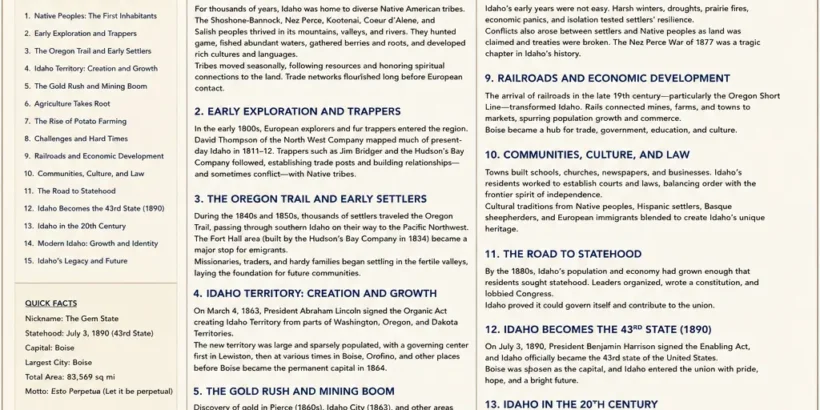
The Complete History of Idaho
Idaho, affectionately known as The Gem State, is a land of towering mountains, deep forests, winding rivers, fertile farmland, and vast wilderness. While many people immediately associate Idaho with its famous potatoes, the state’s history is far richer and more complex than agriculture alone. For thousands of years before European explorers arrived, Native American peoples developed thriving cultures throughout the region. Later, fur traders, missionaries, miners, ranchers, and pioneers transformed Idaho into one of the most significant territories of the American West.
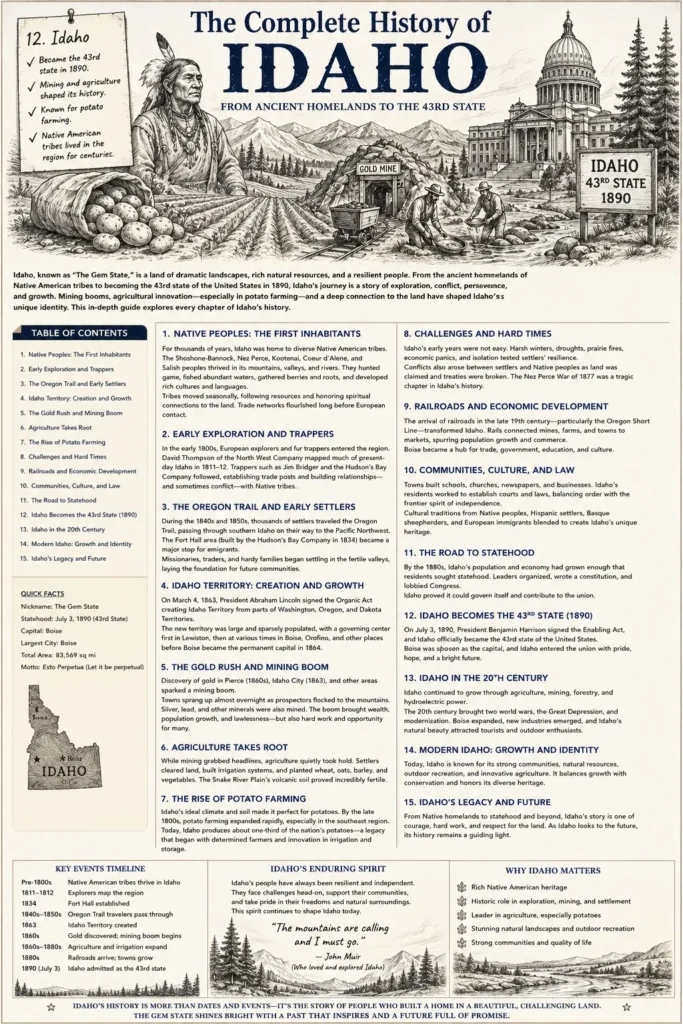
Today, Idaho is recognized for its natural beauty, outdoor recreation, agricultural excellence, and growing economy. However, the path to becoming the 43rd state of the United States on July 3, 1890, was marked by exploration, conflict, economic booms, and cultural change.
Mining and agriculture shaped Idaho’s development. Gold and silver discoveries attracted thousands of fortune seekers during the nineteenth century, while fertile volcanic soil eventually made the state one of the world’s leading potato producers. Railroads connected isolated settlements with national markets, encouraging towns, businesses, and industries to flourish.
The story of Idaho is also the story of resilience. Native American communities preserved their traditions despite enormous challenges. Early settlers endured harsh winters, rugged mountains, and isolated conditions. Miners risked everything searching for precious metals, while farmers transformed valleys into productive agricultural landscapes.
This comprehensive guide explores Idaho’s remarkable journey—from ancient Native American civilizations to modern economic development—revealing how history shaped one of America’s most beautiful and fascinating states.
Quick Facts About Idaho
| Category | Information |
|---|---|
| State Name | Idaho |
| Nickname | The Gem State |
| Statehood | July 3, 1890 |
| Order of Statehood | 43rd State |
| Capital | Boise |
| Largest City | Boise |
| State Motto | Esto Perpetua (“Let it be perpetual”) |
| State Bird | Mountain Bluebird |
| State Flower | Syringa |
| Highest Point | Borah Peak |
| Major River | Snake River |
| Famous Crop | Potatoes |
Where Is Idaho?
Located in the Pacific Northwest and Rocky Mountain regions of the United States, Idaho shares borders with:
- Montana
- Wyoming
- Utah
- Nevada
- Oregon
- Washington
- Canada (British Columbia)
Its diverse geography includes:
- Rocky Mountains
- Snake River Plain
- Dense evergreen forests
- Alpine lakes
- Deep river canyons
- High deserts
- Rich agricultural valleys
The state covers more than 83,500 square miles, making it the 14th-largest state in the nation.
Why Is Idaho Called “The Gem State”?
Unlike many states known for a single natural resource, Idaho contains nearly every type of gemstone naturally found in the United States. Precious and semi-precious stones discovered in Idaho include:
- Garnets
- Opals
- Jasper
- Agates
- Topaz
- Zircon
- Star garnets (rare and famous worldwide)
Although potatoes became Idaho’s international symbol, the nickname “The Gem State” reflects the extraordinary mineral diversity beneath its mountains and valleys.
Mining has therefore played an essential role throughout Idaho’s history.
Idaho Before Human Settlement
Long before written history, Idaho’s landscapes were shaped by powerful geological forces.
Millions of years ago:
- Massive volcanic eruptions created rich basalt plains.
- Lava flows formed fertile soils.
- Glaciers carved mountain valleys.
- Rivers created deep canyons.
- Earthquakes uplifted mountain ranges.
These geological events produced the fertile Snake River Plain, one of North America’s most productive agricultural regions.
The abundance of wildlife, fish, fresh water, and edible plants made Idaho attractive to human populations thousands of years ago.
The First People of Idaho
Archaeological evidence suggests humans lived in present-day Idaho for at least 14,000 years.
Ancient peoples adapted remarkably well to Idaho’s varied environments.
They hunted:
- Bison
- Elk
- Deer
- Mountain sheep
- Antelope
They also gathered:
- Berries
- Camas bulbs
- Roots
- Nuts
- Medicinal plants
Fishing became especially important along the Snake, Clearwater, and Salmon Rivers, where seasonal salmon runs provided abundant food.
Over thousands of years, distinct Native American cultures developed throughout the region.
Native American Tribes of Idaho
Several tribes established permanent homelands across what is now Idaho, each with its own language, customs, and traditions.
The Nez Perce
The Nez Perce, who call themselves Nimiipuu (“The People”), occupied north-central Idaho, northeastern Oregon, and southeastern Washington.
Their society was known for:
- Expert horse breeding
- Skilled fishing
- Trade networks
- Rich oral traditions
- Seasonal migrations
The Nez Perce became renowned for breeding the Appaloosa horse, prized for its speed, endurance, and distinctive spotted coat.
The Shoshone
The Shoshone inhabited southern Idaho and neighboring regions.
They relied on:
- Hunting
- Fishing
- Gathering
- Seasonal movement
- Trade
Bands moved throughout the year to follow food sources, demonstrating deep ecological knowledge of Idaho’s landscapes.
The Bannock
Closely related to the Northern Paiute, the Bannock lived primarily in southeastern Idaho.
They hunted buffalo on the Great Plains during seasonal expeditions and returned to Idaho’s valleys and rivers for fishing and gathering.
The Coeur d’Alene
The Coeur d’Alene people lived in northern Idaho’s forests and lakes.
They became known for:
- Woodworking
- Canoe building
- Fishing
- Sustainable forest management
Their villages thrived near Lake Coeur d’Alene and surrounding waterways.
The Kootenai
The Kootenai occupied northern Idaho and parts of Montana and British Columbia.
They depended heavily on rivers, forests, and wildlife while maintaining extensive trade relationships with neighboring tribes.
The Paiute
Smaller Paiute communities lived in southwestern Idaho.
Their lifestyle reflected adaptation to desert environments through careful management of limited water resources.
Native American Life Before European Contact
For thousands of years, Idaho’s Indigenous peoples lived in balance with their environment.
Daily life centered on:
Fishing
Salmon runs were among the largest in North America.
Communities gathered every year to catch and preserve fish for winter.
Hunting
Hunters pursued:
- Elk
- Deer
- Moose
- Bighorn sheep
- Buffalo (during eastern expeditions)
Nothing from the animals was wasted.
Gathering
Women collected edible plants including:
- Camas bulbs
- Wild onions
- Berries
- Roots
- Herbs
Camas, in particular, became a staple food.
Trade
Native trade routes stretched across western North America.
Items exchanged included:
- Obsidian
- Shells
- Horses
- Buffalo hides
- Food
- Tools
- Decorative items
Long before Europeans arrived, Idaho was connected to extensive Indigenous trading networks.
Spiritual Beliefs
Most tribes viewed nature as sacred.
Mountains, rivers, animals, and plants held spiritual significance.
Ceremonies celebrated:
- Seasonal changes
- Successful hunts
- Salmon migrations
- Community gatherings
- Family milestones
These traditions continue today within many Native communities.
Idaho’s Natural Resources
One reason Native peoples thrived in Idaho was the abundance of natural resources.
These included:
- Freshwater rivers
- Salmon
- Timber
- Fertile valleys
- Wild game
- Minerals
- Volcanic soils
Centuries later, these same resources attracted miners, settlers, farmers, railroad companies, and entrepreneurs.
Early Signs of European Interest
Although Native peoples had occupied Idaho for millennia, Europeans did not explore the region extensively until the late eighteenth and early nineteenth centuries.
Spanish explorers traveled throughout parts of western North America, but Idaho remained largely outside their routes. The first sustained European interest came through British and American fur traders, who sought valuable beaver pelts.
The Lewis and Clark Expedition (1804–1806) crossed portions of present-day Idaho, documenting the landscape and meeting Native communities. Their journals described rugged mountains, swift rivers, abundant wildlife, and the hospitality of tribes such as the Nez Perce, whose assistance helped the expedition survive a difficult crossing.
These early encounters opened the door to future exploration, trade, missionary activity, and eventually permanent settlement.
The Complete History of Idaho
Part 2: Exploration, the Fur Trade, the Oregon Trail, and the Birth of Idaho Territory
Lewis and Clark Open the Door to Idaho (1805–1806)
One of the most significant events in Idaho’s early recorded history was the arrival of the Lewis and Clark Expedition. Commissioned by President Thomas Jefferson after the Louisiana Purchase of 1803, the Corps of Discovery was tasked with exploring the newly acquired lands and seeking a practical route to the Pacific Ocean.
In the fall of 1805, Meriwether Lewis and William Clark crossed the Bitterroot Mountains into present-day Idaho. The journey was one of the most difficult stages of their expedition. The explorers faced freezing temperatures, deep snow, exhaustion, and dwindling food supplies.
When they reached the lands of the Nez Perce (Nimiipuu) near the Clearwater River, the expedition was in desperate condition. The Nez Perce welcomed the travelers, shared food, helped them recover from starvation, and cared for their horses. This assistance proved crucial to the expedition’s survival.
During their stay, the expedition built canoes from local timber and traveled along the Clearwater, Snake, and Columbia Rivers toward the Pacific Ocean.
What Lewis and Clark Recorded
Their journals described:
- Towering mountain ranges
- Thick pine forests
- Fertile river valleys
- Large salmon runs
- Rich wildlife populations
- Native villages and trade routes
These detailed records introduced much of the American public to Idaho’s landscapes and resources.
The Fur Trade Era
Following Lewis and Clark’s reports, Idaho attracted professional fur trappers and trading companies eager to profit from the region’s abundant beaver populations.
During the early nineteenth century, beaver pelts were highly valuable because they were used to manufacture fashionable waterproof hats in Europe and eastern North America.
Several companies competed fiercely for control of the fur trade.
Major participants included:
- Hudson’s Bay Company
- North West Company
- American Fur Company
- Rocky Mountain Fur Company
The Mountain Men
Independent trappers—often called mountain men—became legendary figures throughout the American West.
These adventurous frontiersmen spent months or even years living in Idaho’s wilderness.
They learned survival skills from Native American tribes and became experts in:
- Hunting
- Trapping
- River travel
- Mountain navigation
- Wilderness survival
Some famous mountain men associated with Idaho include:
- Jim Bridger
- Jedediah Smith
- Donald Mackenzie
- Osborne Russell
Although many came seeking wealth from beaver pelts, their maps and knowledge later guided settlers traveling west.
Trading Posts and Frontier Commerce
To support the growing fur trade, trading posts were established across the Pacific Northwest.
These outposts served several purposes:
- Buying and selling furs
- Trading supplies
- Repairing equipment
- Sharing news
- Restocking food
Native American tribes traded:
- Beaver pelts
- Deer hides
- Horses
- Salmon
- Handmade goods
In exchange they received:
- Metal tools
- Blankets
- Firearms
- Cooking utensils
- Glass beads
- Cloth
While trade created economic opportunities, it also introduced diseases that devastated many Native communities.
Missionaries Arrive in Idaho
During the 1830s and 1840s, Christian missionaries established missions among Native tribes.
Their goals included:
- Teaching Christianity
- Opening schools
- Providing medical care
- Introducing European farming methods
One of the best-known missionaries was Henry Spalding, who established a mission among the Nez Perce near present-day Lapwai in 1836.
Another important missionary was Marcus Whitman, whose work in the Pacific Northwest influenced later American settlement.
Missionaries introduced:
- Reading and writing
- Printing presses
- Agriculture
- Western education
However, cultural misunderstandings often created tension between Native peoples and newcomers.
The Oregon Trail
During the 1840s and 1850s, Idaho became an important section of the famous Oregon Trail, one of America’s greatest migration routes.
Thousands of emigrants traveled west in covered wagons seeking:
- Fertile farmland
- New opportunities
- Religious freedom
- Economic independence
The trail crossed southern Idaho, particularly along the Snake River Plain.
Travelers encountered numerous hardships.
Common Challenges
- River crossings
- Disease
- Heat
- Lack of water
- Mountain passes
- Food shortages
- Wagon breakdowns
Despite these dangers, migration increased dramatically each year.
Fort Hall: Idaho’s Gateway to the West
Perhaps no location was more important to westward migration than Fort Hall.
Originally built in 1834 by Nathaniel Wyeth, the fort was later purchased by the Hudson’s Bay Company.
Fort Hall served as:
- Trading center
- Supply station
- Rest stop
- Meeting place
- Emergency refuge
Thousands of Oregon Trail emigrants repaired wagons, purchased supplies, and rested before continuing their difficult journey west.
The fort became one of the busiest frontier posts in the American West.
Idaho During the California Gold Rush
In 1848, gold was discovered in California.
Although most fortune seekers hurried south, many crossed Idaho while traveling to California.
This migration increased awareness of Idaho’s own mineral wealth.
Soon prospectors began searching Idaho’s mountains and streams for gold.
Gold Is Discovered in Idaho
Everything changed in 1860, when significant gold deposits were discovered near Pierce in north-central Idaho.
News spread rapidly.
Within months, thousands of miners flooded into the region.
Mining camps appeared almost overnight.
Among the earliest mining communities were:
- Pierce
- Florence
- Elk City
- Warren
The Idaho Gold Rush had begun.
Life in the Mining Camps
Mining towns grew with astonishing speed.
Some communities that had no residents one month contained thousands of people only weeks later.
Life was exciting but difficult.
Miners faced:
- Harsh winters
- Dangerous working conditions
- Disease
- Limited medical care
- Fires
- Floods
Many miners never found significant gold.
Instead, merchants, blacksmiths, hotel owners, restaurant operators, and transportation businesses often earned steadier incomes than the prospectors themselves.
Gold Changes Idaho Forever
The gold rush dramatically transformed Idaho.
Population increased rapidly.
New businesses opened.
Roads were built.
Mail service expanded.
Banks appeared.
Local governments formed.
Mining also attracted immigrants from:
- China
- Ireland
- Germany
- England
- Scandinavia
This growing diversity influenced Idaho’s developing culture.
Silver and Other Minerals
Gold was only the beginning.
Soon miners discovered rich deposits of:
- Silver
- Lead
- Zinc
- Copper
Northern Idaho eventually became one of the world’s leading silver-producing regions.
The Coeur d’Alene Mining District became internationally famous.
For decades, mining remained one of Idaho’s largest industries.
The Creation of Idaho Territory
As population increased, governing the vast frontier became increasingly difficult.
Recognizing this need, President Abraham Lincoln signed legislation creating Idaho Territory on March 4, 1863.
The new territory included land that now forms:
- Idaho
- Montana
- Wyoming
The original Idaho Territory was enormous, covering more than 326,000 square miles.
Choosing a Capital
The first territorial capital was Lewiston, located in northern Idaho.
However, as mining activity expanded farther south, government leaders decided a more centrally located capital was needed.
In 1864, the capital moved to Boise, where it remains today.
Boise’s location along the Boise River made it an important transportation and commercial center.
Territorial Government
Like other U.S. territories, Idaho was governed by officials appointed by the federal government.
The territorial government established:
- Courts
- Counties
- Tax systems
- Public offices
- Law enforcement
- Land records
As more settlers arrived, residents increasingly demanded greater political representation and eventual statehood.
Transportation Across Idaho
Travel across Idaho remained difficult during the nineteenth century.
Before railroads, people relied on:
- Horseback
- Stagecoaches
- Riverboats
- Freight wagons
Mountain ranges and deep river canyons made transportation expensive and slow.
Road construction gradually connected isolated communities.
These transportation improvements encouraged trade and permanent settlement.
Native American Resistance
As settlers, miners, and ranchers expanded into Native lands, conflicts increased.
Many Native American leaders sought peaceful solutions through negotiation.
However, disagreements over land, treaties, and resources often led to violence.
The most famous conflict involved the Nez Perce War of 1877.
Chief Joseph became internationally respected for his leadership during the conflict.
Although the Nez Perce fought skillfully while retreating over more than 1,000 miles, they were eventually forced to surrender just short of the Canadian border.
Chief Joseph’s famous words, “I will fight no more forever,” became one of the most remembered statements in American history.
The war marked a tragic turning point, leading to the removal of many Native communities from their traditional homelands.
Ranching and Early Agriculture
While mining dominated headlines, farming and ranching steadily expanded.
Settlers discovered that Idaho’s river valleys contained fertile soil ideal for crops and livestock.
Early farmers raised:
- Wheat
- Oats
- Barley
- Hay
- Vegetables
Ranchers raised:
- Cattle
- Sheep
- Horses
Irrigation projects gradually transformed dry landscapes into productive farmland, laying the foundation for Idaho’s future agricultural success.
Idaho in the 1880s
By the 1880s, Idaho was changing rapidly.
The territory featured:
- Growing towns
- Flourishing mines
- Expanding farms
- Schools
- Newspapers
- Churches
- Rail connections under development
Its population had grown large enough that many residents believed Idaho was ready to become a state.
Political leaders began preparing a state constitution and lobbying Congress for admission to the Union.
Part 3: Statehood, Railroads, Agriculture, and the Rise of the Potato State
This is Part 3 of a multi-part, SEO-friendly article on the complete history of Idaho.
The Road to Statehood
By the late 1880s, Idaho had changed dramatically from the rugged frontier territory established in 1863. Mining camps had grown into permanent towns, agriculture was expanding across fertile valleys, and transportation networks were steadily improving. The population had increased enough to justify the formation of a state government.
Residents wanted greater control over local affairs instead of relying on federally appointed territorial officials. Business leaders believed statehood would attract investment, encourage immigration, and strengthen Idaho’s economy.
Political leaders gathered to draft a state constitution that would establish the framework for Idaho’s future government.
Writing Idaho’s Constitution
In 1889, delegates met in Boise for a constitutional convention.
Their responsibilities included creating a government that would:
- Protect individual rights
- Establish a legislature
- Create a judicial system
- Organize elections
- Manage public education
- Regulate taxation
- Encourage economic development
The resulting constitution reflected many of the principles found in the United States Constitution while addressing issues unique to the American West, including mining, water rights, and public lands.
Although amended many times since its adoption, the Idaho Constitution remains the foundation of state government today.
Idaho Becomes the 43rd State
After reviewing Idaho’s constitution and population growth, Congress approved its admission into the Union.
On July 3, 1890, President Benjamin Harrison signed the proclamation admitting Idaho as the 43rd state of the United States.
The event was celebrated across Idaho.
Church bells rang.
Parades filled city streets.
Newspapers printed special editions announcing the historic achievement.
Communities proudly displayed American flags, and residents celebrated the beginning of a new chapter in Idaho’s history.
Boise officially became the permanent state capital.
Idaho’s First State Government
With statehood came elected officials responsible for guiding Idaho’s future.
The new government focused on:
- Expanding schools
- Building roads
- Improving law enforcement
- Encouraging settlement
- Supporting agriculture
- Promoting mining
- Attracting businesses
These efforts helped transform Idaho from a frontier territory into a stable and growing state.
The Importance of the Railroads
One of the greatest forces shaping Idaho after statehood was the expansion of the railroad system.
Before railroads, transporting goods across Idaho’s mountains was slow and expensive. Farmers, miners, and merchants often struggled to reach national markets.
The arrival of railroads changed everything.
Major rail lines connected Idaho with:
- Portland
- Seattle
- Salt Lake City
- Chicago
- San Francisco
- Eastern manufacturing centers
This transportation revolution dramatically reduced travel times and shipping costs.
Economic Growth Through Rail Transportation
Railroads stimulated nearly every part of Idaho’s economy.
Mining companies could now ship ore efficiently to smelters and factories.
Farmers transported crops to distant markets.
Manufacturers received machinery and supplies more quickly.
Communities located along railroad routes often experienced rapid growth.
New hotels, stores, warehouses, grain elevators, and businesses appeared near train stations.
Many towns owe their existence to the railroad era.
Mining Continues to Prosper
Even after statehood, mining remained one of Idaho’s most important industries.
Northern Idaho’s Coeur d’Alene Mining District became famous for producing enormous quantities of:
- Silver
- Lead
- Zinc
The region earned international recognition for its exceptionally rich mineral deposits.
Mining companies invested heavily in:
- Underground tunnels
- Rail systems
- Processing mills
- New equipment
Thousands of workers found employment in Idaho’s mines.
Although mining was dangerous, it provided economic opportunities that attracted immigrants from around the world.
The Rise of Agriculture
While mining generated headlines, agriculture gradually became the backbone of Idaho’s long-term economy.
Settlers discovered that much of southern Idaho contained fertile volcanic soil capable of producing abundant crops when supplied with water.
Farmers expanded production of:
- Wheat
- Oats
- Barley
- Sugar beets
- Alfalfa
- Apples
- Cherries
- Livestock feed
Irrigation projects transformed previously dry land into productive farmland.
Irrigation Changes Idaho
Water was essential to Idaho’s agricultural success.
Beginning in the late nineteenth century, communities invested in:
- Canals
- Reservoirs
- Ditches
- Diversion dams
These irrigation systems carried water from rivers to farms throughout the Snake River Plain.
The federal government later supported additional irrigation projects through reclamation programs.
As irrigation expanded, agriculture became increasingly reliable and profitable.
Why Idaho Became Famous for Potatoes
No crop became more closely associated with Idaho than the potato.
Several natural advantages contributed to its success.
Fertile Volcanic Soil
Ancient lava flows left behind nutrient-rich soil ideal for growing potatoes.
Warm Days and Cool Nights
Large temperature differences between day and night help potatoes develop slowly, improving flavor and texture.
Reliable Irrigation
Water from rivers and reservoirs allows farmers to maintain consistent growing conditions.
Agricultural Innovation
Researchers and farmers continuously improved:
- Seed quality
- Irrigation methods
- Pest management
- Harvesting equipment
- Storage technology
By the twentieth century, Idaho had become one of the world’s leading potato-producing regions.
Today, the phrase “Idaho potatoes” is recognized internationally as a symbol of quality.
More Than Potatoes
Although potatoes dominate Idaho’s agricultural reputation, the state produces many other important products.
These include:
- Wheat
- Barley
- Dairy products
- Beef cattle
- Sugar beets
- Onions
- Hops
- Peas
- Lentils
- Hay
- Apples
- Cherries
- Trout
Agriculture remains one of Idaho’s largest economic sectors.
Growth of Boise
Following statehood, Boise developed into Idaho’s political, educational, and commercial center.
Businesses established:
- Banks
- Hotels
- Department stores
- Newspapers
- Manufacturing companies
Government offices expanded alongside private industry.
Boise’s population steadily increased as people moved from rural areas and other states seeking opportunity.
Today, Boise is one of the fastest-growing metropolitan areas in the American West.
Education in the New State
State leaders understood that education would be essential for long-term prosperity.
Public schools expanded rapidly.
Teachers were recruited from across the country.
Communities built schoolhouses in both rural and urban areas.
Higher education also grew.
One of Idaho’s most important educational institutions, the University of Idaho, was established in 1889, just before statehood.
The university became a center for:
- Agricultural research
- Engineering
- Forestry
- Science
- Teacher education
Its research has played a major role in improving Idaho’s farming practices.
Timber and Forestry
Northern Idaho contains vast forests of:
- Douglas fir
- Ponderosa pine
- Western red cedar
- Spruce
- Larch
The lumber industry became another important source of employment.
Timber supported:
- Home construction
- Railroad ties
- Furniture manufacturing
- Paper production
As concerns about conservation grew, forest management practices gradually improved to balance economic development with environmental protection.
Immigration and Cultural Diversity
The promise of work attracted people from many parts of the world.
Immigrant communities included:
- Chinese laborers
- Irish miners
- Scandinavian farmers
- German settlers
- Italian workers
- Basque shepherds
The Basque community, in particular, left a lasting influence on southern Idaho through sheep ranching, cuisine, festivals, and cultural traditions.
Boise remains home to one of the largest Basque communities in the United States.
Idaho at the Beginning of the Twentieth Century
By 1900, Idaho had become a state with a diversified economy.
Its major industries included:
- Mining
- Agriculture
- Ranching
- Forestry
- Transportation
- Commerce
Cities continued to grow while many rural communities prospered through farming and livestock production.
The state’s population increased steadily as improved transportation made settlement easier.
Conservation and Natural Resources
As mining, logging, and farming expanded, many Americans became concerned about protecting natural landscapes.
The federal government created national forests throughout Idaho to preserve timber resources and watersheds.
Today, Idaho contains millions of acres of protected public lands, including:
- National forests
- Wilderness areas
- State parks
- Wildlife refuges
These protected landscapes support tourism, recreation, and biodiversity while preserving the state’s natural beauty.
Challenges of Frontier Life
Despite economic growth, life remained demanding for many Idaho residents.
Communities faced:
- Harsh winters
- Floods
- Wildfires
- Economic downturns
- Labor disputes in mining regions
- Isolated rural conditions
Families often depended on cooperation among neighbors to survive difficult times.
This spirit of resilience became an important part of Idaho’s identity.
Idaho Enters a New Century
As the twentieth century began, Idaho was no longer simply a frontier territory. It had become a growing agricultural and mining state with expanding towns, developing infrastructure, and increasing influence in the American West.
The foundations laid during the late nineteenth century would support decades of growth, innovation, and change.
The Complete History of Idaho
Part 4: World Wars, the Great Depression, and Idaho’s Transformation in the Twentieth Century
This is Part 4 of a multi-part, SEO-friendly article on the complete history of Idaho.
Idaho Enters the Twentieth Century
At the beginning of the twentieth century, Idaho was transitioning from a frontier state into a modern society. Agriculture, mining, logging, and ranching remained the pillars of the economy, while railroads connected Idaho’s towns with the rest of the nation.
The state’s population continued to grow as immigrants and settlers established farms, opened businesses, and built communities. Although much of Idaho remained rural, cities such as Boise, Pocatello, Lewiston, and Coeur d’Alene expanded steadily.
State leaders invested in roads, schools, public services, and irrigation systems, laying the groundwork for future prosperity.
The Progressive Era in Idaho
Like many states during the early 1900s, Idaho experienced the influence of the Progressive Era, a nationwide movement aimed at improving government and addressing social problems.
Reforms included:
- Expanding public education
- Improving road construction
- Strengthening public health systems
- Regulating businesses
- Promoting conservation of natural resources
Women also became increasingly active in public life. Idaho was one of the earliest states to grant women the right to vote, doing so in 1896, well before the adoption of the Nineteenth Amendment to the U.S. Constitution in 1920.
Mining Labor Conflicts
Mining continued to generate wealth, but it also brought labor disputes.
The Coeur d’Alene Mining District saw tensions between mine owners and workers over issues such as:
- Wages
- Working hours
- Safety conditions
- Union recognition
Several strikes and confrontations occurred during the late nineteenth and early twentieth centuries. These events highlighted the challenges of balancing industrial growth with workers’ rights.
Over time, improvements in labor laws and workplace safety helped reduce some of these conflicts.
Idaho During World War I (1914–1918)
When the United States entered World War I in 1917, Idaho contributed significantly to the national war effort.
Thousands of Idaho residents enlisted in the armed forces.
At home, citizens supported the war by:
- Purchasing Liberty Bonds
- Conserving food
- Growing victory gardens
- Producing crops for military use
Agriculture became especially important because American troops and Allied nations depended on reliable food supplies.
Farmers increased production of:
- Wheat
- Potatoes
- Livestock
- Dairy products
Mining also remained essential, providing metals needed for weapons, machinery, and transportation.
Economic Changes After the War
Following World War I, Idaho experienced a period of economic adjustment.
During the war, high demand had driven up prices for agricultural products. After the war ended, prices fell sharply.
Many farmers struggled with:
- Lower crop prices
- Debt
- Changing markets
Despite these challenges, agriculture remained central to Idaho’s economy.
Communities continued investing in irrigation, transportation, and education.
The Roaring Twenties
The 1920s brought modernization to many parts of Idaho.
Technological advances improved daily life.
Families increasingly gained access to:
- Automobiles
- Electricity
- Telephones
- Radios
Road construction expanded rapidly, making travel easier between rural communities and growing cities.
Businesses adopted new machinery, increasing productivity in farming, logging, and manufacturing.
Although Idaho remained more rural than many eastern states, the influence of modern technology became increasingly visible.
The Great Depression (1929–1939)
The stock market crash of 1929 triggered the Great Depression, the most severe economic crisis in modern American history.
Idaho, like the rest of the nation, suffered greatly.
Many residents experienced:
- Unemployment
- Falling farm prices
- Business closures
- Bank failures
- Financial hardship
Agricultural communities were particularly affected because farmers received much less income for their crops.
Mining production also declined as industrial demand weakened.
Families often relied on neighbors and extended relatives to survive difficult times.
New Deal Programs in Idaho
President Franklin D. Roosevelt introduced the New Deal, a series of federal programs designed to stimulate the economy and provide employment.
Several New Deal agencies operated throughout Idaho.
Projects included:
- Building roads
- Constructing bridges
- Improving parks
- Developing irrigation systems
- Planting trees
- Expanding public buildings
The Civilian Conservation Corps (CCC) employed thousands of young men in conservation projects.
CCC workers:
- Built hiking trails
- Fought forest fires
- Improved campgrounds
- Restored forests
- Protected watersheds
Many parks and recreational facilities in Idaho still reflect work completed during the New Deal era.
The Importance of Dams
The twentieth century saw major investments in dams throughout the Snake River Basin.
These projects served several purposes:
- Hydroelectric power generation
- Irrigation
- Flood control
- Water storage
Hydroelectric dams supplied affordable electricity to homes, farms, and industries, supporting economic growth across southern Idaho.
Idaho During World War II (1939–1945)
World War II brought another period of rapid economic expansion.
Thousands of Idaho residents served in every branch of the U.S. military.
Those who remained at home supported the war through increased industrial and agricultural production.
Idaho farms supplied enormous quantities of:
- Potatoes
- Wheat
- Beef
- Dairy products
- Vegetables
Mining operations produced valuable minerals needed for military equipment.
Factories manufactured goods supporting the national defense.
The Minidoka War Relocation Center
One of the most significant and difficult chapters in Idaho’s World War II history was the establishment of the Minidoka War Relocation Center near Hunt, Idaho.
Following Executive Order 9066 in 1942, the U.S. government forcibly relocated more than 120,000 Japanese Americans from the West Coast. More than 9,000 of them were confined at Minidoka.
Families lived in barracks under difficult conditions while losing homes, businesses, and property elsewhere. Despite these hardships, many residents built schools, gardens, newspapers, and community organizations within the camp.
Today, the Minidoka National Historic Site preserves this history and serves as a place for education and remembrance.
Scientific Research in Idaho
The post-war years brought new opportunities in science and technology.
In 1949, the federal government established what is now the Idaho National Laboratory (INL) in southeastern Idaho.
The laboratory became a leader in:
- Nuclear energy research
- Reactor development
- National security research
- Advanced engineering
- Energy innovation
In 1951, scientists at the facility generated the first usable electricity from a nuclear reactor, marking a milestone in the history of nuclear power.
INL remains one of Idaho’s most important research institutions.
Agriculture After World War II
Agriculture underwent major changes after the war.
Farmers increasingly adopted:
- Tractors
- Combines
- Mechanical harvesters
- Improved irrigation systems
- Scientific fertilizers
- Better seed varieties
These innovations greatly increased productivity while reducing manual labor.
Potato farming became even more efficient, strengthening Idaho’s reputation as one of the world’s leading producers.
Food-processing industries also expanded, creating jobs beyond the farm.
Growth of Idaho’s Cities
The decades following World War II brought steady urban growth.
Boise developed into:
- The state capital
- A financial center
- A technology hub
- A center for higher education
Other growing cities included:
- Idaho Falls
- Twin Falls
- Pocatello
- Nampa
- Meridian
- Coeur d’Alene
Improved highways encouraged commerce, tourism, and suburban development.
Interstate Highways
The construction of the Interstate Highway System during the 1950s and 1960s greatly improved transportation.
Major routes such as:
- Interstate 84
- Interstate 86
- Interstate 90
- Interstate 15
connected Idaho more efficiently with neighboring states.
The highway network supported:
- Tourism
- Freight transportation
- Business development
- Population growth
Outdoor Recreation Becomes an Industry
Idaho’s spectacular landscapes increasingly attracted visitors from across the United States.
Popular activities included:
- Camping
- Fishing
- Hunting
- Whitewater rafting
- Skiing
- Hiking
- Mountain climbing
National forests, rivers, and wilderness areas became important economic assets as tourism grew into a major industry.
Protecting Idaho’s Natural Heritage
During the second half of the twentieth century, conservation efforts expanded.
State and federal agencies worked to protect:
- Salmon habitats
- Forest ecosystems
- Wildlife populations
- Scenic rivers
- Wilderness areas
Environmental policies sought to balance resource development with long-term sustainability.
Idaho Near the End of the Twentieth Century
By the late 1900s, Idaho had developed a diversified economy.
In addition to agriculture and mining, important sectors included:
- Technology
- Scientific research
- Food processing
- Manufacturing
- Tourism
- Healthcare
- Education
Population growth accelerated, particularly in the Boise metropolitan area.
Although Idaho retained its rural traditions, it had become an increasingly modern and economically diverse state.
The Complete History of Idaho
Part 5: Modern Idaho, Culture, Economy, Timeline, FAQs, and Conclusion
This is Part 5, the final installment of the SEO-friendly article on the complete history of Idaho.
Idaho in the Twenty-First Century
The twenty-first century has brought significant growth and transformation to Idaho. Once known primarily for mining and agriculture, the state now has one of the fastest-growing economies and populations in the United States. New residents are drawn by Idaho’s scenic beauty, outdoor recreation, strong job market, and relatively affordable cost of living.
The Boise metropolitan area has become a center for technology, healthcare, finance, and education. At the same time, rural communities continue to contribute to the state’s agricultural and natural resource industries.
Today, Idaho successfully combines its frontier heritage with innovation, making it one of the most dynamic states in the American West.
Population Growth and Urban Development
Idaho’s population has grown rapidly over the past several decades. Cities have expanded, and new housing developments, schools, and businesses have been built to meet the needs of growing communities.
Fast-Growing Cities
Some of Idaho’s fastest-growing cities include:
- Boise
- Meridian
- Nampa
- Idaho Falls
- Coeur d’Alene
- Twin Falls
- Caldwell
- Post Falls
Despite urban growth, much of Idaho remains rural, preserving its agricultural traditions and natural landscapes.
Idaho’s Modern Economy
Although potatoes remain an iconic symbol of Idaho, the state’s economy is much more diverse than many people realize.
Agriculture
Agriculture continues to be one of Idaho’s largest industries.
Major agricultural products include:
- Potatoes
- Wheat
- Barley
- Sugar beets
- Onions
- Hops
- Hay
- Corn
- Dairy products
- Beef cattle
- Trout
Idaho consistently ranks among the nation’s leading producers of potatoes, barley, and several dairy products.
Food Processing
Many crops grown in Idaho are processed within the state.
Major products include:
- Frozen potato products
- Cheese
- Yogurt
- Butter
- Packaged vegetables
- Grain products
Food processing adds significant value to Idaho’s agricultural economy and provides thousands of jobs.
Technology
Technology has become one of Idaho’s fastest-growing industries.
Companies specialize in:
- Computer hardware
- Semiconductor manufacturing
- Software development
- Cybersecurity
- Cloud computing
- Artificial intelligence
The Boise area has developed into an important regional technology center.
Scientific Research
The Idaho National Laboratory (INL) continues to lead research in:
- Nuclear energy
- Clean energy technologies
- National security
- Robotics
- Advanced manufacturing
The laboratory collaborates with universities, private companies, and government agencies to solve complex scientific challenges.
Tourism
Tourism has become increasingly important to Idaho’s economy.
Millions of visitors travel to Idaho every year to experience its mountains, rivers, forests, and outdoor recreation.
Popular activities include:
- Hiking
- Camping
- Skiing
- Snowboarding
- Fishing
- Hunting
- Whitewater rafting
- Rock climbing
- Mountain biking
- Wildlife viewing
Tourism supports hotels, restaurants, guide services, and local businesses across the state.
Idaho’s Natural Wonders
Idaho is home to some of the most breathtaking landscapes in North America.
Snake River
The Snake River flows for more than 1,000 miles, shaping Idaho’s geography and supporting agriculture through irrigation.
Hells Canyon
Located along the Idaho–Oregon border, Hells Canyon is the deepest river gorge in North America, reaching depths of about 8,000 feet in places.
Visitors enjoy rafting, fishing, hiking, and wildlife viewing.
Sawtooth Mountains
The Sawtooth Range features dramatic peaks, alpine lakes, and extensive hiking trails.
It is one of Idaho’s most visited outdoor destinations.
Shoshone Falls
Often called the “Niagara of the West,” Shoshone Falls is approximately 212 feet (65 meters) high, making it higher than Niagara Falls.
Craters of the Moon National Monument and Preserve
This unique volcanic landscape contains lava fields, cinder cones, caves, and other geological features formed by ancient eruptions.
The monument provides insight into Idaho’s volcanic past.
Native American Communities Today
Native American tribes continue to play an essential role in Idaho’s cultural, economic, and political life.
Federally recognized tribes in Idaho include:
- Nez Perce Tribe
- Shoshone-Bannock Tribes
- Coeur d’Alene Tribe
- Kootenai Tribe of Idaho
- Shoshone-Paiute Tribes
These nations preserve their languages, traditions, ceremonies, and cultural heritage while contributing to education, healthcare, environmental stewardship, and economic development.
Many tribes also manage museums, cultural centers, and historical sites that help visitors understand Idaho’s Indigenous history.
Idaho’s Education System
Education remains a priority throughout the state.
Major public universities include:
- University of Idaho
- Boise State University
- Idaho State University
- Lewis-Clark State College
These institutions offer programs in:
- Agriculture
- Engineering
- Medicine
- Business
- Computer Science
- Environmental Science
- Education
Research conducted at these universities contributes to Idaho’s economy and technological advancement.
Culture and Traditions
Idaho’s culture reflects influences from Native American peoples, pioneers, ranchers, miners, immigrants, and modern entrepreneurs.
Traditional values often include:
- Hard work
- Community involvement
- Respect for nature
- Outdoor recreation
- Family traditions
Many communities celebrate local history through annual festivals, county fairs, rodeos, and cultural events.
Famous Idaho Foods
Idaho’s culinary identity extends beyond potatoes.
Popular foods include:
- Baked potatoes
- French fries
- Potato chips
- Finger steaks
- Rainbow trout
- Huckleberry pie
- Fry sauce
- Beef dishes
- Artisan cheeses
Fresh produce, dairy products, and locally grown ingredients are common features of Idaho cuisine.
Famous People from Idaho
Many notable individuals have connections to Idaho, including:
- Ezra Pound – Influential poet born in Hailey.
- Philo Farnsworth – Pioneer in electronic television development who spent part of his youth in Idaho.
- Picabo Street – Olympic gold medal-winning alpine skier.
- Sarah Palin – Politician and former governor of Alaska, born in Sandpoint, Idaho.
- Aaron Paul – Emmy Award-winning actor, born in Emmett, Idaho.
- Kristin Armstrong – Three-time Olympic gold medalist in cycling.
Their achievements have brought national and international attention to the state.
Major Historical Timeline
| Year | Event |
|---|---|
| c. 12,000 BCE | Earliest evidence of human habitation in present-day Idaho |
| 1805 | Lewis and Clark Expedition enters Idaho |
| 1834 | Fort Hall established |
| 1836 | Henry Spalding establishes mission near Lapwai |
| 1840s | Oregon Trail brings thousands of emigrants through Idaho |
| 1860 | Gold discovered near Pierce |
| 1863 | Idaho Territory created |
| 1864 | Boise becomes territorial capital |
| 1877 | Nez Perce War |
| 1890 | Idaho becomes the 43rd U.S. state |
| 1889–1900s | Expansion of the University of Idaho and public education |
| 1917–1918 | Idaho supports World War I |
| 1930s | New Deal projects improve infrastructure |
| 1942–1945 | Minidoka War Relocation Center operates during World War II |
| 1949 | Idaho National Laboratory established |
| 1951 | First usable electricity generated from a nuclear reactor at INL |
| Late 20th Century | Growth of technology, tourism, and higher education |
| 21st Century | Idaho becomes one of the fastest-growing states in the U.S. |
Interesting Facts About Idaho
- Idaho became the 43rd U.S. state on July 3, 1890.
- It is known as “The Gem State” because nearly every type of gemstone found in the United States has been discovered there.
- Idaho produces about one-third of the potatoes grown in the United States.
- Hells Canyon is deeper than the Grand Canyon in terms of maximum depth.
- The state has more than 3,000 rivers and thousands of lakes.
- Shoshone Falls is taller than Niagara Falls.
- Idaho contains millions of acres of protected forests and wilderness.
- The Appaloosa horse was developed by the Nez Perce people.
- Idaho has one of the largest Basque communities in the United States.
- Outdoor recreation contributes billions of dollars to the state’s economy.
Frequently Asked Questions (FAQ)
When did Idaho become a state?
Idaho became the 43rd state of the United States on July 3, 1890.
Why is Idaho called the Gem State?
The nickname comes from the state’s rich deposits of precious and semi-precious gemstones, including the rare star garnet.
What is Idaho famous for?
Idaho is famous for:
- Potatoes
- Beautiful mountains
- Rivers
- Mining history
- Outdoor recreation
- Gemstones
- National forests
- Scientific research
Who lived in Idaho before European settlers?
Native American peoples—including the Nez Perce, Shoshone, Bannock, Coeur d’Alene, Kootenai, and Paiute—lived in the region for thousands of years before European exploration.
What industries shaped Idaho’s history?
Historically, the most influential industries have been:
- Mining
- Agriculture
- Ranching
- Forestry
- Transportation
Today, technology, research, healthcare, tourism, and food processing also play major roles.
Why are Idaho potatoes so famous?
Idaho’s fertile volcanic soil, warm days, cool nights, clean water, and advanced farming practices create excellent growing conditions for potatoes, contributing to their quality and worldwide reputation.
Conclusion
Idaho’s history is one of resilience, adaptation, and opportunity. For thousands of years, Indigenous peoples thrived across its mountains, rivers, and valleys, developing rich cultures deeply connected to the land. The arrival of explorers, fur traders, missionaries, miners, and settlers transformed the region, while the discovery of gold and silver fueled rapid growth. On July 3, 1890, Idaho proudly entered the Union as the 43rd state, marking the beginning of a new era.
Mining and agriculture became the foundations of Idaho’s economy, with fertile volcanic soils helping make the state synonymous with high-quality potato production. Over time, education, scientific research, manufacturing, technology, and tourism broadened Idaho’s economic base. At the same time, its spectacular landscapes—from Hells Canyon to the Sawtooth Mountains—continue to inspire residents and visitors alike.
Today, Idaho honors its Indigenous heritage, celebrates its pioneering past, and embraces innovation while preserving the natural beauty that has defined the Gem State for thousands of years. Its journey from ancient Native homelands to a modern, thriving state reflects the enduring spirit of its people and the remarkable richness of its land.
References
- Idaho State Historical Society. History of Idaho. https://history.idaho.gov/
- Idaho State Government. https://www.idaho.gov/
- National Park Service. Nez Perce National Historical Park. https://www.nps.gov/nepe/
- National Park Service. Minidoka National Historic Site. https://www.nps.gov/miin/
- Library of Congress. Lewis and Clark Expedition. https://www.loc.gov/
- University of Idaho Library. Special Collections and Archives. https://www.lib.uidaho.edu/
- Idaho National Laboratory. https://inl.gov/
- U.S. Geological Survey. https://www.usgs.gov/
- Encyclopaedia Britannica. Idaho. https://www.britannica.com/place/Idaho
- U.S. Census Bureau. https://www.census.gov/