Complete History of Florida: From Ancient Civilizations to the Sunshine State
Part 1: Florida Before European Contact and the Arrival of the Spanish
Featured Image


5
Introduction
Florida is one of the most fascinating and historically rich states in the United States. Known today for its beautiful beaches, world-famous attractions, diverse population, and tropical climate, Florida’s story stretches back thousands of years before European explorers ever arrived.
Long before modern cities such as Miami, Orlando, and Tallahassee existed, the peninsula was home to thriving indigenous societies that developed sophisticated cultures, trade networks, and political systems.
The history of Florida is a story of exploration, colonization, conflict, resilience, migration, and transformation. From prehistoric hunters and Native American civilizations to Spanish conquistadors and colonial settlements, Florida has played a unique role in shaping the history of North America.
This comprehensive guide explores Florida’s remarkable journey, beginning with the people who first called the peninsula home.
Florida Before Florida: The Earliest Human Settlements
Long before Florida appeared on European maps, the region was inhabited by ancient peoples who adapted to changing climates and landscapes over thousands of years.
Archaeological evidence suggests humans lived in Florida at least 14,000 years ago. During the last Ice Age, sea levels were significantly lower than today. As a result, Florida was nearly twice its current size, with coastlines extending far into areas now covered by the Atlantic Ocean and Gulf of Mexico.
These earliest inhabitants, often referred to as Paleo-Indians, lived in a dramatically different environment. Large mammals such as mastodons, giant sloths, and ancient bison roamed the landscape. Early Floridians hunted these animals using stone-tipped spears and gathered edible plants from forests and wetlands.
As glaciers melted and sea levels rose, the geography of Florida changed dramatically. Coastal areas disappeared beneath the water, forcing communities to adapt. Rather than relying solely on large game hunting, they turned increasingly toward fishing, shellfish gathering, and small-game hunting.
This adaptation laid the foundation for the development of Florida’s earliest civilizations.
The Rise of Indigenous Florida Civilizations
By the time Europeans arrived in the early sixteenth century, Florida was home to numerous Native American societies.
These communities were not primitive or isolated. Instead, they maintained organized political structures, extensive trade networks, religious traditions, and advanced environmental knowledge.
Among the most influential groups were:
- Timucua
- Calusa
- Apalachee
Each civilization adapted uniquely to Florida’s diverse environments.
The Timucua Civilization


7
The Timucua occupied a vast territory across northeastern and central Florida.
Their settlements extended through regions that now include:
- Jacksonville
- St. Johns River Valley
- Parts of Central Florida
Rather than a single tribe, the Timucua consisted of multiple chiefdoms connected through language and culture.
Timucua Society
The Timucua developed sophisticated agricultural communities.
Their primary crops included:
- Corn (maize)
- Beans
- Squash
These crops formed the foundation of their economy and supported large permanent settlements.
Timucua villages typically featured:
- Thatched houses
- Community gathering spaces
- Agricultural fields
- Ceremonial centers
Chiefs governed communities with assistance from religious leaders and councils.
Timucua Culture
The Timucua were known for:
- Intricate tattoos
- Decorative body paint
- Skilled woodworking
- Pottery production
- Dugout canoe construction
Religion played a central role in daily life. Natural forces such as the sun, rain, fire, and moon held spiritual significance.
The Timucua also maintained elaborate burial traditions, reflecting a complex belief system concerning ancestry and the afterlife.
The Calusa: Masters of the Gulf Coast
Among Florida’s most remarkable civilizations were the Calusa.
Their territory extended throughout southwestern Florida, including areas near modern:
- Fort Myers
- Naples
- Charlotte Harbor
Unlike many Native American societies, the Calusa did not rely heavily on agriculture.
Instead, they built an economy based on the sea.
The Shell Kingdom
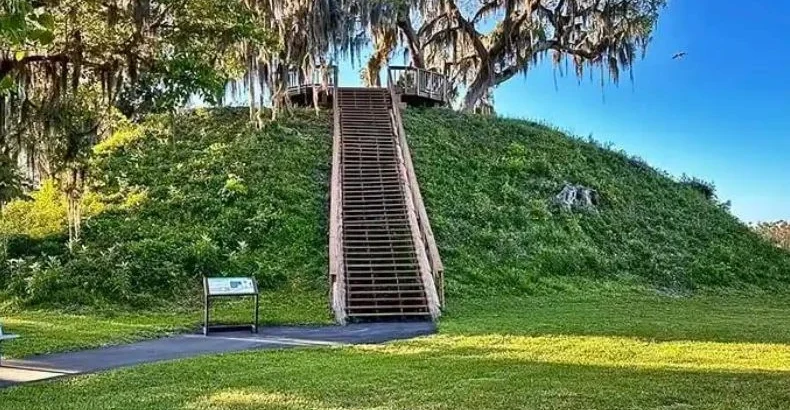
The Calusa became famous for constructing enormous shell mounds.
Over generations, they used:
- Oyster shells
- Fish bones
- Marine debris
to build artificial islands and ceremonial centers.
One of their most impressive settlements was located near present-day Mound Key.
Today, Mound Key Archaeological State Park remains one of Florida’s most important historical locations.
Calusa Engineering and Trade
The Calusa created:
- Canal systems
- Fishing platforms
- Water transportation routes
They built large canoes capable of carrying dozens of people and maintained trade relationships throughout southern Florida and the Florida Keys.
Their political system was highly organized.
Powerful rulers governed multiple communities and controlled extensive regional trade.
Warriors of the Coast
The Calusa were fierce defenders of their homeland.
When European explorers arrived, they resisted foreign intrusion with determination and military skill.
Their resistance would frustrate Spanish efforts for decades.
The Apalachee Civilization
In northwestern Florida, another powerful society flourished.
The Apalachee occupied fertile lands around modern-day Tallahassee.
Tallahassee sits within what was once the heartland of Apalachee territory.
Agricultural Powerhouse
The Apalachee benefited from some of Florida’s richest agricultural soils.
Their economy centered on:
- Corn cultivation
- Trade
- Hunting
- Community labor
Large villages surrounded ceremonial centers and temple mounds.
Political Organization
Apalachee society was highly structured.
Leaders combined political and religious authority, serving as intermediaries between spiritual and earthly realms.
Archaeological sites reveal:
- Large ceremonial complexes
- Planned settlements
- Extensive trade connections
Spanish explorers later described Apalachee communities as among the most powerful and organized societies in Florida.
Trade Networks Across Florida
Although geographically separated, Florida’s indigenous civilizations interacted extensively.
Trade routes connected communities across the peninsula.
Common trade items included:
- Pottery
- Shell tools
- Copper objects
- Animal products
- Ceremonial goods
Ideas, traditions, and technologies spread through these networks, creating a vibrant cultural landscape.
Florida was not an isolated frontier.
It was an interconnected world of thriving civilizations.
The Arrival of European Explorers
Everything changed in the early sixteenth century.
Spain, having established itself as a major colonial power in the Caribbean, began exploring lands farther north.
One explorer would forever become associated with Florida’s name.
That explorer was Juan Ponce de León.
Juan Ponce de León and the Naming of Florida


4
In March 1513, Ponce de León set sail from Puerto Rico with three ships.
His objectives included:
- Exploration
- Territorial claims
- Wealth acquisition
- Personal prestige
After sailing through the Bahamas, he sighted land on April 2, 1513.
The timing was significant.
The discovery occurred during the Easter season, known in Spanish as “Pascua Florida,” meaning the Festival of Flowers.
Inspired by both the holiday and the region’s lush vegetation, he named the land:
La Florida
The name would endure for centuries.
First Encounters with Native Peoples
Ponce de León quickly realized Florida was not an empty wilderness.
Indigenous peoples already occupied the land.
Interactions were often tense.
Spanish explorers encountered organized societies capable of defending themselves.
Many Native groups viewed the newcomers with suspicion.
Conflicts soon erupted.
The Calusa, in particular, fiercely opposed Spanish intrusion.
Their knowledge of local waterways and terrain gave them significant advantages.
Spanish expeditions frequently struggled against both environmental challenges and indigenous resistance.
Spain’s Early Colonial Ambitions
Spain viewed Florida as strategically important.
The peninsula occupied a critical position along maritime routes connecting:
- Spain
- The Caribbean
- Mexico
- South America
Control of Florida offered protection for treasure fleets transporting wealth back to Europe.
However, establishing permanent settlements proved difficult.
Challenges included:
- Hostile terrain
- Tropical diseases
- Hurricanes
- Native resistance
- Lack of precious metals
Unlike Mexico or Peru, Florida offered no vast gold-rich empire waiting to be conquered.
Ponce de León’s Final Expedition
In 1521, Ponce de León returned with colonization plans.
This expedition included settlers, livestock, and supplies intended for permanent occupation.
The effort ended disastrously.
Native warriors attacked the settlement.
Ponce de León suffered a serious wound, reportedly from a poisoned arrow.
He was transported back to Cuba, where he later died.
His dream of colonizing Florida never became reality.
Yet his expedition permanently linked Spain and Florida.
Florida Becomes a Spanish Frontier
Throughout the following decades, Spain launched additional expeditions.
Explorers searched for:
- Gold
- Strategic advantages
- Religious conversions
- New settlements
Many ventures ended in failure.
The Florida wilderness proved extraordinarily difficult for European colonizers.
However, Spain remained determined.
By the mid-sixteenth century, Florida had become an increasingly important component of Spanish imperial strategy.
This determination would eventually lead to the establishment of permanent settlements and the founding of the oldest continuously occupied European city in the continental United States.
Conclusion of Part 1
The earliest chapters of Florida’s history reveal a land far more complex than many imagine.
Long before Spanish explorers arrived, sophisticated Native American civilizations had already flourished for centuries. The Timucua, Calusa, and Apalachee built thriving societies that adapted remarkably to Florida’s diverse environments.
The arrival of Spanish explorers marked the beginning of a transformative era that would forever alter the peninsula’s future. Yet the story of Florida’s indigenous peoples remains the true foundation upon which all later history was built.
Complete History of Florida: From Ancient Civilizations to the Sunshine State
Part 2: Florida as a Battleground of Empires (1565–1821)
Featured Image


7
The Founding of St. Augustine: America’s Oldest European City
After decades of failed expeditions and conflicts with Native peoples, Spain finally established a permanent settlement in Florida.
In 1565, Spanish admiral Pedro Menéndez de Avilés founded St. Augustine on Florida’s northeastern coast.
This event marked a turning point in American history.
More than four decades before the English established Jamestown in Virginia, St. Augustine became the first permanent European settlement in what is now the continental United States.
Spain viewed Florida not as a source of gold but as a strategic military outpost protecting treasure fleets traveling through the Atlantic.
The settlement quickly became the center of Spanish power in North America.
The French Challenge and Fort Caroline
Spain was not the only European power interested in Florida.
In 1564, French Huguenots established a settlement known as Fort Caroline near present-day Jacksonville.
The colony was intended to provide a refuge for French Protestants escaping religious persecution.
For Spain, the French settlement represented both a political and religious threat.
The Spanish Crown considered Florida its territory and viewed the Protestant presence as unacceptable.
Pedro Menéndez de Avilés was given explicit instructions to remove the French.
The Destruction of Fort Caroline
Soon after founding St. Augustine, Menéndez launched an attack against Fort Caroline.
The assault was swift and devastating.
Spanish forces captured the fort and killed most of its defenders.
The event became one of the most dramatic episodes in early colonial American history.
The conflict transformed Florida into a frontline of European rivalry.
It also demonstrated that religious and political tensions from Europe had crossed the Atlantic Ocean.
Florida was no longer merely a remote frontier.
It had become an international battleground.
Building Spanish Florida
St. Augustine Grows


6
During the following century, Spain focused on strengthening its hold over Florida.
Spanish authorities developed:
- Military forts
- Religious missions
- Agricultural settlements
- Trade networks
The most important structure was the massive Castillo de San Marcos.
Constructed from coquina stone, the fortress became one of the strongest military installations in North America.
Even today, it remains one of Florida’s most iconic historical landmarks.
The Spanish Mission System
Spain’s colonial strategy relied heavily on Catholic missions.
Franciscan missionaries traveled throughout Florida, particularly among the Timucua and Apalachee peoples.
The objectives included:
- Religious conversion
- Cultural assimilation
- Political control
- Economic development
Hundreds of Native Americans were baptized and incorporated into mission communities.
However, this system had profound consequences.
Traditional cultures, languages, and customs began to disappear under colonial influence.
Disease and Native Population Decline
Perhaps the greatest tragedy of Spanish colonization was the introduction of European diseases.
Smallpox, measles, influenza, and other illnesses spread rapidly among indigenous populations.
Native communities had no immunity to these diseases.
As a result:
- Entire villages vanished.
- Populations collapsed.
- Social structures weakened.
- Ancient traditions disappeared.
By the late 1600s, many once-powerful Native societies had been dramatically reduced.
The Timucua population, which may have numbered tens of thousands before European contact, nearly disappeared.
Florida During the Age of Imperial Rivalries
Throughout the seventeenth century, European competition intensified.
Spain faced growing challenges from:
- England
- France
- Dutch traders
Florida’s strategic location became increasingly important.
Any nation controlling Florida could influence shipping routes between Europe, the Caribbean, and the Americas.
As a result, the peninsula became a geopolitical prize.
English Expansion Threatens Spanish Florida
By the late 1600s, English colonies along the Atlantic coast were expanding rapidly.
Settlers from the Carolinas moved southward and established relationships with Native groups hostile to Spain.
English traders supplied:
- Firearms
- Ammunition
- Metal goods
- Textiles
These alliances dramatically shifted the balance of power.
Native raids against Spanish settlements increased.
Mission communities became frequent targets.
The Destruction of the Mission System
In the early eighteenth century, English-supported attacks devastated Spanish Florida.
Many mission towns were:
- Burned
- Abandoned
- Depopulated
The once-thriving Apalachee mission region collapsed.
Thousands of Native Americans were killed, displaced, or enslaved.
Spanish authority weakened considerably.
St. Augustine survived largely because of the protection provided by Castillo de San Marcos.
The British Attack on St. Augustine
In 1702, during the broader conflict known as the War of the Spanish Succession, English forces launched a major assault on St. Augustine.
Although much of the town was destroyed, the fortress held firm.
The Spanish defenders successfully resisted the siege.
The attack reinforced Florida’s reputation as a military frontier rather than a prosperous colony.
Spain’s Declining Empire
By the mid-eighteenth century, Spain’s influence in North America was declining.
Meanwhile, Britain’s colonial empire continued expanding.
The balance of power shifted dramatically after the conclusion of the Seven Years’ War.
Florida Becomes British Territory (1763)
One of the most significant changes in Florida history occurred in 1763.
As part of postwar negotiations, Spain transferred Florida to Britain in exchange for the return of Havana.
For the first time in nearly 250 years, Florida was no longer Spanish.
The British reorganized the territory into:
- East Florida
- West Florida
This division would shape regional development for decades.
British East Florida
The capital of East Florida remained St. Augustine.
British authorities encouraged settlement by offering generous land grants.
New settlers arrived from:
- England
- Scotland
- Ireland
- Other American colonies
Plantations expanded rapidly.
Major crops included:
- Indigo
- Rice
- Cotton
- Citrus
Trade increased and economic activity accelerated.
For a brief period, Florida experienced greater growth under British administration than it had under Spanish rule.
British West Florida
The capital of West Florida was Pensacola.
The colony extended into territories that today belong partly to Alabama, Mississippi, and Louisiana.
Pensacola developed as:
- A military base
- A trading center
- A strategic port
British authorities invested heavily in regional infrastructure.
Roads, forts, and commercial facilities improved significantly.
The American Revolution and Florida
When the American Revolution erupted in 1775, Florida remained loyal to Britain.
Unlike the Thirteen Colonies, East and West Florida did not join the rebellion.
Instead, Florida became:
- A refuge for Loyalists
- A military staging area
- A supply center for British operations
Thousands of colonists who supported the Crown relocated to Florida during the conflict.
Spain Returns to Florida
The American Revolution ended in 1783.
Britain recognized the independence of the United States.
As part of the peace settlement, Florida was returned to Spain.
The transfer created unusual circumstances.
Spanish officials suddenly governed a territory populated by many English-speaking settlers.
The result was a unique cultural blend of:
- Spanish traditions
- British legal influences
- Native American communities
- African populations
Florida became one of the most culturally diverse regions in North America.
The Rise of the Seminoles
A New People Emerges


7
During the late eighteenth century, a new Native American society emerged in Florida.
These people became known as the Seminoles.
The Seminoles were not a single tribe descended from one group.
Instead, they developed from:
- Creek migrants
- Indigenous refugees
- Escaped enslaved Africans
- Other displaced communities
Over time, these groups formed a distinct identity.
The name “Seminole” likely originated from the Spanish word cimarrón, meaning “wild” or “runaway.”
Seminole Society and Culture
The Seminoles adapted exceptionally well to Florida’s environment.
Their settlements spread across:
- Northern Florida
- Central Florida
- The Everglades
They developed strong agricultural traditions and maintained extensive trade networks.
One of the most remarkable aspects of Seminole society was its relationship with free Black communities.
Many escaped slaves found refuge among Seminole settlements.
This cooperation alarmed plantation owners in neighboring states.
Why Florida Became a Strategic Problem for the United States
By the early nineteenth century, the young United States viewed Florida as increasingly important.
American leaders worried about:
- Foreign influence
- Border security
- Escaped slaves seeking refuge
- Seminole resistance
Spain’s weakening control made the situation even more unstable.
Many American politicians believed Florida should become part of the United States.
Their opportunity would soon arrive.
The Adams-Onís Treaty
In 1819, Spain and the United States signed the historic Adams–Onís Treaty.
Under the agreement:
- Spain ceded Florida to the United States.
- The U.S. assumed certain financial obligations.
- Boundaries between Spanish and American territories were clarified.
The transfer officially took effect in 1821.
After more than three centuries of European colonial rule, Florida entered a new chapter.
Conclusion of Part 2
Between 1565 and 1821, Florida changed dramatically.
The region witnessed:
- Spanish colonization
- French challenges
- British rule
- Native resistance
- Population shifts
- Cultural transformation
By the time Florida became a U.S. territory, the peninsula had already experienced centuries of conflict, migration, and political change.
The foundations of modern Florida had been established, but some of the most dramatic chapters were still ahead.
Part 3: Seminole Wars, Territorial Florida, and Statehood (1821–1845)
Featured Image


6
Florida Becomes an American Territory
In 1821, Florida officially became part of the United States under the Adams-Onís Treaty. After centuries of Spanish, British, and Spanish rule again, the American flag was raised over Florida.
The transfer represented far more than a simple change in government.
For Native Americans, African Americans, settlers, and political leaders, it marked the beginning of a new era defined by expansion, conflict, and transformation.
The United States viewed Florida as:
- A strategic military asset
- A frontier for settlement
- A source of agricultural wealth
- A buffer against foreign powers
However, controlling Florida would prove far more difficult than acquiring it.
Andrew Jackson’s Influence on Florida
One of the most influential figures in Florida’s early American history was Andrew Jackson.
Before becoming president, Jackson had already conducted military campaigns in Florida.
In 1821, he became Florida’s first territorial governor.
Jackson quickly imposed American legal and administrative systems.
His objectives included:
- Establishing law and order
- Encouraging settlement
- Reducing Native resistance
- Expanding federal authority
Although his governorship lasted only a short period, his influence on Florida remained significant for decades.
The Seminoles and American Expansion
The greatest challenge facing American authorities was the Seminole Nation.
Unlike many Native groups elsewhere, the Seminoles maintained substantial control over large portions of Florida.
Their settlements stretched across forests, wetlands, rivers, and the Everglades.
American settlers increasingly viewed the Seminoles as obstacles to expansion.
Several factors intensified tensions:
- Land disputes
- Escaped slaves living among Seminoles
- Agricultural expansion
- Federal Indian removal policies
Conflict became inevitable.
Origins of the Seminole Wars
The Seminole Wars were among the longest and most expensive Native American conflicts in United States history.
The wars stemmed from fundamental disagreements about land ownership and sovereignty.
The federal government wanted Seminoles removed west of the Mississippi River.
The Seminoles refused.
Many believed Florida was their homeland and had no intention of abandoning it.
The First Seminole War (1817–1818)
Although Florida had not yet officially become American territory, the first major conflict began before the transfer.
Andrew Jackson led military operations against Seminole communities and escaped slave settlements.
American troops:
- Destroyed villages
- Seized forts
- Conducted military raids
The campaign weakened Spanish authority and strengthened U.S. claims over Florida.
It also set the stage for future conflicts.
The Indian Removal Era
In 1830, Congress passed the Indian Removal Act.
The law authorized the relocation of Native peoples from the southeastern United States to lands west of the Mississippi River.
Affected nations included:
- Cherokee
- Creek
- Chickasaw
- Choctaw
- Seminole
Federal officials expected the Seminoles to comply.
Instead, resistance intensified.
Osceola: Symbol of Seminole Resistance


5
One of the most iconic figures in Florida history was Osceola.
Osceola emerged as a powerful voice against forced removal.
Although not a traditional hereditary chief, his charisma and leadership inspired widespread resistance.
He rejected treaties that required Seminoles to leave Florida and became a symbol of indigenous independence.
The Second Seminole War (1835–1842)
The Second Seminole War began in December 1835 and became one of the most difficult military campaigns in American history.
The conflict erupted after federal authorities attempted to enforce removal treaties.
The war officially began with the famous Dade Battle.
The Dade Battle
On December 28, 1835, approximately 110 American soldiers marched through central Florida.
Seminole warriors ambushed the column.
Only a handful of soldiers survived.
The event shocked the nation and demonstrated the determination of Seminole resistance.
The Dade Battle remains one of the most significant military engagements in Florida history.
Guerrilla Warfare in the Florida Wilderness
The Seminoles possessed a major advantage:
They knew Florida’s terrain.
American troops struggled against:
- Dense forests
- Swamps
- Rivers
- Mosquito-infested wetlands
- Extreme heat
Seminole fighters used guerrilla tactics, striking quickly and disappearing into the wilderness.
Traditional military strategies often failed.
The war dragged on year after year.
The Capture of Osceola
In 1837, Osceola was captured under a flag of truce during negotiations.
Many Americans and Seminoles considered the capture dishonorable.
He was imprisoned and later died in captivity.
Despite his death, resistance continued.
Osceola became one of the most famous Native American leaders in United States history.
The End of the Second Seminole War
By the early 1840s, the U.S. military adopted increasingly aggressive strategies.
Military forces:
- Destroyed crops
- Burned settlements
- Captured families
- Disrupted food supplies
Thousands of Seminoles were eventually removed to Indian Territory in present-day Oklahoma.
However, not all left.
A small population retreated deep into the Everglades.
Their descendants still live in Florida today.
The Third Seminole War (1855–1858)
Although smaller in scale, the Third Seminole War represented the final major conflict.
Federal authorities sought complete removal of remaining Seminoles.
The campaign eventually ended without a formal peace treaty.
Some Seminoles remained in Florida permanently.
This makes the Seminole Tribe unique among Native nations because it was never fully removed from its ancestral homeland.
Today, the Seminole Tribe of Florida remains an important part of Florida’s cultural heritage.
Development of Territorial Florida
While conflict continued, American settlement expanded rapidly.
The federal government encouraged migration by offering land opportunities.
Settlers arrived from:
- Georgia
- Alabama
- South Carolina
- North Carolina
- Virginia
Many migrants brought agricultural expertise and enslaved laborers.
As a result, Florida’s economy increasingly resembled that of the Deep South.
Establishment of Tallahassee
One important question faced territorial leaders:
Where should the capital be located?
The existing centers of power were:
- Pensacola in the west
- St. Augustine in the east
Travel between these cities was difficult.
Officials selected a central location between them.
Thus, Tallahassee became the territorial capital.
The site had once been part of the Apalachee homeland.
Today, Tallahassee remains Florida’s capital city.
Growth of Plantation Agriculture
Cotton Kingdom Expansion


5
Northern Florida possessed fertile soils ideal for cotton cultivation.
As settlement expanded, plantations became increasingly common.
Major crops included:
- Cotton
- Sugarcane
- Tobacco
- Corn
Cotton quickly emerged as the most profitable agricultural commodity.
Florida became economically linked to the broader Southern plantation system.
Slavery in Territorial Florida
The expansion of plantation agriculture depended heavily on enslaved labor.
Thousands of enslaved African Americans were brought into Florida.
They performed much of the labor required to:
- Clear forests
- Construct roads
- Build plantations
- Harvest crops
By the 1840s, slavery had become deeply embedded in Florida’s economy and political system.
Enslaved individuals lived under harsh conditions and faced constant restrictions on freedom.
Yet resistance persisted through:
- Escapes
- Cultural preservation
- Community networks
- Acts of defiance
Their labor helped build Florida’s early economy while their struggles shaped its social history.
The Push for Statehood
As population growth accelerated, Floridians increasingly sought statehood.
Becoming a state offered several advantages:
- Congressional representation
- Greater political autonomy
- Increased federal influence
- Economic opportunities
However, statehood was complicated by the national debate over slavery.
The United States sought to maintain a balance between free and slave states.
Florida’s Constitutional Convention
In 1838, delegates gathered to draft a state constitution.
The document reflected the political priorities of the era.
It:
- Protected slavery
- Limited voting rights
- Established state government structures
The convention represented a significant step toward admission into the Union.
Florida Joins the Union
On March 3, 1845, Florida officially became the 27th state of the United States.
The admission occurred alongside the admission of Iowa as a free state.
This arrangement helped maintain political balance in Congress.
For Florida’s leaders, statehood represented a major achievement.
The new state now possessed:
- Full representation in Congress
- A state government
- Greater control over internal affairs
Florida had completed its transition from colony to territory to state.
Life in Florida in 1845
At the moment of statehood, Florida looked very different from the modern Sunshine State.
The population was relatively small.
Most residents lived in:
- Rural communities
- Agricultural regions
- Small towns
Major cities such as Miami and Orlando did not yet exist.
Transportation remained difficult.
Large areas of the state remained undeveloped wilderness.
Yet the foundations of modern Florida were beginning to emerge.
Challenges Facing the New State
Despite statehood, Florida faced significant challenges:
- Seminole resistance continued
- Transportation infrastructure was limited
- Economic development remained uneven
- Political tensions over slavery were increasing
National debates over slavery would soon dominate American politics.
Florida, as a Southern slave state, would become deeply involved in those conflicts.
The next chapter of Florida history would be shaped by the most devastating crisis in American history.
Conclusion of Part 3
The period between 1821 and 1845 transformed Florida forever.
During these years:
- Florida became a U.S. territory.
- The Seminole Wars reshaped the peninsula.
- American settlement expanded.
- Plantation agriculture grew rapidly.
- Tallahassee became the capital.
- Florida joined the Union as the 27th state.
Yet statehood did not bring stability.
Part 4: Civil War, Reconstruction, Railroads, and the Rise of Modern Florida (1845–1900)
Featured Image


6
Florida Before the Civil War
Following statehood in 1845, Florida remained one of the least populated states in the Union.
Most Floridians lived in:
- Small agricultural communities
- Plantation regions
- Frontier settlements
The economy depended heavily on:
- Cotton production
- Cattle ranching
- Timber harvesting
- Enslaved labor
Politically and economically, Florida identified strongly with the Southern states.
As national tensions over slavery intensified, Florida increasingly aligned itself with states supporting the institution.
Growing Sectional Tensions
During the 1850s, the United States became deeply divided over slavery and states’ rights.
Major national controversies included:
- The Compromise of 1850
- The Kansas-Nebraska Act
- The Dred Scott decision
- The expansion of slavery into western territories
Many Floridians believed their economic future depended on the continuation of slavery.
As political divisions deepened, the possibility of civil war became increasingly likely.
Abraham Lincoln’s Election and Southern Secession
The election of Abraham Lincoln in 1860 alarmed many Southern leaders.
Although Lincoln initially focused on preventing the expansion of slavery rather than abolishing it immediately, many Southerners feared federal interference.
Following Lincoln’s victory, several Southern states voted to leave the Union.
Florida joined this movement.
Florida Secedes from the Union
On January 10, 1861, Florida officially seceded from the United States.
It became the third state to leave the Union.
Soon afterward, Florida joined the newly formed Confederate States of America.
Many Floridians believed secession was necessary to protect:
- States’ rights
- Southern economic interests
- The institution of slavery
The decision would profoundly shape Florida’s future.
Florida’s Role in the Civil War
A Different Kind of Battlefield


5
Unlike Virginia or Tennessee, Florida did not witness numerous large-scale battles.
However, the state played a crucial strategic role.
Florida supplied the Confederacy with:
- Beef cattle
- Salt
- Timber
- Agricultural products
Because many major Confederate supply routes were disrupted during the war, Florida became an important provider of resources.
Thousands of cattle were driven from Florida ranches to Confederate armies.
Union Naval Blockade
The Union Navy established blockades along Florida’s extensive coastline.
The goal was to prevent Confederate trade and restrict supplies.
Federal forces gradually gained control of several coastal locations.
These included:
- Key West
- Pensacola
- Jacksonville (periodically)
The blockade weakened Florida’s economy and limited Confederate access to international markets.
The Battle of Olustee
Florida’s most significant Civil War battle occurred in February 1864.
The Battle of Olustee took place near Lake City.
Union troops advanced into northern Florida hoping to:
- Disrupt Confederate supply lines
- Recruit African American soldiers
- Expand federal control
Confederate forces successfully repelled the attack.
The battle resulted in heavy casualties and remains the largest military engagement ever fought in Florida.
African Americans During the War
The Civil War dramatically altered the lives of Florida’s African American population.
Many enslaved individuals escaped to Union-controlled areas.
Others joined federal military units.
The war opened opportunities for freedom, although immense challenges remained.
As Union forces advanced, the institution of slavery began to collapse throughout Florida.
The End of Slavery
The Confederacy surrendered in 1865, bringing the Civil War to an end.
The abolition of slavery transformed Florida society.
Formerly enslaved individuals gained legal freedom, though equality remained elusive.
The transition from slavery to freedom represented one of the most significant social changes in Florida history.
Communities began rebuilding their lives amid uncertain economic and political conditions.
Reconstruction in Florida
After the Civil War, Florida entered the Reconstruction era.
The federal government sought to:
- Reintegrate Southern states
- Protect civil rights
- Rebuild political institutions
- Establish new economic systems
Reconstruction produced dramatic political changes.
African American men gained voting rights and participated actively in government.
Several African Americans held public office during this period.
Challenges of Reconstruction
Despite progress, Reconstruction faced intense opposition.
Many white Floridians resisted federal reforms.
Political conflicts emerged over:
- Voting rights
- Land ownership
- Education
- Labor systems
Violence and intimidation often accompanied these struggles.
As federal commitment weakened during the late nineteenth century, many Reconstruction reforms were reversed.
The Rise of Jim Crow
Following Reconstruction, segregation laws expanded throughout the South.
Florida adopted policies that restricted African American political participation and civil rights.
These laws affected:
- Voting
- Education
- Transportation
- Public accommodations
The Jim Crow era would shape Florida society for decades.
Despite discrimination, African American communities built schools, churches, businesses, and cultural institutions that strengthened local life.
Economic Recovery and New Opportunities
After the Civil War, Florida’s economy gradually diversified.
Important industries included:
- Timber
- Phosphate mining
- Citrus production
- Fishing
- Tourism
Investors increasingly recognized Florida’s economic potential.
Natural resources attracted businesses and entrepreneurs from across the nation.
The state began transitioning from a frontier society toward a more modern economy.
The Discovery of Phosphate
One of Florida’s most important economic developments was the discovery of phosphate deposits.
Phosphate became essential for fertilizer production.
Large mining operations emerged throughout central Florida.
The industry created jobs and attracted investment.
By the late nineteenth century, Florida had become one of the world’s leading phosphate producers.
Florida’s Expanding Citrus Industry
The Orange Boom


6
Florida’s climate proved ideal for citrus cultivation.
Orange groves expanded rapidly.
Florida oranges became famous throughout the United States.
Railroads allowed fresh fruit to reach distant markets.
The citrus industry became one of the defining features of Florida’s economy.
Even today, oranges remain closely associated with the state.
Henry Flagler: The Man Who Changed Florida
No individual influenced Florida’s nineteenth-century development more than Henry Flagler.
A wealthy businessman and co-founder of Standard Oil, Flagler recognized opportunities in Florida that others overlooked.
He believed tourism and transportation could transform the state.
His vision would reshape Florida forever.
The Florida East Coast Railway
Flagler invested heavily in railroad construction.
His railroad system connected previously isolated communities along Florida’s Atlantic coast.
The Florida East Coast Railway facilitated:
- Tourism
- Agriculture
- Commerce
- Population growth
Communities that had once been difficult to reach suddenly became accessible.
This infrastructure revolution accelerated economic development.
Building Luxury Tourism
Flagler also constructed grand hotels that attracted wealthy visitors.
His developments helped establish Florida as a winter destination for northern travelers.
Cities benefiting from his investments included:
- Palm Beach
- St. Augustine
- Miami
Tourism began evolving into a major economic force.
The industry would eventually become one of Florida’s largest employers.
The Birth of Miami
One of Flagler’s most important achievements involved helping establish modern Miami.
In 1896, his railroad reached the region.
The arrival of transportation infrastructure stimulated rapid growth.
That same year, the City of Miami was officially incorporated.
Today, Miami is one of the most influential cities in the world, but its modern development owes much to the railroad expansion of the late nineteenth century.
Florida at the End of the Nineteenth Century
By 1900, Florida had undergone extraordinary transformation.
Compared to the frontier territory of the early nineteenth century, the state now possessed:
- Expanding railroads
- Growing cities
- Commercial agriculture
- Tourism infrastructure
- Industrial development
Population growth accelerated as migrants arrived seeking economic opportunities and a warmer climate.
Florida was preparing to enter a new century of rapid modernization.
Natural Challenges Remained
Despite progress, Florida still faced obstacles.
Residents contended with:
- Hurricanes
- Flooding
- Disease outbreaks
- Transportation limitations in remote regions
Large portions of South Florida remained undeveloped wilderness.
The Everglades, in particular, were viewed by many developers as land awaiting transformation.
Future generations would dramatically alter these landscapes.
Conclusion of Part 4
The second half of the nineteenth century reshaped Florida in profound ways.
During this era:
- Florida joined the Confederacy.
- The Civil War transformed society.
- Slavery ended.
- Reconstruction reshaped politics.
- Citrus agriculture expanded.
- Phosphate mining developed.
- Henry Flagler revolutionized transportation and tourism.
- Miami emerged as a growing city.
By 1900, Florida was no longer a sparsely populated frontier state. It was becoming an economic and transportation hub poised for explosive growth.
In Part 5, we will explore:
- The Florida Land Boom
- The Great Miami Hurricane
- The Great Depression
- World War II
- Disney World
- Space exploration
- Civil Rights movements
- Modern Florida
- Florida in the 21st century
(Continued in Part 5…)
Continued in Part 5……
Complete History of Florida: From Ancient Civilizations to the Sunshine State
Part 5: Land Boom, World Wars, Disney, Space Exploration, and Modern Florida (1900–Present)
Featured Image


6
Florida Enters the Twentieth Century
At the dawn of the twentieth century, Florida was rapidly changing.
Railroads connected growing communities, tourism was expanding, and agriculture remained a major economic force. Investors, developers, and migrants increasingly viewed Florida as a land of opportunity.
Between 1900 and 1930, Florida experienced one of the most dramatic growth periods in American history.
The state’s population more than doubled as newcomers arrived from across the United States and abroad.
Florida was evolving from a rural Southern state into a modern economic powerhouse.
The Florida Land Boom of the 1920s
One of the most remarkable episodes in Florida history was the Land Boom of the 1920s.
Developers promoted Florida as a tropical paradise where investors could make fortunes through real estate.
Advertisements promised:
- Beautiful beaches
- Warm weather
- Luxurious lifestyles
- Endless investment opportunities
Thousands of people rushed to buy land.
Cities such as:
- Miami
- Palm Beach
- Fort Lauderdale
experienced explosive growth.
Property values soared as speculation intensified.
Many investors purchased land without ever visiting Florida.
The Collapse of the Land Boom
Like many speculative bubbles, the boom could not last forever.
Several factors contributed to its collapse:
- Transportation bottlenecks
- Overdevelopment
- Financial instability
- Declining investor confidence
By the mid-1920s, property prices began falling.
Many investors lost substantial amounts of money.
The collapse exposed weaknesses in Florida’s rapidly expanding economy.
The Great Miami Hurricane of 1926
Nature’s Devastating Blow


7
In September 1926, one of the most destructive hurricanes in American history struck South Florida.
The Great Miami Hurricane devastated:
- Homes
- Businesses
- Infrastructure
- Transportation systems
Thousands were injured and many lost their lives.
The disaster accelerated the end of the land boom and caused widespread economic hardship.
Despite the destruction, Floridians rebuilt and continued expanding their communities.
The Great Depression
The stock market crash of 1929 triggered the Great Depression.
Florida, already weakened by the land boom collapse and hurricanes, suffered significantly.
Economic difficulties included:
- Unemployment
- Bank failures
- Reduced tourism
- Agricultural challenges
Many families struggled to survive.
Federal New Deal programs introduced by President Franklin D. Roosevelt provided jobs and infrastructure projects that helped stimulate recovery.
World War II and Florida’s Military Importance
The outbreak of World War II transformed Florida once again.
The state’s warm climate and extensive coastline made it ideal for military training.
Numerous bases were established throughout Florida.
Thousands of soldiers, pilots, and sailors trained in the state.
Important military locations included:
- Pensacola
- Jacksonville
- Tampa
- Miami
Military investment boosted local economies and accelerated population growth.
Florida’s Postwar Population Explosion
After World War II, Florida experienced unprecedented growth.
Several factors contributed:
- Air conditioning technology
- Improved highways
- Economic opportunities
- Retirement migration
- Tourism expansion
Millions of Americans relocated to Florida.
Communities expanded rapidly, particularly in South and Central Florida.
Cities that were once relatively small became major metropolitan centers.
The Civil Rights Movement in Florida
Like other Southern states, Florida faced challenges regarding racial segregation and civil rights.
African Americans fought for equal treatment in:
- Education
- Voting
- Public accommodations
- Employment
The national Civil Rights Movement influenced communities across Florida.
Important legal victories and grassroots activism gradually dismantled segregation.
Although progress was often slow and difficult, these efforts significantly transformed Florida society.
The Space Age and Cape Canaveral
Florida Reaches for the Stars


7
One of the most exciting chapters in Florida history began during the Space Race.
The federal government selected Florida’s Atlantic coast as a launch site because of its geographic advantages.
The region became home to:
- Cape Canaveral Space Force Station
- Kennedy Space Center
Florida played a central role in America’s space program.
The Apollo Era
During the 1960s, Florida became synonymous with space exploration.
Historic missions launched from Kennedy Space Center, including those associated with the Apollo program.
The most famous achievement occurred in 1969 when astronauts from Apollo 11 Moon Landing reached the Moon.
Millions watched launches from Florida’s Space Coast.
The region became a symbol of American innovation and scientific achievement.
Walt Disney World Changes Florida Forever
Perhaps no single development transformed modern Florida more dramatically than the creation of Walt Disney World Resort.
After the success of Disneyland in California, Walt Disney sought a larger location for an ambitious new project.
Central Florida was selected.
In 1971, Walt Disney World opened near Orlando.
The impact was enormous.
The Tourism Revolution
Disney’s success attracted additional attractions and investments.
Major tourism destinations soon included:
- Universal Orlando Resort
- SeaWorld Orlando
- Florida beaches
- State parks
- Cruise ports
Tourism became one of Florida’s largest industries.
Millions of visitors arrive each year from around the world.
Orlando emerged as one of the world’s leading tourism destinations.
Growth of Miami as a Global City
International Gateway


8
Throughout the second half of the twentieth century, Miami evolved into an international center for:
- Finance
- Trade
- Tourism
- Culture
Immigration from Latin America and the Caribbean significantly shaped the city’s identity.
Miami became one of America’s most culturally diverse metropolitan areas.
Today, it serves as an important gateway connecting the United States with Latin America.
Environmental Challenges and the Everglades
Rapid development created environmental concerns.
One of Florida’s most important ecosystems is the Everglades National Park.
The Everglades support:
- Unique wildlife
- Water resources
- Biodiversity
Development, drainage projects, and pollution threatened the ecosystem.
Conservation efforts emerged to protect Florida’s natural heritage.
Environmental preservation remains a major issue in the twenty-first century.
Florida in National Politics
Florida’s growing population increased its political influence.
The state became one of the most important battlegrounds in American elections.
Its diverse population includes:
- Retirees
- Urban professionals
- Agricultural communities
- Immigrant populations
- Military families
As a result, Florida often plays a decisive role in national politics.
Florida’s Economy in the Twenty-First Century
Modern Florida possesses one of the largest economies in the United States.
Major industries include:
- Tourism
- Aerospace
- International trade
- Agriculture
- Real estate
- Healthcare
- Financial services
- Technology
Key economic centers include:
- Miami
- Orlando
- Tampa
- Jacksonville
- Tallahassee
The state’s strategic location continues to support global commerce.
Population Growth and Diversity
Florida remains one of America’s fastest-growing states.
Residents come from:
- Other U.S. states
- Latin America
- Europe
- Asia
- The Caribbean
This diversity enriches Florida’s cultural landscape.
Languages, traditions, cuisines, and artistic expressions from around the world contribute to the state’s unique identity.
Hurricanes and Climate Challenges
Florida continues to face natural hazards.
Major concerns include:
- Hurricanes
- Coastal erosion
- Flooding
- Rising sea levels
Communities invest heavily in preparedness and resilience.
Balancing development with environmental sustainability remains a key challenge for future generations.
Florida Today
Modern Florida is known worldwide for:
- Beautiful beaches
- Theme parks
- Space exploration
- Cultural diversity
- International commerce
- Retirement communities
- Professional sports
The state welcomes millions of visitors annually and continues to attract new residents seeking economic opportunities and a warm climate.
Florida’s influence extends far beyond its borders.
Conclusion: The Complete Story of Florida
The history of Florida is a remarkable journey spanning thousands of years.
From the ancient civilizations of the Timucua, Calusa, and Apalachee to Spanish explorers, British colonists, Seminole resistance, Civil War struggles, railroad expansion, tourism development, and space exploration, Florida has continually reinvented itself.
Major milestones in Florida’s history include:
- Ancient Native American civilizations
- Spanish exploration in 1513
- Founding of St. Augustine in 1565
- British rule from 1763–1783
- U.S. acquisition in 1821
- Seminole Wars
- Statehood in 1845
- Civil War and Reconstruction
- Henry Flagler’s railroad expansion
- The Land Boom of the 1920s
- World War II growth
- The Space Age
- Opening of Walt Disney World
- Modern economic and cultural development
Today, Florida stands as one of the most dynamic and influential states in the United States—a place where history, innovation, nature, and culture intersect.
Its story continues to evolve, shaped by the same spirit of resilience, opportunity, and transformation that has defined Florida for centuries.
SEO Keywords
Florida Historical Timeline
Complete History of Florida
Florida History Timeline
Ancient Florida History
Spanish Florida History
Seminole Wars History
Florida Statehood History
Civil War in Florida
Henry Flagler Florida
Walt Disney World History
Kennedy Space Center History
Florida Tourism History
Modern Florida History
History of the Sunshine State
Florida Historical Events
Reference List: History of Florida
🏛️ Major Academic Books (Core Scholarly Works)
- Tebeau, Charlton W. A History of Florida. University of Miami Press, 1971.
https://doi.org/10.2307/1917895 - Gannon, Michael V. The New History of Florida. University Press of Florida, 1996.
https://dos.fl.gov/florida-facts/florida-history/a-brief-history/bibliography/ - Gannon, Michael V. Florida: A Short History. University Press of Florida, 1993.
https://dos.fl.gov/florida-facts/florida-history/a-brief-history/bibliography/ - Worth, John E. The Timucuan Chiefdoms of Spanish Florida. University Press of Florida, 1998.
- Milanich, Jerald T. Florida’s Indians from Ancient Times to the Present. University Press of Florida.
- Milanich, Jerald T. Laboring in the Fields of the Lord: Spanish Missions and Southeastern Indians.
- Hann, John H. Apalachee: The Land Between the Rivers. University Press of Florida.
- Mahon, John K. History of the Second Seminole War, 1835–1842. University Press of Florida.
- Griffin, John W. Archaeology of the Florida Gulf Coast.
- Deagan, Kathleen. Spanish St. Augustine: The Archaeology of a Colonial Creole Community.
🏺 Colonial & Early Florida History
- Arnold, J. Barto. The Archaeology of Spanish Florida.
- DeVane, Charles. Early Florida History Vol. I & II.
- Peck, Douglas T. Spanish Florida and the Atlantic World.
- Bushnell, Amy Turner. Situado and Sabana: Spain and the Colonization of Florida.
- Weber, David J. The Spanish Frontier in North America.
- Lyon, Eugene. The Enterprise of Florida: Pedro Menéndez de Avilés and Spanish Conquest.
- Hoffman, Paul E. Florida’s Frontiers.
⚔️ Native Americans & Seminole Wars
- Missall, John & Mary Lou. The Seminole Wars: America’s Longest Indian Conflict.
- Covington, James W. The Seminoles of Florida.
- Mahon, John K. History of the Second Seminole War.
- Porter, Kenneth W. The Black Seminoles.
- Weisman, Brent R. Unconquered People: Florida’s Seminole and Miccosukee Indians.
🌾 19th–20th Century Florida Development
- Grunwald, Michael. The Swamp: The Everglades, Florida, and the Politics of Paradise.
- Dunn, Hampton. Florida: A Pictorial History.
- Gold, Pleasant Daniel. History of Central Florida.
- Taylor, Robert A. Old St. Augustine to New Florida.
- Covington, James W. The Story of Southwestern Florida.
- Brown, Canter. Florida’s Peace River Frontier.
🌊 Environment, Geography & Everglades
- Douglas, Marjory Stoneman. The Everglades: River of Grass.
- Light, Stephen S. The Environmental History of Florida.
- Lodge, Thomas E. The Everglades Handbook.
- Watts, Sheldon. Florida Wetlands History and Ecology.
- Odum, Howard T. Environmental Systems of Florida.
🏙️ Urbanization, Economy & Modern Florida
- Connolly, N.D.B. A World More Concrete: Real Estate and the Remaking of Jim Crow South Florida.
- Mormino, Gary R. Land of Sunshine, State of Dreams: A Social History of Modern Florida.
- Colburn, David R. Florida’s Megatrends.
- Portes, Alejandro & Stepick, Alex. City on the Edge: The Transformation of Miami.
- Holloway, Thomas H. Immigrants on the Land: Agriculture in Florida.
📜 Academic Journals & Scholarly Articles
- Florida Historical Quarterly – Florida Historical Society
https://stars.library.ucf.edu/fhq/ - Journal of American History – Multiple Florida history reviews
https://academic.oup.com/jah - American Historical Review – Articles on Florida colonial and modern history
- Ethnohistory Journal – Native Florida and Seminole research
- The Journal of Southern History – Florida regional studies
- Florida Anthropologist Journal – Archaeology and indigenous history
🏛️ Digital Academic Archives & Bibliographies
- Florida Department of State – Historical Resources
https://dos.fl.gov/historical/ - University of South Florida – Floripedia
https://fcit.usf.edu/Florida/docs/h/hisoffl.htm - University of Florida Digital Collections
https://ufdc.ufl.edu/ - Florida Memory Project (State Library & Archives)
https://www.floridamemory.com/ - University of Central Florida STARS Repository
https://stars.library.ucf.edu/ - Library of Congress – Florida Digital Archives
https://www.loc.gov/collections/