Part 1: Origins, Geography, Ancient Hawaii, and the First Polynesian Settlers )
The Complete History of Hawaii (USA)
Introduction
Hawaii is one of the most fascinating places on Earth. Located in the middle of the Pacific Ocean, nearly 2,400 miles (3,860 kilometers) from the west coast of the United States, Hawaii is the only U.S. state entirely made up of islands. It is renowned worldwide for its breathtaking beaches, active volcanoes, lush tropical rainforests, rich marine ecosystems, vibrant culture, and welcoming spirit known as Aloha.
However, Hawaii’s story extends far beyond its modern image as a world-famous tourist destination. Its history spans millions of years, beginning with volcanic eruptions deep beneath the Pacific Ocean. Thousands of years later, fearless Polynesian navigators crossed thousands of miles of open ocean using only stars, ocean currents, winds, birds, and wave patterns to discover and settle these isolated islands. Over centuries, they built one of the most sophisticated societies in the Pacific.
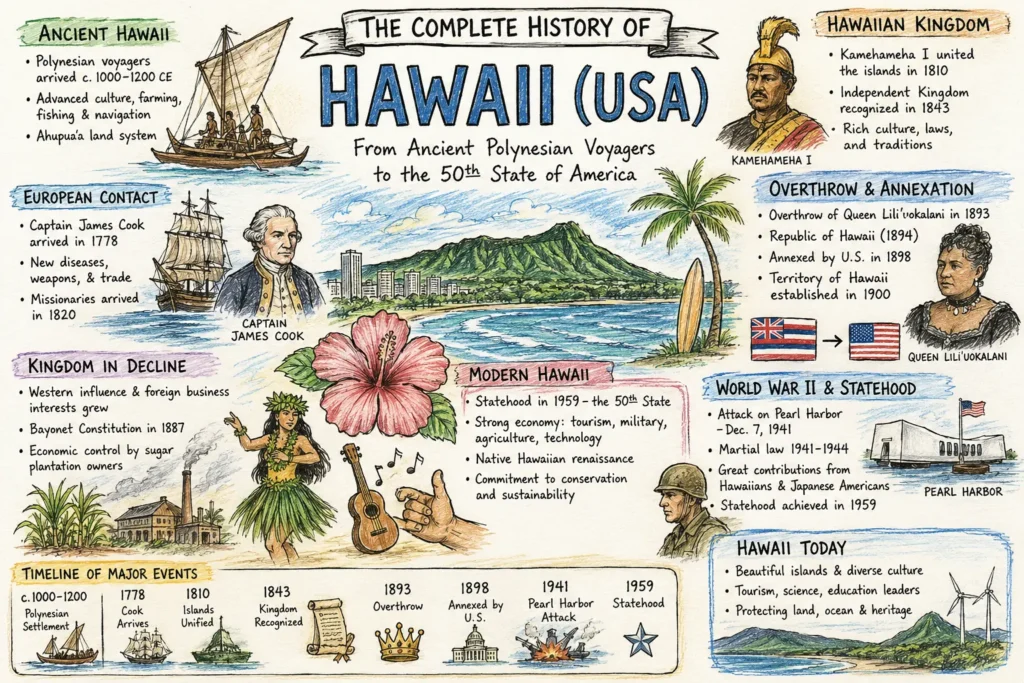
The Hawaiian Islands later became the center of international trade, exploration, missionary activity, and political competition among global powers. Hawaii transformed from an independent kingdom into a U.S. territory and finally became the 50th state of the United States in 1959. Throughout this remarkable journey, Hawaiians have preserved their unique traditions, language, music, dance, and cultural identity despite immense challenges.
This comprehensive guide explores the complete history of Hawaii, beginning with the geological birth of the islands and the earliest chapters of Hawaiian civilization.
Quick Facts About Hawaii
| Feature | Details |
|---|---|
| Official Name | State of Hawaii |
| Nickname | The Aloha State |
| Capital | Honolulu |
| Largest Island | Hawaii (The Big Island) |
| Statehood | August 21, 1959 |
| Population | Approximately 1.4 million |
| Official Languages | English and Hawaiian |
| Highest Peak | Mauna Kea (13,803 ft / 4,207 m) |
| Largest City | Honolulu |
| Time Zone | Hawaii-Aleutian Standard Time |
Why Hawaii Is Unique Among U.S. States
Hawaii differs significantly from every other American state in terms of geography, history, culture, biodiversity, and political development.
Some of Hawaii’s unique characteristics include:
- The only U.S. state located entirely in the Pacific Ocean.
- The only state with two official languages: English and Hawaiian.
- The only U.S. state that was once an internationally recognized sovereign kingdom.
- Home to the world’s most active volcanoes.
- One of Earth’s most isolated inhabited island chains.
- Rich Polynesian cultural heritage unlike anywhere else in the United States.
- Exceptional biodiversity with thousands of endemic species.
These characteristics have shaped Hawaii into a place where indigenous traditions coexist with modern American society.
Geography of Hawaii
Location
The Hawaiian Islands are situated in the central Pacific Ocean, approximately:
- 2,400 miles from California
- 3,850 miles from Japan
- 4,900 miles from Australia
Their remote location played a crucial role in protecting Hawaiian culture for centuries before European contact.
The Hawaiian Archipelago
The Hawaiian archipelago consists of more than 130 islands, islets, reefs, shoals, and atolls stretching over 1,500 miles (2,400 km) across the Pacific Ocean.
The eight major islands are:
- Hawaii (Big Island)
- Maui
- Oahu
- Kauai
- Molokai
- Lanai
- Niihau
- Kahoolawe
Among these, only seven are permanently inhabited.
Climate
Hawaii experiences a tropical climate characterized by:
- Warm temperatures throughout the year
- Trade winds
- Distinct wet and dry regions
- Mild seasonal variation
Average annual temperatures range between:
- 75°F–85°F (24°C–29°C)
Rainfall varies dramatically due to mountainous terrain. Some locations receive over 450 inches (11,400 mm) annually, while others remain relatively dry.
Natural Beauty
Hawaii is home to extraordinary natural landscapes, including:
- Active volcanoes
- White sand beaches
- Black sand beaches
- Green sand beaches
- Coral reefs
- Waterfalls
- Rainforests
- Alpine deserts
- Lava fields
Few places on Earth possess such remarkable ecological diversity within a relatively small land area.
Geological History of Hawaii
Birth of the Hawaiian Islands
The story of Hawaii begins not with humans but with molten rock deep beneath the Earth’s crust.
Unlike most volcanic islands, Hawaii did not form along tectonic plate boundaries. Instead, it emerged above a hotspot—a stationary plume of magma rising from deep within Earth’s mantle.
As the Pacific Plate slowly moved northwest over this hotspot, magma pierced the ocean floor repeatedly, creating a chain of volcanic islands over millions of years.
This process continues today.
The Hawaiian Hotspot
The Hawaiian hotspot has been active for approximately 70–80 million years.
Key features include:
- Continuous volcanic activity
- Gradual island formation
- Progressive erosion of older islands
- Creation of underwater seamounts
Today, the youngest island—the Big Island—is still growing through active volcanic eruptions.
Island Ages
The islands become progressively older from southeast to northwest.
Approximate ages include:
| Island | Estimated Age |
|---|---|
| Hawaii | Less than 1 million years |
| Maui | 1–2 million years |
| Molokai | About 2 million years |
| Oahu | About 3 million years |
| Kauai | About 5 million years |
Beyond Kauai lie ancient submerged volcanoes that have gradually eroded beneath the sea.
Volcanoes
Hawaii hosts some of the world’s largest volcanoes.
Major volcanoes include:
Mauna Loa
- Largest volcano on Earth by volume.
- Still active.
- Covers more than half of the Big Island.
Kilauea
One of the most active volcanoes in the world, Kilauea has erupted frequently for decades, continuously reshaping Hawaii’s landscape.
Mauna Kea
Although dormant, Mauna Kea rises over 33,000 feet (10,000 meters) from the ocean floor, making it taller than Mount Everest when measured from its base.
Formation of Hawaiian Ecosystems
When volcanic islands first emerged from the ocean, they were barren landscapes of hardened lava.
Over thousands of years:
- Wind carried seeds.
- Birds introduced plants.
- Ocean currents transported vegetation.
- Insects arrived naturally.
Gradually, forests developed.
These ecosystems evolved in extraordinary isolation, leading to the emergence of countless endemic species found nowhere else on Earth.
Examples include:
- Hawaiian honeycreepers
- Silversword plants
- Hawaiian monk seals
- Nēnē (Hawaiian goose)
The First Human Arrival
Who Were the First Hawaiians?
The first humans to settle Hawaii were Polynesians, skilled seafarers from the vast Pacific region.
Their ancestors originated in Southeast Asia thousands of years earlier and gradually migrated across islands such as:
- Samoa
- Tonga
- Tahiti
- Marquesas Islands
Eventually, they reached Hawaii after extraordinary voyages across the open ocean.
When Did They Arrive?
Most scholars believe the earliest permanent settlements occurred between A.D. 1000 and 1200, although some evidence suggests earlier exploratory visits.
These settlers established communities that would develop into a distinctive Hawaiian civilization.
Polynesian Navigation
One of humanity’s greatest achievements was Polynesian navigation.
Without:
- Maps
- Compasses
- GPS
- Metal instruments
Polynesian navigators crossed thousands of miles of open ocean.
They relied upon:
- Stars
- Ocean swells
- Wind directions
- Cloud formations
- Bird migration
- Floating vegetation
- Color of seawater
Their knowledge was passed orally through generations.
Modern scientists continue to admire the precision of these navigators.
Double-Hulled Canoes
The Polynesians reached Hawaii aboard impressive double-hulled voyaging canoes.
These vessels:
- Could exceed 70 feet in length.
- Carried families.
- Transported livestock.
- Held food supplies.
- Included freshwater storage.
- Survived weeks at sea.
Such canoes represented remarkable engineering achievements.
Plants and Animals Brought by Early Settlers
The settlers intentionally introduced species essential for survival.
Important plants included:
- Taro
- Breadfruit
- Coconut
- Banana
- Sugarcane
- Sweet potato
- Paper mulberry
Animals included:
- Dogs
- Chickens
- Pigs
These species became the foundation of Hawaiian agriculture and cuisine.
Establishing Villages
Early Hawaiian communities developed near:
- Freshwater streams
- Fertile valleys
- Coastal fisheries
Villages featured:
- Thatched houses
- Fishponds
- Agricultural terraces
- Religious temples
- Canoe landings
Communities were largely self-sufficient, relying on farming, fishing, and resource management.
Ancient Hawaiian Society
Over centuries, Hawaiian society evolved into a highly organized system.
Social Classes
The population was divided into several primary classes.
Aliʻi (Chiefs)
The Aliʻi were the ruling nobility. They controlled land, led warfare, and maintained political authority.
Kahuna (Priests and Specialists)
Kahuna served as:
- Priests
- Healers
- Navigators
- Builders
- Astrologers
- Craftsmen
Their expertise was highly respected.
Makaʻāinana (Common People)
Most Hawaiians belonged to this class.
They farmed, fished, built homes, and produced goods that sustained society.
Kauā
A small group occupied the lowest social status and experienced significant social restrictions.
The Ahupuaʻa System
One of ancient Hawaii’s greatest innovations was the Ahupuaʻa land management system.
Each land division stretched from:
- Mountain forests
- Agricultural lands
- Rivers
- Coastal fisheries
- Coral reefs
This arrangement ensured that every community had access to diverse natural resources.
It promoted sustainability and minimized conflict over resources.
Modern environmental planners often cite the Ahupuaʻa system as an early model of integrated resource management.
Part 2: Religion, the Kapu System, Daily Life, Culture, Mythology, and the Rise of Hawaiian Chiefdoms
Religion in Ancient Hawaii
Religion formed the foundation of every aspect of life in ancient Hawaii. Before the arrival of Christianity in the nineteenth century, Hawaiians practiced a sophisticated indigenous belief system deeply connected to nature, ancestors, and numerous gods and goddesses.
The Hawaiian religion was polytheistic, meaning people worshipped many deities, each responsible for different aspects of the natural world and human life. Religion influenced politics, agriculture, fishing, warfare, navigation, construction, and family traditions.
Unlike many ancient civilizations where religion was separated from daily life, Hawaiian spirituality was woven into every activity. Every important decision—from planting crops to launching a canoe or beginning a battle—was accompanied by rituals and prayers.
Priests, known as Kahuna, played an essential role in interpreting divine messages, conducting ceremonies, healing illnesses, preserving sacred knowledge, and advising chiefs.
The Hawaiian Pantheon of Gods
Ancient Hawaiians believed the universe was governed by powerful supernatural beings.
Among the most important were four principal gods.
Kāne – God of Creation
Kāne was considered the highest creator deity.
He represented:
- Freshwater
- Sunlight
- Forests
- Life itself
- Fertility
Many sacred springs and forests were dedicated to Kāne.
Kū – God of War and Government
Kū symbolized:
- Warfare
- Strength
- Leadership
- Politics
- Agriculture
Chiefs frequently sought Kū’s blessings before battles.
Some temples dedicated to Kū accepted elaborate offerings before military campaigns.
Lono – God of Peace and Agriculture
Lono represented:
- Rain
- Fertility
- Farming
- Music
- Prosperity
- Peace
The annual Makahiki Festival honored Lono with months of celebration, sports, feasting, and tribute.
During Makahiki:
- Warfare stopped.
- Taxes were collected.
- Athletic competitions were held.
- Communities celebrated successful harvests.
Kanaloa – God of the Ocean
Kanaloa ruled:
- The sea
- Navigation
- Marine life
- Healing
Since Hawaii depended heavily on the ocean, Kanaloa was greatly respected by fishermen and sailors.
The Goddess Pele
Perhaps no figure is more famous in Hawaiian mythology than Pele, the goddess of volcanoes and fire.
According to Hawaiian legends:
- Pele lived within the crater of Kīlauea Volcano.
- Lava flows represented her movement.
- Volcanic eruptions reflected her emotions.
- She continually created new land through flowing lava.
Even today, many Hawaiians regard Pele with deep respect.
Local traditions often discourage removing lava rocks from Hawaii because doing so is believed to anger Pele and bring misfortune.
Other Important Hawaiian Deities
Ancient Hawaiians recognized hundreds of spiritual beings.
Some included:
Hiʻiaka
- Goddess of hula
- Forest protector
- Sister of Pele
Hina
Associated with:
- Moon
- Motherhood
- Women
- Creativity
Māui
A legendary demigod famous for:
- Slowing the sun
- Fishing islands from the ocean
- Discovering fire
- Outsmarting powerful spirits
His adventures remain among Hawaii’s most beloved traditional stories.
Sacred Places (Heiau)
Religious ceremonies were conducted in sacred temples known as Heiau.
These structures ranged from small family shrines to massive stone temple complexes.
Different Heiau served different purposes.
Examples included:
- Agricultural blessings
- Healing
- Navigation
- Fishing success
- Royal ceremonies
- Military sacrifices
Some Heiau covered several acres and required thousands of workers to build.
Large temples demonstrated the political power of Hawaii’s ruling chiefs.
The Kahuna
The word Kahuna referred not only to priests but also to highly skilled experts.
Different types of Kahuna specialized in:
- Medicine
- Canoe building
- Astronomy
- Navigation
- Religious ceremonies
- Agriculture
- Healing
- Genealogy
Their knowledge was passed orally through generations.
Kahuna occupied respected positions within Hawaiian society.
The Kapu System
One of the most distinctive institutions in ancient Hawaii was the Kapu System.
“Kapu” means:
- Sacred
- Forbidden
- Restricted
The Kapu System regulated nearly every aspect of Hawaiian life.
It functioned as:
- Religious law
- Political authority
- Environmental regulation
- Social order
Breaking Kapu rules often resulted in severe punishment.
Purpose of the Kapu System
The Kapu System helped maintain:
- Social stability
- Respect for chiefs
- Religious traditions
- Environmental sustainability
- Resource management
It also reinforced the authority of the Aliʻi (chiefs), who were believed to possess divine ancestry.
Examples of Kapu Rules
Numerous restrictions governed daily life.
Examples included:
Food Restrictions
Certain foods were reserved exclusively for chiefs.
Others were forbidden to women.
Examples included:
- Pork
- Bananas
- Certain fish
- Coconut
Men and women generally ate separately.
Sacred Areas
Some forests, mountains, and temples were off-limits except for priests or chiefs.
Entering these areas without permission could result in punishment.
Fishing Seasons
Specific reefs were periodically closed to fishing.
This protected fish populations and ensured sustainable harvests.
Modern conservation experts recognize this practice as an early form of fisheries management.
Royal Protection
Commoners were forbidden from allowing their shadows to fall upon a high chief.
Such rules emphasized the sacred status of Hawaii’s rulers.
Environmental Conservation
Although primarily religious, many Kapu laws protected Hawaii’s natural resources.
Restrictions included:
- Seasonal fishing bans
- Controlled harvesting
- Protected forests
- Water management
- Agricultural regulations
These practices helped preserve Hawaii’s fragile island ecosystems for centuries.
Daily Life in Ancient Hawaii
Despite strict social organization, daily life was productive, communal, and closely connected to nature.
Families worked together to meet their needs.
Hawaiian Homes
Traditional homes were built from natural materials.
Construction materials included:
- Wood
- Bamboo
- Pili grass
- Coconut fiber
- Palm leaves
Different buildings served different purposes.
Typical household structures included:
- Sleeping house
- Cooking house
- Men’s eating house
- Women’s eating house
- Storage house
Homes were designed to maximize ventilation in Hawaii’s tropical climate.
Clothing
Traditional Hawaiian clothing reflected the islands’ warm weather.
Men commonly wore:
- Malo (loincloth)
Women typically wore:
- Pāʻū (wrapped skirts)
Special occasions featured elaborate feather cloaks, capes, and helmets worn by chiefs.
These feather garments required years to create and symbolized immense prestige.
Agriculture
Farming formed the backbone of Hawaiian society.
Major crops included:
- Taro
- Sweet potato
- Breadfruit
- Coconut
- Sugarcane
- Banana
- Yams
Among these, taro held special importance.
Taro and Poi
Taro was considered sacred.
According to Hawaiian tradition, the first taro plant descended from the ancestors of the Hawaiian people.
The root was processed into Poi, a smooth purple paste that became Hawaii’s staple food.
Poi remains popular throughout Hawaii today.
Fishpond Engineering
Ancient Hawaiians developed remarkable aquaculture systems.
Stone fishponds:
- Controlled tidal water.
- Raised fish naturally.
- Increased food security.
- Supported growing populations.
Some fishponds remain functional after hundreds of years.
Modern scientists consider them among the world’s earliest examples of sustainable aquaculture.
Fishing Techniques
Fishing required extensive knowledge of marine ecosystems.
Methods included:
- Nets
- Spears
- Hooks made from bone
- Fish traps
- Canoe fishing
Different techniques were used depending on:
- Moon phases
- Seasons
- Fish species
- Ocean currents
Canoe Building
Canoes were essential for:
- Fishing
- Transportation
- Trade
- Exploration
- Warfare
Master canoe builders selected giant koa trees from mountain forests.
Construction often required months or years.
Large double-hulled canoes carried dozens of people across the Pacific Ocean.
Hawaiian Navigation
Even after settling Hawaii, navigators continued voyages among Pacific islands.
Their navigation relied upon:
- Rising stars
- Setting stars
- Wave patterns
- Wind
- Birds
- Clouds
Modern Polynesian voyaging societies continue these traditions using traditional methods.
Hawaiian Food
Ancient Hawaiian diets were nutritious and diverse.
Common foods included:
- Poi
- Fish
- Shellfish
- Seaweed
- Breadfruit
- Coconut
- Sweet potatoes
- Bananas
- Pigs
- Chickens
Cooking methods included underground ovens known as Imu.
Hot volcanic stones cooked food slowly beneath layers of leaves and soil.
Today’s traditional Hawaiian luaus still feature Imu-cooked dishes.
Family Life
The extended family, or ʻOhana, was the center of Hawaiian society.
Family members shared:
- Food
- Labor
- Childcare
- Education
- Religious responsibilities
Respect for elders was strongly emphasized.
Knowledge passed orally between generations preserved Hawaiian traditions.
Education
Children learned through observation and participation rather than formal classrooms.
Skills included:
- Fishing
- Farming
- Canoe building
- Weaving
- Dancing
- Chanting
- Navigation
- Genealogy
Young nobles also studied leadership and diplomacy.
Hawaiian Language
The Hawaiian language developed over centuries as one of the Polynesian languages.
Characteristics include:
- Only 13 letters
- Rich oral tradition
- Poetic expression
- Sacred chants
- Genealogies
Before Western contact, the language had no written form.
History, religion, and cultural knowledge were preserved through memory.
Hula: More Than Dance
Today, many people associate Hula with entertainment.
Originally, Hula was a sacred storytelling tradition.
Hula communicated:
- History
- Religion
- Genealogy
- Legends
- Nature
- Royal events
Every movement had symbolic meaning.
Traditional chants accompanied performances instead of modern music.
Hawaiian Music
Music played an essential role in daily life.
Traditional instruments included:
- Nose flute
- Bamboo flute
- Drums
- Gourds
- Rattles
Songs celebrated:
- Nature
- Love
- Family
- Chiefs
- Gods
- Historical events
Sports and Recreation
Ancient Hawaiians enjoyed many athletic activities.
Popular sports included:
Surfing
Known as Heʻe Nalu, surfing originated in ancient Hawaii.
Chiefs often rode the largest waves using beautifully crafted wooden boards.
Surfing was both recreation and a demonstration of skill and status.
Other Traditional Activities
- Canoe racing
- Wrestling
- Spear throwing
- Boxing
- Stone lifting
- Cliff diving
Many of these activities became part of the Makahiki Festival.
Hawaiian Mythology and Oral Traditions
Without a written language, Hawaiian history and beliefs were preserved through oral tradition.
Storytellers memorized:
- Creation stories
- Family genealogies
- Battles
- Voyages
- Royal successions
These traditions helped maintain cultural continuity for centuries.
The Rise of Independent Chiefdoms
By approximately A.D. 1400–1600, the Hawaiian Islands had developed into several powerful chiefdoms.
Each major island was governed by its own ruling chief.
Competition among these chiefdoms often led to:
- Alliances
- Trade
- Ritual diplomacy
- Warfare
This political landscape laid the groundwork for the later unification of the islands under King Kamehameha I, one of the most influential figures in Hawaiian history.
Conclusion of Part 2
By the time Europeans first arrived in the late eighteenth century, Hawaii had already developed a sophisticated civilization with advanced agriculture, sustainable resource management, complex religious traditions, remarkable navigation skills, vibrant arts, and powerful island chiefdoms. These achievements formed the foundation of the Hawaiian Kingdom that would soon encounter profound changes through contact with the outside world.
Part 3: European Discovery, Captain James Cook, King Kamehameha I, and the Unification of the Hawaiian Kingdom (1778–1819)
Introduction
For nearly a thousand years after the first Polynesian settlers reached Hawaii, the Hawaiian Islands remained one of the most isolated inhabited places on Earth. Hawaiian civilization flourished independently, developing its own political systems, religion, language, agricultural practices, and maritime traditions. This long period of isolation came to an end in 1778, when British explorer Captain James Cook arrived in the archipelago during his third Pacific voyage.
Cook’s arrival marked the beginning of a new era in Hawaiian history. Contact with Europeans introduced new technologies, trade opportunities, diseases, and political relationships that would profoundly reshape Hawaiian society. Within only a few decades, Hawaii transformed from a group of competing island chiefdoms into a unified kingdom under one ruler—King Kamehameha I. His military genius, diplomatic skill, and strategic use of foreign technology laid the foundation for the internationally recognized Kingdom of Hawaii.
This chapter explores the first encounters between Hawaiians and Europeans, the dramatic events surrounding Captain Cook’s death, the rise of Kamehameha I, and the creation of one of the Pacific’s most influential indigenous kingdoms.
Hawaii Before European Contact
Before 1778, the Hawaiian Islands were divided among several independent chiefdoms. The four principal island kingdoms were:
- Hawaii (the Big Island)
- Maui
- Oahu
- Kauai
Each kingdom was ruled by powerful Aliʻi Nui (high chiefs), who governed through hereditary authority and maintained alliances with lesser chiefs. Warfare between islands was common, but these conflicts were generally limited in scale and fought with traditional Polynesian weapons such as spears, clubs, slings, and wooden daggers.
Despite political rivalries, Hawaiian society was highly organized. Extensive agricultural systems, fishponds, and trade networks supported a population estimated between 250,000 and 800,000 people before European contact. The exact population remains debated by historians due to the absence of written records.
European Exploration of the Pacific
The eighteenth century was an age of global maritime exploration. European powers—including Britain, Spain, France, Portugal, and the Netherlands—competed to map unknown regions, establish trade routes, and claim overseas territories.
The Pacific Ocean remained one of the least understood parts of the world. Explorers sought answers to several important questions:
- Was there a large southern continent?
- Could a Northwest Passage connect the Atlantic and Pacific Oceans?
- Where were the unexplored islands reported by earlier sailors?
- What commercial opportunities existed in the Pacific?
Among the most accomplished explorers of this era was Captain James Cook of the British Royal Navy.
Captain James Cook
James Cook was born in England in 1728 and became one of history’s greatest navigators.
Before discovering Hawaii, Cook had already:
- Mapped New Zealand with remarkable accuracy.
- Charted the eastern coast of Australia.
- Explored the South Pacific.
- Conducted scientific observations for the British Admiralty.
- Improved navigational methods and cartography.
His third voyage (1776–1780) aimed to discover the Northwest Passage from the Pacific side.
Discovery of the Hawaiian Islands (1778)
On January 18, 1778, Cook’s ships—the HMS Resolution and HMS Discovery—approached the island of Kauai.
This marked the first documented contact between Europeans and Hawaiians.
Cook named the islands the Sandwich Islands in honor of his patron, the Fourth Earl of Sandwich, who served as Britain’s First Lord of the Admiralty.
The indigenous inhabitants, however, had long referred to their homeland as Hawaiʻi.
First Encounters
The arrival of Cook’s ships astonished the Hawaiian people.
Many islanders had never seen:
- Large European sailing vessels.
- Iron tools.
- Cannons.
- Firearms.
- European clothing.
- Glass.
- Livestock such as goats and sheep.
Likewise, Cook and his crew were fascinated by Hawaii’s:
- Fertile valleys.
- Skilled canoe builders.
- Sophisticated agriculture.
- Organized villages.
- Friendly inhabitants.
Initial interactions were peaceful and characterized by curiosity. Hawaiians traded food, water, pigs, sweet potatoes, and fresh fruit in exchange for metal objects, nails, knives, and cloth.
Iron, previously unknown in Hawaii, quickly became one of the most valuable trade items because it could be fashioned into stronger tools and weapons than stone or bone.
The Makahiki Festival and Cook’s Reception
Cook’s arrival coincided with the annual Makahiki Festival, a sacred season dedicated to the god Lono. During this period:
- Warfare ceased.
- Taxes and tributes were collected.
- Athletic competitions took place.
- Religious ceremonies honored Lono.
- Communities celebrated successful harvests.
Some historians believe that Cook’s ships, with their towering masts and white sails, resembled descriptions associated with Lono in Hawaiian tradition. This may have contributed to the respectful reception Cook initially received.
However, modern scholarship cautions against the simplistic claim that Hawaiians universally believed Cook was a god. It is more likely that interpretations varied among different communities and leaders.
Cultural Exchange
The first months of contact involved extensive exchanges of knowledge and goods.
Hawaiians introduced Europeans to:
- Breadfruit
- Taro (poi)
- Coconut
- Traditional fishponds
- Surfing
- Double-hulled canoes
- Hawaiian navigation techniques
Europeans introduced Hawaiians to:
- Iron tools
- Muskets
- Cannons
- Western sailing technology
- New crops
- Livestock
- Western textiles
These exchanges would have lasting effects on Hawaiian society.
Cook’s Departure and Return
After provisioning his ships, Cook departed Hawaii to continue his search for the Northwest Passage.
His expedition reached the northern Pacific but failed to find a navigable route through the Arctic ice.
Forced to return to Hawaii in early 1779 for repairs after a damaged mast, Cook anchored in Kealakekua Bay on the island of Hawaii.
The circumstances had changed. The Makahiki Festival had ended, and tensions between the British sailors and local Hawaiians had increased due to thefts, misunderstandings, and disputes over resources.
The Death of Captain Cook (1779)
On February 14, 1779, conflict erupted after one of Cook’s small boats was stolen.
Following a common British naval practice, Cook attempted to take the ruling chief hostage until the boat was returned.
Thousands of Hawaiians gathered at the shoreline. A confrontation ensued, during which Cook and several Marines were attacked. Cook was struck and killed on the beach.
His death shocked Europe and became one of the most famous events in the history of Pacific exploration.
Although the incident has often been portrayed as a clash between “civilization” and “primitive” peoples, modern historians emphasize that it resulted from mutual misunderstandings, cultural differences, and escalating tensions rather than inherent hostility.
Legacy of Captain Cook
Cook’s voyages transformed global understanding of the Pacific.
His achievements included:
- Accurate maps of Hawaii.
- Scientific observations.
- Documentation of Hawaiian society.
- Opening Hawaii to international commerce.
- Stimulating further exploration.
At the same time, his arrival also marked the beginning of profound changes that would challenge Hawaiian independence and culture.
The Arrival of Foreign Ships
Following Cook’s voyages, Hawaii became an important stop for:
- British traders
- American merchants
- French explorers
- Russian navigators
- Whaling fleets
- Fur traders
Ships visited Hawaii to obtain:
- Fresh water
- Food supplies
- Firewood
- Repairs
- Safe harbors
Honolulu gradually emerged as one of the Pacific’s busiest ports.
New Trade Opportunities
International commerce expanded rapidly.
Hawaiians traded:
- Sandalwood
- Salt
- Fresh produce
- Pigs
- Canoes
In return, they acquired:
- Guns
- Iron
- Glass
- Clothing
- Tools
- Ammunition
- Sailing equipment
These imported goods significantly altered the balance of power among Hawaiian chiefs.
The Tragedy of Foreign Diseases
One of the most devastating consequences of European contact was the introduction of infectious diseases.
Native Hawaiians had no immunity to illnesses such as:
- Smallpox
- Measles
- Influenza
- Tuberculosis
- Whooping cough
- Typhoid fever
Epidemics spread rapidly, causing catastrophic population decline over the nineteenth century. Entire villages disappeared, and traditional knowledge was lost with the deaths of elders.
The Birth of Kamehameha I
Kamehameha I was born around 1758 on the island of Hawaii.
According to Hawaiian tradition, his birth coincided with the appearance of Halley’s Comet, which many interpreted as a sign that he would become a great leader.
He belonged to a high-ranking chiefly family and received extensive training in:
- Warfare
- Leadership
- Diplomacy
- Religion
- Hawaiian traditions
From a young age, he displayed exceptional physical strength and strategic intelligence.
Early Military Career
As a young warrior, Kamehameha served under High Chief Kalaniʻōpuʻu, who ruled the island of Hawaii.
He distinguished himself in numerous battles and earned the respect of fellow warriors.
After Kalaniʻōpuʻu’s death in 1782, a succession dispute erupted. Kamehameha eventually secured control over much of the island of Hawaii after a series of conflicts, establishing himself as its dominant ruler.
The Rise of a Powerful Leader
Kamehameha recognized that European technology could provide a decisive military advantage.
He cultivated relationships with British and American traders, acquiring:
- Muskets
- Cannons
- Ammunition
- Sailing vessels
- Military advisors
Among his most valuable foreign allies were John Young and Isaac Davis, two British sailors who became trusted advisors. They trained Hawaiian warriors in the effective use of firearms and artillery.
The Campaign to Unite the Hawaiian Islands
Kamehameha’s ultimate ambition was to unite all the major Hawaiian Islands under one government.
His military campaigns unfolded over several years.
Conquest of Maui
Following victories on Hawaii Island, Kamehameha launched expeditions against Maui. After fierce battles and shifting alliances, he gained control of the island.
The Battle of Nuʻuanu (1795)
One of the most decisive engagements occurred on Oahu at the Battle of Nuʻuanu.
Kamehameha’s forces overwhelmed the defenders, driving many warriors toward the steep cliffs overlooking Nuʻuanu Valley. Tradition holds that numerous defenders fell from the precipice during the battle.
This victory secured Oahu and demonstrated the effectiveness of Kamehameha’s combination of traditional Hawaiian tactics and imported firearms.
The Peaceful Submission of Kauai
The island of Kauai, ruled by Chief Kaumualiʻi, remained independent for several years.
Rather than launching a costly invasion, Kamehameha pursued diplomacy.
In 1810, Kaumualiʻi agreed to recognize Kamehameha’s authority while retaining local leadership under the new political arrangement.
With this agreement, the Hawaiian Islands became united under a single sovereign for the first time in history.
The Establishment of the Kingdom of Hawaii
The unification of the islands marked the birth of the Kingdom of Hawaii.
Kamehameha I became its first monarch.
His achievements included:
- Ending centuries of inter-island warfare.
- Creating a centralized government.
- Promoting trade with foreign nations.
- Strengthening agriculture and commerce.
- Protecting Hawaiian sovereignty during an era of expanding European imperialism.
The Kingdom of Hawaii soon gained increasing recognition from foreign governments as an independent state.
Kamehameha’s Legacy
Kamehameha I is widely regarded as one of the greatest leaders in Hawaiian history. Through military skill, diplomacy, and careful engagement with foreign powers, he transformed a divided archipelago into a unified kingdom that could negotiate with the world’s leading nations on more equal terms.
His reign laid the political and institutional foundations for the Hawaiian Kingdom, whose later monarchs would face new challenges from missionaries, global commerce, and increasing foreign influence.
Part 4: The Hawaiian Kingdom Under Kamehameha’s Successors (1819–1874): The End of the Kapu System, Christian Missionaries, Constitutional Government, Economic Transformation, and International Recognition
Introduction
The death of Kamehameha I in 1819 marked the end of one of the greatest chapters in Hawaiian history. Through diplomacy, military leadership, and strategic alliances, he had united the Hawaiian Islands into a single kingdom. However, the decades following his death proved to be just as transformative.
Between 1819 and 1874, Hawaii experienced sweeping political, religious, social, and economic changes. Ancient religious traditions gave way to Christianity, the centuries-old Kapu System was abolished, the Hawaiian language was developed into a written form, Western-style schools and constitutional government emerged, and Hawaii became an internationally recognized sovereign nation.
At the same time, these changes also brought challenges. Foreign merchants, missionaries, and plantation owners gained increasing influence, traditional Hawaiian customs began to decline, and diseases introduced by outsiders devastated the Native Hawaiian population. This period laid both the foundations of modern Hawaii and the circumstances that would later threaten the kingdom’s independence.
Death of King Kamehameha I
King Kamehameha I died in May 1819, leaving behind a unified kingdom that stretched across all the major Hawaiian Islands.
In accordance with Hawaiian custom, the exact location of his burial was kept secret to protect the sanctity of his remains. To this day, the burial site of Kamehameha I remains one of Hawaii’s greatest historical mysteries.
His eldest son succeeded him as King Kamehameha II, also known by his Hawaiian name Liholiho.
King Kamehameha II (1819–1824)
A Young King in a Time of Change
Kamehameha II inherited a stable kingdom but faced enormous social pressures. Although he became king, much of the political influence rested with powerful members of the royal family, particularly:
- Queen Regent Kaʻahumanu
- Queen Mother Keōpūolani
These influential women believed that many ancient customs should be reformed.
The End of the Kapu System
One of the most revolutionary events in Hawaiian history occurred shortly after Kamehameha II’s accession.
For centuries, Hawaiian society had been governed by the Kapu System, a sacred code regulating religion, politics, social behavior, and environmental management.
Breaking Tradition
In 1819, Kamehameha II publicly shared a meal with women—an act forbidden under the Kapu system. This symbolic event, known as ʻAi Noa (“free eating”), challenged one of the most important religious restrictions in Hawaiian society.
Queen Kaʻahumanu and other leaders supported the decision, and the Kapu system rapidly collapsed.
The consequences were profound:
- Ancient religious laws lost legal authority.
- Many temples (Heiau) were abandoned or dismantled.
- Traditional priesthoods lost influence.
- The political and religious foundations of old Hawaii were transformed.
This peaceful internal revolution occurred even before the arrival of American missionaries.
Arrival of Christian Missionaries (1820)
In 1820, the first Protestant missionaries from American Board of Commissioners for Foreign Missions arrived in Hawaii aboard the brig Thaddeus.
The missionary group included:
- Ministers
- Teachers
- Doctors
- Printers
- Farmers
Their goals were to:
- Spread Christianity.
- Establish schools.
- Teach reading and writing.
- Translate the Bible into Hawaiian.
- Introduce Western educational methods.
Unlike explorers and traders, missionaries intended to settle permanently.
Hawaiian Response to Christianity
The reception was mixed.
Some Hawaiians embraced Christianity because:
- The traditional religion had recently collapsed.
- Literacy opened new opportunities.
- Missionaries provided education and medical care.
- Members of the royal family converted.
Others resisted because Christianity discouraged many traditional cultural practices.
Over the following decades, Christianity became the dominant religion throughout the islands.
Creation of the Written Hawaiian Language
Before the nineteenth century, Hawaiian existed only as an oral language.
Missionaries collaborated with Hawaiian scholars to develop a written alphabet using the Latin script.
The Hawaiian alphabet contains only 13 letters:
Vowels
- A
- E
- I
- O
- U
Consonants
- H
- K
- L
- M
- N
- P
- W
- ʻ (ʻOkina, the glottal stop)
The Kahakō, a macron placed over vowels, was later adopted to indicate long vowel sounds.
This writing system made it possible to record:
- Oral traditions
- Genealogies
- Laws
- Religious texts
- Government documents
- Literature
- Newspapers
The preservation of the Hawaiian language remains one of the missionaries’ most enduring contributions, despite the broader cultural changes their work introduced.
Growth of Literacy
Missionaries quickly established schools across the islands.
Subjects included:
- Reading
- Writing
- Arithmetic
- Geography
- History
- Religious education
By the mid-nineteenth century, Hawaii had one of the highest literacy rates in the world. Thousands of Native Hawaiians learned to read and write in their own language before many European countries achieved comparable literacy levels.
This educational achievement fostered a vibrant Hawaiian-language press, with newspapers discussing politics, agriculture, international affairs, and literature.
King Kamehameha II’s Foreign Journey
In 1823, King Kamehameha II and Queen Kamāmalu embarked on a historic voyage to London to strengthen diplomatic relations with United Kingdom.
The visit generated great public interest. However, tragedy struck when both the king and queen contracted measles, a disease to which they had little immunity.
Both died in 1824, highlighting the devastating impact of introduced diseases on the Hawaiian people.
Their bodies were later returned to Hawaii with full honors.
King Kamehameha III (1825–1854)
After Kamehameha II’s death, his younger brother Kauikeaouli became King Kamehameha III.
His reign lasted nearly thirty years and is widely regarded as one of the most important in Hawaiian history.
Constitutional Government
As foreign influence increased, the kingdom began adopting Western legal and political institutions.
The 1840 Constitution
King Kamehameha III proclaimed Hawaii’s first written constitution in 1840.
It established:
- A constitutional monarchy.
- Separation of powers.
- A legislature.
- Formal courts.
- A cabinet of ministers.
Although the king retained significant authority, governance increasingly followed constitutional principles rather than solely traditional customs.
The Declaration of Rights (1839)
Often called Hawaii’s Bill of Rights, the Declaration of Rights of 1839 guaranteed important protections for the kingdom’s subjects, including:
- Protection of life and property.
- Equal justice under the law.
- Recognition of private rights.
- Limits on arbitrary government action.
These reforms strengthened Hawaii’s standing as a modern sovereign state.
The Great Māhele (1848)
One of the most significant—and controversial—events in Hawaiian history was the Great Māhele.
Traditionally, land belonged collectively to the chiefs and was managed according to the Ahupuaʻa system. Individuals generally held rights to use land rather than owning it outright.
The Great Māhele transformed this system by introducing private land ownership.
Land was divided among:
- The king.
- High chiefs.
- The government.
- Common people (through later claims).
Positive Effects
- Encouraged commercial agriculture.
- Clarified land ownership.
- Facilitated investment.
Negative Effects
Many common Hawaiians lacked familiarity with Western legal procedures and failed to file claims. As a result, large areas eventually came under the control of foreign investors and plantation owners, accelerating economic and political change.
Expansion of the Sugar Industry
Sugar cultivation became the kingdom’s most important commercial enterprise.
Several factors contributed to its growth:
- Fertile volcanic soil.
- Tropical climate.
- Improved irrigation.
- Expanding international demand.
Large plantations were established across the islands, particularly on Maui, Oʻahu, and Kauaʻi.
Sugar exports soon became the backbone of Hawaii’s economy.
Labor Immigration
As plantations expanded, labor shortages developed because the Native Hawaiian population had declined sharply due to disease.
To meet labor needs, plantation owners recruited workers from:
- China
- Japan
- Portugal
- Korea
- Puerto Rico
- Philippines
This immigration transformed Hawaii into one of the world’s most culturally diverse societies.
Many descendants of these immigrant communities continue to shape Hawaii’s identity today.
Population Decline
The Native Hawaiian population suffered catastrophic losses during the nineteenth century.
Diseases introduced by foreign visitors included:
- Measles
- Influenza
- Smallpox
- Tuberculosis
- Whooping cough
Historians estimate that the Native Hawaiian population declined from several hundred thousand before European contact to fewer than 100,000 by the mid-1800s.
This demographic collapse had lasting social, cultural, and political consequences.
International Recognition of the Kingdom
King Kamehameha III worked tirelessly to secure Hawaii’s independence through diplomacy.
Recognition by Great Powers
In 1843, both:
- United Kingdom
- France
formally recognized the independence of the Kingdom of Hawaii through the Anglo-French Proclamation.
This recognition affirmed Hawaii as a sovereign nation under international law.
Subsequently, many other countries established diplomatic relations with the kingdom.
The Paulet Affair (1843)
One of the greatest challenges to Hawaiian sovereignty occurred when British naval officer Lord George Paulet temporarily seized control of Hawaii, claiming that British subjects had been mistreated.
For five months, the Hawaiian flag was lowered and the British flag raised.
King Kamehameha III chose diplomacy rather than armed resistance.
Later that year, British Admiral Richard Thomas investigated the matter, restored Hawaiian sovereignty, and formally apologized.
The restoration was celebrated by the king with the famous declaration:
“Ua Mau ke Ea o ka ʻĀina i ka Pono.”
Meaning:
“The life of the land is perpetuated in righteousness.”
This phrase later became the official motto of the State of Hawaii.
Expansion of Government
During Kamehameha III’s reign, Hawaii established many institutions associated with modern states:
- Ministries of government.
- Civil courts.
- Police forces.
- Tax administration.
- Public education.
- Diplomatic missions abroad.
- Postal services.
These reforms demonstrated that Hawaii was functioning as a modern constitutional monarchy recognized by the international community.
The Reign of Kamehameha IV (1855–1863)
After Kamehameha III’s death, Kamehameha IV ascended the throne.
His reign focused on:
- Public health.
- Education.
- International diplomacy.
- Strengthening Hawaiian identity.
Together with Queen Emma, he founded The Queen’s Hospital (now known as The Queen’s Medical Center) to provide healthcare for Native Hawaiians.
The Reign of Kamehameha V (1863–1872)
Kamehameha V believed the 1852 Constitution limited royal authority excessively.
In 1864, he introduced a new constitution that:
- Strengthened the monarchy.
- Reorganized the legislature.
- Revised voting qualifications.
He also promoted infrastructure improvements and government modernization while seeking to preserve Hawaiian traditions.
End of the Kamehameha Dynasty
When Kamehameha V died in 1872 without naming an heir, the direct Kamehameha line came to an end.
For the first time, Hawaii’s legislature elected a monarch.
The election of William Charles Lunalilo demonstrated that the kingdom possessed functioning constitutional mechanisms for a peaceful transfer of power.
Conclusion of Part 4
Between 1819 and 1874, Hawaii underwent one of the most remarkable transformations in its history. The abolition of the Kapu system, the rise of Christianity, the creation of a written Hawaiian language, widespread literacy, constitutional reforms, the Great Māhele, and international recognition established Hawaii as a respected sovereign nation in the Pacific.
Yet these achievements came with profound challenges. Population decline, the expansion of foreign-owned plantations, changing land ownership, and increasing economic dependence on outside powers gradually shifted the balance of influence within the kingdom. These developments would shape the political struggles that unfolded in the following decades.
Part 5: The Decline of the Hawaiian Kingdom (1874–1893): King Kalākaua, the Hawaiian Renaissance, the Bayonet Constitution, Queen Liliʻuokalani, and the Overthrow of the Hawaiian Kingdom
Introduction
The period between 1874 and 1893 represents one of the most dramatic and controversial chapters in Hawaiian history. During these two decades, the Hawaiian Kingdom experienced both a remarkable cultural revival and an accelerating political crisis. Under the reign of David Kalākaua, Hawaiian traditions, language, music, dance, and national identity flourished in what historians now call the Hawaiian Renaissance. At the same time, increasing foreign economic influence, particularly from American sugar plantation owners, steadily weakened the kingdom’s political independence.
The signing of the Reciprocity Treaty of 1875, the expansion of the sugar industry, the imposition of the Bayonet Constitution in 1887, and the growing ambitions of American business interests created deep divisions within Hawaiian society. These tensions reached their climax in 1893, when Queen Liliʻuokalani was overthrown in a coup supported by a group of American and European residents, aided by the landing of U.S. Marines.
This chapter examines how Hawaii’s independent constitutional monarchy came to an end and how events during this period continue to influence discussions about Hawaiian sovereignty today.
Election of King Kalākaua (1874)
Following the death of William Charles Lunalilo in 1874 without an heir, the Hawaiian Legislature was tasked with electing a new monarch. Two principal candidates emerged:
- David Kalākaua
- Queen Emma (widow of King Kamehameha IV)
After a heated campaign, the Legislature elected David Kalākaua as king. Supporters of Queen Emma protested the decision, and riots erupted in Honolulu. Government buildings were attacked, and several legislators were assaulted.
To restore order, Hawaiian authorities requested assistance from British and American naval forces anchored in Honolulu Harbor. Sailors from both countries helped protect public buildings until stability returned.
Despite the unrest, Kalākaua’s election followed the constitutional process and marked another peaceful transition of power under the kingdom’s laws.
King David Kalākaua: The “Merrie Monarch”
King Kalākaua quickly became one of Hawaii’s most memorable rulers.
He earned the nickname “The Merrie Monarch” because of his love of:
- Music
- Dance
- Festivals
- Literature
- Public celebrations
- Hawaiian traditions
Unlike some earlier monarchs who embraced Western customs almost exclusively, Kalākaua believed Hawaii could modernize while preserving its indigenous identity.
He famously declared:
“Hula is the language of the heart, therefore the heartbeat of the Hawaiian people.”
This philosophy shaped much of his reign.
The Hawaiian Cultural Renaissance
By the late nineteenth century, many traditional Hawaiian customs had declined under missionary influence.
Practices discouraged or banned included:
- Hula
- Traditional chanting
- Native religious ceremonies
- Hawaiian medicine
- Ancient music
King Kalākaua actively promoted their revival.
Revival of Hula
Perhaps his greatest cultural achievement was restoring Hula as a respected national art.
He invited master dancers and musicians to perform at royal ceremonies and encouraged younger generations to learn traditional dances.
Modern Hawaiian hula schools trace much of their revival to Kalākaua’s patronage.
Revival of Hawaiian Music
Traditional instruments once again became popular.
These included:
- Ipu (gourd drums)
- Pahu drums
- Bamboo flutes
- Nose flutes
- Chanting traditions
Western musical influences blended with indigenous melodies, creating the foundations of modern Hawaiian music.
Preservation of Oral Traditions
Kalākaua encouraged scholars to record Hawaiian legends, genealogies, and historical traditions that had previously been preserved through oral storytelling.
Without these efforts, many important aspects of Hawaiian history might have been lost forever.
ʻIolani Palace
One of Kalākaua’s most enduring legacies was the construction of ʻIolani Palace, completed in 1882.
The palace symbolized Hawaii’s status as an independent modern kingdom.
It featured remarkable innovations for its time, including:
- Electric lighting before the White House.
- Indoor plumbing.
- Telephones.
- Modern administrative offices.
- Elegant throne rooms.
- Grand reception halls.
The palace hosted visiting diplomats, foreign dignitaries, and members of royal families from around the world.
Today, it remains the only official royal palace in the United States.
King Kalākaua’s World Tour (1881)
In 1881, Kalākaua became the first reigning monarch to travel around the world.
His journey included visits to:
- Japan
- China
- Siam
- India
- Egypt
- Italy
- France
- Belgium
- Germany
- United Kingdom
- United States
The objectives of the tour were to:
- Strengthen diplomatic relations.
- Encourage immigration.
- Promote trade.
- Enhance Hawaii’s international reputation.
- Learn about modernization.
The trip demonstrated that Hawaii was recognized globally as an independent nation.
The Reciprocity Treaty of 1875
One of the most significant economic agreements in Hawaiian history was the Reciprocity Treaty, signed in 1875 between Hawaii and the United States.
The treaty allowed Hawaiian sugar to enter the U.S. market duty-free, while granting the United States favorable commercial access.
Economic Benefits
The treaty transformed Hawaii’s economy.
Sugar exports increased dramatically.
New investments flowed into:
- Sugar plantations.
- Railroads.
- Irrigation systems.
- Mills.
- Ports.
Government revenue also increased significantly.
Economic Dependence
While the treaty brought prosperity, it also increased Hawaii’s dependence on the United States.
By the 1880s:
- Most sugar was exported to the U.S.
- Many plantations were owned by American investors.
- American banks financed agricultural expansion.
- U.S. commercial influence dominated Hawaii’s economy.
This growing dependence would later have major political consequences.
Expansion of the Sugar Economy
Sugar quickly became Hawaii’s principal export.
Large plantations spread across:
- Oʻahu
- Maui
- Kauaʻi
- Hawaiʻi Island
Plantation owners invested heavily in:
- Irrigation canals.
- Modern machinery.
- Rail transport.
- Harbor facilities.
The industry created thousands of jobs but also concentrated wealth in the hands of a relatively small group of plantation owners.
Immigration and a Multicultural Society
Because Native Hawaiians alone could not supply enough labor, plantation owners recruited workers from abroad.
Large immigrant communities arrived from:
- Japan
- China
- Portugal
- Korea
- Philippines
These communities enriched Hawaii’s cultural landscape with new languages, cuisines, religious traditions, and customs.
Modern Hawaii remains one of the world’s most ethnically diverse societies because of this immigration.
Rise of American Business Interests
By the mid-1880s, a powerful group of American and European businessmen controlled much of Hawaii’s economy.
They owned:
- Sugar plantations.
- Banks.
- Shipping companies.
- Trading firms.
- Commercial real estate.
Many believed that closer political ties—or even annexation—to the United States would protect their economic interests.
They also sought greater influence over the Hawaiian government.
The Bayonet Constitution (1887)
In 1887, armed members of the Honolulu Rifles, a volunteer militia largely composed of men of European and American descent, confronted King Kalākaua.
Under the threat of force, he signed a new constitution that became known as the Bayonet Constitution, because it was accepted under coercion.
Major Provisions
The new constitution:
- Greatly reduced the king’s executive powers.
- Increased the authority of the cabinet.
- Strengthened the legislature.
- Imposed property and income requirements for voting.
- Extended voting rights to many foreign residents while restricting many Native Hawaiians and Asian immigrants.
The constitution shifted political power toward wealthy property owners, particularly those connected to the plantation economy.
Many Native Hawaiians viewed it as a severe blow to the kingdom’s sovereignty.
Political Tensions Increase
Following the Bayonet Constitution:
- Royal authority weakened.
- Business elites gained greater influence.
- Native Hawaiian political organizations expanded.
- Calls for constitutional reform intensified.
The kingdom became increasingly divided between supporters of the monarchy and advocates of closer ties with the United States.
Death of King Kalākaua
King Kalākaua traveled to San Francisco in 1890 to discuss political and commercial matters.
He became seriously ill and died there on January 20, 1891.
His body was returned to Honolulu aboard the USS Charleston, where he received a state funeral.
Kalākaua was remembered as a visionary who sought to preserve Hawaiian culture while modernizing his kingdom.
Queen Liliʻuokalani
After Kalākaua’s death, his sister Liliʻuokalani became queen.
She was:
- Highly educated.
- A talented musician and composer.
- Fluent in several languages.
- Deeply committed to Hawaiian independence.
She composed the beloved song Aloha ʻOe, which remains one of Hawaii’s best-known musical works.
Efforts to Restore Royal Authority
Queen Liliʻuokalani believed the Bayonet Constitution had been imposed illegally.
She proposed a new constitution that would:
- Restore executive authority to the monarchy.
- Expand voting rights for Native Hawaiians.
- Reduce the political influence of foreign business elites.
Her proposal alarmed many American and European residents who feared losing their political and economic advantages.
The Committee of Safety
In January 1893, a group of businessmen and lawyers formed the Committee of Safety.
Its objectives included:
- Preventing the queen’s constitutional reforms.
- Removing the monarchy.
- Establishing a provisional government.
- Pursuing annexation by the United States.
The committee argued that political stability and economic prosperity required closer ties with the United States.
Supporters of the monarchy strongly disagreed.
The Landing of U.S. Marines
On January 16, 1893, approximately 160 U.S. Marines and sailors from the USS Boston landed in Honolulu.
U.S. Minister John L. Stevens stated that the deployment was intended to protect American lives and property.
However, the presence of armed U.S. forces provided significant support to the Committee of Safety during the unfolding political crisis.
Although the Marines did not directly storm the palace, their deployment discouraged armed resistance by royal supporters and influenced the balance of power.
The Overthrow of the Hawaiian Kingdom (January 17, 1893)
On January 17, 1893, the Committee of Safety declared the monarchy abolished and established a Provisional Government of Hawaii.
Faced with the prospect of bloodshed, Queen Liliʻuokalani chose not to order military resistance.
Instead, she yielded authority under protest, hoping that the United States government would investigate the legality of the coup and restore the constitutional monarchy if it found the overthrow improper.
Her decision likely prevented a violent conflict in Honolulu but marked the end of nearly a century of independent Hawaiian monarchy.
The Provisional Government
The newly established Provisional Government was led by Sanford B. Dole.
Its immediate objectives were:
- Maintain order.
- Gain international recognition.
- Secure annexation to the United States.
- Protect commercial interests.
Several foreign governments quickly recognized the new administration, though the legitimacy of the overthrow remained a matter of intense debate.
Historical Legacy
The overthrow of the Hawaiian Kingdom remains one of the most significant and debated events in Pacific and American history.
For many Native Hawaiians, it represents the loss of an internationally recognized sovereign nation. Others emphasize the economic and geopolitical factors that shaped the decisions of the period.
The events of 1893 continue to influence discussions about Hawaiian identity, self-determination, historical justice, and the relationship between Hawaii and the United States.
Conclusion of Part 5
Between 1874 and 1893, Hawaii experienced both extraordinary cultural renewal and mounting political instability. King Kalākaua championed the preservation of Hawaiian traditions while leading a modern constitutional monarchy recognized around the world. Yet the rapid growth of the sugar economy, increasing foreign investment, and constitutional changes that shifted power away from the monarchy weakened the kingdom’s political independence.
The accession of Queen Liliʻuokalani, her attempt to restore constitutional authority, and the subsequent overthrow of the monarchy in 1893 brought the era of the Hawaiian Kingdom to a close. The establishment of the Provisional Government set Hawaii on a new course—one that would soon lead to annexation by the United States.
Part 6: From Republic to U.S. Territory (1893–1941): Annexation, Territorial Government, Economic Growth, Immigration, and the Road to Pearl Harbor
Introduction
The overthrow of the Hawaiian Kingdom in 1893 marked the end of nearly a century of independent monarchy, but it did not immediately make Hawaii part of the United States. Instead, the islands entered a turbulent five-year period during which competing political factions debated Hawaii’s future. Some favored restoring the monarchy, others supported an independent republic, while many influential American businessmen advocated annexation to the United States.
Between 1893 and 1941, Hawaii underwent another profound transformation. The Republic of Hawaii replaced the monarchy, a failed royalist uprising attempted to restore Queen Liliʻuokalani, the United States annexed the islands in 1898, and Hawaii became an organized U.S. territory in 1900. During the following decades, sugar and pineapple plantations expanded rapidly, immigration reshaped Hawaiian society into one of the world’s most multicultural communities, and the islands became one of America’s most important military outposts in the Pacific.
These developments set the stage for one of the most significant events of the twentieth century—the Japanese attack on Pearl Harbor in 1941.
Political Uncertainty After the Overthrow
Following the overthrow of Queen Liliʻuokalani on January 17, 1893, the newly established Provisional Government assumed control under the leadership of Sanford B. Dole.
The new government immediately sought annexation by the United States.
However, the political situation in Washington changed unexpectedly.
President Grover Cleveland Opposes Annexation
Shortly after the overthrow, newly inaugurated U.S. President Grover Cleveland questioned whether the overthrow had been conducted fairly.
Believing that American officials may have improperly supported the coup, Cleveland temporarily suspended annexation efforts and ordered an official investigation.
This decision delayed Hawaii’s annexation for several years.
The Blount Report (1893)
President Cleveland appointed former U.S. Congressman James Henderson Blount to investigate the events surrounding the overthrow.
After interviewing numerous witnesses in Hawaii, Blount submitted his findings.
Major Conclusions
The Blount Report concluded that:
- U.S. Minister John L. Stevens exceeded his authority.
- The landing of U.S. Marines gave moral and practical support to the Committee of Safety.
- Without American assistance, the overthrow might not have succeeded as it did.
- Queen Liliʻuokalani had surrendered authority largely to avoid bloodshed.
President Cleveland accepted many of Blount’s conclusions and considered restoring the monarchy.
The Morgan Report (1894)
The U.S. Senate later conducted its own investigation, chaired by Senator John Tyler Morgan.
The resulting Morgan Report reached different conclusions.
It stated that:
- U.S. Marines remained neutral.
- American military forces did not directly participate in the overthrow.
- Minister Stevens acted within his authority.
- Responsibility for the overthrow rested primarily with local political leaders.
The conflicting findings of the Blount and Morgan Reports have remained central to historical debates about the legality and legitimacy of the overthrow.
Failure to Restore the Monarchy
President Cleveland favored restoring Queen Liliʻuokalani if certain conditions could be met, including assurances of amnesty for those involved in the overthrow.
Negotiations ultimately failed, and the Provisional Government refused to relinquish power.
As a result, the monarchy was never restored.
The Republic of Hawaii (1894–1898)
On July 4, 1894, the Provisional Government was replaced by the Republic of Hawaii.
Sanford B. Dole became its first and only president.
The new republic adopted:
- A written constitution.
- Executive departments.
- Legislative institutions.
- Judicial courts.
- A modern civil administration.
Although the Republic functioned as an independent state, its leaders viewed annexation by the United States as their long-term objective.
Sanford B. Dole
President Dole emphasized:
- Political stability.
- Economic growth.
- International diplomacy.
- Strong relations with the United States.
His administration expanded public infrastructure, improved government institutions, and continued promoting Hawaii’s export economy.
The 1895 Royalist Counterrevolution
Not all Hawaiians accepted the end of the monarchy.
In January 1895, supporters of Queen Liliʻuokalani organized an armed uprising intended to restore the Hawaiian Kingdom.
The movement included:
- Native Hawaiian royalists.
- Former government officials.
- Loyal military supporters.
Several skirmishes occurred on Oʻahu.
However, government forces defeated the uprising within days.
Arrest of Queen Liliʻuokalani
Following the failed rebellion, government authorities searched ʻIolani Palace and discovered weapons that royalist supporters had hidden on palace grounds.
Although Queen Liliʻuokalani denied involvement in planning the revolt, she was arrested and placed under house arrest inside the palace.
She remained confined for several months.
During this difficult period, she composed songs, translated Hawaiian literature, and reflected on her nation’s future.
Abdication of the Queen
In 1895, Queen Liliʻuokalani formally abdicated her claim to the throne after the failed uprising.
She hoped this action would reduce suffering among her supporters and spare them harsher punishment.
Her resignation marked the definitive end of the Hawaiian monarchy.
Why Annexation Became More Likely
Several factors strengthened the movement for annexation.
Strategic Importance
The United States increasingly viewed Hawaii as:
- A naval base.
- A refueling station.
- A communications center.
- A gateway to Asia.
Its central Pacific location made Hawaii vital for American defense planning.
Economic Interests
American plantation owners favored annexation because it promised:
- Stable access to U.S. markets.
- Elimination of trade uncertainties.
- Political security.
- Increased investment.
Changing U.S. Foreign Policy
By the late nineteenth century, the United States had adopted a more expansionist foreign policy.
American leaders increasingly sought overseas territories to support trade and naval power.
Hawaii fit naturally into these strategic ambitions.
The Spanish-American War (1898)
The outbreak of the Spanish–American War dramatically increased Hawaii’s military value.
As American forces prepared operations in the Philippines and elsewhere in the Pacific, Hawaii became an indispensable supply base.
Ships passing between California and Asia relied heavily upon Honolulu Harbor.
The war accelerated congressional support for annexation.
Annexation by the United States (1898)
On July 7, 1898, the United States approved the Newlands Resolution, formally annexing Hawaii.
Unlike a treaty—which would have required a two-thirds Senate majority—the Newlands Resolution passed by a simple congressional majority.
On August 12, 1898, a formal ceremony in Honolulu transferred sovereignty from the Republic of Hawaii to the United States.
The Hawaiian flag was lowered, and the American flag was raised.
For many Native Hawaiians, this ceremony symbolized the loss of their nation’s independence.
Others welcomed annexation because they believed it would bring greater economic opportunities and political stability.
Reactions to Annexation
Opinions varied considerably.
Supporters believed annexation would:
- Strengthen the economy.
- Protect the islands.
- Increase trade.
- Encourage investment.
Opponents argued that:
- Hawaii remained an independent nation.
- Annexation occurred without a popular referendum.
- Native Hawaiian political rights were ignored.
- The monarchy had been removed unjustly.
These differing perspectives remain important in discussions of Hawaiian history today.
The Organic Act of 1900
Congress passed the Organic Act in 1900, officially creating the Territory of Hawaii.
The Act established:
- A territorial governor appointed by the U.S. President.
- A territorial legislature.
- Territorial courts.
- Representation by a non-voting delegate in the U.S. House of Representatives.
- U.S. citizenship for many residents of Hawaii.
Although Hawaii gained territorial institutions, it did not receive the same political rights as U.S. states.
Territorial Government
The governor held significant executive authority and was appointed from Washington rather than elected locally.
The territorial legislature addressed issues including:
- Education.
- Public health.
- Roads.
- Agriculture.
- Public works.
- Labor regulation.
Local governments continued operating under the territorial system while remaining subject to federal oversight.
Expansion of the Sugar Industry
During the territorial period, sugar production expanded to unprecedented levels.
Technological improvements included:
- Steam-powered mills.
- Large irrigation systems.
- Mechanized harvesting.
- Railroad networks connecting plantations to ports.
Sugar exports became one of Hawaii’s largest economic drivers.
Rise of the Pineapple Industry
Another industry transformed Hawaii’s economy: pineapple cultivation.
Entrepreneurs established large commercial plantations, especially on Oʻahu and Maui.
Canning factories processed millions of pineapples annually for export around the world.
By the early twentieth century, Hawaii had become synonymous with canned pineapple.
The “Big Five”
Economic power increasingly became concentrated in several influential corporations, often called the “Big Five.”
These companies controlled much of Hawaii’s:
- Sugar plantations.
- Pineapple production.
- Banking.
- Shipping.
- Insurance.
- Transportation.
Their influence extended beyond business into territorial politics and public policy.
Immigration Continues
Labor shortages encouraged continued immigration.
Workers arrived from:
- Japan
- Philippines
- China
- Portugal
- Korea
- Puerto Rico
Plantation workers often lived in multicultural communities where different languages, cuisines, and traditions blended together.
This diversity became one of Hawaii’s defining characteristics.
Education and Social Change
Public education expanded throughout the territorial period.
Schools increasingly emphasized:
- English-language instruction.
- American civic education.
- Vocational training.
- Public health.
At the same time, many Native Hawaiians worked to preserve their language, music, dance, and cultural traditions despite pressures toward assimilation.
Military Development
Hawaii’s strategic location made it increasingly important to American defense planning.
The U.S. Army and Navy expanded:
- Coastal fortifications.
- Army bases.
- Naval facilities.
- Airfields.
- Communications systems.
The most significant naval installation developed during this period was Pearl Harbor Naval Base.
Its protected deep-water harbor became one of the most valuable naval bases in the Pacific.
Hawaii on the Eve of World War II
By the late 1930s, Hawaii had become:
- A major military headquarters.
- A thriving agricultural exporter.
- A multicultural society.
- An important transportation hub linking North America and Asia.
International tensions in the Pacific were rising rapidly as Japan expanded its influence in East Asia.
American military planners recognized that Hawaii would likely play a central role in any future Pacific conflict.
Few, however, anticipated the scale and impact of the surprise attack that would occur on the morning of December 7, 1941.
Conclusion of Part 6
The years from 1893 to 1941 transformed Hawaii from an independent Pacific kingdom into an organized territory of the United States. Political investigations into the overthrow reflected continuing disagreements over the monarchy’s fall, while the Republic of Hawaii served as a transitional government before annexation in 1898. The Organic Act established a territorial government, and rapid growth in sugar, pineapple, immigration, and military infrastructure reshaped the islands’ economy and society.
By the eve of World War II, Hawaii had become both a vibrant multicultural community and one of the most strategically important locations in the Pacific. These developments set the stage for the events of Pearl Harbor, which would draw the United States into global war and permanently change Hawaii’s role in world history
Part 7: Hawaii During World War II and the Road to Statehood (1941–1959): Pearl Harbor, Martial Law, Military Service, and Becoming America’s 50th State
Introduction
The years between 1941 and 1959 represent one of the most transformative periods in Hawaii’s modern history. During these eighteen years, Hawaii changed from a peaceful U.S. territory into the center of the Pacific theater of World War II, experienced nearly three years of martial law, witnessed extraordinary acts of courage by civilians and soldiers, and ultimately achieved its long-sought goal of becoming the 50th state of the United States.
The Japanese attack on Pearl Harbor National Memorial on December 7, 1941, forever changed the course of world history. The attack brought the United States into World War II, transformed Hawaii into one of the world’s largest military centers, and accelerated political, economic, and social developments that eventually led to statehood in 1959.
This chapter explores Hawaii’s wartime experience, the contributions of Native Hawaiians and Japanese Americans, the postwar movement for equal political rights, and Hawaii’s admission into the Union.
Hawaii on the Eve of World War II
By 1941, Hawaii had become one of America’s most strategically important territories.
Its central location in the Pacific made it an ideal base for:
- Naval operations
- Air defense
- Communications
- Military logistics
- Pacific trade routes
Major military installations included:
- Pearl Harbor Naval Base
- Hickam Field
- Schofield Barracks
- Fort Shafter
Although many residents recognized increasing tensions between the United States and Japan, few expected Hawaii itself to become the target of a surprise attack.
Rising International Tensions
During the late 1930s, Japan expanded its influence across East Asia through military campaigns in China and Southeast Asia.
Relations between the United States and Japan deteriorated because of:
- Economic sanctions
- Oil embargoes
- Diplomatic disagreements
- Competition for influence in the Pacific
Japanese military planners believed disabling the U.S. Pacific Fleet would provide freedom to expand across Asia.
Their chosen target was Pearl Harbor.
The Attack on Pearl Harbor (December 7, 1941)
On the morning of Sunday, December 7, 1941, shortly before 8:00 a.m., aircraft from six Japanese aircraft carriers launched a surprise attack on Pearl Harbor and nearby military installations.
The assault occurred in two major waves.
Targets included:
- Battleships
- Airfields
- Aircraft
- Naval facilities
- Fuel depots
- Military barracks
The attack lasted approximately two hours.
The Scale of the Attack
The attack caused devastating losses.
American casualties included:
- More than 2,400 people killed
- More than 1,100 wounded
Military losses included:
- Eight battleships damaged or sunk
- Hundreds of aircraft destroyed or damaged
- Numerous military facilities severely damaged
Among the ships most heavily affected was the USS Arizona, whose explosion claimed more than 1,100 lives.
The wreck of the USS Arizona remains beneath Pearl Harbor today as a national memorial.
A Day That Changed History
The following day, Franklin D. Roosevelt addressed Congress, describing December 7 as:
“A date which will live in infamy.”
Congress declared war on Japan.
Within days:
- Germany declared war on the United States.
- Italy joined the conflict.
- The United States entered World War II.
The attack transformed Hawaii from a territorial outpost into the center of America’s Pacific war effort.
Immediate Impact on Hawaii
The attack created widespread fear throughout the islands.
Residents experienced:
- Air raid sirens
- Explosions
- Fires
- Blackouts
- Curfews
- Evacuations
Rumors of an invasion spread rapidly.
Many civilians prepared for additional attacks.
Hawaii Under Martial Law
Only hours after the attack, Hawaii was placed under martial law.
The military assumed authority over many functions previously managed by civilian government.
Martial law remained in effect from December 1941 until October 1944, making Hawaii unique among U.S. territories during the war.
Military Control
Military authorities introduced numerous emergency regulations.
These included:
- Curfews
- Blackout requirements
- Travel restrictions
- Press censorship
- Military tribunals
- Identity cards
- Food rationing
- Fuel conservation
Civil courts were largely replaced by military courts during this period.
Daily Life During Wartime
Life in Hawaii changed dramatically.
Residents adapted to:
- Nighttime blackouts.
- Air raid drills.
- Military checkpoints.
- Food shortages.
- Gasoline rationing.
- Increased security.
Many beaches and coastal areas were closed because of military concerns.
Construction focused primarily on defense projects.
Civil Defense
Thousands of civilians volunteered for civil defense organizations.
Responsibilities included:
- Firefighting.
- First aid.
- Rescue operations.
- Emergency communications.
- Air raid observation.
- Shelter management.
Women played essential roles in hospitals, relief organizations, and community support networks.
Military Expansion
Following Pearl Harbor, Hawaii became one of the world’s largest military headquarters.
The number of military personnel stationed in Hawaii increased dramatically.
New facilities included:
- Airfields.
- Naval bases.
- Hospitals.
- Warehouses.
- Training camps.
- Radar stations.
Large-scale construction transformed many parts of Oʻahu.
Native Hawaiians During the War
Native Hawaiians contributed significantly to the Allied war effort.
Many served in:
- The U.S. Army.
- The U.S. Navy.
- The Marine Corps.
- The Coast Guard.
Others worked in:
- Agriculture.
- Shipbuilding.
- Transportation.
- Civil defense.
- Government services.
Traditional Hawaiian values of community cooperation helped support wartime recovery.
Japanese Americans in Hawaii
Before the war, people of Japanese ancestry made up approximately one-third of Hawaii’s population.
Following the attack, many faced suspicion because Japan had carried out the assault.
However, Hawaii’s experience differed significantly from that of the U.S. mainland.
Unlike the mass incarceration of Japanese Americans on the mainland, only a relatively small number of Hawaii residents were interned, largely because people of Japanese ancestry were essential to the territory’s economy and society.
The 100th Infantry Battalion
Japanese American volunteers from Hawaii formed the 100th Infantry Battalion.
Their courage became legendary.
The battalion fought in:
- Italy
- France
Its members earned numerous decorations for bravery.
The 442nd Regimental Combat Team
Many soldiers from Hawaii later joined the 442nd Regimental Combat Team.
The unit became one of the most highly decorated military formations in American history for its size and length of service.
Its motto was:
“Go For Broke.”
The regiment demonstrated extraordinary courage in Europe while many of their families faced discrimination at home.
Their achievements helped challenge prejudice and strengthened support for equal rights after the war.
Women During World War II
Women assumed many new responsibilities.
They worked as:
- Nurses
- Teachers
- Factory employees
- Clerks
- Volunteers
- Military support personnel
Many organizations expanded opportunities for women in education and public service.
Hawaii’s Wartime Economy
Military spending transformed Hawaii’s economy.
Growth occurred in:
- Construction
- Transportation
- Ship repair
- Agriculture
- Communications
- Manufacturing
Thousands of jobs were created.
Honolulu became one of the busiest military cities in the Pacific.
End of World War II
Japan surrendered on September 2, 1945, bringing World War II to an end.
Hawaii celebrated with:
- Public gatherings
- Military parades
- Religious services
- Community festivals
The territory had become permanently linked to one of history’s defining events.
Postwar Economic Transformation
After the war, Hawaii entered a period of rapid modernization.
Important developments included:
- Expansion of tourism.
- Growth of aviation.
- New highways.
- Housing construction.
- University expansion.
- Improved healthcare.
Military installations remained major employers.
Growth of Tourism
Commercial aviation revolutionized travel.
Visitors increasingly arrived from:
- California
- Washington
- Oregon
- Canada
- Australia
- Japan
Hotels expanded rapidly, particularly in Waikiki.
Tourism gradually overtook agriculture as Hawaii’s largest economic sector.
The Statehood Movement
Although Hawaii had been a U.S. territory since 1900, its residents lacked full political representation.
They could not:
- Vote for President.
- Elect voting members of Congress.
- Enjoy all rights granted to states.
Many residents believed statehood was necessary for equal citizenship.
Arguments for Statehood
Supporters argued that Hawaii:
- Had demonstrated loyalty during World War II.
- Maintained stable democratic institutions.
- Possessed a growing economy.
- Had a permanent civilian population.
- Was culturally integrated into the United States.
Veterans returning from the war became strong advocates for equal political rights.
Opposition to Statehood
Some members of Congress initially opposed statehood because of concerns about:
- Hawaii’s distance from the mainland.
- Its ethnically diverse population.
- Military considerations.
- National politics.
Over time, these objections diminished.
The Hawaii Admission Act (1959)
In 1959, the U.S. Congress approved the Hawaii Admission Act.
The Act authorized Hawaii to become the fiftieth state after approval by territorial voters.
Statehood Referendum
On June 27, 1959, Hawaii held a referendum.
An overwhelming majority of participating voters supported statehood.
The result reflected broad support among the electorate for joining the Union as a state.
Hawaii Becomes the 50th State
On August 21, 1959, President Dwight D. Eisenhower officially proclaimed Hawaii the 50th state of the United States.
The Hawaiian flag became the official state flag while continuing to honor the islands’ royal heritage.
Celebrations occurred throughout Hawaii with:
- Parades
- Fireworks
- Public ceremonies
- Traditional Hawaiian performances
Immediate Effects of Statehood
Statehood brought significant political changes.
Hawaii gained:
- Two U.S. Senators.
- Voting members in the U.S. House of Representatives.
- Participation in presidential elections.
- Greater federal funding.
- Expanded infrastructure investment.
The state’s economy also benefited from increased tourism, federal programs, and business investment.
Social and Economic Impact
Statehood accelerated:
- Airport expansion.
- Hotel construction.
- Highway development.
- Public education.
- Healthcare services.
- Residential growth.
Tourism became the state’s leading industry, attracting millions of visitors annually.
Historical Legacy
The period from 1941 to 1959 reshaped Hawaii forever.
The attack on Pearl Harbor highlighted the islands’ strategic importance, while wartime service by Native Hawaiians, Japanese Americans, and other residents demonstrated their commitment to the United States. The postwar years brought economic modernization and a successful campaign for full political participation through statehood.
At the same time, historians and community leaders continue to examine how the transition from an independent kingdom to a U.S. territory and then a state affected Native Hawaiian culture, sovereignty, and identity. These discussions remain an important part of Hawaii’s contemporary history.
Conclusion of Part 7
From the devastation of Pearl Harbor to the celebrations of August 21, 1959, Hawaii underwent one of the most remarkable transformations in American history. The islands emerged from World War II as a strategic military center, a rapidly modernizing society, and a territory seeking equal representation. Statehood marked a new constitutional chapter while also preserving many symbols of Hawaii’s unique heritage.
The events of this era continue to influence Hawaii’s politics, economy, and cultural identity, linking its indigenous past, royal history, wartime sacrifices, and modern role within the United States.
Part 8
Modern Hawaii (1959–Present): Society, Economy, Culture, Tourism, Environmental Challenges, Native Hawaiian Renaissance, Government, and Hawaii in the 21st Century
Introduction
On August 21, 1959, Hawaii officially became the 50th state of the United States, marking the beginning of a new era in its long and remarkable history. Since statehood, Hawaii has evolved into one of the world’s most recognizable island destinations, renowned for its breathtaking landscapes, multicultural society, strategic military importance, thriving tourism industry, rich Indigenous heritage, and unique biodiversity.
Modern Hawaii represents a remarkable blend of ancient Polynesian traditions and contemporary American institutions. Native Hawaiian culture has experienced a powerful renaissance, the Hawaiian language has been revitalized, and the state has become a global leader in environmental conservation, renewable energy initiatives, marine science, and volcanic research.
This final chapter explores Hawaii’s political development, economy, culture, education, environmental challenges, and its place in the twenty-first century.
Political Development After Statehood
Following statehood, Hawaii gradually established itself as one of the most politically stable states in the United States.
Important developments included:
- Election of state governors.
- Expansion of local government.
- Growth of public education.
- Increased federal investment.
- Infrastructure modernization.
- Greater political representation in Washington, D.C.
Statehood gave Hawaii:
- Two U.S. Senators.
- Two voting members of the U.S. House of Representatives (following reapportionment).
- Participation in presidential elections.
- Full constitutional rights enjoyed by other states.
Modern Hawaiian Government
Hawaii operates under a democratic state government based on the U.S. Constitution and the Constitution of Hawaii.
The government consists of three branches.
Executive Branch
The executive branch is led by the Governor.
Responsibilities include:
- Implementing state laws.
- Preparing budgets.
- Managing emergency responses.
- Appointing department leaders.
- Overseeing state agencies.
Legislative Branch
The Hawaii State Legislature is bicameral.
It includes:
- Senate
- House of Representatives
The legislature enacts state laws, approves budgets, and oversees government programs.
Judicial Branch
The state’s highest court is the Supreme Court of Hawaii.
The judiciary interprets laws, protects constitutional rights, and resolves legal disputes.
Hawaii’s Economy
Modern Hawaii has one of the most diverse economies in the Pacific.
Major industries include:
- Tourism
- Military and defense
- Agriculture
- Healthcare
- Education
- Technology
- Renewable energy
- Film production
- Scientific research
Although tourism remains the largest private-sector industry, the economy has diversified considerably since statehood.
Tourism Industry
Tourism is Hawaii’s most recognized economic sector.
Millions of visitors arrive annually to enjoy:
- Tropical beaches
- Volcanoes
- Rainforests
- Coral reefs
- Surfing
- Luxury resorts
- Hawaiian culture
Popular destinations include:
- Waikiki
- Hawaii Volcanoes National Park
- Haleakalā National Park
- Nā Pali Coast State Wilderness Park
- Pearl Harbor National Memorial
Tourism generates billions of dollars annually and supports hundreds of thousands of jobs directly and indirectly.
Agriculture in Modern Hawaii
Although sugar and pineapple once dominated Hawaii’s economy, both industries declined significantly during the late twentieth century.
Today, agriculture focuses on:
- Coffee
- Macadamia nuts
- Tropical fruits
- Flowers
- Seed crops
- Cacao
- Livestock
- Aquaculture
Kona coffee has earned international recognition for its quality.
Technology and Innovation
Hawaii has become increasingly important in:
- Astronomy
- Space science
- Oceanography
- Climate research
- Renewable energy
- Artificial intelligence applications
- Marine biology
Research institutions collaborate with international organizations on projects related to the Pacific Ocean and environmental sustainability.
Military Importance
Hawaii remains one of America’s most strategically important states.
Major military facilities include:
- Joint Base Pearl Harbor–Hickam
- Schofield Barracks
- Marine Corps Base Hawaii
The state’s location allows rapid deployment throughout the Indo-Pacific region.
Native Hawaiian Cultural Renaissance
Beginning in the 1970s, Hawaii experienced a remarkable revival of Native Hawaiian identity.
The movement promoted:
- Hawaiian language
- Traditional navigation
- Hula
- Music
- Chanting
- Indigenous rights
- Historical preservation
This renaissance continues today.
Hawaiian Language Revitalization
For much of the twentieth century, Hawaiian language use declined sharply.
Community leaders, educators, and Native Hawaiian organizations launched revitalization efforts.
Important achievements include:
- Hawaiian immersion schools.
- University programs.
- Hawaiian-language newspapers.
- Television and radio programming.
- Digital learning resources.
Today, Hawaiian is one of Hawaii’s two official state languages alongside English.
Traditional Navigation Returns
One of the greatest cultural achievements of the modern renaissance was the revival of traditional Polynesian navigation.
The double-hulled canoe Hōkūleʻa successfully sailed thousands of miles across the Pacific using only traditional navigation techniques.
These voyages demonstrated the extraordinary maritime knowledge of ancient Polynesian navigators and inspired renewed pride in Indigenous science and culture.
Education
Hawaii possesses a highly developed education system.
Major institutions include:
- University of Hawaiʻi
- Community colleges
- Private universities
- Public school districts
- Hawaiian immersion schools
Research focuses on:
- Marine science
- Astronomy
- Volcanology
- Tropical medicine
- Environmental science
- Indigenous studies
Environmental Conservation
Hawaii contains thousands of endemic species found nowhere else on Earth.
Conservation priorities include:
- Coral reefs
- Native forests
- Endangered birds
- Marine mammals
- Sea turtles
- Freshwater ecosystems
Protected areas preserve many fragile habitats.
Climate Change
Climate change presents significant challenges.
Major concerns include:
- Rising sea levels.
- Coastal erosion.
- Coral bleaching.
- Ocean warming.
- Stronger storms.
- Water shortages.
- Wildfire risk.
Government agencies, universities, and community organizations are implementing adaptation and resilience strategies.
Volcanoes
Hawaii is home to some of Earth’s most active volcanoes.
Notable volcanoes include:
- Kīlauea
- Mauna Loa
- Mauna Kea
- Haleakalā
Volcanic eruptions continue shaping Hawaii’s landscape today.
Scientists closely monitor volcanic activity to improve public safety.
Natural Disasters
Hawaii faces several natural hazards.
These include:
- Volcanic eruptions
- Earthquakes
- Tsunamis
- Hurricanes
- Flooding
- Landslides
- Wildfires
Emergency preparedness remains a major priority.
Sports in Hawaii
Popular sports include:
- Surfing
- Canoe paddling
- Volleyball
- Football
- Baseball
- Golf
- Triathlon
Surfing holds special cultural significance because Hawaii is widely recognized as its birthplace.
Many world surfing championships are held on the North Shore of Oʻahu.
Music and Performing Arts
Modern Hawaiian music blends traditional and international influences.
Popular genres include:
- Traditional Hawaiian music
- Slack-key guitar
- Ukulele music
- Contemporary Hawaiian music
- Reggae-inspired island music
The Israel Kamakawiwoʻole version of Somewhere Over the Rainbow/What a Wonderful World became internationally famous.
Festivals
Important annual celebrations include:
- Merrie Monarch Festival
- Aloha Festivals
- Prince Lot Hula Festival
- Lei Day
These events celebrate Hawaiian dance, music, arts, and traditions.
Famous Hawaiians
Notable people associated with Hawaii include:
| Name | Contribution |
|---|---|
| Kamehameha I | Unified the Hawaiian Islands |
| David Kalākaua | Cultural renaissance |
| Liliʻuokalani | Composer and queen |
| Duke Kahanamoku | Popularized modern surfing |
| Israel Kamakawiwoʻole | International music icon |
| Patsy Mink | First woman of color elected to the U.S. Congress |
| Daniel K. Inouye | Decorated WWII veteran and long-serving U.S. Senator |
| Barack Obama | Born in Honolulu |
Timeline of Major Events
| Year | Event |
|---|---|
| c. 1000–1200 | Polynesian settlement of Hawaii |
| 1778 | Captain James Cook reaches Hawaii |
| 1779 | Death of James Cook |
| 1810 | Kamehameha I unifies the islands |
| 1819 | Kapu system abolished |
| 1820 | Protestant missionaries arrive |
| 1840 | First Hawaiian Constitution |
| 1843 | International recognition of the Kingdom of Hawaii |
| 1848 | Great Māhele land division |
| 1875 | Reciprocity Treaty with the United States |
| 1887 | Bayonet Constitution |
| 1893 | Overthrow of Queen Liliʻuokalani |
| 1894 | Republic of Hawaii established |
| 1898 | Annexation by the United States |
| 1900 | Organic Act creates the Territory of Hawaii |
| 1941 | Attack on Pearl Harbor |
| 1944 | End of martial law |
| 1959 | Hawaii becomes the 50th U.S. state |
| 1970s | Native Hawaiian Renaissance gains momentum |
| Present | Hawaii remains a global tourism, cultural, military, and scientific center |
Frequently Asked Questions (FAQs)
1. When did Hawaii become a U.S. state?
On August 21, 1959.
2. What number state is Hawaii?
The 50th state.
3. Who unified Hawaii?
King Kamehameha I.
4. Who discovered Hawaii for Europe?
Captain James Cook in 1778.
5. What was Hawaii called before?
The Hawaiian Islands were called the Sandwich Islands by James Cook, although Native Hawaiians have long used the name Hawaiʻi.
6. Who was the last monarch?
Queen Liliʻuokalani.
7. When was the monarchy overthrown?
8. What is Hawaii’s capital?
Honolulu.
9. What are Hawaii’s major islands?
Hawaiʻi, Maui, Oʻahu, Kauaʻi, Molokaʻi, Lānaʻi, Niʻihau, and Kahoʻolawe.
10. Why is Pearl Harbor important?
It was the site of the Japanese attack that brought the United States into World War II.
11. What is Hawaii’s largest industry?
Tourism.
12. What languages are official in Hawaii?
English and Hawaiian.
13. What is Hawaii famous for?
Beaches, volcanoes, surfing, hula, and multicultural heritage.
14. What is the state flower?
The yellow hibiscus.
15. What is the state bird?
The Nēnē (Hawaiian goose).
16. What is the state fish?
Humuhumunukunukuāpuaʻa (reef triggerfish).
17. What is the tallest volcano?
Mauna Kea (measured from base to summit, it exceeds Mount Everest).
18. Which volcano is most active?
Kīlauea.
19. Is Hawaiian still spoken?
Yes, and revitalization efforts have increased the number of speakers.
20. What is hula?
A traditional Hawaiian dance combining movement, chant, and music.
21. What is aloha?
A Hawaiian concept expressing love, compassion, peace, and mutual respect.
22. What is the Merrie Monarch Festival?
A premier annual hula competition and cultural festival.
23. What is Kona coffee?
A premium coffee grown on Hawaiʻi Island.
24. Why is Hawaii important militarily?
Its central Pacific location supports U.S. defense operations.
25. What is the Native Hawaiian Renaissance?
A cultural revival beginning in the 1970s that promoted language, traditions, and Indigenous identity.
26. What is Hōkūleʻa?
A traditional Polynesian voyaging canoe.
27. What national park protects active volcanoes?
Hawaii Volcanoes National Park.
28. What environmental challenges does Hawaii face?
Climate change, invasive species, coral bleaching, sea-level rise, and wildfires.
29. Is Hawaii culturally diverse?
Yes. It is one of the most ethnically and culturally diverse states in the United States.
30. Why is Hawaii historically unique?
It is the only U.S. state that was once an internationally recognized independent kingdom before becoming part of the United States.
Conclusion
The history of Hawaii is one of resilience, adaptation, innovation, and cultural continuity. From the arrival of skilled Polynesian navigators and the development of a sophisticated Indigenous civilization to the unification of the islands under King Kamehameha I, the internationally recognized Hawaiian Kingdom, the overthrow of the monarchy, annexation by the United States, the pivotal role of Pearl Harbor during World War II, and eventual statehood in 1959, Hawaii has followed a path unlike that of any other U.S. state.
Today, Hawaii stands at the crossroads of the Pacific, balancing its Native Hawaiian heritage with its role as a modern American state. Its volcanic landscapes, rich biodiversity, multicultural communities, and enduring traditions continue to inspire people around the world. Ongoing efforts to preserve the Hawaiian language, protect fragile ecosystems, and honor Indigenous history ensure that Hawaii’s legacy remains vibrant for future generations.
References (APA 7th Edition)
- Hawaiian Historical Society. (Various publications). Hawaiian Historical Society Papers.
- National Park Service. (n.d.). Resources on Pearl Harbor, ʻIolani Palace, and Hawaii Volcanoes.
- University of Hawaiʻi. (Various publications). Center for Hawaiian Studies.
- Hawaii State Archives. Historical records and government documents.
- Bishop Museum. Collections on Hawaiian history and culture.
- Ralph S. Kuykendall. The Hawaiian Kingdom (Vols. 1–3).
- Samuel M. Kamakau. Ruling Chiefs of Hawaii.
- Lilikalā Kameʻeleihiwa. Native Land and Foreign Desires.
- Gavan Daws. Shoal of Time: A History of the Hawaiian Islands.
- Office of Hawaiian Affairs. Publications on Native Hawaiian culture and history.