
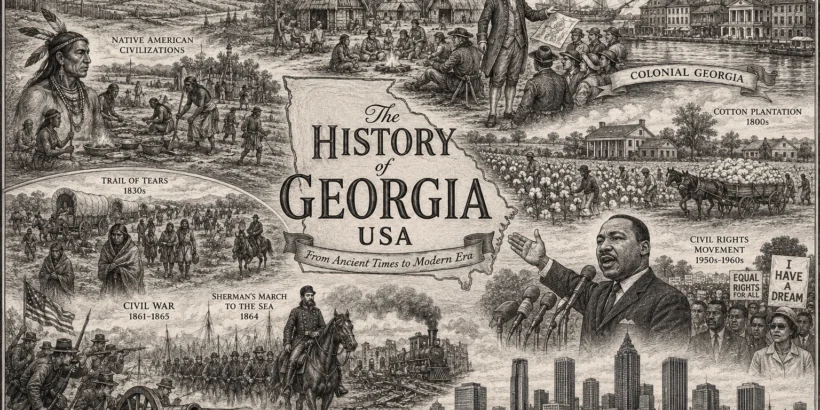
The Complete History of Georgia (USA): From Ancient Native Civilizations to Modern Economic Powerhouse
Introduction
The history of Georgia is one of the most fascinating stories in American history. Located in the southeastern United States, Georgia has played a pivotal role in shaping the political, economic, and cultural development of the nation.
From the ancient Native American civilizations that flourished thousands of years ago to the rise of modern Atlanta as a global business hub, Georgia’s journey spans centuries of transformation. It is a story of indigenous innovation, European colonization, revolutionary ideals, economic expansion, slavery, civil war, civil rights struggles, and remarkable modernization.
Today, Georgia is known as the Peach State, home to vibrant cities, world-renowned corporations, major universities, and diverse cultural communities. However, its modern success is rooted in a complex and often turbulent past.
This comprehensive guide explores the complete history of Georgia from its earliest inhabitants to the present day.
Chapter 1: Ancient Georgia – Before European Contact
The First People of Georgia
Human habitation in Georgia dates back more than 12,000 years.
Archaeological evidence indicates that Paleo-Indians inhabited the region shortly after the last Ice Age. These early people were hunters and gatherers who followed animal migrations across North America.
Over thousands of years, communities evolved into increasingly sophisticated societies.
The abundance of rivers, forests, wildlife, and fertile land made Georgia one of the most attractive places for settlement in the southeastern United States.
Archaic and Woodland Periods
Between 8000 BCE and 1000 CE, Native American societies developed agriculture, pottery, trade networks, and permanent villages.
Major developments included:
- Domestication of native crops
- Construction of ceremonial sites
- Growth of trade routes
- Development of tribal governance
The foundations of later civilizations were established during these periods.
The Rise of the Mississippian Culture
Around 1000 CE, Georgia became part of the powerful Mississippian cultural world.
The Mississippians built large ceremonial centers throughout the Southeast.
Etowah Mounds
One of Georgia’s most significant archaeological sites is the Etowah Indian Mounds near present-day Cartersville.
Features included:
- Massive earthen mounds
- Religious temples
- Government centers
- Elite residences
- Public gathering areas
Archaeologists have uncovered:
- Copper ornaments
- Stone tools
- Shell jewelry
- Ceremonial artifacts
These discoveries reveal a highly organized society with extensive trade networks.
Creek and Cherokee Nations
Following the decline of the Mississippian Culture, two major Native nations dominated Georgia.
The Creek Confederacy
The Creek people occupied central and southern Georgia.
Their society emphasized:
- Agricultural production
- Consensus-based governance
- Trade alliances
- Spiritual traditions
The Cherokee Nation
The Cherokee inhabited northern Georgia.
Their society developed:
- Written language traditions
- Clan systems
- Agricultural communities
- Advanced political institutions
The Cherokee became one of the most sophisticated Native nations in North America.
Chapter 2: European Exploration and Spanish Influence
Hernando de Soto’s Expedition
The first Europeans known to travel through Georgia were members of the Spanish expedition led by Hernando de Soto in 1540.
De Soto sought:
- Gold
- Wealth
- New territories
Although he found neither riches nor permanent settlements, his expedition dramatically affected Native communities.
The Impact of Disease
European diseases proved devastating.
Smallpox, measles, and influenza spread rapidly among Native populations who had no immunity.
Entire communities disappeared within generations.
The demographic impact fundamentally altered Georgia’s indigenous societies.
Spanish Missions
Spanish missionaries established missions along portions of the southeastern coast.
Their goals included:
- Religious conversion
- Political control
- Economic expansion
However, Spain never fully controlled Georgia’s interior regions.
Chapter 3: The Founding of Colonial Georgia
Why Georgia Was Founded
In 1732, King George II granted a charter establishing the colony of Georgia.
The colony served three primary purposes:
1. Humanitarian Purpose
Provide opportunities for impoverished English citizens.
2. Military Purpose
Act as a buffer against Spanish Florida.
3. Economic Purpose
Produce goods for the British Empire.
James Oglethorpe
General James Edward Oglethorpe became Georgia’s founder and visionary leader.
His goals included:
- Social reform
- Economic development
- Religious tolerance
- Military security
Oglethorpe remains one of the most influential figures in Georgia history.
The Founding of Savannah
In 1733, Oglethorpe established Savannah.
Savannah’s innovative city plan included:
- Public squares
- Organized streets
- Community spaces
- Defensive advantages
The city remains one of America’s best-preserved colonial settlements.
Alliance with Tomochichi
Chief Tomochichi of the Yamacraw people formed an alliance with Oglethorpe.
This relationship helped ensure the survival of the early colony.
Mary Musgrove played a crucial role as interpreter and mediator.
Chapter 4: Georgia Before the American Revolution
Economic Development
Colonial Georgia developed industries including:
- Rice production
- Indigo cultivation
- Timber exports
- Fur trading
Trade expanded rapidly with Britain and the Caribbean.
Slavery Arrives
Initially, Georgia prohibited slavery.
However, economic pressures eventually led to legalization.
By the mid-1700s:
- Plantation agriculture expanded
- Enslaved labor increased
- Wealth became concentrated
Georgia increasingly resembled neighboring Southern colonies.
Chapter 5: Georgia and the American Revolution
Growing Revolutionary Sentiment
Initially reluctant to rebel, Georgia gradually joined the revolutionary movement.
Factors included:
- Tax disputes
- British policies
- Colonial solidarity
Georgia eventually supported independence.
Major Revolutionary Battles
Battle of Kettle Creek (1779)
Patriot forces defeated Loyalists.
The battle strengthened American resistance in the South.
Siege of Savannah
French and American forces attempted to retake Savannah.
Although unsuccessful, the siege became one of the Revolution’s most significant Southern campaigns.
Independence Achieved
Following the Revolution, Georgia became one of the original states of the United States.
The state entered a new era of expansion and opportunity.
Chapter 6: Cotton, Slavery, and Expansion
Eli Whitney’s Cotton Gin
The invention of the cotton gin in 1793 transformed Georgia’s economy.
Cotton production increased dramatically.
The crop became known as:
“White Gold.”
Expansion of Plantation Agriculture
Plantations spread across Georgia.
Major cotton-growing regions included:
- Piedmont
- Coastal Plain
- River Valleys
New towns emerged as commercial centers.
The Expansion of Slavery
Cotton’s profitability increased demand for enslaved labor.
By 1860:
- Georgia had over 460,000 enslaved people.
- Slavery dominated the economy.
- Plantation owners accumulated enormous wealth.
Chapter 7: The Cherokee Removal and Trail of Tears
Discovery of Gold
In 1828, gold was discovered in Cherokee territory.
The Georgia Gold Rush intensified pressure for Native removal.
Worcester v. Georgia
The Supreme Court recognized Cherokee sovereignty.
However, the ruling was largely ignored.
Indian Removal Act
Federal policy shifted toward forced relocation.
The Cherokee were ordered to leave their homeland.
The Trail of Tears
In 1838, thousands of Cherokee were forcibly removed.
The journey west became known as the Trail of Tears.
Approximately 4,000 Cherokee died during relocation.
This remains one of the darkest chapters in American history.
Chapter 8: Georgia in the Civil War
Secession
Georgia seceded on January 19, 1861.
The state joined the Confederacy.
Why Georgia Supported Secession
Major reasons included:
- Protection of slavery
- States’ rights arguments
- Economic interests
Battle of Chickamauga
One of the bloodiest battles of the Civil War occurred in Georgia.
Casualties exceeded 34,000.
Sherman’s Atlanta Campaign
General William Tecumseh Sherman targeted Atlanta in 1864.
After months of fighting:
- Atlanta fell
- Confederate infrastructure collapsed
- Southern morale declined
Sherman’s March to the Sea
Sherman’s forces marched from Atlanta to Savannah.
They destroyed:
- Railroads
- Factories
- Supply depots
The campaign crippled the Confederacy.
Chapter 9: Reconstruction Era
Freedom and New Challenges
The end of slavery transformed Georgia society.
Freed African Americans sought:
- Education
- Land ownership
- Political participation
- Economic independence
Black Political Participation
African Americans voted and held office during Reconstruction.
This represented a historic breakthrough.
Rise of White Resistance
Groups such as the Ku Klux Klan opposed Reconstruction reforms.
Violence and intimidation became widespread.
Jim Crow Emerges
After Reconstruction, segregation laws spread throughout Georgia.
Racial inequality remained deeply entrenched.
Chapter 10: The New South
Atlanta’s Growth
Atlanta emerged as the leading city of the South.
Industries expanded rapidly.
The city attracted:
- Investors
- Railroads
- Manufacturers
Economic Modernization
Georgia diversified beyond agriculture.
Growth sectors included:
- Textiles
- Banking
- Transportation
Social Challenges
Despite economic progress:
- Segregation continued
- Voting rights were restricted
- Racial violence remained common
Chapter 11: Georgia and the Civil Rights Movement
Martin Luther King Jr.
Born in Atlanta in 1929, Martin Luther King Jr. became the face of the Civil Rights Movement.
His leadership transformed American society.
Student Activism
College students organized:
- Sit-ins
- Boycotts
- Freedom rides
- Voter registration campaigns
Atlanta’s Role
Atlanta became a strategic center of civil rights organizing.
Major organizations coordinated efforts from the city.
Legislative Victories
The movement contributed to:
- Civil Rights Act (1964)
- Voting Rights Act (1965)
These laws reshaped Georgia and the nation.
Chapter 12: Modern Georgia
Economic Transformation
Modern Georgia boasts one of the largest economies in the United States.
Major industries include:
- Technology
- Logistics
- Aerospace
- Film production
- Healthcare
- Finance
Atlanta: Global City
Atlanta hosts:
- Major corporations
- International airport
- Global conferences
- Cultural institutions
The city serves as the economic engine of the Southeast.
Georgia Today
Modern Georgia is characterized by:
- Rapid population growth
- Diverse communities
- Economic innovation
- Expanding global influence
The state continues to shape America’s future.
Timeline of Georgia History
- 1000 CE – Mississippian Culture flourishes
- 1540 – Hernando de Soto explores Georgia
- 1732 – Georgia colony established
- 1733 – Savannah founded
- 1776 – Georgia joins American Revolution
- 1788 – Georgia ratifies U.S. Constitution
- 1793 – Cotton gin invented
- 1838 – Trail of Tears
- 1861 – Georgia secedes
- 1864 – Atlanta captured by Sherman
- 1865 – Slavery abolished
- 1960s – Civil Rights Movement
- Present – Georgia becomes a major global economic center
Frequently Asked Questions (FAQs)
Why is Georgia called the Peach State?
Georgia earned the nickname because of its historic peach production and high-quality peaches.
Who founded Georgia?
James Edward Oglethorpe founded Georgia in 1733.
What was Georgia’s role in the Civil War?
Georgia joined the Confederacy and became a major military and industrial center.
Why is Atlanta important?
Atlanta is Georgia’s capital, largest city, and economic hub.
What was the Trail of Tears?
The Trail of Tears was the forced removal of Cherokee people from Georgia and other southeastern states in the 1830s.
Who was Martin Luther King Jr.?
Martin Luther King Jr. was a civil rights leader born in Atlanta who led the fight against racial segregation and discrimination.
References
- Georgia Historical Society
- National Park Service
- Library of Congress
- Georgia State Archives
- University of Georgia Press
- Cherokee Nation Historical Records
- Civil War Trust Archives
- Martin Luther King Jr. National Historical Park
- Smithsonian Institution
- U.S. National Archives
Source:The United States Chronicles