
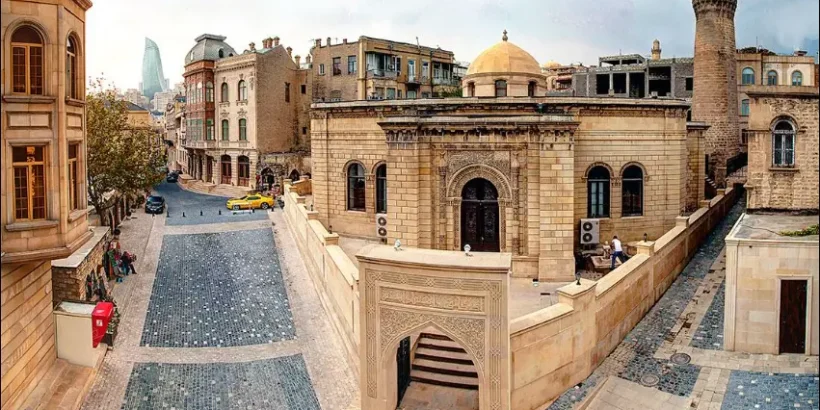
History of Azerbaijan: A Complete Historical Journey from Ancient Civilizations to the Modern Republic


Introduction
The history of Azerbaijan is one of the most fascinating stories in Eurasia. Situated at the crossroads of Europe and Asia, Azerbaijan has served as a meeting point for civilizations, religions, empires, and cultures for thousands of years. From prehistoric settlements and ancient kingdoms to powerful empires, Soviet rule, and modern independence, Azerbaijan’s historical journey reflects resilience, cultural richness, and continuous transformation.
Known as the “Land of Fire” because of its natural gas flames and ancient fire worship traditions, Azerbaijan has been shaped by Persian, Turkic, Arab, Russian, and Caucasian influences. Its strategic location along major trade routes connected the country with the civilizations of the Middle East, Central Asia, Europe, and the Mediterranean world.
This article explores the complete history of Azerbaijan based on the attached reference material while avoiding duplication and presenting a coherent, expanded narrative.
Azerbaijan in Prehistoric Times
The Earliest Human Presence
The territory of modern Azerbaijan is among the oldest continuously inhabited regions in the world. Archaeological discoveries indicate that humans lived in this area nearly 1.8 million years ago.
One of the most significant archaeological sites is Azykh Cave, where researchers uncovered primitive stone tools, animal bones, and evidence of early human settlements. These discoveries suggest that Azerbaijan was one of humanity’s earliest homes.
The region’s favorable geography contributed to early settlement:
- Fertile valleys
- Abundant water resources
- Mild climate
- Protection provided by the Caucasus Mountains
These natural advantages allowed prehistoric communities to thrive for thousands of years.
Bronze Age Development
During the Bronze Age, Azerbaijan witnessed remarkable cultural and technological progress.
The famous Kura-Araxes civilization emerged across the South Caucasus and developed:
- Advanced metalworking techniques
- Sophisticated pottery production
- Agricultural innovations
- Long-distance trade networks
Distinctive black-polished pottery discovered throughout the Near East demonstrates the extensive influence of these ancient communities.
The people of the Kura-Araxes culture were skilled craftsmen and traders who helped establish Azerbaijan as an important regional center.
Ancient Azerbaijan and Caucasian Albania
Formation of Early States
By the first millennium BCE, tribal societies had evolved into organized political entities. The most important ancient state in Azerbaijan’s history was Caucasian Albania.
Founded around the 4th century BCE, Caucasian Albania controlled much of present-day Azerbaijan and parts of neighboring regions.
Its capital, Gabala, became a prominent center of commerce, governance, and culture.
Diversity of Caucasian Albania
Ancient sources describe Caucasian Albania as an extraordinarily diverse kingdom.
The Greek geographer Strabo reported that more than twenty tribes lived within the kingdom. Each possessed distinct customs and dialects, yet all were united under Albanian rulers.
This diversity helped create a vibrant society characterized by:
- Cultural exchange
- Linguistic variety
- Religious coexistence
- Economic cooperation
Roman and Persian Influence
Due to its strategic location, Caucasian Albania frequently became the target of powerful neighboring empires.
Roman forces under Pompey reached the region during campaigns in the Caucasus.
Later, the powerful Sasanian Empire established control over much of the territory.
Persian influence brought:
- Administrative reforms
- Urban development
- Zoroastrian religious traditions
- Architectural advancements
The Land of Fire
Zoroastrian Heritage
Long before Islam arrived, Azerbaijan was an important center of Zoroastrianism.
Natural gas escaping from underground reservoirs created eternal flames that burned continuously for centuries.
These sacred fires inspired worship and gave rise to Azerbaijan’s famous nickname:
“The Land of Fire.”
Ancient fire temples became important pilgrimage destinations for worshippers throughout the Persian world.
Among the most famous examples is Ateshgah Fire Temple, which symbolizes Azerbaijan’s ancient spiritual heritage.
Christianity in Ancient Azerbaijan
Adoption of Christianity
Christianity reached Azerbaijan during the fourth century through missionaries traveling from neighboring regions.
The rulers of Caucasian Albania embraced Christianity, making it one of the earliest Christian kingdoms in the world.
Numerous churches and monasteries were built throughout the country.
These institutions became centers for:
- Education
- Religious scholarship
- Literature
- Cultural preservation
The ancient church at Kish Church remains an important symbol of Azerbaijan’s Christian past.
The Arab Conquest and the Arrival of Islam
Transformation in the Seventh Century
A major turning point occurred during the seventh century when Arab armies entered the Caucasus.
Rather than completely dismantling existing structures, the new rulers often incorporated local institutions into the Islamic administration.
The region gradually became part of the expanding Islamic world.
Islamic Civilization Flourishes
Under the Umayyad and Abbasid Caliphates, Azerbaijan became one of the most prosperous regions of the Muslim world.
Cities such as:
- Barda
- Ganja
- Nakhchivan
developed into major centers of commerce, learning, and culture.
Trade routes connected Azerbaijan with:
- Baghdad
- Damascus
- Cairo
- Constantinople
- Samarkand
This commercial prosperity stimulated intellectual and cultural growth.
The Golden Age of Learning
Scientific Achievements
Medieval Azerbaijan produced influential scholars whose contributions extended far beyond the region.
Among them was Nasir al-Din al-Tusi, one of the greatest scientists of the medieval Islamic world.
His achievements included:
- Astronomy
- Mathematics
- Philosophy
- Engineering
His work later influenced scientific developments in Europe.
Literary Development
The medieval period witnessed the emergence of rich literary traditions.
Ancient Turkic oral epics evolved into written literature, preserving heroic legends and cultural values.
The famous Book of Dede Korkut became a cornerstone of Azerbaijani cultural identity.
Its stories celebrate courage, wisdom, family, and honor.
The Shirvanshahs and Medieval Prosperity
Rise of a Powerful Dynasty
The Shirvanshah Dynasty ruled large parts of Azerbaijan for centuries.
Their reign contributed significantly to:
- Urban development
- Architecture
- Literature
- Commerce
The dynasty established strong local governance while maintaining relations with larger Islamic powers.
Architectural Legacy
One of the greatest monuments from this era is the magnificent Palace of the Shirvanshahs.
The complex reflects a unique blend of:
- Persian artistic traditions
- Islamic architecture
- Local Azerbaijani craftsmanship
Today it remains one of the country’s most treasured historical landmarks.
Turkic Migration and Azerbaijani Identity
Arrival of Turkic Peoples
Beginning in the eleventh century, large waves of Turkic tribes migrated into Azerbaijan.
The arrival of:
- Oghuz Turks
- Kipchaks
- Other Turkic groups
transformed the region’s ethnic and linguistic character.
The Turkish language gradually became dominant among the population.
Seljuk Influence
The expansion of the Seljuk Empire integrated Azerbaijan into a vast political and cultural sphere.
Under Seljuk rule:
- Cities expanded rapidly
- Trade prospered
- Religious institutions flourished
- New architectural styles emerged
The combination of Turkic traditions and Persian culture shaped the foundations of modern Azerbaijani identity.
Nizami Ganjavi and Cultural Excellence
Azerbaijan’s greatest literary figure is undoubtedly Nizami Ganjavi.
His celebrated work, the Khamsa, became one of the masterpieces of world literature.
His writings explored:
- Love
- Ethics
- Leadership
- Spirituality
- Human values
Nizami’s influence continues to extend across the Middle East, Central Asia, and beyond.
Mongol Invasion and Recovery
Devastation of the Thirteenth Century
The Mongol invasions brought immense destruction to Azerbaijan.
Many cities suffered:
- Population decline
- Economic collapse
- Cultural disruption
Yet Azerbaijan eventually recovered and adapted to the new political order.
Cultural Revival
Under Mongol and later Ilkhanid rule, Azerbaijan regained prominence as a center of trade and scholarship.
The city of Tabriz became one of the most cosmopolitan cities in Eurasia.
Merchants, artists, scholars, and travelers from across the world visited its markets and institutions.
The Safavid Empire and Azerbaijan’s Golden Age


Shah Ismail I and the Rise of the Safavids
The sixteenth century marked another turning point with the rise of Shah Ismail I.
In 1501 he established the powerful Safavid Empire.
Tabriz became the empire’s first capital and one of the most magnificent cities in the Islamic world.
Religious Transformation
The Safavids officially adopted Twelver Shi’a Islam as the state religion.
This decision profoundly influenced Azerbaijan’s religious identity and continues to shape the country today.
The Safavid era witnessed:
- Construction of mosques
- Expansion of religious education
- Growth of Shi’a traditions
- Artistic achievements
Artistic and Economic Prosperity
The Safavid period represented a golden age of craftsmanship.
Azerbaijani artisans became famous for:
- Carpet weaving
- Silk production
- Metalwork
- Miniature painting
The carpets of Tabriz became internationally renowned and were sought after by European royalty.
Fragmentation and the Khanates
Following the decline of the Safavid Empire, Azerbaijan fragmented into numerous independent khanates.
Major khanates included:
- Baku
- Shirvan
- Ganja
- Karabakh
- Shaki
Although politically divided, these states preserved Azerbaijani cultural traditions and local governance.
Russian Expansion and Imperial Rule
Russo-Persian Wars
The nineteenth century brought Russian expansion into the South Caucasus.
Following a series of wars between Russia and Persia, Azerbaijan was divided.
The key agreements were:
- Treaty of Gulistan
- Treaty of Turkmenchay
These treaties established the modern border between northern and southern Azerbaijani territories.
Economic Modernization
Russian rule introduced:
- New administrative systems
- Infrastructure development
- Educational reforms
- Industrial investment
These changes accelerated modernization while simultaneously weakening traditional political institutions.
Baku and the Global Oil Boom
Emergence of an Energy Giant
The discovery and development of oil transformed Azerbaijan’s economy.
By the late nineteenth century, Baku had become one of the world’s leading oil-producing centers.
International investors rushed to the city.
The Nobel Brothers
Among the most famous investors were:
- Ludvig Nobel
- Robert Nobel
Their innovations revolutionized petroleum extraction and transportation.
Baku soon became one of the most dynamic industrial cities in the world.
National Awakening and Independence
Cultural Renaissance
The late nineteenth and early twentieth centuries witnessed a surge in Azerbaijani intellectual life.
Newspapers, schools, and cultural organizations promoted:
- Education
- National identity
- Social reform
- Political awareness
Writers and reformers played crucial roles in shaping modern Azerbaijani nationalism.
Azerbaijan Democratic Republic
On May 28, 1918, Azerbaijan established the Azerbaijan Democratic Republic.
This republic achieved several historic milestones:
- Parliamentary democracy
- Universal suffrage
- Women’s voting rights
- Protection of minority representation
It became the first secular democratic republic in the Muslim world.
Soviet Azerbaijan
Incorporation into the Soviet Union
In 1920 Soviet forces occupied Azerbaijan, ending the brief independence period.
The country became the Azerbaijan Soviet Socialist Republic.
Industrialization and Modernization
Despite political repression, Soviet rule brought:
- Universal education
- Industrial growth
- Infrastructure development
- Scientific advancement
Azerbaijan became one of the Soviet Union’s most important industrial regions.
World War II
During World War II, Azerbaijani oil was vital to Soviet military success.
Hundreds of thousands of Azerbaijanis served in the armed forces.
The country’s contribution played a crucial role in the Allied victory.
Independence and Modern Azerbaijan
Restoration of Sovereignty
The collapse of the Soviet Union allowed Azerbaijan to restore independence in 1991.
The new republic faced enormous challenges including:
- Economic instability
- Political transition
- Territorial conflict
The Karabakh Conflict
The conflict over Nagorno-Karabakh became the most significant issue of the post-Soviet era.
The war displaced hundreds of thousands of people and shaped Azerbaijan’s domestic and foreign policies.
Economic Recovery
Major energy projects transformed Azerbaijan’s economy.
The development of Caspian Sea oil and gas resources attracted substantial foreign investment.
Key projects included:
- Baku-Tbilisi-Ceyhan Pipeline
- Shah Deniz Gas Field
- Azeri-Chirag-Gunashli Oil Complex
These initiatives strengthened Azerbaijan’s role in global energy markets.
Azerbaijan in the Twenty-First Century
Modern Azerbaijan has emerged as:
- A regional energy producer
- A transportation hub
- An important diplomatic actor
- A growing tourism destination
The country continues investing in:
- Infrastructure
- Technology
- Education
- Economic diversification
At the same time, it seeks to preserve its unique cultural and historical heritage.
Daily Life of Azerbaijan Village People


The daily life of village people in Azerbaijan reflects a rich blend of tradition, agriculture, family values, and hospitality. Although modernization has reached many rural areas, village communities continue to preserve customs that have been passed down through generations.
Early Morning Activities
Village life in Azerbaijan begins early. Farmers typically wake up before sunrise to prepare for the day’s work. Many families keep livestock such as:
- Cows
- Sheep
- Goats
- Chickens
- Horses
The first tasks of the day often include feeding animals, milking cows, collecting eggs, and cleaning animal shelters.
Agriculture and Farming
Agriculture remains the backbone of rural life in many Azerbaijani villages. Depending on the region, villagers cultivate the following:
- Wheat
- Barley
- Corn
- Vegetables
- Grapes
- Pomegranates
- Apples
- Tea
Farmers spend much of their day working in fields, orchards, and vineyards. The fertile valleys and mountain slopes support a variety of agricultural activities.
Traditional Homes
Most village homes are built using stone, brick, or concrete and often include:
- Large family courtyards
- Fruit trees
- Vegetable gardens
- Animal sheds
- Outdoor cooking areas
The courtyard serves as the center of family life, where relatives gather, children play, and guests are welcomed.
Family Structure
Family plays a central role in Azerbaijani village society. It is common for multiple generations to live together or nearby.
Elders are highly respected and often participate in important family decisions. Grandparents frequently help care for children while younger adults work in agriculture or local businesses.
Traditional Food
Food is an essential part of village life. Meals are often prepared using fresh ingredients grown locally.
Popular dishes include:
- Plov
- Dolma
- Fresh bread
- Kebabs
- Yogurt
- Cheese
- Seasonal fruits
Tea is the most common beverage and is often served to guests with sweets or jam.
Community and Social Life
Villages maintain strong community ties. Neighbors frequently help one another during:
- Harvest seasons
- Weddings
- House construction
- Religious celebrations
Hospitality is one of the most valued traditions. Visitors are warmly welcomed and usually offered tea, fruit, and homemade food.
Education and Children
Most villages have primary or secondary schools. Children attend classes during the day and often assist their families after school by:
- Feeding animals
- Working in gardens
- Collecting firewood
- Helping with household chores
Despite modern technology, many children still grow up closely connected to nature and traditional lifestyles.
Cultural Traditions
Village residents actively preserve Azerbaijani customs through:
- Folk music
- Traditional dances
- Storytelling
- Handicrafts
- Local festivals
Traditional music styles such as Mugham and Ashiq performances remain important cultural expressions.
Religious Life
The majority of villagers practice Islam, and local mosques often serve as centers of community life. Religious holidays and family celebrations bring people together and strengthen social bonds.
Evening Routine
After a long day of work, families gather for dinner and conversation. Evenings are often spent:
- Drinking tea
- Sharing stories
- Watching television
- Visiting relatives and neighbors
During summer, many families enjoy sitting outdoors in their courtyards, taking advantage of the cool evening air.
Conclusion
The daily life of Azerbaijan’s village people is characterized by hard work, strong family relationships, agricultural traditions, and deep-rooted cultural values. While modern developments continue to improve rural living standards, many villages still preserve a lifestyle that reflects Azerbaijan’s rich heritage and enduring sense of community. This balance between tradition and modernization makes Azerbaijani village life both unique and culturally significant.
Conclusion
The history of Azerbaijan is a remarkable narrative spanning nearly two million years of human development. From prehistoric settlements and the ancient kingdom of Caucasian Albania to Islamic civilization, Turkic migrations, Safavid power, Russian imperial rule, Soviet modernization, and modern independence, Azerbaijan has continually adapted while preserving its unique identity.
Today, Azerbaijan stands as a bridge between East and West, combining ancient traditions with modern ambitions. Its historical legacy—shaped by diverse civilizations, religions, and cultures—remains one of the richest and most fascinating in the world. This extraordinary journey through time demonstrates how Azerbaijan evolved into the dynamic and influential nation that exists today.
References
Primary Source
The historical information presented in this article was adapted and synthesized from the user’s supplied source document:
- History of Azerbaijan: From Prehistoric Settlements to the Modern Republic (User-provided manuscript, 2026).
Books and Academic Sources
- Altstadt, Audrey L. (2017). Azerbaijan: Past, Present, and Future. Hoover Institution Press.
- Swietochowski, Tadeusz (2004). Russian Azerbaijan, 1905–1920: The Shaping of National Identity in a Muslim Community. Cambridge University Press.
- Swietochowski, Tadeusz (1995). Russia and Azerbaijan: A Borderland in Transition. Columbia University Press.
- Cornell, Svante E. (2011). Azerbaijan Since Independence. M.E. Sharpe.
- De Waal, Thomas (2013). Black Garden: Armenia and Azerbaijan Through Peace and War. New York University Press.
- Golden, Peter B. (1992). An Introduction to the History of the Turkic Peoples. Otto Harrassowitz.
- Bosworth, Clifford Edmund (2007). Historic Cities of the Islamic World. Brill Academic Publishers.
- Frye, Richard N. (1984). The History of Ancient Iran. C.H. Beck.
- Burney, Charles & Lang, David Marshall (1971). The Peoples of the Hills: Ancient Ararat and Caucasus. Weidenfeld & Nicolson.
- Hewsen, Robert H. (2001). Armenia: A Historical Atlas. University of Chicago Press.
Ancient and Medieval Sources
- Geographica – Strabo.
- The History of the Albanians by Movses Kaghankatvatsi.
- Book of Dede Korkut.
- Khamsa by Nizami Ganjavi.
- Writings of Nasir al-Din al-Tusi.
Government and Institutional Sources
- President of the Republic of Azerbaijan Official Website
- Ministry of Culture of Azerbaijan
- National Library of Azerbaijan
- Azerbaijan National Academy of Sciences
- State Statistical Committee of Azerbaijan