The Complete History of Hawaii: From Polynesian Settlement to America’s 50th State
Focus Keywords: history of Hawaii, complete history of Hawaii, Hawaiian Kingdom, Hawaii statehood, Hawaii annexation, Pearl Harbor history, Polynesian settlers Hawaii
Introduction: Why the History of Hawaii Matters
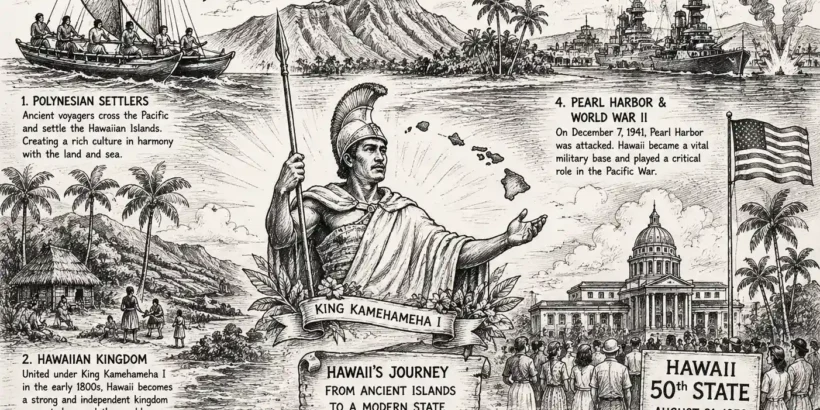
Hawaii is one of the most unique places in the United States. Known for its volcanic islands, beautiful beaches, rich culture, and deep traditions, Hawaii has a history unlike any other U.S. state. It was originally inhabited by Polynesian settlers, later became a powerful independent kingdom, was annexed by the United States in 1898, played a major military role during World War II, and finally became the 50th state in 1959.
The complete history of Hawaii is not just a story of islands in the Pacific. It is a story of migration, monarchy, cultural strength, foreign influence, political conflict, military strategy, and modern identity. Hawaii’s past includes ancient voyaging traditions, the rise of chiefs and kingdoms, the arrival of European explorers, the growth of plantations, the overthrow of the monarchy, the attack on Pearl Harbor, and the long road to American statehood.
Today, Hawaii remains a place where Native Hawaiian traditions, Asian immigrant cultures, American institutions, and Pacific identity meet. Understanding Hawaii’s history helps explain why the islands are so culturally rich and why their political past remains important.
Quick Facts About Hawaii
- Statehood: Hawaii became the 50th U.S. state on August 21, 1959. (Eisenhower Presidential Library)
- Original inhabitants: Polynesian settlers reached the islands centuries before European contact.
- Former status: Hawaii was once an independent kingdom.
- Annexation: The United States annexed Hawaii through the 1898 Joint Resolution. (National Archives)
- World War II role: Pearl Harbor became a major military site, and the 1941 attack helped bring the United States into World War II. (National Park Service)
1. Ancient Hawaii: The Arrival of Polynesian Settlers
The earliest history of Hawaii begins with the remarkable voyages of Polynesian navigators. Long before modern ships, maps, or compasses, Polynesian voyagers crossed thousands of miles of open ocean using the stars, winds, currents, birds, clouds, and waves as guides.
These early settlers brought plants, animals, tools, religious traditions, social customs, and a deep understanding of ocean life. They introduced crops such as taro, sweet potato, banana, and coconut. They also brought pigs, chickens, and dogs, which became important parts of Hawaiian life.
Over time, a distinct Hawaiian culture developed. Native Hawaiians built communities around land divisions known as ahupuaʻa, which usually stretched from the mountains to the sea. This system helped people share resources wisely. Forests provided wood and birds; uplands supported farming; coastal waters provided fish and salt.
Religion and spirituality were central to ancient Hawaiian society. Hawaiians believed in powerful gods connected to nature, including Kāne, Kū, Lono, and Kanaloa. Chiefs, priests, farmers, fishers, and craftspeople all had roles within a highly organized social system.
2. The Rise of Chiefs and Traditional Hawaiian Society
Before Hawaii became a unified kingdom, the islands were ruled by local chiefs. Each island had its own political divisions, rival families, alliances, and conflicts. Chiefs gained power through genealogy, military strength, religious authority, and control over land.
The Hawaiian social order was hierarchical. At the top were the aliʻi, or chiefs. Priests known as kahuna held religious and technical knowledge. Commoners, called makaʻāinana, farmed, fished, built homes, and supported the community. The kapu system regulated behavior, food, gender roles, sacred spaces, and political authority.
Although ancient Hawaii was not a modern nation-state, it had complex laws, resource systems, warfare, diplomacy, and cultural practices. Oral history, chant, hula, genealogy, and storytelling preserved knowledge across generations.
3. European Contact and the Arrival of Captain James Cook
European contact changed Hawaii forever. In 1778, British explorer Captain James Cook arrived in the Hawaiian Islands. His arrival connected Hawaii more directly to global trade, exploration, disease, and foreign politics.
At first, Hawaiians and Europeans exchanged goods and knowledge. Hawaiians were interested in metal tools, weapons, cloth, and other foreign items. Europeans were interested in fresh food, water, sandalwood, and strategic Pacific locations.
However, contact also brought major disruption. Diseases introduced from abroad devastated Native Hawaiian populations, who had no immunity to many foreign illnesses. European weapons also changed the balance of power among Hawaiian chiefs.
4. King Kamehameha I and the Unification of Hawaii
One of the most important figures in Hawaiian history is King Kamehameha I. Through warfare, diplomacy, and strategic alliances, Kamehameha unified the Hawaiian Islands in the late 18th and early 19th centuries.
Kamehameha used both traditional Hawaiian power and foreign military technology. With access to Western weapons and advisors, he defeated rival chiefs and eventually brought most of the islands under his rule. By 1810, Hawaii was unified as a kingdom.
This unification created the foundation for the Hawaiian Kingdom. It allowed Hawaii to deal with foreign powers as a single political entity rather than as separate island chiefdoms.
5. The Hawaiian Kingdom: A Sovereign Nation in the Pacific
After unification, Hawaii became an independent kingdom. The Hawaiian monarchy developed diplomatic relationships with foreign countries, adopted written laws, and modernized many parts of government.
During the 19th century, Hawaii was increasingly influenced by American and European missionaries, merchants, sailors, and plantation owners. Christian missionaries arrived in 1820 and played a major role in education, literacy, religion, and politics. They helped develop a written form of the Hawaiian language and established schools.
The monarchy also adopted constitutions, legal reforms, and Western-style institutions. Hawaii had kings and queens, courts, treaties, newspapers, schools, and international recognition.
However, foreign influence also created tension. Land ownership changed dramatically. The Great Māhele of 1848 transformed traditional land relationships into a private property system. This shift benefited some Hawaiians but also allowed foreigners to acquire large amounts of land.
6. Sugar Plantations and Immigration
Sugar became one of the most important forces in Hawaiian history. Plantation agriculture reshaped the islands’ economy, politics, labor system, and population.
As sugar plantations expanded, plantation owners needed workers. Laborers were brought from China, Japan, Portugal, Korea, the Philippines, Puerto Rico, and other places. These immigrant communities helped create Hawaii’s multicultural society.
The plantation economy made Hawaii increasingly tied to the United States. American businessmen gained power, especially in sugar, shipping, banking, and politics. This economic influence later played a major role in the overthrow of the Hawaiian monarchy and annexation by the United States.
7. Queen Liliʻuokalani and the Overthrow of the Monarchy
Queen Liliʻuokalani, Hawaii’s last reigning monarch, came to the throne in 1891. She wanted to strengthen the authority of the monarchy and restore political power to Native Hawaiians.
In 1893, a group of American and European businessmen, with support from U.S. interests in Hawaii, overthrew the Hawaiian monarchy. Queen Liliʻuokalani was removed from power. The overthrow remains one of the most controversial and painful events in Hawaiian history.
Many Native Hawaiians opposed annexation and supported the queen. Petitions and protests showed that many Hawaiians did not want to lose their nation’s independence. Nevertheless, the monarchy was not restored.
8. Annexation by the United States in 1898
In 1898, the United States annexed Hawaii through the Newlands Resolution, officially titled the Joint Resolution to Provide for Annexing the Hawaiian Islands to the United States. (National Archives)
The timing was closely connected to American expansion and the Spanish-American War. Hawaii’s location in the Pacific made it strategically valuable for the United States. It could serve as a naval station, supply base, and military bridge between North America and Asia.
After annexation, Hawaii became a U.S. territory in 1900. Its government, economy, and legal system became more closely tied to the United States. However, the memory of the lost kingdom remained central to Native Hawaiian identity.
9. Hawaii as a U.S. Territory
As a U.S. territory, Hawaii continued to grow economically and strategically. Sugar and pineapple plantations dominated much of the economy. Large companies controlled land, labor, and politics.
The territorial period also saw major social change. Immigrant labor communities developed strong local cultures. Workers organized, families built new communities, and Hawaii became one of the most ethnically diverse places under U.S. control.
The U.S. military presence also expanded. Pearl Harbor became increasingly important as America’s Pacific strategy developed.
10. Pearl Harbor and Hawaii During World War II
Hawaii’s role in World War II is one of the most famous parts of its history. On December 7, 1941, Japan attacked Pearl Harbor on Oʻahu. The attack caused massive destruction and led the United States to enter World War II. (National Park Service)
The attack killed thousands and damaged or sank many ships. According to the U.S. Naval History and Heritage Command, about 2,403 military personnel and civilians were killed, and 21 ships were damaged or sunk. (Naval History and Heritage Command)
After Pearl Harbor, Hawaii became an essential military center. The islands served as a headquarters, training ground, supply base, and strategic command location for the Pacific War.
World War II transformed Hawaii. Martial law was declared. Military authority shaped daily life. Civilians experienced blackouts, rationing, censorship, and restrictions. Japanese Americans in Hawaii faced suspicion and discrimination, though mass incarceration in Hawaii was more limited than on the U.S. mainland because Japanese Americans made up a large part of the local population and were essential to the islands’ economy.
11. The Road to Statehood
After World War II, support for Hawaii statehood increased. Many residents had served in the war, contributed to the U.S. economy, and argued that territorial status denied them full democratic representation.
Hawaii’s diverse population challenged older arguments against statehood. Labor movements, veterans, local political leaders, and community organizations pushed for equal rights and representation.
In 1959, Hawaii voters approved statehood in a referendum. President Dwight D. Eisenhower signed the proclamation admitting Hawaii as the 50th state on August 21, 1959. (Eisenhower Presidential Library)
Statehood marked a major turning point. Hawaii gained full congressional representation and became officially part of the United States as a state rather than a territory.
12. Hawaii Becomes the 50th State in 1959
Hawaii’s admission as the 50th state was a historic moment. It came shortly after Alaska became the 49th state. Hawaii’s statehood expanded the geographic and cultural identity of the United States into the Pacific.
For many residents, statehood meant political equality, economic opportunity, and recognition. For others, especially many Native Hawaiians, statehood did not erase the history of overthrow, annexation, and loss of sovereignty.
This dual legacy still shapes Hawaii today. Statehood is celebrated by some as progress and questioned by others as part of a longer history of colonization.
13. The Hawaiian Renaissance and Cultural Revival
In the 1960s and 1970s, the Hawaiian Renaissance brought renewed interest in Native Hawaiian culture, language, music, hula, voyaging, land rights, and sovereignty.
Traditional navigation became a powerful symbol of cultural revival. The voyaging canoe Hōkūleʻa showed that Polynesian ancestors had intentionally navigated the Pacific with advanced skill, not by accident.
The Hawaiian language also experienced revival. Schools, cultural programs, music, and activism helped restore pride in Hawaiian identity.
14. Modern Hawaii: Tourism, Culture, and Identity
Today, Hawaii is known worldwide as a tourist destination, but its history is much deeper than beaches and resorts. Modern Hawaii faces challenges involving housing costs, land use, environmental protection, Native Hawaiian rights, military presence, and cultural preservation.
Tourism is a major part of the economy, but it also creates pressure on local communities and natural resources. Many residents continue to call for respectful tourism that honors Hawaiian culture and protects the islands.
Hawaii’s modern identity is shaped by Native Hawaiian traditions, immigrant cultures, American statehood, and Pacific connections. It is both local and global, ancient and modern.
15. Timeline of Hawaii History
- Ancient period: Polynesian settlers arrive and develop Hawaiian culture.
- 1778: Captain James Cook arrives, beginning sustained European contact.
- 1810: Kamehameha I unifies the Hawaiian Islands.
- 1820: Christian missionaries arrive.
- 1848: The Great Māhele changes land ownership.
- 1891: Queen Liliʻuokalani becomes monarch.
- 1893: The Hawaiian monarchy is overthrown.
- 1898: Hawaii is annexed by the United States. (National Archives)
- 1900: Hawaii becomes a U.S. territory.
- 1941: Pearl Harbor is attacked, bringing the U.S. into World War II. (National Park Service)
- 1959: Hawaii becomes the 50th U.S. state. (Eisenhower Presidential Library)
- 1970s onward: Hawaiian cultural revival grows.
Conclusion: The Lasting Legacy of Hawaii’s History
The complete history of Hawaii is a powerful story of ocean voyaging, cultural achievement, monarchy, colonization, military importance, and statehood. Hawaii was originally inhabited by Polynesian settlers who created a sophisticated island civilization. It later became an independent kingdom, entered global trade and diplomacy, experienced foreign influence and political upheaval, was annexed by the United States in 1898, became a vital military location during World War II, and finally joined the Union as the 50th state in 1959.
But Hawaii’s history is not only about dates and political events. It is also about people, language, land, memory, and identity. Native Hawaiian culture continues to shape the islands, and the legacy of the Hawaiian Kingdom remains meaningful today.
To understand Hawaii is to understand that it is more than a paradise destination. It is a place with a deep past, a complex present, and a living culture that continues to inspire the world.
References
- U.S. National Archives. Joint Resolution to Provide for Annexing the Hawaiian Islands to the United States, 1898.
- Dwight D. Eisenhower Presidential Library. Hawaii Statehood, 1959.
- National Park Service. Pearl Harbor National Memorial.
- Naval History and Heritage Command. Naval Station Pearl Harbor History.
- Encyclopaedia Britannica. Hawaii: History and Government.
- Smithsonian Institution. Hawaiian History and Culture.
- Library of Congress. Hawaii and the Pacific Collection.
- University of Hawaiʻi at Mānoa. Hawaiian History Resources.
- Hawaiʻi State Archives. Historical Records of the Hawaiian Kingdom.
- National Geographic. Polynesian Navigation and Settlement of the Pacific.
SEO Keywords
history of Hawaii, complete history of Hawaii, Hawaii history timeline, Hawaiian Kingdom, Hawaii statehood, Hawaii became 50th state, Hawaii annexation 1898, Polynesian settlers Hawaii, Pearl Harbor Hawaii, Hawaii World War II, Queen Liliuokalani, King Kamehameha, Native Hawaiian history
The sketch image request is already being processed from your previous message.