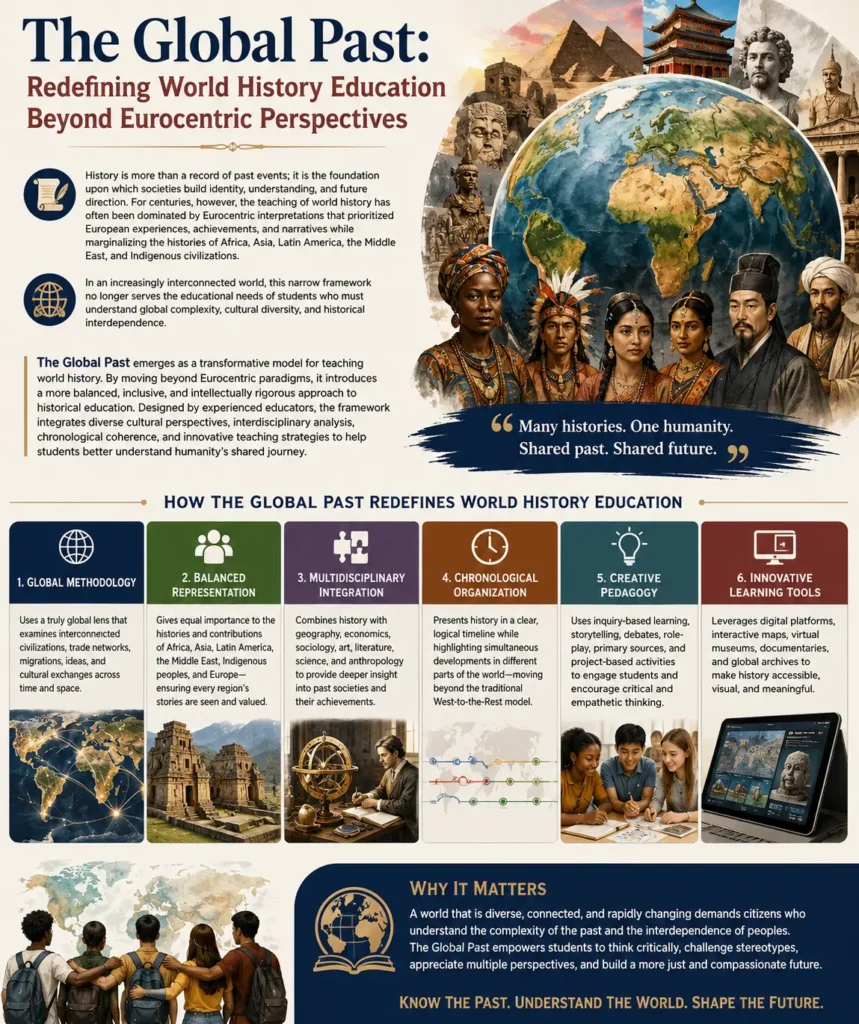
History is more than a record of past events; it is the foundation upon which societies build identity, understanding, and future direction. For centuries, however, the teaching of world history has often been dominated by Eurocentric interpretations that prioritized European experiences, achievements, and narratives while marginalizing the histories of Africa, Asia, Latin America, the Middle East, and Indigenous civilizations. In an increasingly interconnected world, this narrow framework no longer serves the educational needs of students who must understand global complexity, cultural diversity, and historical interdependence.
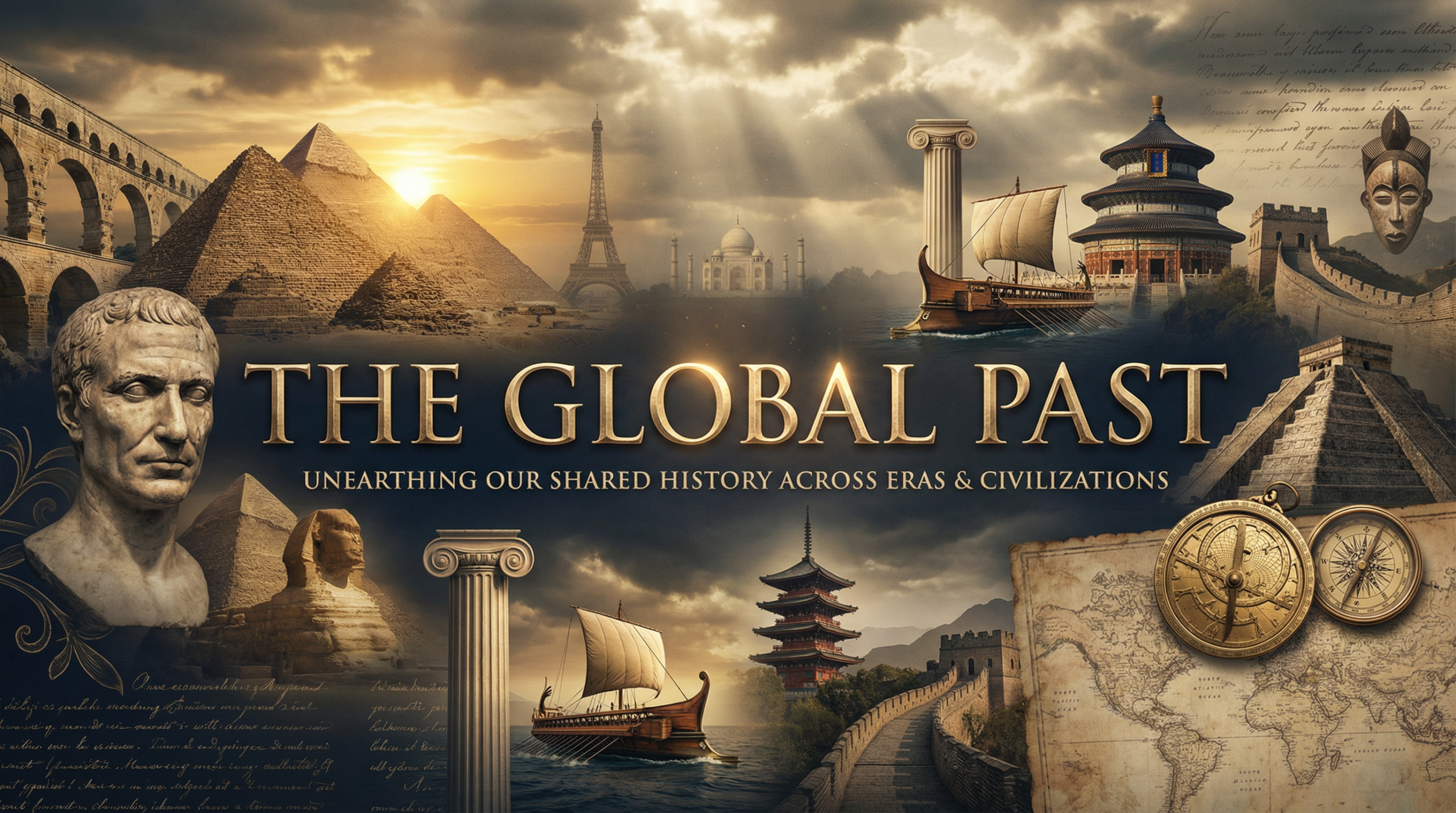
The Global Past emerges as a transformative model for teaching world history. By moving beyond Eurocentric paradigms, it introduces a more balanced, inclusive, and intellectually rigorous approach to historical education. Designed by experienced educators, the framework integrates diverse cultural perspectives, interdisciplinary analysis, chronological coherence, and innovative teaching strategies to help students better understand humanity’s shared journey.
This article explores how The Global Past redefines world history education through its global methodology, balanced representation, multidisciplinary integration, chronological organization, creative pedagogy, and innovative learning tools. It also examines why such an approach is essential for preparing students for the realities of the twenty-first century.
Understanding Eurocentrism in Historical Education
What Is Eurocentrism?
Eurocentrism refers to the tendency to interpret world history primarily through European perspectives and experiences. Traditional historical narratives often presented Europe as the center of civilization, progress, innovation, and modernization. Other regions were frequently portrayed as secondary, underdeveloped, or merely reactive to European expansion.
This perspective shaped educational systems worldwide, influencing textbooks, curricula, and academic research for generations.
Characteristics of Eurocentric History
Some common features of Eurocentric historical narratives include:
- Overemphasis on European achievements
- Limited attention to non-European civilizations
- Portrayal of colonialism as “civilizing”
- Marginalization of Indigenous voices
- Viewing modernization as a uniquely Western phenomenon
- Ignoring interconnected global developments
Such approaches often fail to capture the complexity of historical interactions and the contributions of diverse societies.
Why Traditional World History Models Are Inadequate
A Changing Global Society
Modern societies are deeply interconnected economically, politically, technologically, and culturally. Students today interact with global ideas daily through digital communication, migration, trade, and media. A narrow historical framework cannot adequately explain the interconnected realities of contemporary life.
Problems with Older Models
Traditional approaches to world history create several educational limitations:
- Incomplete Understanding
Students may develop distorted perceptions of global development. - Cultural Bias
Histories of non-European societies may appear less important. - Lack of Comparative Insight
Connections between civilizations remain unexplored. - Reduced Critical Thinking
Singular narratives discourage analytical interpretation. - Weak Global Awareness
Students struggle to understand multicultural realities.
These limitations highlight the urgent need for a broader and more inclusive model like The Global Past.
The Vision Behind The Global Past
A Truly Global Approach
The primary strength of The Global Past lies in its commitment to genuine global inclusivity. Rather than positioning Europe at the center of history, it treats all civilizations as active participants in shaping human development.
This approach emphasizes the following:
- Interconnected histories
- Cultural exchange
- Shared human experiences
- Regional diversity
- Global transformations
Students are encouraged to see history as a network of interactions rather than isolated national or continental narratives.
Diverse Perspectives in Historical Interpretation
Including Multiple Voices
One of the defining features of The Global Past is its integration of diverse perspectives. Historical events are analyzed from the viewpoints of different societies, cultures, and communities.
Examples of Diverse Perspectives
- Colonialism viewed by both colonizers and colonized peoples
- Trade routes analyzed from Asian, African, Middle Eastern, and European perspectives
- Indigenous interpretations of exploration and conquest
- Gendered analyses of social and political change
- Labor history from the perspective of workers and peasants
By incorporating multiple viewpoints, students develop a richer and more balanced understanding of world events.
Moving Beyond Western Dominance
Recognizing Non-European Contributions
The Global Past highlights the achievements and influence of civilizations often overlooked in traditional textbooks.
Important Contributions from Global Civilizations
China
- Papermaking
- Gunpowder
- Compass technology
- Civil service systems
India
- Mathematical innovations
- Philosophical traditions
- Textile production
- Medical advancements
Islamic Civilizations
- Preservation of classical knowledge
- Advances in astronomy and medicine
- Architectural achievements
- Development of trade networks
Africa
- Kingdoms such as Mali and Songhai
- Intellectual centers like Timbuktu
- Metallurgical innovations
- Extensive trade systems
Indigenous Americas
- Agricultural engineering
- Sophisticated urban planning
- Complex governance systems
This balanced recognition challenges stereotypes and broadens students’ historical awareness.
Chronological Structure with Global Connections
Why Chronology Matters
While thematic approaches are valuable, students often struggle when history lacks chronological clarity. The Global Past addresses this challenge by placing key themes within a coherent chronological framework.
This structure helps students:
- Understand cause and effect
- Trace long-term developments
- Compare societies across time
- Identify patterns of change
- Recognize simultaneous global developments
Example of Comparative Chronology
During the fifteenth century:
- European maritime exploration expanded
- Ming China engaged in naval expeditions
- Islamic empires flourished
- African kingdoms expanded trade
- Indigenous American civilizations thrived
Rather than presenting these histories separately, The Global Past encourages comparative understanding.
Comparative History as a Learning Tool
Building Analytical Skills
Comparative history allows students to examine similarities and differences between societies, institutions, and historical developments.
Comparative Topics
- Empires across continents
- Religious expansion
- Industrialization in different regions
- Political revolutions
- Migration patterns
- Gender roles in various cultures
Comparative analysis promotes deeper critical thinking and encourages students to move beyond simplistic conclusions.
Interdisciplinary Learning in The Global Past
Integrating Multiple Disciplines
History does not exist in isolation. The Global Past integrates insights from:
- Anthropology
- Sociology
- Economics
- Political science
- Geography
- Environmental studies
- Archaeology
- Literature
This multidisciplinary approach enriches students’ understanding of historical complexity.
The Role of Geography in World History
Geography as a Historical Force
Geography significantly shapes civilizations, trade, warfare, migration, and cultural interaction.
Key Geographic Themes
- River valley civilizations
- Maritime trade routes
- Climate and agriculture
- Mountain barriers and political boundaries
- Environmental adaptation
Students learn how geography influences historical development and global interaction.
Economic History and Global Exchange
Understanding Economic Interdependence
The Global Past explores how trade and economic systems connected societies long before globalization became a modern term.
Historical Trade Networks
- Silk Roads
- Indian Ocean trade
- Trans-Saharan commerce
- Atlantic trade systems
Students discover how goods, ideas, religions, technologies, and diseases spread through interconnected economic systems.
Cultural Exchange and Hybridization
Civilizations Influence One Another
History is filled with examples of cultural interaction and blending.
Examples of Cultural Exchange
- Spread of Buddhism across Asia
- Islamic influence in Spain
- African cultural influence in the Americas
- Fusion cuisines and languages
- Artistic and architectural borrowing
The Global Past emphasizes these exchanges to show that civilizations evolve through interaction rather than isolation.
Teaching Colonialism with Balance and Accuracy
Reassessing Imperial Narratives
Traditional textbooks often framed colonialism primarily through European achievements. The Global Past examines both the benefits and devastating consequences of imperial expansion.
Topics Addressed
- Economic exploitation
- Cultural destruction
- Forced labor systems
- Resistance movements
- Decolonization struggles
- Lasting global inequalities
This balanced approach encourages moral and historical reflection.
Highlighting Resistance and Agency
Colonized Peoples Were Not Passive
The Global Past challenges portrayals of colonized populations as helpless victims.
Forms of Resistance
- Armed rebellion
- Cultural preservation
- Intellectual resistance
- Religious adaptation
- Nationalist movements
Students learn that oppressed communities actively shaped history through resilience and resistance.
Gender Perspectives in Global History
Expanding Historical Inclusion
Women’s experiences have often been marginalized in historical narratives. The Global Past incorporates gender analysis across historical periods.
Key Topics
- Women in governance
- Labor and economic roles
- Education and literacy
- Feminist movements
- Family structures
- Gender and religion
This inclusion provides a fuller understanding of social development.
Environmental History and Sustainability
Humanity and the Environment
Environmental history has become increasingly important in understanding civilization development.
Environmental Themes
- Agricultural revolutions
- Deforestation
- Climate change
- Disease and pandemics
- Resource extraction
- Industrial pollution
Students learn how human societies both shape and are shaped by environmental conditions.
The Importance of Historical Themes
Connecting Global Experiences
The Global Past organizes history around major themes that transcend regions.
Common Themes
- Migration
- Empire
- Trade
- Religion
- Technology
- Revolution
- Nationalism
- Globalization
These themes help students identify connections between seemingly unrelated events.
Technology and Historical Transformation
Innovations that Changed the World
Technology has continuously transformed societies.
Major Technological Revolutions
- Agricultural tools
- Printing press
- Steam engine
- Electricity
- Telecommunications
- Internet and digital technology
The Global Past examines technological diffusion across civilizations rather than attributing innovation solely to Europe.
Religion and Spiritual Exchange
Faith as a Global Force
Religious traditions have shaped ethics, governance, culture, and identity throughout history.
Major Religious Traditions Covered
- Hinduism
- Buddhism
- Judaism
- Christianity
- Islam
- Confucianism
- Indigenous spiritual systems
Students explore how religions spread, interacted, and influenced societies globally.
Global Migration Patterns
Movement of People Across History
Migration is central to human history.
Historical Migration Examples
- Bantu migrations
- Silk Road travelers
- Atlantic slave trade
- European immigration
- Refugee movements
- Modern labor migration
Students learn how migration reshaped demographics, economies, and cultures worldwide.
Revolution and Political Change
Transformations Across Continents
Political revolutions are examined comparatively rather than through isolated national narratives.
Revolutionary Movements
- American Revolution
- French Revolution
- Haitian Revolution
- Latin American independence movements
- Russian Revolution
- Chinese Revolution
This comparative approach highlights both shared ideals and regional differences.
Nationalism and Identity Formation
The Rise of Modern Nations
The Global Past explores how nationalism emerged globally.
Topics Include
- Anti-colonial nationalism
- Ethnic identity
- Language movements
- State formation
- National myths
Students examine both the unifying and destructive effects of nationalism.
Globalization in Historical Context
Globalization Is Not New
Modern globalization has historical roots stretching back centuries.
Historical Globalization Processes
- Ancient trade routes
- Maritime exploration
- Colonial empires
- Industrial capitalism
- Digital communication
Students understand globalization as an evolving historical process rather than a purely modern phenomenon.
Critical Thinking and Historical Inquiry
Encouraging Independent Analysis
The Global Past prioritizes analytical skills over memorization.
Students Learn To
- Analyze primary sources
- Evaluate evidence
- Compare interpretations
- Identify bias
- Construct arguments
- Interpret historical data
This inquiry-based model strengthens academic and intellectual development.
The Role of Primary Sources
Learning Through Historical Evidence
Primary sources bring history to life.
Examples of Sources
- Letters
- Speeches
- Government documents
- Artifacts
- Maps
- Diaries
- Religious texts
Students engage directly with historical voices rather than relying solely on textbook summaries.
Creative Pedagogy in The Global Past
Making History Engaging
One of the greatest strengths of The Global Past is its creative pedagogy.
Innovative Teaching Methods
- Role-playing activities
- Debates
- Historical simulations
- Comparative charts
- Interactive timelines
- Digital projects
These approaches improve student engagement and retention.
Supporting Different Learning Styles
Inclusive Educational Design
Students learn differently, and The Global Past accommodates diverse learning preferences.
Learning Supports
- Visual diagrams
- Audio resources
- Interactive activities
- Discussion prompts
- Case studies
- Collaborative assignments
This flexibility improves accessibility and comprehension.
Digital Learning and Technological Integration
Modern Tools for Modern Education
Technology enhances history education through:
- Multimedia presentations
- Virtual museums
- Online archives
- Interactive maps
- Educational videos
- Digital collaboration platforms
Innovative ancillaries provide students and teachers with tools to navigate complex historical content effectively.
Benefits for Teachers
Empowering Educators
The Global Past supports instructors with:
- Structured lesson plans
- Flexible teaching materials
- Comparative frameworks
- Assessment tools
- Digital resources
Teachers gain the flexibility to adapt content for different classrooms and educational goals.
Benefits for Students
Developing Global Citizens
Students benefit from:
- Broader worldviews
- Stronger critical thinking
- Cultural understanding
- Historical empathy
- Analytical writing skills
These abilities are essential for success in higher education and global careers.
Addressing Historical Bias
Encouraging Intellectual Fairness
The Global Past teaches students to recognize bias in historical interpretation.
Students Explore
- Political agendas
- Cultural assumptions
- Source limitations
- Historiographical debates
This awareness fosters intellectual maturity and responsible scholarship.
Historical Empathy and Human Understanding
Connecting with Human Experiences
History education should cultivate empathy alongside knowledge.
Students encounter:
- Diverse struggles
- Cultural achievements
- Human resilience
- Ethical dilemmas
Understanding historical experiences helps students appreciate shared humanity.
Preparing Students for the Twenty-First Century
Skills for a Globalized World
Modern employers and institutions increasingly value:
- Cross-cultural communication
- Critical analysis
- Global awareness
- Problem-solving
- Adaptability
The Global Past equips students with these competencies through comprehensive historical education.
Challenges in Teaching Global History
Complexity and Scope
Teaching global history presents challenges such as:
- Vast amounts of content
- Diverse interpretations
- Limited classroom time
- Resource accessibility
The Global Past addresses these challenges through structured organization and pedagogical support.
The Importance of Balanced Coverage
Avoiding Overcorrection
While moving beyond Eurocentrism is essential, balance remains crucial. The Global Past does not ignore Europe; rather, it places European history within a broader global framework.
This balanced perspective ensures:
- Fair representation
- Historical accuracy
- Comparative understanding
- Contextual learning
History as an Interconnected Narrative
Humanity’s Shared Story
One of the most powerful aspects of The Global Past is its presentation of history as interconnected.
Interconnected Historical Processes
- Trade linked continents
- Migration reshaped societies
- Disease crossed borders
- Technologies spread globally
- Religions transcended regions
Students recognize that no civilization developed in isolation.
The Future of World History Education
A More Inclusive Historical Framework
As societies become increasingly diverse, educational systems must adapt. The future of history education depends on:
- Inclusive curricula
- Global perspectives
- Interdisciplinary analysis
- Digital accessibility
- Critical inquiry
The Global Past represents an important step toward this future.
Case Studies in Global Historical Comparison
Comparative Empire Building
Roman Empire vs. Mongol Empire
Students can compare:
- Governance systems
- Military organization
- Trade facilitation
- Cultural integration
Such comparisons reveal universal patterns and regional uniqueness.
Case Study: Industrialization
Britain, Japan, and India
Industrialization affected regions differently.
Britain
- Industrial leadership
- Capital accumulation
- Colonial markets
Japan
- Rapid modernization
- State-driven industrial policy
India
- Colonial economic restructuring
- Deindustrialization impacts
Comparative analysis deepens understanding of economic transformation.
Case Study: Revolutions
Atlantic Revolutions
Students compare:
- Ideological foundations
- Social outcomes
- Class dynamics
- Political consequences
The Haitian Revolution, often marginalized in traditional curricula, gains rightful prominence alongside European and American revolutions.
Case Study: Global Pandemics
Historical Disease and Society
Pandemics provide opportunities to examine global interconnectedness.
Examples
- Black Death
- Smallpox in the Americas
- Influenza pandemics
- COVID-19
Students analyze how disease reshaped demographics, economies, and political systems.
Building Historical Literacy
Understanding Sources and Interpretation
Historical literacy involves more than memorizing facts.
Students develop the ability to:
- Analyze documents
- Understand context
- Recognize interpretation
- Distinguish evidence from opinion
This literacy is essential in an age of misinformation.
Encouraging Lifelong Learning
History Beyond the Classroom
The Global Past inspires curiosity that extends beyond formal education.
Students become more likely to:
- Explore world cultures
- Engage with current events
- Travel thoughtfully
- Participate in civic life
History becomes relevant, meaningful, and transformative.
Inclusivity and Representation
Seeing Humanity in History
Students from diverse backgrounds benefit when they see their cultures represented in educational narratives.
Inclusive history education:
- Builds confidence
- Encourages participation
- Reduces cultural marginalization
- Promotes social understanding
Representation strengthens educational engagement and equity.
Ethical Dimensions of Historical Study
Learning from the Past
History education also has ethical significance.
Students confront questions about:
- Justice
- Oppression
- Responsibility
- Human rights
- Conflict
- Reconciliation
Such discussions encourage thoughtful citizenship.
The Role of Teachers in Global History Education
Facilitators of Inquiry
Teachers using The Global Past become facilitators of exploration rather than simple transmitters of information.
Effective educators:
- Encourage debate
- Foster curiosity
- Present multiple perspectives
- Guide analytical thinking
This approach transforms classroom dynamics.
Assessment in Modern History Education
Beyond Memorization Exams
Traditional exams often reward memorization rather than understanding.
The Global Past supports assessments such as:
- Research projects
- Comparative essays
- Source analysis
- Presentations
- Collaborative work
These methods better evaluate critical thinking and comprehension.
Student Engagement Through Storytelling
Humanizing Historical Events
Narratives and personal stories make history memorable.
Engaging Historical Elements
- Biographies
- Oral histories
- Personal letters
- Eyewitness accounts
Storytelling fosters emotional connection and deeper understanding.
The Importance of Historical Context
Avoiding Presentism
Students must understand historical events within their original contexts rather than judging the past solely by modern standards.
The Global Past teaches contextual analysis by examining:
- Social norms
- Political structures
- Economic realities
- Cultural beliefs
This encourages nuanced interpretation.
Building Intercultural Understanding
Education for Peaceful Coexistence
Global history education promotes respect for cultural diversity.
Students learn:
- Shared human experiences
- Cultural achievements
- Historical misunderstandings
- Paths toward cooperation
Such understanding supports peaceful global interaction.
Adapting History Education for Digital Generations
Engaging Modern Learners
Digital-native students benefit from interactive learning environments.
Effective Digital Features
- Interactive timelines
- Multimedia archives
- Historical mapping tools
- Gamified learning experiences
The Global Past integrates modern educational technology to maintain engagement and accessibility.
Academic Rigor and Accessibility
Balancing Depth and Clarity
One challenge in global history education is balancing complexity with accessibility.
The Global Past achieves this through:
- Clear organization
- Engaging language
- Structured themes
- Guided analysis
Students gain rigorous understanding without becoming overwhelmed.
The Global Past and Higher Education
Preparing Students for Advanced Study
Universities increasingly emphasize:
- Comparative analysis
- Global perspectives
- Interdisciplinary research
Students educated through The Global Past enter higher education better prepared for advanced academic inquiry.
Influence on Public Understanding of History
Beyond Academic Institutions
Inclusive historical frameworks also shape public discourse.
Balanced world history education can:
- Reduce cultural stereotypes
- Encourage informed citizenship
- Promote international awareness
- Strengthen democratic dialogue
History education influences society far beyond classrooms.
Reimagining Civilization Narratives
Multiple Centers of Human Development
Rather than presenting civilization as flowing outward from Europe, The Global Past recognizes multiple historical centers of innovation.
Civilizational Centers Include
- Mesopotamia
- Egypt
- China
- India
- Mesoamerica
- West Africa
- Islamic civilizations
This broader framework reflects historical reality more accurately.
Language, Translation, and Historical Understanding
The Power of Communication
Translation and language exchange have shaped intellectual history.
Students explore:
- Translation movements
- Cross-cultural scholarship
- Linguistic diffusion
- Preservation of knowledge
Language becomes a key factor in global intellectual development.
Historical Memory and Identity
How Societies Remember
Different societies remember history differently.
The Global Past examines:
- National memory
- Monuments
- Museums
- Public commemorations
- Historical controversies
Students understand how history shapes collective identity.
Media, Information, and Historical Narratives
Controlling Historical Interpretation
Governments, institutions, and media often influence historical narratives.
Students analyze:
- Propaganda
- Historical revisionism
- Political memory
- Educational policy
This encourages media literacy and critical awareness.
Human Rights in Historical Perspective
Evolution of Rights and Freedoms
The history of human rights is global and complex.
Topics include:
- Slavery abolition
- Women’s rights
- Civil rights movements
- Indigenous rights
- International law
Students see how struggles for justice developed across societies.
War and Peace in Global History
Conflict as a Historical Force
Wars have shaped borders, economies, technologies, and identities.
The Global Past examines:
- Causes of conflict
- Civilian experiences
- Peacebuilding efforts
- Global consequences
Students gain nuanced understanding beyond military narratives.
Intellectual and Scientific Exchange
Knowledge Across Civilizations
Scientific advancement has always been collaborative and transnational.
Examples
- Mathematical exchange between India and the Islamic world
- Chinese technological influence
- Greek knowledge preserved by Islamic scholars
- Global scientific collaboration today
Students understand science as a shared human endeavor.
Urbanization and Global Development
Cities as Historical Centers
Cities have long served as hubs of:
- Trade
- Culture
- Governance
- Innovation
The Global Past explores urban history across civilizations, from ancient cities to modern megacities.
Labor and Social Class
Understanding Economic Inequality
Class structures have influenced societies globally.
Topics include:
- Serfdom
- Slavery
- Industrial labor
- Workers’ movements
- Economic inequality
Students examine how labor systems shaped historical development.
Art, Music, and Cultural Expression
Creativity Across Civilizations
Artistic traditions reveal cultural values and historical interaction.
Students study:
- Architecture
- Literature
- Music
- Visual arts
- Performance traditions
This broadens appreciation for global cultural heritage.
Food History and Cultural Exchange
Culinary Globalization
Food history offers engaging insights into:
- Migration
- Trade
- Colonialism
- Cultural blending
Examples include:
- Spread of spices
- Columbian Exchange crops
- Tea and coffee trade
Food becomes a lens for understanding globalization.
Indigenous Histories and Knowledge Systems
Valuing Indigenous Perspectives
The Global Past emphasizes Indigenous agency, innovation, and resilience.
Students explore:
- Ecological knowledge
- Governance traditions
- Oral history
- Resistance to colonization
This inclusion corrects long-standing historical marginalization.
Slavery and Human Exploitation
A Global Historical Reality
Slavery existed across civilizations and periods.
The Global Past examines:
- Transatlantic slavery
- African slavery systems
- Asian labor systems
- Economic impacts
- Cultural legacies
Students confront difficult histories honestly and critically.
Ethics of Historical Representation
Responsible Scholarship
Historians carry ethical responsibilities when interpreting the past.
The Global Past encourages:
- Evidence-based analysis
- Respectful representation
- Awareness of bias
- Inclusive interpretation
Such principles strengthen academic integrity.
The Global Past and the Evolution of Historical Scholarship
The Transformation of Historical Thinking
Historical scholarship has evolved significantly over the past century. Earlier generations of historians often concentrated on kings, wars, political institutions, and imperial achievements. While these topics remain important, modern scholarship recognizes that history is also shaped by ordinary people, social movements, economic systems, cultural interactions, environmental factors, and intellectual exchange.
The Global Past reflects this transformation by embracing broader historical methodologies. It moves beyond the narrow focus on political elites and incorporates the experiences of workers, women, Indigenous populations, migrants, traders, religious minorities, and marginalized communities. This expansion of historical inquiry creates a richer and more accurate understanding of the past.
Rather than presenting history as a linear progression led by a single civilization, The Global Past demonstrates that human development emerged through centuries of interaction among multiple societies.
Historiography and the Interpretation of History
Understanding Historiography
Historiography refers to the study of how history is written and interpreted. Different historians often analyze the same event in different ways depending on their perspectives, cultural background, political context, and available evidence.
The Global Past encourages students to understand that historical narratives are not fixed truths but interpretations shaped by evidence and perspective.
Key Historiographical Approaches
Political History
Focuses on governments, diplomacy, leadership, and institutions.
Social History
Examines everyday life, class structures, and ordinary communities.
Economic History
Studies trade, labor, production, and financial systems.
Cultural History
Explores beliefs, art, traditions, and intellectual life.
Environmental History
Investigates relationships between humans and nature.
Global History
Analyzes interconnected developments across regions.
By introducing these approaches, students gain a more sophisticated understanding of historical interpretation.
Decentering Europe Without Excluding It
A Balanced Historical Perspective
One misconception about inclusive world history is that it seeks to erase or minimize European history. The Global Past does not reject Europe’s significance. Instead, it places Europe within a wider global context.
European developments such as:
- The Renaissance
- Scientific Revolution
- Industrial Revolution
- Colonial expansion
- Democratic movements
are still studied in depth. However, they are examined alongside simultaneous developments in Asia, Africa, the Americas, and the Islamic world.
This approach prevents historical imbalance while promoting comparative understanding.
The Importance of Cross-Cultural Interaction
Civilizations Have Always Been Connected
The Global Past emphasizes that no civilization developed independently. Human societies have continuously exchanged ideas, technologies, goods, and beliefs.
Historical Examples of Cross-Cultural Interaction
The Silk Roads
Connected East Asia, Central Asia, the Middle East, and Europe through trade and cultural exchange.
Indian Ocean Networks
Facilitated commerce between Africa, Arabia, India, and Southeast Asia.
Mediterranean Exchange
Enabled interaction among European, African, and Middle Eastern civilizations.
Trans-Saharan Trade
Connected West African kingdoms with North African and Islamic societies.
These networks shaped global development long before modern globalization.
Education and the Development of Global Awareness
Why Global Awareness Matters
Students today live in societies influenced by migration, digital communication, international trade, and multicultural interaction. A globally informed education prepares them to understand complex international issues.
Global awareness helps students:
- Respect cultural diversity
- Understand international conflicts
- Analyze global economic systems
- Recognize historical roots of modern problems
- Participate responsibly in global society
The Global Past contributes directly to these educational goals.
Historical Themes Across Civilizations
Governance and Political Organization
Different societies developed unique political systems.
Examples of Governance Models
- Chinese bureaucratic administration
- Greek democracy
- Islamic caliphates
- African kingdoms
- Indigenous confederacies
- European monarchies
Students compare how different societies addressed leadership, law, and political legitimacy.
Trade and Commercial Expansion
Economic Exchange as a Driver of Change
Trade networks shaped cultural and political developments across the globe.
Goods Traded Historically
- Silk
- Gold
- Salt
- Spices
- Textiles
- Porcelain
- Slaves
Trade also facilitated:
- Religious diffusion
- Technological spread
- Artistic exchange
- Linguistic interaction
The Global Past highlights the complexity of these interconnected systems.
The Spread of Knowledge and Education
Intellectual Exchange Across Regions
Knowledge has historically crossed cultural boundaries through travel, conquest, trade, and translation.
Important Historical Centers of Learning
Alexandria
A center of classical scholarship.
Baghdad
A hub of scientific and philosophical advancement during the Islamic Golden Age.
Nalanda
An important Buddhist university in India.
Timbuktu
A major intellectual center in West Africa.
Chang’an
A cosmopolitan center of learning in China.
Students discover that intellectual advancement emerged from multiple regions rather than a single civilization.
Historical Narratives and National Identity
The Role of History in Nation Building
Governments and societies often use history to shape national identity.
Examples
- National independence narratives
- Revolutionary myths
- Heroic historical figures
- Memorials and monuments
The Global Past encourages students to critically examine how historical narratives influence politics and identity formation.
Religion as a Global Historical Force
Spiritual Traditions and Cultural Development
Religions influenced:
- Law
- Education
- Ethics
- Architecture
- Governance
- Art
The Global Past studies religious traditions comparatively and globally.
Major Historical Religious Movements
- Spread of Buddhism across Asia
- Christian expansion through Europe and the Americas
- Islamic trade networks
- Hindu cultural influence in Southeast Asia
Students learn how religion shaped civilizations and facilitated cultural interaction.
Scientific Development Across Civilizations
Collaborative Human Innovation
Scientific advancement has always depended on shared knowledge.
Examples of Global Scientific Contributions
Islamic Scholars
Preserved and expanded Greek mathematics and medicine.
Chinese Innovations
Developed paper, printing, and navigational tools.
Indian Mathematics
Introduced the concept of zero and advanced algebraic methods.
African Metallurgy
Produced sophisticated ironworking technologies.
The Global Past demonstrates that scientific progress is a collective human achievement.
Environmental Change and Human Civilization
Environmental Factors in Historical Development
Climate, geography, and environmental conditions have significantly influenced history.
Historical Environmental Challenges
- Droughts
- Floods
- Desertification
- Deforestation
- Resource scarcity
Environmental history helps students understand how ecological factors shape political and economic systems.
Agricultural Revolutions and Human Society
The Foundations of Civilization
Agriculture transformed human history by enabling permanent settlements and urbanization.
Major Agricultural Developments
- Fertile Crescent farming
- Rice cultivation in Asia
- Maize agriculture in the Americas
- Irrigation systems in Africa and the Middle East
Students learn how food production influenced population growth, labor specialization, and state formation.
Urbanization in World History
Cities as Centers of Civilization
Cities became centers of:
- Governance
- Trade
- Education
- Religion
- Cultural exchange
Important Historical Cities
- Rome
- Constantinople
- Cairo
- Beijing
- Tenochtitlan
- Timbuktu
Urban history reveals the interconnected nature of civilization development.
Historical Memory and Public Commemoration
How Societies Remember the Past
Memory plays a central role in shaping cultural identity.
Forms of Historical Memory
- Museums
- National holidays
- Statues and monuments
- Memorial ceremonies
- School curricula
The Global Past encourages students to analyze how societies construct and preserve historical memory.
Conflict and Cooperation in Human History
Beyond Narratives of War
Although wars shaped historical change, cooperation has also been central to human progress.
Examples of Cooperation
- Trade alliances
- Diplomatic agreements
- Scientific collaboration
- Cultural exchange
- International institutions
Students learn that history involves both conflict and collaboration.
Migration and Cultural Transformation
Human Movement Throughout History
Migration reshaped societies through demographic and cultural change.
Major Migration Patterns
- Nomadic expansions
- Forced migration through slavery
- Colonial settlement
- Refugee movements
- Labor migration
The Global Past examines both the opportunities and hardships associated with migration.
Slavery and Systems of Exploitation
Confronting Difficult Histories
Slavery has existed in many forms throughout human history.
Topics Explored
- Atlantic slave trade
- Domestic slavery systems
- Forced labor under colonialism
- Economic impacts of slavery
- Cultural resistance
Students analyze slavery as both an economic institution and a human tragedy.
The Global Past and Historical Empathy
Understanding Human Experiences
Historical empathy involves understanding how people in the past viewed their world.
Students are encouraged to:
- Consider historical context
- Analyze motivations
- Understand cultural norms
- Avoid simplistic judgment
This approach strengthens analytical and emotional intelligence.
Literature and Historical Understanding
Stories as Historical Evidence
Literature provides valuable insight into historical societies.
Historical Literary Sources
- Epic poetry
- Religious texts
- Philosophical writings
- Political speeches
- Personal memoirs
Students explore how literature reflects social values and historical conditions.
Art and Architecture as Historical Sources
Visual Culture and Civilization
Art and architecture reveal political power, religious belief, and cultural identity.
Examples
- Egyptian pyramids
- Gothic cathedrals
- Islamic mosques
- Chinese palaces
- African sculpture
- Indigenous murals
Visual analysis helps students understand historical societies beyond written records.
Music and Oral Traditions
Preserving Cultural Memory
Many societies preserved history through oral storytelling and musical traditions.
Importance of Oral Histories
- Transmission of cultural identity
- Preservation of Indigenous knowledge
- Community memory
- Resistance against cultural erasure
The Global Past recognizes oral traditions as legitimate and valuable historical sources.
Technology and Communication
The Evolution of Human Connectivity
Communication technologies transformed global interaction.
Historical Communication Advances
- Writing systems
- Printing technology
- Telegraph networks
- Radio broadcasting
- Internet communication
Students trace how communication reshaped politics, economics, and culture.
The Role of Women in Historical Development
Recovering Hidden Histories
Women played critical roles in:
- Agriculture
- Commerce
- Governance
- Education
- Resistance movements
- Cultural preservation
The Global Past integrates women’s experiences into broader historical narratives rather than isolating them into separate sections.
Education Systems Across Civilizations
Learning Traditions Around the World
Different societies developed distinct educational traditions.
Examples
- Confucian academies
- Islamic madrasas
- Monastic schools
- Indigenous knowledge systems
- European universities
Comparative analysis highlights the diversity of intellectual traditions.
Industrialization and Global Transformation
Economic Modernization
Industrialization transformed labor, production, transportation, and urban life.
Global Consequences
- Population growth
- Urban expansion
- Labor movements
- Colonial exploitation
- Environmental degradation
The Global Past examines industrialization as a worldwide process with uneven impacts.
Imperialism and Resistance
Global Power Structures
Imperial expansion reshaped societies politically, economically, and culturally.
Imperial Systems Studied
- British Empire
- Ottoman Empire
- Spanish Empire
- French colonialism
- Japanese imperialism
Equally important are the resistance movements that challenged imperial domination.
Revolution and Social Change
Transforming Political Systems
Revolutions often emerge from social inequality, economic crisis, and political oppression.
Comparative Revolutionary Themes
- Liberty
- Equality
- Nationalism
- Social justice
Students compare revolutionary movements across continents and time periods.
Nationalism in Comparative Perspective
Constructing Modern Nations
Nationalism influenced:
- Independence movements
- State-building projects
- Ethnic conflict
- Cultural revival
The Global Past analyzes both the positive and destructive consequences of nationalist ideologies.
Human Rights and Global Justice
Expanding Rights Across History
The idea of universal human rights developed gradually through centuries of struggle.
Historical Rights Movements
- Abolitionism
- Women’s suffrage
- Civil rights campaigns
- Anti-colonial activism
- Labor rights movements
Students understand that rights were achieved through collective action and sacrifice.
Decolonizing Historical Education
Challenging Colonial Legacies
Decolonizing education involves reexamining historical assumptions and restoring marginalized voices.
Key Goals
- Inclusive representation
- Critical analysis of empire
- Recognition of Indigenous knowledge
- Balanced interpretation
The Global Past contributes significantly to this educational transformation.
Historical Skills for Modern Students
Beyond Memorization
Students develop essential skills such as:
- Research
- Source analysis
- Argument construction
- Comparative reasoning
- Data interpretation
These abilities remain valuable far beyond history classrooms.
Digital Archives and Historical Accessibility
Expanding Access to Knowledge
Modern technology provides unprecedented access to historical resources.
Digital Learning Tools
- Online archives
- Virtual exhibitions
- Historical databases
- Interactive maps
- Multimedia resources
The Global Past integrates these tools to enhance learning experiences.
Collaborative Learning in History Education
Learning Through Discussion
Collaborative activities encourage deeper engagement.
Examples
- Group debates
- Comparative projects
- Peer analysis
- Historical role-playing
Students learn communication and teamwork alongside historical content.
Ethical Challenges in Historical Study
Responsible Interpretation
Historians must approach sensitive topics carefully and ethically.
Ethical Considerations
- Representation of violence
- Cultural sensitivity
- Source reliability
- Avoiding stereotypes
The Global Past emphasizes responsible scholarship and respectful analysis.
Preparing Students for Future Challenges
History and Modern Problem-Solving
Historical understanding helps students analyze:
- Global conflict
- Economic crises
- Environmental change
- Political instability
- Social inequality
History becomes a tool for understanding contemporary challenges.
The Continuing Relevance of World History
Why History Still Matters
In an age of rapid technological change, historical knowledge remains essential because it:
- Provides perspective
- Encourages critical thinking
- Builds cultural understanding
- Informs civic participation
- Strengthens ethical awareness
The Global Past ensures that history education remains relevant and meaningful in modern society.
Conclusion: Building a More Inclusive Historical Future
The Global Past represents a major advancement in world history education because it recognizes the interconnectedness of human civilization and values the contributions of all societies. By moving beyond Eurocentric paradigms, it creates a more balanced, inclusive, and intellectually honest understanding of the human experience.
Its integration of diverse perspectives, comparative analysis, interdisciplinary learning, chronological organization, and innovative pedagogy transforms the study of history into a dynamic and engaging exploration of humanity’s shared past.
Most importantly, The Global Past equips students with the knowledge, empathy, and critical thinking skills necessary to navigate an increasingly interconnected world. In doing so, it not only improves historical education but also contributes to the development of informed, thoughtful, and globally aware citizens prepared for the challenges of the future.
The Role of Historical Debate in Global Education
Understanding That History Is Not Static
One of the most important lessons students gain from The Global Past is that history is not a collection of fixed facts carved permanently into stone. Historical understanding changes over time as new evidence emerges, fresh interpretations develop, and societies reevaluate the meaning of past events.
Historical debates encourage students to question assumptions, analyze evidence carefully, and recognize that interpretations are influenced by culture, politics, and ideology. This process transforms history from passive memorization into active intellectual inquiry.
Examples of Historical Debates
- Causes of the fall of empires
- Motivations behind colonial expansion
- Interpretations of revolutions
- Origins of global inequality
- Impact of industrialization
- Responsibility for major wars
Conclusion
By engaging with these debates, students develop analytical maturity and intellectual independence.
The study of history is ultimately the study of humanity itself. In a world shaped by interconnected economies, multicultural societies, global communication, and shared challenges, history education must evolve beyond narrow national or Eurocentric frameworks. The Global Past represents a major advancement in world history education because it embraces inclusivity, diversity, interdisciplinary learning, comparative analysis, and critical inquiry.
By integrating multiple perspectives and organizing historical themes within a coherent chronological structure, it enables students to understand the complexity of global development while recognizing the interconnectedness of civilizations. Its innovative pedagogy, creative teaching tools, and balanced coverage empower both educators and learners to engage deeply with the human story.
Most importantly, The Global Past prepares students not merely to pass examinations but to become informed global citizens capable of critical thinking, cultural understanding, and ethical reflection. It encourages learners to appreciate both diversity and shared humanity, helping them navigate an increasingly interconnected world with intelligence, empathy, and historical awareness.
As educational systems continue to adapt to modern realities, approaches like The Global Past will play an essential role in shaping the future of historical scholarship and global education. By moving beyond Eurocentric paradigms and embracing a truly global perspective, history education can become more accurate, inclusive, meaningful, and transformative for generations to come.