
History of Armenia: From Ancient Kingdoms to the Modern Republic
Introduction
Armenia is one of the world’s oldest civilizations, with a history stretching back thousands of years. Located in the South Caucasus region between Europe and Asia, Armenia has played a significant role in the development of culture, religion, trade, and politics throughout human history. Known as the first nation to adopt Christianity as its state religion in 301 AD, Armenia possesses a rich heritage shaped by empires, invasions, independence movements, and national resilience.
The history of Armenia is marked by remarkable achievements, including the establishment of powerful kingdoms, the creation of a unique alphabet, contributions to Christianity, and the preservation of national identity despite centuries of foreign domination. This comprehensive article explores Armenia’s journey from prehistoric settlements to the modern Republic of Armenia.
Geographic Importance of Armenia


Armenia is situated in the Armenian Highlands, a mountainous region historically located between the Black Sea and the Caspian Sea. Its strategic position made it a crossroads for trade routes connecting Europe, Asia, and the Middle East.
The country’s geography influenced its history in several ways:
- Served as a bridge between civilizations
- Became a battleground for competing empires
- Facilitated cultural exchanges
- Helped preserve Armenian identity through isolated mountain communities
The iconic Mount Ararat remains the most important symbol of Armenian national identity despite being located within modern-day Turkey.
Prehistoric Armenia
Archaeological discoveries indicate human habitation in the Armenian Highlands dating back over 100,000 years.
Important prehistoric sites include:
- Areni Cave
- Shengavit Settlement
- Karahunj Observatory
Evidence suggests that ancient inhabitants practiced:
- Agriculture
- Animal domestication
- Metalworking
- Wine production
Remarkably, archaeologists discovered the world’s oldest known winery at the Areni-1 Cave, dating to approximately 4100 BCE.
The Kingdom of Urartu (860–590 BCE)
One of the earliest organized states in the Armenian Highlands was the Kingdom of Urartu.


Urartu emerged around 860 BCE and became a major regional power.
Major Characteristics
Capital Cities
- Tushpa
- Erebuni
The fortress of Erebuni Fortress, founded in 782 BCE, is considered the historical origin of modern Yerevan.
Achievements
- Advanced irrigation systems
- Strong military organization
- Sophisticated architecture
- Extensive trade networks
Urartu eventually declined due to invasions by the Medes, Scythians, and other neighboring peoples.
Formation of the Armenian Nation
Following the collapse of Urartu, Armenian tribes gradually united and formed a distinct ethnic and cultural identity.
The Armenian people emerged through the blending of:
- Urartian populations
- Indo-European tribes
- Indigenous highland communities
By the 6th century BCE, Armenians had become a recognizable nation.
Armenia Under the Achaemenid Persian Empire
In the 6th century BCE, Armenia became part of the Achaemenid Persian Empire Expansion.
Although governed by Persian satraps, Armenia retained considerable autonomy.
Key developments included:
- Growth of trade
- Administrative reforms
- Cultural interaction with Persia
- Strengthening of local noble families
The Orontid Dynasty
The Orontid Dynasty ruled Armenia from approximately 570 BCE to 200 BCE.
The dynasty served as both:
- Persian governors
- Independent Armenian rulers
During this period Armenia strengthened its political institutions and military capabilities.
Hellenistic Influence After Alexander the Great
The conquests of Alexander the Great dramatically transformed the Near East.
Following Alexander’s death:
- Armenia gained greater independence
- Greek cultural influences spread
- Trade increased
- Urban centers developed
This era laid the groundwork for the rise of a powerful Armenian kingdom.
The Artaxiad Kingdom (189 BCE–1 CE)
The Artaxiad Dynasty established one of Armenia’s golden ages.
Artaxias I
Artaxias I united Armenian territories and founded the capital city of Artashat.
Achievements
- National unification
- Administrative reforms
- Expansion of territory
- Economic development
Artashat became a major commercial center.
Tigranes the Great and the Armenian Empire


The reign of Tigranes the Great (95–55 BCE) represents the peak of Armenian power.
Territorial Expansion
The Armenian Empire extended from:
- The Mediterranean Sea
- To the Caspian Sea
It became one of the most influential states in the Near East.
Major Accomplishments
- Founded Tigranocerta
- Expanded trade
- Promoted culture
- Built a powerful military
At its height, Armenia rivaled both Rome and Parthia.
Roman-Parthian Rivalry and Armenia
Armenia’s strategic location made it a buffer state between:
- The Roman Empire
- The Parthian Empire
For centuries Armenia became the focus of intense diplomatic and military competition.
Consequences included:
- Frequent wars
- Dynastic changes
- Political instability
- Cultural blending
Despite foreign influence, Armenian identity remained strong.
Armenia Becomes the First Christian Nation (301 AD)
One of the most significant events in world history occurred when Armenia officially adopted Christianity.
Saint Gregory the Illuminator
Gregory the Illuminator converted King Tiridates III.
In 301 AD:
- Christianity became the state religion
- Pagan temples were replaced by churches
- Armenia became the world’s first Christian state
This decision profoundly shaped Armenian culture and national identity.
Creation of the Armenian Alphabet
In 405 AD, Mesrop Mashtots invented the Armenian alphabet.
Importance
The alphabet:
- Preserved Armenian language
- Enabled translation of religious texts
- Strengthened national identity
- Fostered literature and scholarship
The Armenian alphabet remains in use today with only minor modifications.
The Armenian Golden Age
The 5th century is often called Armenia’s Golden Age.
Major achievements included:
- Translation of the Bible
- Growth of literature
- Expansion of education
- Development of theology
Notable historians emerged during this period, helping preserve Armenian history for future generations.
The Battle of Avarayr (451 AD)
Location
2020 Lomita Blvd,
Torrance, CA 90101
United States
Pages
Proudly powered by WordPress
The Battle of Avarayr became a defining moment in Armenian history.
Led by Vardan Mamikonian, Armenians fought against Persian efforts to impose Zoroastrianism.
Although militarily defeated, Armenians succeeded in preserving Christianity and religious freedom.
Arab Rule in Armenia
In the 7th century, Arab forces conquered much of the region.
Armenia became part of the expanding Islamic Caliphate.
Despite foreign rule:
- Armenian princes retained influence
- Christianity survived
- Local culture continued
Trade flourished through connections with the Islamic world.
The Bagratid Kingdom (885–1045)
The Bagratid Kingdom marked another Armenian renaissance.
Capital of Ani


The city of Ani became known as the “City of 1,001 Churches.”
Achievements
- Economic prosperity
- Architectural excellence
- Population growth
- Cultural revival
Ani became one of the largest cities in the medieval world.
Byzantine and Seljuk Conquests
By the 11th century:
- Byzantine influence increased
- Internal conflicts weakened Armenia
- Seljuk Turks invaded
The defeat of Byzantine forces at the Battle of Manzikert accelerated major political changes throughout the region.
Armenian Kingdom of Cilicia (1080–1375)
Many Armenians migrated to Cilicia on the Mediterranean coast.
The Armenian Kingdom of Cilicia became:
- A major commercial center
- An ally of Crusader states
- A hub of Armenian culture
Its rulers maintained close relations with European powers.
Mongol and Turkic Invasions
During the 13th and 14th centuries:
- Mongol armies entered the region
- Trade routes shifted
- Political fragmentation increased
Armenian communities adapted but faced significant challenges.
Armenia Under Ottoman and Persian Rule
For centuries Armenia was divided between:
- The Ottoman Empire
- The Safavid Persian Empire
Armenians often endured:
- Heavy taxation
- Religious restrictions
- Political marginalization
Yet Armenian merchants, clergy, and intellectuals continued preserving national traditions.
Armenian Cultural Renaissance
From the 17th to 19th centuries:
- Armenian printing expanded
- Schools developed
- Literature flourished
- National consciousness grew
Armenian communities in Europe, the Middle East, and Asia contributed significantly to cultural revival.
Russian Expansion into Armenia
During the 19th century, the Russo-Persian Wars transformed the region.
Eastern Armenia came under the control of the Russian Empire Expansion into the Caucasus.
Many Armenians viewed Russian rule as protection against regional instability.
The Armenian Genocide (1915–1923)
One of the darkest chapters in Armenian history occurred during World War I.
Background
The Ottoman government carried out mass deportations and killings of Armenians.
Historians estimate that approximately 1 to 1.5 million Armenians perished.
Consequences
- Massive loss of life
- Destruction of communities
- Creation of a global diaspora
- Long-lasting political disputes
The Armenian Genocide remains a central element of Armenian historical memory.
First Republic of Armenia (1918–1920)
Following the collapse of the Russian Empire and Ottoman defeat:
The First Republic of Armenia was established.
Achievements included:
- National independence
- Formation of government institutions
- International diplomacy
However, economic hardship and regional conflicts limited its survival.
Soviet Armenia (1920–1991)
In 1920 Armenia became part of the Soviet system.
Eventually it joined the Union of Soviet Socialist Republics.
Developments
Positive Changes
- Industrialization
- Education expansion
- Healthcare improvements
- Urban development
Challenges
- Political repression
- Restrictions on freedoms
- Economic centralization
The capital city of Yerevan grew into a major cultural and industrial center.
The Road to Independence
During the late 1980s:
- National movements gained momentum
- Calls for reform increased
- Soviet authority weakened
The collapse of the USSR created an opportunity for independence.
Modern Republic of Armenia
On September 21, 1991, Armenia declared independence.
Early Challenges
The newly independent republic faced:
- Economic transition
- Energy shortages
- Regional conflicts
- Political restructuring
Despite difficulties, Armenia developed democratic institutions and market reforms.
Armenia in the 21st Century
Modern Armenia continues to evolve politically, economically, and culturally.
Key sectors include:
- Information technology
- Tourism
- Agriculture
- Mining
Armenia has become increasingly recognized for its growing technology industry and highly educated workforce.
Armenian Diaspora
One of the most remarkable aspects of Armenian history is its global diaspora.
Large Armenian communities exist in:
- United States
- France
- Russia
- Lebanon
- Argentina
The diaspora plays an important role in:
- Economic development
- Cultural preservation
- International advocacy
Armenian Culture and Heritage
Armenia’s cultural achievements include:
Architecture
- Ancient monasteries
- Stone churches
- Fortresses
Literature
- Classical chronicles
- Poetry
- Modern fiction
Music
Traditional Armenian music features unique instruments such as:
- Duduk
- Zurna
- Kanun
Cuisine
Popular Armenian foods include:
- Lavash
- Khorovats
- Dolma
- Harissa
UNESCO Heritage Sites
Important Armenian heritage sites include:
- Monasteries of Haghpat and Sanahin
- Geghard Monastery
- Cathedral and Churches of Echmiatsin
These monuments demonstrate the country’s rich architectural and religious traditions.
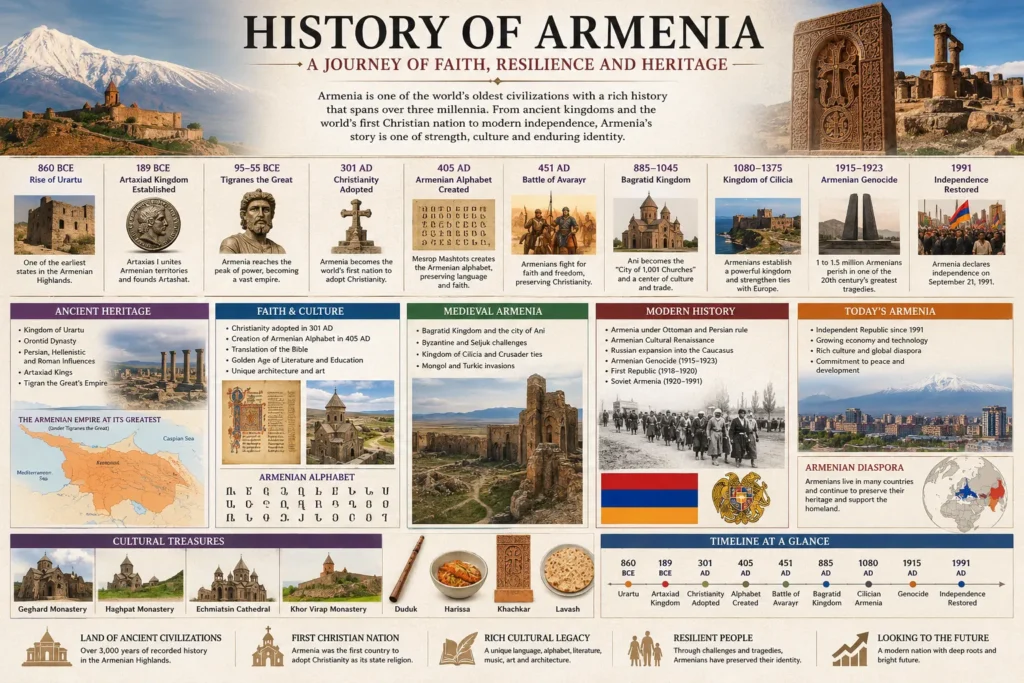
Timeline of Armenian History
| Year | Event |
|---|---|
| 860 BCE | Rise of Urartu |
| 189 BCE | Artaxiad Kingdom established |
| 95 BCE | Reign of Tigranes the Great |
| 301 AD | Christianity adopted |
| 405 AD | Armenian alphabet created |
| 451 AD | Battle of Avarayr |
| 885 AD | Bagratid Kingdom founded |
| 1080 AD | Cilician Armenia established |
| 1915 AD | Armenian Genocide begins |
| 1918 AD | First Republic established |
| 1920 AD | Soviet rule begins |
| 1991 AD | Independence restored |
Conclusion
The history of Armenia is a story of endurance, faith, and cultural achievement. From the ancient Kingdom of Urartu and the empire of Tigranes the Great to the adoption of Christianity, the invention of the Armenian alphabet, and the challenges of modern independence, Armenia has preserved its unique identity through centuries of transformation.
Despite invasions, foreign domination, and tragic events such as the Armenian Genocide, the Armenian people have maintained a strong sense of national pride and cultural continuity. Today, Armenia stands as one of the world’s oldest surviving civilizations, bridging ancient traditions with modern aspirations. Its rich heritage, resilient people, and enduring contributions to world history continue to inspire scholars, travelers, and historians across the globe.
SEO Keywords: History of Armenia, Armenian civilization, Armenian Empire, Tigranes the Great, Armenian Genocide, Armenian Kingdom, Armenia history timeline, Christianity in Armenia, Armenian culture, Republic of Armenia, Armenian Highlands, ancient Armenia, Armenia historical facts, Armenian alphabet, Armenia independence.
References
The following books, academic publications, historical records, and authoritative sources were consulted and are recommended for further reading on the history of Armenia.
Books
- A Concise History of the Armenian People – George A. Bournoutian
- The Armenians: Past and Present in the Making of National Identity
- The Armenian People from Ancient to Modern Times
- Armenia: A Historical Atlas
- The Kingdom of Armenia
- Armenian History and the Question of Genocide
- The Heritage of Armenian Literature
- Armenia and the Crusades
- Armenia: Survival of a Nation
- The Burning Tigris
Academic Sources
- Encyclopaedia Britannica – Armenia articles and historical records.
- UNESCO – Armenian cultural heritage and World Heritage Sites.
- Library of Congress – Country studies on Armenia.
- Armenian National Academy of Sciences
- Armenian Genocide Museum-Institute
Historical Chronicles and Primary Sources
- History of Armenia
- History of the Armenians
- Epic Histories
- History of Vardan and the Armenian War
- The Geography
Official Government and International Sources
- Government of Armenia
- Ministry of Foreign Affairs of Armenia
- National Statistical Committee of Armenia
- UNESCO World Heritage Centre – Armenia
- Encyclopaedia Britannica – Armenia
Online Historical Resources
- Armenica.org History Archive
- Armenian Genocide Museum-Institute
- World History Encyclopedia – Armenia
- Britannica History of Armenia
Suggested Citation Format (APA 7th Edition)
Bournoutian, G. A. (2020). A Concise History of the Armenian People. Mazda Publishers.
Hovannisian, R. G. (Ed.). (1997). The Armenian People from Ancient to Modern Times. St. Martin’s Press.
Hewsen, R. H. (2001). Armenia: A Historical Atlas. University of Chicago Press.
Walker, C. J. (2001). Armenia: Survival of a Nation. Routledge.
Balakian, P. (2003). The Burning Tigris: The Armenian Genocide and America’s Response. HarperCollins.
These references provide strong academic support for a long-form SEO article on “History of Armenia” and are suitable for inclusion in a bibliography, endnotes section, or scholarly blog post.