Global Country List by Continent
The world is generally divided into 7 continents and includes 195 sovereign countries (193 UN member states plus 2 observer states).
🌏 Asia (49 Countries)
- Afghanistan
- Armenia
- Azerbaijan
- Bahrain
- Bangladesh
- Bhutan
- Brunei
- Cambodia
- China
- Cyprus
- Georgia
- India
- Indonesia
- Iran
- Iraq
- Israel
- Japan
- Jordan
- Kazakhstan
- Kuwait
- Kyrgyzstan
- Laos
- Lebanon
- Malaysia
- Maldives
- Mongolia
- Myanmar
- Nepal
- North Korea
- Oman
- Pakistan
- Palestine
- Philippines
- Qatar
- Saudi Arabia
- Singapore
- South Korea
- Sri Lanka
- Syria
- Tajikistan
- Thailand
- Timor-Leste
- Turkey
- Turkmenistan
- United Arab Emirates
- Uzbekistan
- Vietnam
- Yemen
- Russia (partly in Europe)
🌍 Africa (54 Countries)
- Algeria
- Angola
- Benin
- Botswana
- Burkina Faso
- Burundi
- Cabo Verde
- Cameroon
- Central African Republic
- Chad
- Comoros
- Democratic Republic of the Congo
- Republic of the Congo
- Côte d’Ivoire
- Djibouti
- Egypt
- Equatorial Guinea
- Eritrea
- Eswatini
- Ethiopia
- Gabon
- Gambia
- Ghana
- Guinea
- Guinea-Bissau
- Kenya
- Lesotho
- Liberia
- Libya
- Madagascar
- Malawi
- Mali
- Mauritania
- Mauritius
- Morocco
- Mozambique
- Namibia
- Niger
- Nigeria
- Rwanda
- São Tomé and Príncipe
- Senegal
- Seychelles
- Sierra Leone
- Somalia
- South Africa
- South Sudan
- Sudan
- Tanzania
- Togo
- Tunisia
- Uganda
- Zambia
- Zimbabwe
🌎 Europe (44 Countries)
- Albania
- Andorra
- Austria
- Belarus
- Belgium
- Bosnia and Herzegovina
- Bulgaria
- Croatia
- Czech Republic
- Denmark
- Estonia
- Finland
- France
- Germany
- Greece
- Hungary
- Iceland
- Ireland
- Italy
- Latvia
- Liechtenstein
- Lithuania
- Luxembourg
- Malta
- Moldova
- Monaco
- Montenegro
- Netherlands
- North Macedonia
- Norway
- Poland
- Portugal
- Romania
- Russia
- San Marino
- Serbia
- Slovakia
- Slovenia
- Spain
- Sweden
- Switzerland
- Ukraine
- United Kingdom
- Vatican City
🌎 North America (23 Countries)
- Antigua and Barbuda
- Bahamas
- Barbados
- Belize
- Canada
- Costa Rica
- Cuba
- Dominica
- Dominican Republic
- El Salvador
- Grenada
- Guatemala
- Haiti
- Honduras
- Jamaica
- Mexico
- Nicaragua
- Panama
- Saint Kitts and Nevis
- Saint Lucia
- Saint Vincent and the Grenadines
- United States
- Trinidad and Tobago
🌎 South America (12 Countries)
- Argentina
- Bolivia
- Brazil
- Chile
- Colombia
- Ecuador
- Guyana
- Paraguay
- Peru
- Suriname
- Uruguay
- Venezuela
🌏 Oceania (14 Countries)
- Australia
- Fiji
- Kiribati
- Marshall Islands
- Micronesia
- Nauru
- New Zealand
- Palau
- Papua New Guinea
- Samoa
- Solomon Islands
- Tonga
- Tuvalu
- Vanuatu
❄️ Antarctica
Antarctica has no sovereign countries. It is governed under the Antarctic Treaty System and is mainly used for scientific research.
Summary
| Continent | Number of Countries |
|---|---|
| Asia | 49 |
| Africa | 54 |
| Europe | 44 |
| North America | 23 |
| South America | 12 |
| Oceania | 14 |
| Antarctica | 0 |
| Total | 196 (including Palestine and Vatican City) |
The global country list with contingent wise
Global Country List by Continent
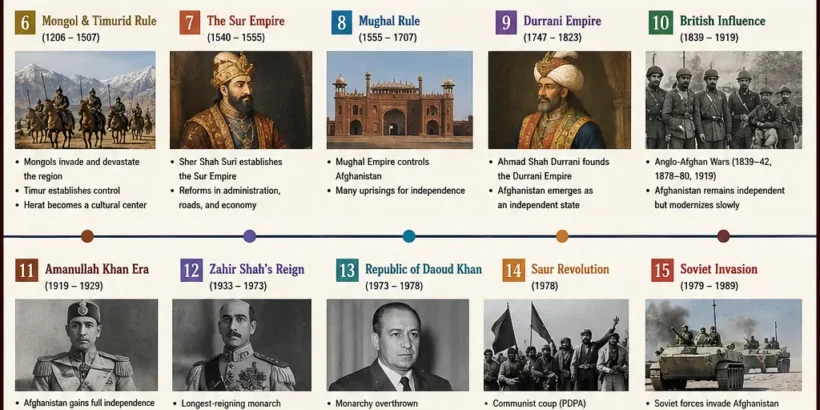
History of Afghanistan: From Ancient Civilizations to the Modern State
Introduction
Afghanistan is one of the world’s oldest inhabited regions and a crossroads of civilizations, empires, cultures, and trade routes. Situated at the heart of Asia, Afghanistan has historically connected the Indian subcontinent, Central Asia, the Middle East, and China. Its strategic location has made it both a center of commerce and a battleground for competing powers throughout history.
The history of Afghanistan spans thousands of years, from prehistoric settlements and ancient kingdoms to modern nation-building efforts. Over the centuries, numerous empires—including the Achaemenids, Greeks, Mauryans, Kushans, Arabs, Mongols, Mughals, British, Soviets, and Americans—have influenced the region. Despite repeated invasions and conflicts, Afghanistan has maintained a distinct cultural identity and remains a symbol of resilience.
This comprehensive article explores the history of Afghanistan from ancient times to the present day, highlighting key events, rulers, civilizations, and developments that have shaped the country.
Geography and Strategic Importance
Afghanistan is a landlocked country located in South-Central Asia. It shares borders with Pakistan, Iran, Turkmenistan, Uzbekistan, Tajikistan, and China.
Its location along the historic Silk Road made it an essential link between East and West. Traders, scholars, conquerors, and religious missionaries passed through Afghanistan, bringing goods, ideas, technologies, and cultures.
The country’s rugged mountains, especially the Hindu Kush range, have provided both protection and challenges throughout its history.
Prehistoric Afghanistan
Archaeological evidence suggests that human beings inhabited Afghanistan more than 50,000 years ago.
Important prehistoric sites include:
- Darra-i-Kur Cave
- Aq Kupruk
- Mundigak
- Shortugai
These sites reveal early human settlements, agricultural activities, and trade connections with neighboring civilizations.
By approximately 3000 BCE, communities in present-day Afghanistan had developed advanced agricultural systems and participated in regional trade networks.
Afghanistan and the Indus Valley Civilization
During the Bronze Age, parts of Afghanistan were connected to the Indus Valley Civilization, one of the world’s earliest urban cultures.
Archaeological discoveries indicate that:
- Afghan lapis lazuli was exported extensively.
- Trade routes connected Afghanistan with Mesopotamia.
- Early cities emerged in northern and southern Afghanistan.
The region served as a major supplier of precious stones and minerals to ancient civilizations.
The Aryan Migration and Early Indo-Iranian Culture
Around 2000 BCE, Indo-Iranian tribes migrated into the region.
These groups introduced:
- Early Indo-European languages
- Religious traditions reflected in the Avesta
- Agricultural innovations
- Tribal governance structures
Many historians believe that parts of modern Afghanistan were among the original homelands of ancient Aryan peoples.
The region became a center for the development of Zoroastrianism, one of the world’s oldest monotheistic religions.
The Achaemenid Persian Empire (550–330 BCE)
The first major empire to control Afghanistan was the Achaemenid Persian Empire.
Under rulers such as:
- Cyrus the Great
- Cambyses II
- Darius I
- Xerxes I
Much of Afghanistan became part of the Persian imperial system.
The territory was divided into satrapies (provinces), including:
- Bactria
- Arachosia
- Drangiana
- Sattagydia
Persian rule brought:
- Administrative organization
- Road networks
- Tax systems
- Cultural exchange
The Persian influence remained significant for centuries.
Alexander the Great and the Greek Conquest
In 330 BCE, Alexander the Great invaded the Persian Empire and entered Afghanistan.
His campaigns faced fierce resistance from local tribes.
Important events include:
Capture of Bactria
Alexander conquered Bactria, a wealthy province in northern Afghanistan.
Foundation of Cities
He established several cities, including:
- Alexandria Arachosia (modern Kandahar)
- Alexandria of the Caucasus near Kabul
Marriage Alliance
Alexander married Roxana, a Bactrian princess, strengthening ties with local elites.
Although he succeeded militarily, Afghan tribes continued to resist foreign control.
The Seleucid Empire
After Alexander’s death in 323 BCE, his empire fragmented.
Afghanistan became part of the Seleucid Empire under Seleucus I Nicator.
Greek influence remained strong in:
- Art
- Architecture
- Governance
- Language
However, Seleucid control gradually weakened.
The Mauryan Empire and Buddhism
In approximately 305 BCE, the Seleucids ceded parts of Afghanistan to the Mauryan Empire of India.
Under Emperor Chandragupta Maurya and later Emperor Ashoka:
- Buddhism expanded rapidly.
- Monasteries were established.
- Trade flourished.
- Roads improved.
Ashoka’s inscriptions found in Afghanistan demonstrate the spread of Buddhist teachings.
This period marked one of the most significant religious transformations in Afghan history.
The Greco-Bactrian Kingdom
Around 250 BCE, the Greco-Bactrian Kingdom emerged as an independent power.
The kingdom became one of the wealthiest states in Central Asia.
Achievements included:
- Expansion of trade routes
- Cultural blending of Greek and local traditions
- Economic prosperity
- Urban development
Greco-Bactrian rulers maintained strong connections with both the Mediterranean and South Asia.
The Indo-Greek Kingdom
The Indo-Greek Kingdom extended Greek influence into northern India and Afghanistan.
This period saw remarkable cultural fusion.
Features included:
Hellenistic Art
Greek artistic styles blended with local traditions.
Religious Tolerance
Greek rulers often supported multiple religions.
Trade Expansion
Merchants connected markets across Asia.
The Indo-Greek period significantly influenced Afghan culture and art.
The Kushan Empire (30–375 CE)
The Kushan Empire became one of the greatest empires in Afghan history.
Founded by the Yuezhi people, the empire controlled:
- Afghanistan
- Pakistan
- Northern India
- Central Asia
The most famous ruler was King Kanishka.
Achievements of the Kushan Empire
Expansion of Buddhism
Kanishka promoted Buddhism throughout Asia.
Silk Road Trade
Afghanistan became a crucial trading hub connecting:
- China
- India
- Persia
- Rome
Economic Prosperity
Trade generated enormous wealth.
Cultural Exchange
Greek, Indian, Persian, and Central Asian influences merged.
Many historians consider the Kushan period a golden age for Afghanistan.
Gandhara Civilization
One of the most remarkable cultural achievements during Kushan rule was the Gandhara Civilization.
Characteristics included:
- Buddhist learning centers
- Advanced sculpture
- Greek-inspired artistic styles
- International trade
The famous Bamiyan Buddhas originated from this broader Buddhist tradition.
Gandhara art remains one of Afghanistan’s greatest historical contributions to world civilization.
The Sassanian Empire
During the third century CE, the Sassanian Empire expanded into Afghanistan.
The Sassanians:
- Strengthened Persian influence
- Promoted Zoroastrianism
- Enhanced trade
- Developed administrative systems
However, their authority was frequently challenged by local rulers and nomadic groups.
The Hephthalites (White Huns)
In the fifth century CE, the Hephthalites, also known as White Huns, entered Afghanistan.
They established control over large territories and challenged both:
- The Sassanian Empire
- The Gupta Empire
Although often associated with warfare, the Hephthalites also participated in regional trade and cultural exchange.
Conclusion of the Ancient Period
By the sixth century CE, Afghanistan had become one of the most culturally diverse regions in Asia.
Its population included:
- Buddhists
- Zoroastrians
- Hindus
- Local tribal communities
The country had witnessed the rise and fall of numerous empires and had become a critical center of trade, religion, and cultural interaction.
These foundations prepared Afghanistan for the next major transformation in its history: the arrival of Islam and the emergence of powerful Islamic dynasties.
History of Afghanistan: From Ancient Civilizations to the Modern State
Part 2: The Arrival of Islam, Ghaznavids, Ghurids, Mongol Invasions, and the Rise of Afghan Empires
The Arrival of Islam in Afghanistan
One of the most significant turning points in Afghan history was the arrival of Islam during the seventh century CE.
Following the death of the Prophet Muhammad in 632 CE, Muslim armies expanded rapidly across the Middle East and Central Asia. By the mid-seventh century, Arab forces had begun entering regions that now form Afghanistan.
The process of Islamization was gradual rather than immediate. Local populations initially resisted foreign rule, and many areas remained under the control of Buddhist, Hindu, and local rulers for generations.
Major centers such as:
- Herat
- Balkh
- Kandahar
- Kabul
became important locations for the spread of Islamic teachings.
Early Arab Conquests
The Umayyad Caliphate launched several military campaigns into Afghanistan.
Key objectives included:
- Expanding Islamic governance
- Securing trade routes
- Collecting taxes
- Establishing military outposts
Arab forces faced strong opposition from local rulers and mountain tribes.
The difficult terrain of Afghanistan made military conquest challenging.
Despite resistance, Islamic influence steadily expanded through:
- Trade
- Religious missionaries
- Political alliances
- Military campaigns
By the ninth century, Islam had become the dominant religion in much of Afghanistan.
Transformation of Afghan Society
The spread of Islam transformed Afghan society in many ways.
Religious Changes
Islam gradually replaced Buddhism, Hinduism, and Zoroastrianism as the primary religion.
Mosques, madrasas, and Islamic learning centers were established throughout the region.
Cultural Development
Arabic and Persian scholarship flourished.
Islamic sciences expanded, including:
- Mathematics
- Astronomy
- Medicine
- Literature
- Philosophy
Political Integration
Afghanistan became part of a broader Islamic world stretching from Spain to Central Asia.
The Rise of Persian Influence
Although Islam arrived through Arab expansion, Persian culture became increasingly influential.
Persian emerged as the language of:
- Administration
- Literature
- Scholarship
- Diplomacy
This cultural shift profoundly shaped Afghan identity.
Many of Afghanistan’s greatest scholars and poets wrote in Persian.
The city of Balkh became known as a major center of Islamic learning and intellectual activity.
The Saffarid Dynasty (861–1003)
One of the earliest Islamic dynasties to rule Afghanistan was the Saffarid Dynasty.
Founded by Ya’qub ibn al-Layth al-Saffar, a former coppersmith turned military leader, the Saffarids expanded their influence across eastern Iran and Afghanistan.
Achievements included:
- Consolidation of Islamic rule
- Expansion of trade
- Promotion of Persian culture
- Strengthening regional governance
The Saffarids helped establish the foundations for later Afghan Islamic states.
The Samanid Empire (819–999)
The Samanids became one of the most influential Islamic dynasties in Central Asia.
Their rule brought:
Economic Prosperity
Trade flourished across the Silk Road.
Educational Growth
Major centers of learning developed.
Persian Cultural Renaissance
Persian literature experienced a golden age.
The Samanids played a crucial role in spreading Islam among Turkic populations of Central Asia.
Many future rulers and military leaders emerged from the Samanid political system.
The Ghaznavid Empire (977–1186)
The Ghaznavid Empire marked the rise of Afghanistan as a major imperial power.
The dynasty was founded by Sabuktigin, a former Turkic slave commander who established his capital at Ghazni.
His son, Sultan Mahmud of Ghazni, transformed the state into one of the most powerful empires of the medieval Islamic world.
Sultan Mahmud of Ghazni
Mahmud ruled from 998 to 1030 CE.
He is remembered as:
- A powerful military leader
- A patron of arts and learning
- A builder of cities
- A promoter of Islamic culture
Military Campaigns
Mahmud launched numerous expeditions into the Indian subcontinent.
These campaigns expanded his empire and brought enormous wealth to Ghazni.
Development of Ghazni
Under Mahmud’s rule, Ghazni became one of the world’s great cities.
It featured:
- Magnificent palaces
- Libraries
- Mosques
- Educational institutions
Patronage of Scholars
Mahmud supported many renowned scholars including:
Al-Biruni
and
Ferdowsi
Their works significantly influenced Islamic civilization.
The Golden Age of Ghazni
The Ghaznavid period represented one of Afghanistan’s earliest golden ages.
Achievements included:
- Expansion of international trade
- Growth of architecture
- Development of Persian literature
- Strengthening of Islamic institutions
Afghanistan became a center of political and cultural influence extending far beyond its borders.
Decline of the Ghaznavids
After Mahmud’s death, internal conflicts weakened the empire.
Challenges included:
- Succession disputes
- Regional rebellions
- External invasions
Eventually, the Ghaznavids lost territory to rising powers, including the Seljuks and Ghurids.
The Ghurid Empire (1148–1215)
The Ghurids emerged from the mountainous region of Ghor in central Afghanistan.
They replaced the Ghaznavids and created another powerful Afghan-based empire.
Rise of the Ghurids
Key leaders included:
- Ala al-Din Husayn
- Ghiyath al-Din Muhammad
- Muhammad of Ghor
The Ghurids expanded across:
- Afghanistan
- Iran
- Pakistan
- Northern India
Their military successes transformed Afghanistan into a major regional power once again.
Muhammad of Ghor and India
Muhammad of Ghor played a critical role in South Asian history.
His victories helped establish Muslim political influence in northern India.
These conquests later contributed to:
- The Delhi Sultanate
- Indo-Islamic civilization
- New trade networks
His campaigns permanently altered the political landscape of the Indian subcontinent.
Cultural Achievements of the Ghurids
The Ghurid era saw advances in:
Architecture
Construction of:
- Mosques
- Fortifications
- Minarets
Education
Growth of Islamic scholarship and religious institutions.
Trade
Expansion of regional commerce across Central and South Asia.
The famous Minaret of Jam remains one of the most important surviving monuments from this period.
The Mongol Invasion
The thirteenth century brought one of the greatest disasters in Afghan history.
The Mongol Empire under Genghis Khan launched devastating campaigns across Central Asia.
Destruction and Devastation
Beginning in 1219 CE, Mongol armies invaded Afghanistan.
Major cities suffered extensive destruction:
- Balkh
- Herat
- Ghazni
- Bamiyan
Consequences included:
- Massive population losses
- Economic collapse
- Destruction of irrigation systems
- Decline of trade routes
Many flourishing urban centers were reduced to ruins.
The Siege of Bamiyan
One of the most famous episodes occurred at Bamiyan.
After fierce resistance, the city was destroyed.
The Mongols carried out severe reprisals, causing widespread devastation.
The event became a symbol of the brutality of Mongol warfare.
Long-Term Effects of the Mongol Invasion
The Mongol conquest transformed Afghanistan.
Effects included:
- Population displacement
- Political fragmentation
- Economic decline
- Changes in settlement patterns
Recovery took centuries.
However, Afghanistan eventually regained its importance through renewed trade and political development.
The Timurid Empire (1370–1507)
Following the Mongol period, Afghanistan became part of the Timurid Empire founded by Timur.
Although Timur’s campaigns were often destructive, his successors promoted culture and learning.
Herat: Jewel of the Timurids
During Timurid rule, Herat became one of the world’s greatest cultural centers.
The city attracted:
- Scholars
- Poets
- Artists
- Scientists
Herat’s influence extended throughout the Islamic world.
Timurid Cultural Renaissance
Achievements included:
Literature
Persian literature flourished.
Art
Miniature painting reached new heights.
Architecture
Magnificent buildings were constructed across the region.
Education
Libraries and schools expanded intellectual life.
This era is often considered one of Afghanistan’s greatest cultural periods.
Babur and the Mughal Connection
In the early sixteenth century, Afghanistan became closely linked to the rise of the Mughal Empire.
Babur captured Kabul in 1504.
Kabul became his power base before he conquered northern India.
Kabul as a Strategic Center
Babur valued Kabul because it connected:
- Central Asia
- Persia
- India
The city became an important center of trade and administration.
Babur frequently praised Kabul’s climate, gardens, and strategic position in his memoirs.
Afghan Tribes and Regional Power
During the sixteenth and seventeenth centuries, various Afghan tribes gained increasing influence.
Important tribal confederations included:
- Ghilzai
- Durrani
- Yusufzai
- Afridi
These groups played crucial roles in regional politics and military affairs.
Tribal structures became an enduring feature of Afghan society.
The Hotak Dynasty (1709–1738)
The beginning of modern Afghan statehood is often traced to the Hotak Dynasty.
In 1709, Mirwais Hotak led a successful revolt against Persian rule in Kandahar.
Mirwais Hotak
Mirwais united local tribes and established an independent Afghan state.
His achievements included:
- Expelling foreign governors
- Strengthening tribal unity
- Establishing local governance
His success inspired future Afghan leaders.
Expansion Under Mahmud Hotak
Mahmud Hotak expanded Afghan influence dramatically.
In 1722, Afghan forces captured the Persian capital of Isfahan.
This remarkable victory demonstrated the growing strength of Afghan political power.
Legacy of the Hotak Dynasty
Although the dynasty was relatively short-lived, it marked an important milestone.
For the first time, Afghan rulers controlled a significant independent state that challenged major regional empires.
The Hotaks paved the way for the emergence of a larger and more enduring Afghan empire.
Conclusion
The medieval period transformed Afghanistan from a frontier region into a center of Islamic civilization and imperial power. The Ghaznavids and Ghurids established influential empires, while the Timurids fostered a cultural renaissance. Despite the devastation of the Mongol invasions, Afghanistan repeatedly recovered and reasserted its importance.
By the early eighteenth century, Afghan tribes had begun laying the foundations for an independent nation. The next phase of history would witness the rise of the Durrani Empire, often regarded as the birth of modern Afghanistan.
History of Afghanistan: From Ancient Civilizations to the Modern State
Part 3: The Durrani Empire, The Great Game, and the Anglo-Afghan Wars
The Birth of Modern Afghanistan
The year 1747 is widely regarded as the beginning of modern Afghanistan.
After the assassination of the Persian ruler Nader Shah, Afghan tribal leaders gathered near Kandahar to choose a new leader.
They selected Ahmad Shah Durrani, a talented military commander from the Abdali tribe.
This decision marked the foundation of what many historians consider the first modern Afghan state.
Because of his achievements, Ahmad Shah Durrani is often called the “Father of Afghanistan.”
Ahmad Shah Durrani and the Formation of the Durrani Empire
In 1747, Ahmad Shah established the Durrani Empire, which quickly became one of the most powerful empires in Asia.
The empire stretched across vast territories that included:
- Present-day Afghanistan
- Pakistan
- Parts of India
- Eastern Iran
- Turkmenistan
- Kashmir
The Durrani Empire became one of the largest Muslim empires of the eighteenth century.
Military Expansion
Ahmad Shah conducted numerous military campaigns that expanded Afghan influence.
His armies achieved victories against:
- Persian forces
- Uzbek rulers
- Mughal authorities
- Regional kingdoms
The empire became a dominant force between Central Asia and South Asia.
The Third Battle of Panipat (1761)
One of Ahmad Shah’s most famous victories occurred during the Third Battle of Panipat in 1761.
Third Battle of Panipat
This battle was fought against the powerful Maratha Confederacy of India.
The Afghan victory:
- Halted Maratha expansion
- Strengthened Durrani prestige
- Reshaped political power in northern India
The battle remains one of the largest military engagements of the eighteenth century.
Administration of the Durrani Empire
Ahmad Shah sought to unite Afghanistan’s diverse tribes and regions.
His administration focused on:
Tribal Cooperation
Local tribal leaders retained significant influence while recognizing central authority.
Trade Development
Caravan routes linking India, Persia, and Central Asia flourished.
Military Organization
A strong cavalry force protected the empire and expanded its borders.
Cultural Legacy of Ahmad Shah Durrani
Ahmad Shah was not only a military leader but also a poet.
His poetry expressed:
- Patriotism
- Spirituality
- Love for Afghanistan
His legacy continues to play an important role in Afghan national identity.
Decline of the Durrani Empire
After Ahmad Shah’s death in 1772, the empire gradually weakened.
Several factors contributed to decline:
Succession Disputes
Competing claims to the throne created instability.
Tribal Rivalries
Regional leaders increasingly pursued their own interests.
External Pressures
Persian, Sikh, and Central Asian powers challenged Afghan authority.
By the early nineteenth century, the empire had fragmented significantly.
Rise of the Barakzai Dynasty
Following the decline of the Durranis, the Barakzai family emerged as the dominant political force.
The most influential early ruler was:
Dost Mohammad Khan
He became emir in 1826 and worked to restore Afghan unity.
Afghanistan’s Strategic Importance
During the nineteenth century, Afghanistan became the focus of intense international rivalry.
Two major powers competed for influence:
- The Russian Empire
- The British Empire
This competition became known as:
The Great Game
What Was the Great Game?
The Great Game was a geopolitical struggle between Britain and Russia.
Britain feared that Russian expansion into Central Asia might threaten British India.
Russia sought greater influence in Central Asia and access to warmer regions.
Afghanistan stood directly between these competing powers.
As a result, it became a crucial buffer state.
The First Anglo-Afghan War (1839–1842)
Britain decided to intervene directly in Afghanistan.
The objective was to install a ruler favorable to British interests.
British forces invaded Afghanistan in 1839 and replaced Dost Mohammad Khan with Shah Shuja.
Initially, the invasion appeared successful.
However, Afghan resistance soon intensified.
Afghan Resistance
Afghans strongly opposed foreign occupation.
Factors fueling resistance included:
- Tribal independence
- National pride
- Religious motivations
- Opposition to foreign interference
Rebellions spread rapidly across the country.
The Retreat from Kabul
One of the most dramatic events in British military history occurred in 1842.
British forces attempted to withdraw from Kabul.
During the retreat:
- Thousands of soldiers and civilians were killed.
- Afghan fighters repeatedly attacked the column.
- Harsh winter conditions worsened the disaster.
Only a handful of survivors reached British-controlled territory.
The event shocked Britain and became a symbol of Afghan resistance.
Consequences of the First Anglo-Afghan War
The war demonstrated that Afghanistan could not easily be controlled by foreign powers.
Britain eventually withdrew and Dost Mohammad Khan returned to power.
Key outcomes included:
- Restoration of Afghan independence
- Strengthening of Afghan nationalism
- Increased caution among foreign powers
Dost Mohammad Khan’s Reign
After regaining power, Dost Mohammad focused on:
Political Stability
Efforts were made to reunify fragmented regions.
Diplomatic Balance
Relations with both Russia and Britain were carefully managed.
Economic Recovery
Trade routes were gradually restored.
His leadership helped stabilize Afghanistan after years of conflict.
Sher Ali Khan and Renewed Tensions
After Dost Mohammad’s death, succession disputes emerged.
Eventually, Sher Ali Khan became ruler.
During his reign:
- Russian influence increased.
- British concerns intensified.
- Diplomatic tensions escalated.
Afghanistan once again became the center of international rivalry.
The Second Anglo-Afghan War (1878–1880)
Britain launched a second invasion in 1878.
The immediate cause involved diplomatic competition between Russia and Britain.
British leaders feared that Russian influence in Kabul was growing too strong.
Major Events of the War
British forces captured several important cities.
However, Afghan resistance remained fierce.
Numerous battles occurred throughout the country.
Although Britain achieved military victories, it struggled to establish long-term control.
The Battle of Maiwand
One of the most celebrated Afghan victories occurred during the:
Battle of Maiwand
Afghan forces defeated a British army near Kandahar.
The battle became a powerful symbol of national pride.
A famous Afghan heroine emerged from this conflict:
Malalai of Maiwand
Her courage inspired Afghan fighters during the battle.
Abdur Rahman Khan: The Iron Emir
Following the war, Britain supported the rise of:
Abdur Rahman Khan
He ruled from 1880 to 1901.
His reign played a crucial role in shaping modern Afghanistan.
Centralization of Power
Abdur Rahman worked to strengthen the central government.
His reforms included:
Administrative Reorganization
Government authority expanded into remote regions.
Military Modernization
A stronger national army was created.
Reduction of Tribal Autonomy
The emir sought greater control over local leaders.
Defining Afghanistan’s Borders
One of the most significant developments during his reign was the establishment of modern borders.
Several agreements with neighboring powers defined Afghanistan’s territory.
Among the most important was:
Durand Line Agreement
This boundary continues to influence regional politics today.
Afghanistan as a Buffer State
By the end of the nineteenth century, Afghanistan had become a recognized buffer state between Russia and British India.
This status provided:
- Relative independence
- Strategic importance
- Protection from direct annexation
However, foreign influence remained significant.
Social Conditions in the Nineteenth Century
Most Afghans lived in rural communities.
The economy depended largely on:
- Agriculture
- Animal husbandry
- Local trade
Education remained limited outside major urban centers.
Nevertheless, traditional institutions helped preserve Afghan culture and identity.
Cultural Diversity
Afghanistan continued to be home to many ethnic groups, including:
- Pashtuns
- Tajiks
- Hazaras
- Uzbeks
- Turkmens
- Baluch
This diversity enriched Afghan society but also created governance challenges.
Afghanistan at the Dawn of the Twentieth Century
By 1900, Afghanistan had survived:
- Imperial rivalries
- Foreign invasions
- Internal conflicts
Although economically underdeveloped, it remained independent while many neighboring regions had fallen under colonial rule.
This achievement strengthened Afghanistan’s reputation as a fiercely independent nation.
Conclusion
The eighteenth and nineteenth centuries witnessed the creation of modern Afghanistan. Ahmad Shah Durrani founded a powerful empire that established Afghan statehood, while later rulers struggled to preserve independence amid growing foreign pressure.
The Anglo-Afghan Wars demonstrated Afghanistan’s determination to resist external control, and the country emerged as a strategically important buffer state during the Great Game.
As the twentieth century approached, Afghanistan faced new challenges: modernization, reform, global conflict, and the quest for full sovereignty.
History of Afghanistan: From Ancient Civilizations to the Modern State
Part 4: Independence, King Amanullah Khan, Constitutional Reforms, the Afghan Monarchy, and the Road to the Republic (1901–1973)
Introduction
The twentieth century marked a new chapter in Afghan history. After surviving the imperial rivalries of the nineteenth century, Afghanistan entered an era of modernization, political reform, and growing national consciousness.
During this period, Afghan rulers sought to:
- Strengthen national independence
- Modernize government institutions
- Improve education
- Develop infrastructure
- Reduce foreign influence
At the same time, Afghanistan faced resistance from conservative groups, tribal leaders, and political factions that feared rapid change.
The decades between 1901 and 1973 laid the foundation for modern Afghanistan while also creating tensions that would later contribute to instability.
Habibullah Khan and the Beginning of Modernization
After the death of Abdur Rahman Khan in 1901, his son:
Habibullah Khan
became ruler of Afghanistan.
Unlike his father, Habibullah pursued a more moderate approach.
Educational Reforms
Habibullah introduced several reforms designed to modernize Afghan society.
These included:
New Schools
Modern educational institutions were established.
Military Training
Efforts were made to improve the national army.
Administrative Improvements
Government functions became more organized.
These reforms represented early attempts to prepare Afghanistan for the modern world.
Afghanistan During World War I
When:
World War I
began, Afghanistan remained officially neutral.
Both Britain and Germany attempted to gain Afghan support.
Habibullah carefully avoided entering the war.
His neutrality helped preserve Afghanistan’s stability and independence.
Assassination of Habibullah Khan
In 1919, Habibullah Khan was assassinated under mysterious circumstances.
His death created a power struggle within Afghanistan.
Eventually, his son:
Amanullah Khan
secured the throne.
His reign would become one of the most transformative periods in Afghan history.
Amanullah Khan and Full Independence
Amanullah believed Afghanistan should be completely independent from foreign influence.
Although Afghanistan was technically sovereign, Britain still controlled aspects of its foreign affairs.
Amanullah sought to end this arrangement permanently.
The Third Anglo-Afghan War (1919)
Shortly after becoming ruler, Amanullah launched military operations against British India.
This conflict became known as:
Third Anglo-Afghan War
The war was relatively brief but historically significant.
Treaty of Rawalpindi
The conflict ended with negotiations that recognized Afghanistan’s right to conduct its own foreign policy.
The outcome effectively granted Afghanistan full independence.
1919 is therefore celebrated as a landmark year in Afghan history.
Afghan Independence Day
Afghanistan’s independence became a powerful symbol of national pride.
The achievement demonstrated that Afghanistan remained one of the few countries in Asia that had successfully resisted colonial domination.
Amanullah’s Reform Program
Following independence, Amanullah launched an ambitious modernization campaign.
His vision was inspired by developments in:
- Turkey
- Europe
- The Middle East
He believed Afghanistan should become a modern, progressive nation.
Constitutional Government
One of Amanullah’s major achievements was introducing constitutional reforms.
The constitution aimed to:
Strengthen National Institutions
Government functions became more structured.
Establish Legal Reforms
New laws were introduced to modernize administration.
Promote National Unity
Efforts were made to create a stronger Afghan identity.
Expansion of Education
Education became a major priority.
Reforms included:
- New schools
- Teacher training programs
- Scholarships abroad
- Educational opportunities for girls
These initiatives represented a major departure from traditional practices.
Women’s Rights Reforms
Amanullah and his wife:
Queen Soraya Tarzi
supported greater opportunities for women.
Reforms included:
- Encouragement of female education
- Opposition to forced marriage
- Increased public participation for women
These policies were groundbreaking for the region at that time.
International Diplomacy
Amanullah sought to establish Afghanistan as an independent actor on the world stage.
Diplomatic relations expanded with:
- Germany
- Turkey
- France
- Italy
- Soviet Russia
Afghanistan became increasingly engaged with international affairs.
Amanullah’s Tour of Europe
In 1927–1928, Amanullah visited several countries.
His travels reinforced his desire to modernize Afghanistan rapidly.
He was impressed by:
- Industrial development
- Modern education
- Infrastructure projects
- Constitutional governance
Upon returning home, he accelerated reforms.
Opposition to Reform
Despite his ambitions, many Afghans viewed rapid modernization with suspicion.
Sources of opposition included:
Tribal Leaders
Some feared losing traditional authority.
Religious Conservatives
Certain reforms were considered too radical.
Rural Communities
Many people felt disconnected from government policies.
Resistance gradually intensified.
Fall of Amanullah Khan
By 1929, widespread unrest had erupted.
A rebellion led by:
Habibullah Kalakani
forced Amanullah to abdicate.
His modernization program came to an abrupt end.
Although his reign was short, Amanullah remains one of Afghanistan’s most influential reformers.
Mohammed Nadir Shah
After a period of instability,
Mohammed Nadir Shah
secured power.
He restored order and attempted a more gradual approach to reform.
Policies of Nadir Shah
His government focused on:
- Stability
- National unity
- Administrative reform
- Limited modernization
Unlike Amanullah, Nadir moved cautiously to avoid provoking widespread opposition.
Assassination of Nadir Shah
In 1933, Nadir Shah was assassinated.
His son,
Mohammed Zahir Shah
became king at only nineteen years of age.
The Reign of King Zahir Shah (1933–1973)
Zahir Shah ruled Afghanistan for approximately forty years.
His reign became the longest period of relative stability in modern Afghan history.
Afghanistan During World War II
When:
World War II
began, Afghanistan again chose neutrality.
This policy helped the country avoid direct involvement in the war.
The government maintained diplomatic relations with multiple countries while protecting national independence.
Economic Development
Following World War II, Afghanistan pursued development projects.
Key areas included:
Roads
Transportation networks expanded.
Agriculture
Irrigation projects increased productivity.
Energy
Hydroelectric development supported modernization.
Urban Growth
Cities such as Kabul expanded significantly.
Foreign Assistance
During the:
Cold War
Afghanistan received aid from both major blocs.
Support came from:
- The United States
- The Soviet Union
Both powers hoped to strengthen their influence.
Afghanistan skillfully balanced relations with each side.
Educational Expansion
The government invested heavily in education.
Universities expanded.
Literacy programs increased access to learning.
Students were sent abroad for higher education.
These efforts contributed to the emergence of a modern professional class.
Growth of Kabul
During the 1950s and 1960s, Kabul became one of the most modern cities in the region.
Developments included:
- Universities
- Hospitals
- Government buildings
- Cultural institutions
The city became a center of intellectual and political activity.
Political Reform in the 1960s
A major milestone occurred with the adoption of the:
Constitution of Afghanistan 1964
The constitution introduced important changes.
Features of the 1964 Constitution
Constitutional Monarchy
The king remained head of state while elected institutions gained greater influence.
Parliamentary System
Representative government expanded.
Civil Rights
Citizens received additional legal protections.
Political Participation
New opportunities emerged for public involvement in politics.
Rise of Political Movements
The 1960s witnessed the emergence of diverse political groups.
These included:
- Nationalists
- Liberals
- Islamists
- Socialists
- Communists
Universities became important centers of political debate.
Although political participation increased, divisions also deepened.
Economic Challenges
Despite modernization efforts, significant problems remained.
Challenges included:
- Poverty
- Rural underdevelopment
- Unemployment
- Regional inequality
These issues contributed to growing dissatisfaction.
The 1973 Coup
By the early 1970s, economic difficulties and political tensions increased.
In 1973, while Zahir Shah was abroad,
Mohammed Daoud Khan
seized power in a bloodless coup.
End of the Monarchy
The coup abolished Afghanistan’s monarchy.
After more than two centuries of kingship, Afghanistan became a republic.
Daoud Khan became the country’s first president.
This event marked the end of one era and the beginning of another.
Legacy of the Monarchy Era
The period from 1901 to 1973 transformed Afghanistan.
Major achievements included:
- Full independence
- Constitutional reform
- Educational expansion
- Infrastructure development
- Increased international engagement
At the same time, tensions between modernization and tradition remained unresolved.
These tensions would contribute to the dramatic events that followed.
Conclusion
The first half of the twentieth century witnessed Afghanistan’s emergence as an independent modern state. Leaders such as Amanullah Khan and Zahir Shah sought to balance reform with tradition while preserving national sovereignty.
Although significant progress was achieved, political divisions, ideological conflicts, and economic challenges continued to grow. By 1973, the monarchy had fallen, setting Afghanistan on a path toward revolution, foreign intervention, and decades of conflict.
History of Afghanistan: From Ancient Civilizations to the Modern State
Part 5: The Republic of Daoud Khan, the Saur Revolution, Soviet Invasion, Afghan Resistance, and the End of the Cold War (1973–1992)
Introduction
The period from 1973 to 1992 is one of the most turbulent and transformative eras in Afghan history. In less than two decades, Afghanistan experienced:
- The end of the monarchy
- The rise of a republic
- A communist revolution
- A Soviet military invasion
- A long and devastating civil war
- The emergence of armed resistance movements
These events reshaped Afghanistan politically, socially, and economically, leaving long-term impacts that continue today.
The Republic of Afghanistan (1973)
After the overthrow of the monarchy in 1973,
Mohammed Daoud Khan
established the Republic of Afghanistan.
Daoud Khan had previously served as Prime Minister and was a cousin of King Zahir Shah.
Daoud Khan’s Political Vision
Daoud Khan aimed to:
- Modernize Afghanistan
- Strengthen central government power
- Reduce dependency on foreign influence
- Promote economic development
- Reform the military and administration
Initially, his government received support from leftist groups, including communists.
Foreign Policy Under Daoud Khan
Daoud Khan shifted Afghanistan’s foreign relations:
- Reduced dependence on the Soviet Union
- Attempted closer ties with Middle Eastern countries
- Sought economic aid from multiple global powers
However, balancing international relationships became increasingly difficult.
Growing Political Tensions
By the mid-1970s, political instability increased.
Key issues included:
- Economic stagnation
- Internal opposition
- Rival political ideologies
- Military dissatisfaction
Two major factions became dominant:
- The People’s Democratic Party of Afghanistan (PDPA) (communist)
- Islamic and nationalist opposition groups
These tensions set the stage for revolution.
The Saur Revolution (1978)
In April 1978, a major coup took place known as:
Saur Revolution
The PDPA overthrew and killed Daoud Khan.
This marked the beginning of communist rule in Afghanistan.
Establishment of the Democratic Republic
After the revolution, Afghanistan was renamed the:
Democratic Republic of Afghanistan
The new government aligned closely with the Soviet Union.
Reforms included:
- Land redistribution
- Education expansion
- Reduction of traditional authority
- Promotion of socialist policies
However, these reforms were often implemented forcefully.
Internal Resistance Begins
Many Afghans opposed the new communist government due to:
- Religious concerns
- Cultural opposition to reforms
- Tribal resistance to central control
- Political repression
Rebellions spread across rural Afghanistan.
Armed resistance groups began forming rapidly.
Soviet Concerns and Intervention
The Soviet Union became increasingly concerned about instability in Afghanistan.
Afghanistan was strategically important during the Cold War due to its location near:
- Central Asia
- Iran
- Pakistan
To protect its influence, the Soviet Union made a major decision.
The Soviet Invasion of Afghanistan (1979)
In December 1979, Soviet forces invaded Afghanistan.
Soviet-Afghan War
This intervention dramatically escalated the conflict.
Soviet forces installed a more compliant government in Kabul.
Impact of the Invasion
The invasion led to:
- Widespread warfare
- Massive civilian displacement
- Destruction of infrastructure
- Economic collapse
- International condemnation
Millions of Afghans fled to Pakistan and Iran as refugees.
Rise of the Mujahideen
Opposition forces, known as the Mujahideen, formed to resist Soviet occupation.
They were composed of:
- Islamic fighters
- Tribal groups
- Regional commanders
Their goal was to defend Afghanistan and remove foreign forces.
International Support for Resistance
The Afghan resistance received support from several countries.
Major supporters included:
- The United States
- Pakistan
- Saudi Arabia
This support included:
- Weapons
- Training
- Financial aid
The conflict became a major Cold War battleground.
Major Mujahideen Groups
Several factions emerged, including:
- Hezb-e Islami
- Jamiat-e Islami
- Ittehad-e Islami
- Harakat-e Inqilab-e Islami
Each group operated independently, often with different political goals.
Life During the War
The Afghan population suffered greatly:
Civilian Impact
- Mass displacement
- High casualty rates
- Destruction of villages
Economic Collapse
- Agriculture declined
- Trade routes were disrupted
- Infrastructure was destroyed
Refugee Crisis
Millions fled to neighboring countries, especially Pakistan.
The Battle for Afghanistan
Throughout the 1980s, intense fighting continued.
The Mujahideen used guerrilla warfare tactics:
- Ambushes
- Mountain warfare
- Hit-and-run attacks
The Soviet military struggled with unfamiliar terrain and local resistance.
The Role of Foreign Fighters
The conflict attracted international fighters and volunteers.
Afghanistan became a symbol of resistance against foreign occupation.
This global involvement further intensified the war.
Soviet Withdrawal Begins
By the mid-1980s, the war had become extremely costly for the Soviet Union.
Challenges included:
- High military casualties
- Economic strain
- International pressure
- Internal Soviet reforms
Under Mikhail Gorbachev, the USSR decided to withdraw.
Geneva Accords (1988)
The withdrawal process was formalized through the:
Geneva Accords
Key outcomes included:
- Soviet withdrawal timeline
- Non-interference agreements
- International guarantees
The Soviet withdrawal was completed in 1989.
After Soviet Withdrawal
Although Soviet forces left, the conflict did not end.
The Afghan government under Mohammad Najibullah remained in power with Soviet support.
However, resistance groups continued fighting.
Collapse of the Communist Government
By 1992, the communist government weakened significantly due to:
- Loss of Soviet support
- Internal divisions
- Continued resistance attacks
Eventually, Kabul fell to Mujahideen forces.
End of the Democratic Republic
In 1992, the government collapsed.
The Mujahideen declared the establishment of the Islamic State of Afghanistan.
However, unity among resistance groups quickly broke down.
Beginning of Civil War
After victory, former allies turned against each other.
Major factions fought for control of Kabul.
This led to a new phase of civil war characterized by:
- Political fragmentation
- Urban destruction
- Leadership struggles
- Continued instability
Humanitarian Crisis
The prolonged conflict created one of the worst humanitarian crises in modern history.
Consequences included:
- Millions of refugees abroad
- Widespread poverty
- Destroyed infrastructure
- Lack of basic services
Afghanistan at the End of the Cold War
By 1992, Afghanistan had:
- Overthrown a monarchy
- Experienced communist rule
- Endured foreign invasion
- Defeated Soviet forces
- Entered civil war
The country stood at a critical turning point with no stable central authority.
Conclusion
The period from 1973 to 1992 reshaped Afghanistan dramatically. What began as a republic under Daoud Khan evolved into a communist state, followed by Soviet intervention and a long war of resistance. Although the Soviet withdrawal marked a major victory for the Mujahideen, it also led to political fragmentation and renewed civil conflict.
Afghanistan entered the 1990s deeply divided, setting the stage for further instability and the rise of new political forces.
History of Afghanistan: From Ancient Civilizations to the Modern State
Part 6: Civil War, Rise of the Taliban, Islamic Emirate, and the Road to U.S. Intervention (1992–2001)
Introduction
After the fall of the communist government in 1992, Afghanistan entered one of the most violent and unstable periods in its modern history. The victory of the Mujahideen did not bring peace. Instead, it led to a power struggle between rival factions that plunged the country into full-scale civil war.
Between 1992 and 2001, Afghanistan experienced:
- Collapse of central authority
- Brutal civil war in Kabul
- Rise of new militant movements
- Emergence of the Taliban
- Establishment of the Islamic Emirate of Afghanistan
- Increasing international isolation
This period reshaped Afghanistan’s political structure and set the stage for global intervention in the early 21st century.
Fall of the Najibullah Government (1992)
After the withdrawal of Soviet forces, the communist government led by President Mohammad Najibullah survived for several years due to limited external support and internal organization.
However, by 1992:
- Soviet aid had stopped
- Military supplies were depleted
- Rebel forces surrounded major cities
- Internal divisions weakened the regime
Najibullah’s government collapsed, ending the Democratic Republic of Afghanistan.
Mujahideen Takeover
After the fall of Kabul in 1992, Mujahideen factions entered the capital.
A new political structure was announced:
Islamic State of Afghanistan
However, this government was fragile from the beginning.
Power Struggles Begin
Although the Mujahideen had fought together against Soviet forces, they were deeply divided politically and ethnically.
Major factions included:
- Burhanuddin Rabbani’s Jamiat-e Islami
- Gulbuddin Hekmatyar’s Hezb-e Islami
- Abdul Rasul Sayyaf’s group
- Various regional commanders
These groups quickly turned against each other.
Civil War in Kabul
Kabul became the center of intense fighting.
The city suffered:
- Heavy artillery bombardment
- Widespread destruction
- Civilian casualties
- Collapse of infrastructure
Different factions controlled different parts of the city.
The capital was effectively divided into war zones.
Humanitarian Crisis Deepens
The civil war created catastrophic conditions:
Urban Destruction
- Homes and government buildings were destroyed
- Roads and electricity systems collapsed
Civilian Suffering
- Thousands of civilians killed
- Massive displacement
- Food shortages
Economic Collapse
- Trade stopped
- Agriculture weakened
- Currency instability increased
Afghanistan became one of the most devastated countries in the world.
Rise of Warlords
During this period, regional commanders gained significant power.
These warlords controlled:
- Territories
- Trade routes
- Military forces
Central authority weakened further as Afghanistan fragmented into local power centers.
Emergence of the Taliban
In the early 1990s, a new movement emerged in southern Afghanistan.
This group became known as the Taliban, meaning “students.”
They originated from religious مدارس (madrasas) in Pakistan and Afghanistan.
Their early goals included:
- Ending civil war
- Establishing Islamic law
- Disarming warlords
- Restoring order
Rapid Expansion of Taliban Power
The Taliban quickly gained support due to:
- Public frustration with warlord violence
- Desire for stability
- Strong organizational discipline
- External support networks
By 1994, they had captured Kandahar.
By 1996, they had expanded rapidly across the country.
Establishment of the Islamic Emirate
In 1996, the Taliban captured Kabul and declared:
Islamic Emirate of Afghanistan
This marked a major turning point in Afghan history.
Taliban Governance System
The Taliban introduced a strict interpretation of Islamic law.
Their governance included:
Legal System
- Implementation of Sharia law
- Religious courts
Social Policies
- Restrictions on media
- Strict public behavior rules
- Enforcement of dress codes
Education Policies
- Boys’ education continued in limited form
- Girls’ education was heavily restricted
Impact on Women and Society
One of the most controversial aspects of Taliban rule was its policies toward women.
Effects included:
- Limited access to education
- Restricted employment opportunities
- Reduced public participation
- Strict mobility controls
These policies drew widespread international criticism.
Resistance to the Taliban
Not all of Afghanistan was controlled by the Taliban.
A major opposition group formed:
Northern Alliance
Led by commanders such as Ahmad Shah Massoud, the Northern Alliance controlled parts of northern and northeastern Afghanistan.
Continued Civil Conflict
From 1996 to 2001, Afghanistan remained divided:
- Taliban controlled most of the country
- Northern Alliance controlled remaining regions
Fighting continued, though at a reduced scale compared to earlier civil war years.
Afghanistan Becomes Isolated
During Taliban rule, Afghanistan faced increasing international isolation.
Most countries:
- Did not officially recognize the government
- Reduced diplomatic relations
- Imposed sanctions or restrictions
Only a few states maintained limited ties.
Presence of Foreign Militants
During this period, Afghanistan became a base for various militant groups.
This development increased global concern, especially from Western countries.
The country’s instability attracted international attention.
Humanitarian Situation in the Late 1990s
Afghanistan faced severe humanitarian challenges:
Poverty
- Widespread unemployment
- Food insecurity
Refugees
Millions remained displaced in neighboring countries.
Infrastructure Collapse
- Schools damaged or closed
- Hospitals under-resourced
- Roads deteriorated
Rise of International Concern
By the late 1990s, global attention focused on Afghanistan due to:
- Civil war
- Human rights issues
- Regional instability
- Presence of extremist networks
International diplomacy efforts attempted but failed to unify the country.
The Assassination of Ahmad Shah Massoud
On September 9, 2001, a major event occurred:
Ahmad Shah Massoud
Massoud, a key anti-Taliban commander, was assassinated shortly before major global events shifted Afghanistan’s future.
His death weakened resistance forces.
Afghanistan on the Eve of Global Intervention
By 2001, Afghanistan remained:
- Politically divided
- Militarily unstable
- Economically collapsed
- Internationally isolated
The country was about to enter a new phase shaped by global events.
Conclusion
The period from 1992 to 2001 was marked by civil war, fragmentation, and the rise of the Taliban. What began as a hopeful post-Soviet transition quickly descended into chaos, followed by the emergence of a new political order under the Islamic Emirate.
Despite temporary stability under Taliban control, Afghanistan remained deeply divided and internationally isolated. These conditions ultimately set the stage for a major turning point in global politics at the beginning of the 21st century.
History of Afghanistan: From Ancient Civilizations to the Modern State
Part 7: 9/11 Attacks, U.S.-Led Invasion, Fall of the Taliban, Islamic Republic, and NATO Era (2001–2014)
Introduction
The events of 2001 marked one of the most dramatic turning points in modern world history—and especially in Afghanistan. After years of civil war and Taliban rule, Afghanistan became the center of global attention following the September 11 attacks in the United States.
This period led to:
- A U.S.-led military invasion
- Collapse of the Taliban regime
- Establishment of a new government
- Long-term NATO presence
- Major reconstruction efforts
Afghanistan entered a new political era known as the Islamic Republic of Afghanistan.
The 9/11 Attacks and Global Response
On September 11, 2001, terrorist attacks were carried out in the United States by the group Al-Qaeda.
September 11 attacks
The U.S. government held Al-Qaeda responsible and demanded that the Taliban hand over its leader, Osama bin Laden.
When the Taliban refused, international military action became imminent.
U.S.-Led Invasion of Afghanistan (2001)
In October 2001, the United States launched a military operation called Operation Enduring Freedom.
U.S. invasion of Afghanistan
The main objectives were:
- Dismantle Al-Qaeda
- Remove the Taliban from power
- Prevent Afghanistan from being used as a terrorist base
Coalition forces included:
- United States
- United Kingdom
- NATO allies
- Afghan Northern Alliance
Fall of the Taliban Regime
The Taliban government collapsed rapidly.
Key developments included:
- Major cities captured by coalition forces
- Taliban fighters retreating from Kabul
- Northern Alliance entering the capital
By late 2001, the Taliban had lost control of most of Afghanistan.
However, they did not disappear completely and regrouped in rural and border areas.
Bonn Agreement and New Government Formation
After the Taliban’s fall, Afghan leaders and international representatives met in Germany.
This led to the:
Bonn Agreement
The agreement outlined:
- Formation of an interim government
- Roadmap for a new constitution
- International support for reconstruction
- Democratic elections
Establishment of the Islamic Republic
In 2004, Afghanistan adopted a new constitution and officially became:
Islamic Republic of Afghanistan
Key features included:
- Presidential system
- Parliamentary elections
- Human rights protections
- International recognition
Presidency of Hamid Karzai
The first elected president was:
Hamid Karzai
He served from 2001 (interim) to 2014.
Nation-Building Efforts
The new government focused on rebuilding Afghanistan.
Major priorities included:
Infrastructure
- Roads
- Bridges
- Airports
- Electricity projects
Education
- Schools reopened
- Universities expanded
- Girls returned to education
Healthcare
- Hospitals rebuilt
- Vaccination programs expanded
Media Freedom
- Television and radio stations increased
- Independent newspapers emerged
NATO and International Military Presence
The United Nations authorized an international security force:
NATO
NATO-led forces remained in Afghanistan to:
- Support Afghan security forces
- Combat insurgency
- Train military and police
This mission was known as ISAF (International Security Assistance Force).
Resurgence of Insurgency
Despite early successes, armed resistance gradually returned.
The Taliban reorganized and launched guerrilla warfare.
Reasons for resurgence included:
- Weak governance in rural areas
- Corruption issues
- Safe havens across borders
- Continued ideological support
Afghanistan During the 2000s
The country experienced mixed developments:
Positive Changes
- Improved urban infrastructure
- Growth of private sector
- Increased media freedom
- Expanded education system
Ongoing Challenges
- Security threats
- Political instability
- Economic dependency on foreign aid
- Rural underdevelopment
Civilian Impact of Conflict
Despite reconstruction efforts, civilians continued to face hardship:
- Suicide bombings in cities
- Displacement in rural regions
- High civilian casualties
- Psychological trauma
Afghanistan remained one of the most conflict-affected countries in the world.
Political Development and Elections
Afghanistan held several democratic elections during this period.
Key milestones:
- Presidential elections
- Parliamentary elections
- Provincial councils
While these elections represented progress, they were often affected by:
- Security issues
- Allegations of fraud
- Political fragmentation
International Aid and Reconstruction
Afghanistan became one of the largest recipients of international aid globally.
Support focused on:
- Security sector development
- Education programs
- Infrastructure projects
- Governance reforms
However, aid effectiveness remained uneven.
Role of Civil Society
A growing civil society emerged, including:
- NGOs
- Women’s rights organizations
- Media groups
- Youth initiatives
These groups played an important role in social development.
Challenges of Governance
The Afghan government faced persistent problems:
Corruption
Administrative corruption weakened public trust.
Weak Institutions
Government capacity remained limited in rural areas.
Security Dependence
Reliance on international military support continued.
The Death of Osama bin Laden (2011)
A major global event occurred in 2011:
Osama bin Laden
He was killed by U.S. forces in Pakistan.
This event marked a symbolic milestone in the global war on terrorism.
Transition Period (2014)
In 2014, Afghanistan experienced a political transition.
Hamid Karzai completed his presidency and stepped down.
A new leadership era began with:
Ashraf Ghani
and a unity government arrangement.
Security Transition
Around this time:
- NATO combat missions began to reduce
- Afghan National Security Forces took greater responsibility
- International troops shifted to advisory roles
This marked a transition toward Afghan-led security.
Conclusion
Between 2001 and 2014, Afghanistan underwent major transformation. The Taliban regime was removed, and a new democratic government was established with strong international support. Despite significant progress in education, infrastructure, and governance, the country continued to struggle with insecurity, political challenges, and dependency on foreign assistance.
This period laid the foundation for Afghanistan’s modern political system but also revealed deep structural weaknesses that would later shape future instability.
History of Afghanistan: From Ancient Civilizations to the Modern State
Part 8: Taliban Resurgence, Peace Talks, U.S. Withdrawal, and Collapse of the Republic (2014–2021)
Introduction
The period from 2014 to 2021 was a decisive and deeply complex phase in Afghan history. After more than a decade of international military presence and state-building efforts, Afghanistan faced renewed instability, rising insurgency, political challenges, and eventually the collapse of the Islamic Republic.
This era is defined by:
- Taliban insurgency resurgence
- Continued war and insecurity
- Fragile political transitions
- Failed peace negotiations
- U.S.–Taliban agreement
- NATO withdrawal
- Rapid fall of the Afghan government in 2021
Political Transition in 2014
In 2014, Afghanistan experienced its first democratic transfer of power.
The presidency passed from Hamid Karzai to:
Ashraf Ghani
A National Unity Government was formed with:
- Ashraf Ghani as President
- Abdullah Abdullah as Chief Executive
This arrangement aimed to reduce political tension after disputed elections.
Taliban Resurgence
After 2014, the Taliban significantly increased their military operations.
Key factors behind their resurgence included:
Weak Rural Governance
Government control outside major cities remained limited.
Corruption
Public dissatisfaction with administrative corruption increased.
Cross-Border Sanctuaries
Militants operated from areas near the Pakistan border.
Reduced Foreign Combat Role
NATO forces shifted from combat to training roles.
Intensification of Conflict
Afghanistan once again became a battleground.
The conflict involved:
- Taliban insurgents
- Afghan National Security Forces
- International coalition support
Major consequences included:
- Increased civilian casualties
- Rising insecurity in rural provinces
- Expansion of Taliban-controlled territories
Growth of Afghan Security Forces
The Afghan government attempted to strengthen its military:
Afghan National Army
Efforts included:
- Training programs with NATO
- Recruitment expansion
- Air force development
However, long-term sustainability remained a major challenge.
Political Instability and Elections
The 2014 and 2019 presidential elections were highly contested.
Issues included:
- Allegations of fraud
- Political polarization
- Weak institutional trust
Despite these challenges, elections continued as a symbol of democratic process.
Emergence of Peace Efforts
By the late 2010s, international focus shifted toward peace negotiations.
Major stakeholders included:
- Afghan government
- Taliban leadership
- United States
- Regional powers
The goal was to end decades of war through dialogue.
U.S.–Taliban Negotiations
A major diplomatic breakthrough occurred in 2020.
The United States and Taliban signed an agreement in Doha, Qatar.
Doha Agreement
Key points included:
- Withdrawal of foreign troops
- Taliban commitment to prevent terrorism
- Intra-Afghan negotiations
- Gradual reduction of violence
Impact of the Doha Agreement
The agreement had significant consequences:
For the United States
- Plan for troop withdrawal
- End of long military engagement
For the Taliban
- Increased political legitimacy
- Preparation for power transition
For Afghanistan
- Uncertain future stability
- Weak progress in peace talks
Withdrawal of NATO Forces
Following the agreement, NATO forces began withdrawing.
NATO
Key developments included:
- Reduction of foreign troops
- Closure of military bases
- Transfer of security responsibilities to Afghan forces
By 2021, most international troops had left Afghanistan.
Collapse of Security Structure
As foreign support decreased:
- Afghan forces struggled with logistics
- Morale declined in remote regions
- Taliban offensives intensified rapidly
Many districts fell with little resistance.
Rapid Taliban Advance (2021)
In mid-2021, the Taliban launched a nationwide offensive.
They quickly captured:
- Rural districts
- Provincial capitals
- Key border crossings
The speed of the advance surprised many international observers.
Fall of Major Cities
Within weeks:
- Kandahar fell
- Herat fell
- Jalalabad fell
Government control shrank rapidly to Kabul.
Collapse of the Islamic Republic
On August 15, 2021, Kabul fell.
President Ashraf Ghani left the country.
Fall of Kabul 2021
The Islamic Republic of Afghanistan effectively collapsed.
Return of the Taliban
The Taliban re-entered Kabul and declared control over the country.
Re-establishment of Islamic Emirate of Afghanistan
They announced the revival of the Islamic Emirate.
Evacuation Crisis
Following the collapse:
- Thousands rushed to Kabul airport
- Foreign governments evacuated citizens and allies
- Humanitarian chaos unfolded
The evacuation became one of the largest airlifts in modern history.
Humanitarian Concerns
After 2021, Afghanistan faced serious challenges:
Economic Crisis
- Banking system disruption
- Frozen international reserves
- Currency instability
Social Impact
- Job losses
- Reduced public services
- Education restrictions in some areas
Humanitarian Aid Dependence
Large portions of the population relied on international assistance.
International Reaction
Global responses included:
- Non-recognition of the Taliban government by many countries
- Calls for human rights protection
- Continued humanitarian aid delivery
Diplomatic relations remained limited and cautious.
Security Situation
While large-scale war ended, security conditions remained complex:
- Reduced nationwide conflict
- Localized tensions in some regions
- Presence of armed resistance pockets
Afghanistan in Transition
The country entered a new phase characterized by:
- Political restructuring
- Economic uncertainty
- International isolation
- Internal governance challenges
Conclusion
Between 2014 and 2021, Afghanistan moved from a fragile democratic system to complete political transformation. Despite international support and years of state-building efforts, the Afghan Republic collapsed rapidly following the withdrawal of foreign forces and the Taliban’s military advance.
This period highlights the deep challenges of building stable governance in a complex and conflict-affected society. Afghanistan once again entered a new historical chapter under Taliban rule, with uncertain prospects for its future.
History of Afghanistan: From Ancient Civilizations to the Modern State
Part 9: Modern Afghanistan, Taliban Rule After 2021, Economy, Society, Geopolitics, and Future Outlook
Introduction
The year 2021 marked the beginning of a new and uncertain chapter in Afghan history. After decades of war, foreign intervention, and political experimentation, Afghanistan once again came under Taliban control.
Unlike earlier periods, the modern era is shaped not only by internal dynamics but also by global geopolitics, economic sanctions, humanitarian concerns, and shifting regional alliances.
This final part examines:
- The structure of Taliban governance after 2021
- Economic conditions and international isolation
- Social and humanitarian developments
- Regional and global geopolitical dynamics
- The future outlook of Afghanistan
Re-establishment of the Islamic Emirate (2021–Present)
After taking control in August 2021, the Taliban announced the restoration of the state as:
Islamic Emirate of Afghanistan
The new system replaced the former Islamic Republic and introduced a centralized leadership model based on religious authority.
Governance Structure
The Taliban government is structured around:
Supreme Leadership
The highest authority is the Amir al-Mu’minin (Leader of the Faithful).
Cabinet System
Ministers oversee:
- Defense
- Interior affairs
- Finance
- Foreign affairs
Provincial Administration
Governors appointed in provinces implement central directives.
Political System Characteristics
The current governance model includes:
- No formal constitution based on the 2004 system
- Religious legal framework (Sharia-based interpretation)
- Limited political party activity
- Centralized decision-making
Economy of Afghanistan After 2021
Afghanistan’s economy faced major disruption following the political transition.
Key challenges include:
Financial Isolation
- Restricted access to international banking systems
- Frozen foreign reserves
- Limited foreign investment
Currency Pressure
The Afghan currency experienced instability due to:
- Reduced aid inflows
- Banking restrictions
- Trade limitations
Agriculture-Based Economy
Despite challenges, agriculture remains the backbone of Afghanistan’s economy.
Major products include:
- Wheat
- Fruits (pomegranates, grapes, melons)
- Nuts (almonds, pistachios)
However, drought and climate change have impacted productivity.
Humanitarian Situation
Afghanistan faces one of the world’s largest humanitarian crises.
Key issues include:
Poverty
A large portion of the population lives below the poverty line.
Food Insecurity
Millions require food assistance.
Healthcare Challenges
Hospitals face shortages of:
- Medicine
- Equipment
- Staff
Education System
Education remains a key area of international concern.
Developments include:
- Reopening of schools in many regions
- Expansion of religious education
- Restrictions on higher education access for some groups in certain periods
The education system continues to evolve under new policies.
Women and Society
One of the most debated aspects of modern Afghanistan is the role of women in society.
Changes after 2021 include:
- Restrictions on secondary and higher education in certain contexts
- Reduced participation in public employment
- Changes in workplace regulations
These policies have drawn global attention and ongoing discussion.
Media and Civil Society
Media operations continue under regulations.
Characteristics include:
- Active local media outlets
- Restrictions on certain content
- Reduced international press presence
Civil society organizations operate with limitations but continue humanitarian work.
Security Situation
Compared to previous decades, large-scale warfare has decreased.
However:
- Security challenges remain in some regions
- Localized resistance groups exist
- Border tensions occasionally arise
Overall, the country is more stable than during the civil war era but remains fragile.
Regional Geopolitics
Afghanistan plays a key role in regional politics due to its location.
Major regional actors include:
Pakistan
Strong historical, cultural, and security ties with Afghanistan.
China
Interested in regional stability and economic connectivity.
Iran
Engaged in border security and refugee management.
Central Asian States
Focused on trade, energy, and border stability.
International Relations
The global response to Afghanistan remains complex.
Key features include:
- Limited formal recognition of the government
- Continued humanitarian assistance from international organizations
- Diplomatic engagement focused on security and aid
Many countries maintain cautious relationships.
Economic Development Efforts
Despite challenges, some development activities continue:
Infrastructure
- Road maintenance projects
- Energy supply improvements
Trade
Cross-border trade remains vital for economic survival.
Investment
Limited but ongoing interest from regional investors.
Role of International Aid
Humanitarian aid plays a critical role in Afghanistan’s survival.
Assistance includes:
- Food distribution
- Healthcare support
- Emergency relief programs
International organizations remain key actors in sustaining basic services.
Social Structure
Afghan society continues to be shaped by:
- Strong tribal systems
- Religious traditions
- Rural community networks
- Urban modernization in major cities
This dual structure creates both stability and complexity.
Challenges Facing Afghanistan
Major ongoing challenges include:
Economic Instability
Limited access to global financial systems.
Unemployment
High joblessness, especially among youth.
Climate Change
Droughts and water shortages affecting agriculture.
Brain Drain
Migration of skilled professionals to other countries.
Opportunities for the Future
Despite difficulties, Afghanistan has long-term potential:
Strategic Location
It connects South Asia, Central Asia, and the Middle East.
Natural Resources
Rich deposits of:
- Minerals
- Rare earth elements
- Precious stones
Youth Population
A young demographic offers potential for future development.
Long-Term Outlook
The future of Afghanistan will likely depend on:
- Political stability
- International engagement
- Economic reforms
- Regional cooperation
- Internal reconciliation
Sustainable development will require balancing tradition with modernization.
Final Conclusion
The modern history of Afghanistan is a story of resilience, transformation, and survival under extraordinary challenges. From ancient civilizations and imperial conquests to modern conflict and reconstruction, Afghanistan has repeatedly endured cycles of disruption and renewal.
The period after 2021 represents a new and uncertain chapter. While the country faces significant economic and humanitarian challenges, it also holds potential for long-term recovery if stability and cooperation can be achieved.
Afghanistan’s history demonstrates one central truth: despite centuries of conflict, it remains a nation shaped by endurance, cultural depth, and strategic importance in global affairs.
Final SEO Summary
Keyword focus: History of Afghanistan, Afghanistan history, Afghan civilization, Taliban history, Afghan wars, modern Afghanistan, Soviet invasion Afghanistan, Afghan monarchy history, Durrani Empire, Afghan civil war.